Phases of the Moon

                Edward M. Murphy
            Space Science for Teachers


6/24/2005           Phases of the Moon   1
Earth Moon System
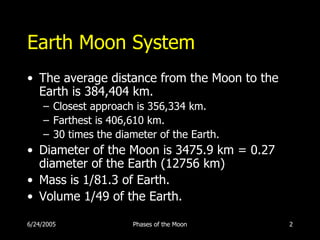
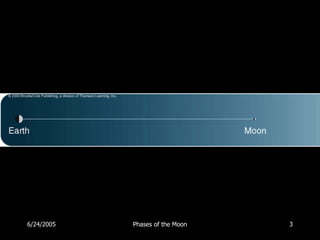
• The average distance from the Moon to the
  Earth is 384,404 km.
     – Closest approach is 356,334 km.
     – Farthest is 406,610 km.
     – 30 times the diameter of the Earth.
• Diameter of the Moon is 3475.9 km = 0.27
  diameter of the Earth (12756 km)
• Mass is 1/81.3 of Earth.
• Volume 1/49 of the Earth.

6/24/2005              Phases of the Moon     2
6/24/2005   Phases of the Moon   3
6/24/2005   Phases of the Moon   4
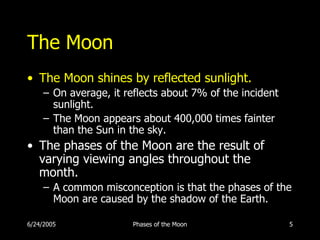
The Moon
• The Moon shines by reflected sunlight.
     – On average, it reflects about 7% of the incident
       sunlight.
     – The Moon appears about 400,000 times fainter
       than the Sun in the sky.
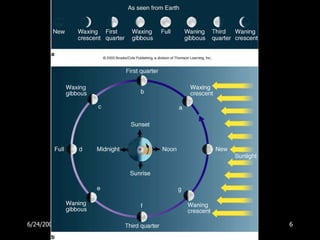
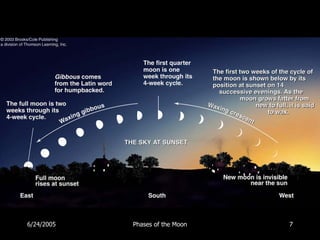
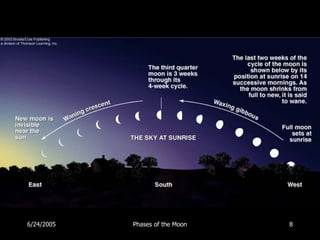
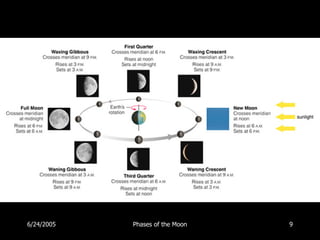
• The phases of the Moon are the result of
  varying viewing angles throughout the
  month.
     – A common misconception is that the phases of the
       Moon are caused by the shadow of the Earth.

6/24/2005               Phases of the Moon                5
6/24/2005   Phases of the Moon   6
6/24/2005   Phases of the Moon   7
6/24/2005   Phases of the Moon   8
6/24/2005   Phases of the Moon   9
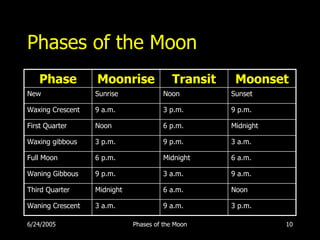
Phases of the Moon
   Phase          Moonrise                Transit    Moonset
New               Sunrise              Noon         Sunset

Waxing Crescent   9 a.m.               3 p.m.       9 p.m.

First Quarter     Noon                 6 p.m.       Midnight

Waxing gibbous    3 p.m.               9 p.m.       3 a.m.

Full Moon         6 p.m.               Midnight     6 a.m.

Waning Gibbous    9 p.m.               3 a.m.       9 a.m.

Third Quarter     Midnight             6 a.m.       Noon

Waning Crescent   3 a.m.               9 a.m.       3 p.m.

6/24/2005                    Phases of the Moon                10
Orbit of the Moon
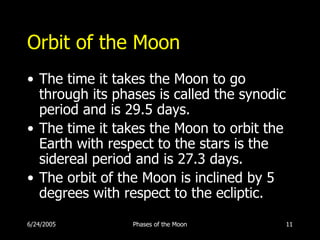
• The time it takes the Moon to go
  through its phases is called the synodic
  period and is 29.5 days.
• The time it takes the Moon to orbit the
  Earth with respect to the stars is the
  sidereal period and is 27.3 days.
• The orbit of the Moon is inclined by 5
  degrees with respect to the ecliptic.

6/24/2005        Phases of the Moon          11
Lunar Lunacy
• Another common misconception is that
  the Moon affects the weather, the
  number of births, the number of
  arrests, and the number of emergency
  room admissions.


6/24/2005      Phases of the Moon        12
Lunar Lunacy
• The astronomer George Abell studied
  the birth rate as a function of the phase
  of the Moon.
     – He looked at 11,691 live births at the UCLA
       hospital between March 17, 1974 and April
       30, 1978 and found no correlation.
     – He then narrowed it down to the 8,142
       natural (not caesarean) births and found
       no correlation.

6/24/2005            Phases of the Moon          13
Lunar Lunacy
• The human female menstrual cycle
  averages 28 days, not 29.5.
     – If it is influenced by the lunar phases, then
       all mammals should have the same cycle
       length.
            • Guinea pigs 11 days, rats and mice 5 days
            • Sheep 16 days, chimpanzees 37 days
            • Cows and horses 21 days
            • Opossum 28 days

6/24/2005                  Phases of the Moon             14
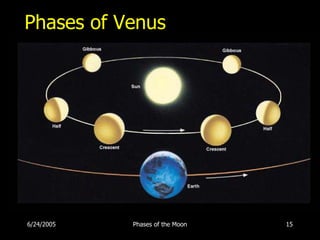
Phases of Venus


6/24/2005   Phases of the Moon   15
Rotation of the Moon
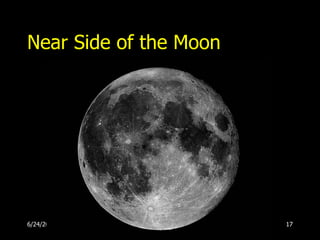
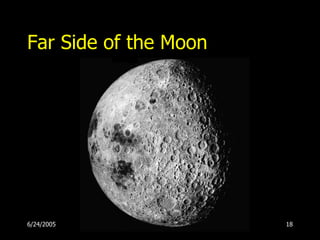
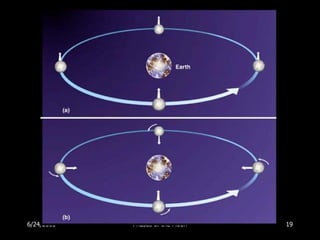
• The Moon always presents the same
  face towards Earth.
     – Another common misconception is that this
       means that the Moon does not rotate.
     – However, in order to keep the same face
       toward Earth, the Moon must rotate once
       every orbit.
     – The far side of the Moon is not dark, it gets
       just as much sunlight as the near side.
6/24/2005            Phases of the Moon           16
Near Side of the Moon


6/24/2005   Phases of the Moon   17
Far Side of the Moon


6/24/2005   Phases of the Moon   18
Rotation of the Moon


6/24/2005      Phases of the Moon   19
Mark Twain
• “Everyone is a Moon, and has a dark
  side which he never shows to anybody.”
     – Mark Twain


6/24/2005           Phases of the Moon   20
Misconception:
Dark Side of the Moon
• The “Dark Side” of the Moon should
  really be called the “Far Side.”
     – The far side gets just as much light as the
       near side. For example, during a new
       moon, the near side of the Moon is dark,
       and the far side of the Moon is fully
       illuminated!
     – http://www.badastronomy.com/bad/misc/dark_side.html


6/24/2005                Phases of the Moon                  21
Lunar Libration
• You might expect that if the Moon always
  keeps the same face pointed toward Earth,
  that we can only see 50% of the Moon.
     – However, the Moon appears to rock back and
       forth. This back and forth rocking is called
       libration.
            • In its elliptical orbit around Earth, the Moon moves faster
              when close to the Earth and slower when farther. Since
              its rotation is fairly constant, we get to see a little bit
              around each limb.
            • In addition, the orbit of the Moon is tilted with respect to
              the ecliptic, so we get to see somewhat beyond the poles
              as the Moon moves above and below the ecliptic.
6/24/2005
            • 59% of the Moon is visible Moon on Earth.
                                  Phases of the
                                                to us                     22
6/24/2005   Phases of the Moon   23
Misconception: The Size of the
Rising Moon
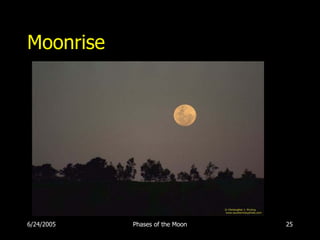
• Many people believe the rising moon is
  larger than when the Moon is high
  overhead.
     – The Moon is actually slightly larger when it
       is high overhead!
     – The effect is an illusion, however, the
       illusion is not well understood! See these
       links for more details:
            • http://www.badastronomy.com/bad/misc/moonbig.html
            • http://www.lhup.edu/~dsimanek/3d/moonillu.htm

6/24/2005                     Phases of the Moon                  24
Moonrise


6/24/2005   Phases of the Moon   25
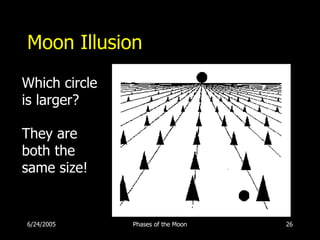
Moon Illusion
Which circle
is larger?

They are
both the
same size!


6/24/2005      Phases of the Moon   26
6/24/2005   Phases of the Moon   27

Phases of-the-moon

  • 1.
    Phases of theMoon Edward M. Murphy Space Science for Teachers 6/24/2005 Phases of the Moon 1
  • 2.
    Earth Moon System •The average distance from the Moon to the Earth is 384,404 km. – Closest approach is 356,334 km. – Farthest is 406,610 km. – 30 times the diameter of the Earth. • Diameter of the Moon is 3475.9 km = 0.27 diameter of the Earth (12756 km) • Mass is 1/81.3 of Earth. • Volume 1/49 of the Earth. 6/24/2005 Phases of the Moon 2
  • 3.
    6/24/2005 Phases of the Moon 3
  • 4.
    6/24/2005 Phases of the Moon 4
  • 5.
    The Moon • TheMoon shines by reflected sunlight. – On average, it reflects about 7% of the incident sunlight. – The Moon appears about 400,000 times fainter than the Sun in the sky. • The phases of the Moon are the result of varying viewing angles throughout the month. – A common misconception is that the phases of the Moon are caused by the shadow of the Earth. 6/24/2005 Phases of the Moon 5
  • 6.
    6/24/2005 Phases of the Moon 6
  • 7.
    6/24/2005 Phases of the Moon 7
  • 8.
    6/24/2005 Phases of the Moon 8
  • 9.
    6/24/2005 Phases of the Moon 9
  • 10.
    Phases of theMoon Phase Moonrise Transit Moonset New Sunrise Noon Sunset Waxing Crescent 9 a.m. 3 p.m. 9 p.m. First Quarter Noon 6 p.m. Midnight Waxing gibbous 3 p.m. 9 p.m. 3 a.m. Full Moon 6 p.m. Midnight 6 a.m. Waning Gibbous 9 p.m. 3 a.m. 9 a.m. Third Quarter Midnight 6 a.m. Noon Waning Crescent 3 a.m. 9 a.m. 3 p.m. 6/24/2005 Phases of the Moon 10
  • 11.
    Orbit of theMoon • The time it takes the Moon to go through its phases is called the synodic period and is 29.5 days. • The time it takes the Moon to orbit the Earth with respect to the stars is the sidereal period and is 27.3 days. • The orbit of the Moon is inclined by 5 degrees with respect to the ecliptic. 6/24/2005 Phases of the Moon 11
  • 12.
    Lunar Lunacy • Anothercommon misconception is that the Moon affects the weather, the number of births, the number of arrests, and the number of emergency room admissions. 6/24/2005 Phases of the Moon 12
  • 13.
    Lunar Lunacy • Theastronomer George Abell studied the birth rate as a function of the phase of the Moon. – He looked at 11,691 live births at the UCLA hospital between March 17, 1974 and April 30, 1978 and found no correlation. – He then narrowed it down to the 8,142 natural (not caesarean) births and found no correlation. 6/24/2005 Phases of the Moon 13
  • 14.
    Lunar Lunacy • Thehuman female menstrual cycle averages 28 days, not 29.5. – If it is influenced by the lunar phases, then all mammals should have the same cycle length. • Guinea pigs 11 days, rats and mice 5 days • Sheep 16 days, chimpanzees 37 days • Cows and horses 21 days • Opossum 28 days 6/24/2005 Phases of the Moon 14
  • 15.
    Phases of Venus 6/24/2005 Phases of the Moon 15
  • 16.
    Rotation of theMoon • The Moon always presents the same face towards Earth. – Another common misconception is that this means that the Moon does not rotate. – However, in order to keep the same face toward Earth, the Moon must rotate once every orbit. – The far side of the Moon is not dark, it gets just as much sunlight as the near side. 6/24/2005 Phases of the Moon 16
  • 17.
    Near Side ofthe Moon 6/24/2005 Phases of the Moon 17
  • 18.
    Far Side ofthe Moon 6/24/2005 Phases of the Moon 18
  • 19.
    Rotation of theMoon 6/24/2005 Phases of the Moon 19
  • 20.
    Mark Twain • “Everyoneis a Moon, and has a dark side which he never shows to anybody.” – Mark Twain 6/24/2005 Phases of the Moon 20
  • 21.
    Misconception: Dark Side ofthe Moon • The “Dark Side” of the Moon should really be called the “Far Side.” – The far side gets just as much light as the near side. For example, during a new moon, the near side of the Moon is dark, and the far side of the Moon is fully illuminated! – http://www.badastronomy.com/bad/misc/dark_side.html 6/24/2005 Phases of the Moon 21
  • 22.
    Lunar Libration • Youmight expect that if the Moon always keeps the same face pointed toward Earth, that we can only see 50% of the Moon. – However, the Moon appears to rock back and forth. This back and forth rocking is called libration. • In its elliptical orbit around Earth, the Moon moves faster when close to the Earth and slower when farther. Since its rotation is fairly constant, we get to see a little bit around each limb. • In addition, the orbit of the Moon is tilted with respect to the ecliptic, so we get to see somewhat beyond the poles as the Moon moves above and below the ecliptic. 6/24/2005 • 59% of the Moon is visible Moon on Earth. Phases of the to us 22
  • 23.
    6/24/2005 Phases of the Moon 23
  • 24.
    Misconception: The Sizeof the Rising Moon • Many people believe the rising moon is larger than when the Moon is high overhead. – The Moon is actually slightly larger when it is high overhead! – The effect is an illusion, however, the illusion is not well understood! See these links for more details: • http://www.badastronomy.com/bad/misc/moonbig.html • http://www.lhup.edu/~dsimanek/3d/moonillu.htm 6/24/2005 Phases of the Moon 24
  • 25.
    Moonrise 6/24/2005 Phases of the Moon 25
  • 26.
    Moon Illusion Which circle islarger? They are both the same size! 6/24/2005 Phases of the Moon 26
  • 27.
    6/24/2005 Phases of the Moon 27