VIENNA young SCIENTISTS SYMPOSIUM
Computing the QCD Phase Diagram from
Efective Polyakov Line Actions via Relative
Weights and Mean Field Theory
Roman Höllwieserab, Jeff Greensitec
aInstitute of Atomic and Subatomic Physics, Nuclear Physics Dept.,
Vienna University of Technology, Operngasse 9, 1040 Vienna, Austria
bDepartment of Physics, New Mexico State University,
Las Cruces, NM 88003-8001, USA
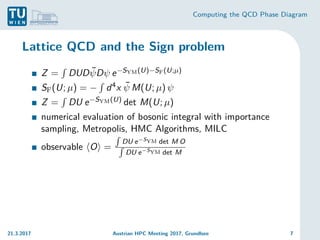
c Physics and Astronomy Dept., San Francisco State University,
San Francisco, CA 94132, USA
Computing the QCD Phase Diagram
Agenda
Motivation
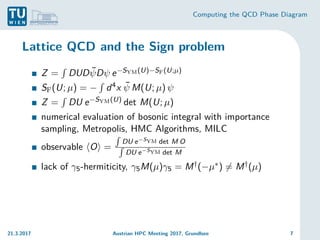
Quantum Chromodynamics (QCD)
Lattice QCD and the Sign problem
The Polyakov Line Action
Preliminary Results
Conclusions & Outlook
Work Group & Collaborations
21.3.2017 Austrian HPC Meeting 2017, Grundlsee 1
Computing the QCD Phase Diagram
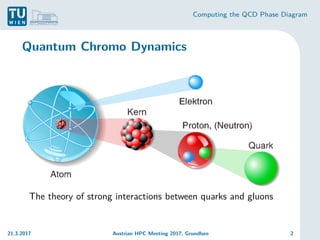
Quantum Chromo Dynamics
The theory of strong interactions between quarks and gluons
21.3.2017 Austrian HPC Meeting 2017, Grundlsee 2
Computing the QCD Phase Diagram
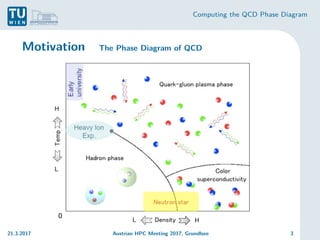
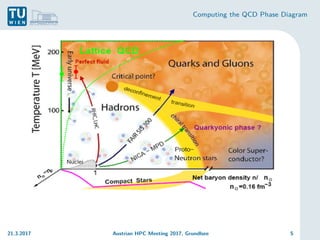
Motivation The Phase Diagram of QCD
21.3.2017 Austrian HPC Meeting 2017, Grundlsee 3
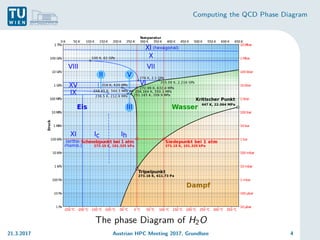
Computing the QCD Phase Diagram
The phase Diagram of H2O
21.3.2017 Austrian HPC Meeting 2017, Grundlsee 4
Computing the QCD Phase Diagram
21.3.2017 Austrian HPC Meeting 2017, Grundlsee 5
Computing the QCD Phase Diagram
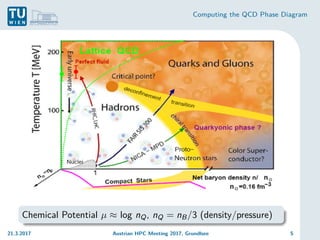
Chemical Potential µ ≈ log nQ, nQ = nB/3 (density/pressure)
21.3.2017 Austrian HPC Meeting 2017, Grundlsee 5
Computing the QCD Phase Diagram
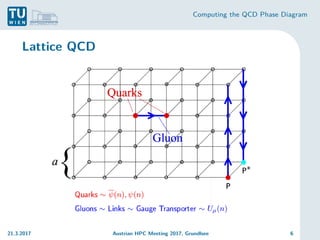
Lattice QCD
21.3.2017 Austrian HPC Meeting 2017, Grundlsee 6
Computing the QCD Phase Diagram
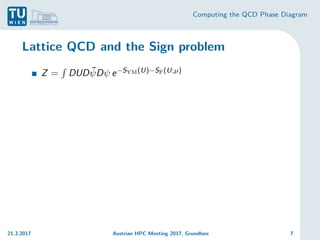
Lattice QCD and the Sign problem
Z =
R
DUDψ̄Dψ e−SYM(U)−SF(U;µ)
21.3.2017 Austrian HPC Meeting 2017, Grundlsee 7
Computing the QCD Phase Diagram
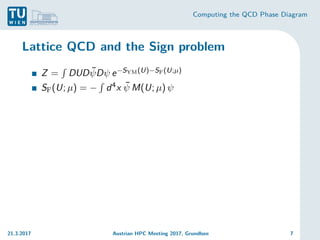
Lattice QCD and the Sign problem
Z =
R
DUDψ̄Dψ e−SYM(U)−SF(U;µ)
SF(U; µ) = −
R
d4x ψ̄ M(U; µ) ψ
21.3.2017 Austrian HPC Meeting 2017, Grundlsee 7
Computing the QCD Phase Diagram
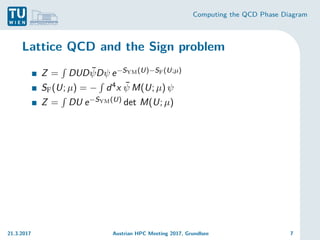
Lattice QCD and the Sign problem
Z =
R
DUDψ̄Dψ e−SYM(U)−SF(U;µ)
SF(U; µ) = −
R
d4x ψ̄ M(U; µ) ψ
Z =
R
DU e−SYM(U) det M(U; µ)
21.3.2017 Austrian HPC Meeting 2017, Grundlsee 7
Computing the QCD Phase Diagram
Lattice QCD and the Sign problem
Z =
R
DUDψ̄Dψ e−SYM(U)−SF(U;µ)
SF(U; µ) = −
R
d4x ψ̄ M(U; µ) ψ
Z =
R
DU e−SYM(U) det M(U; µ)
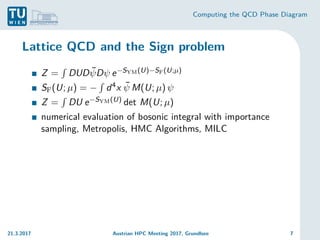
numerical evaluation of bosonic integral with importance
sampling, Metropolis, HMC Algorithms, MILC
21.3.2017 Austrian HPC Meeting 2017, Grundlsee 7
Computing the QCD Phase Diagram
Lattice QCD and the Sign problem
Z =
R
DUDψ̄Dψ e−SYM(U)−SF(U;µ)
SF(U; µ) = −
R
d4x ψ̄ M(U; µ) ψ
Z =
R
DU e−SYM(U) det M(U; µ)
numerical evaluation of bosonic integral with importance
sampling, Metropolis, HMC Algorithms, MILC
observable hOi =
R
DU e−SYM det M O
R
DU e−SYM det M
21.3.2017 Austrian HPC Meeting 2017, Grundlsee 7
Computing the QCD Phase Diagram
Lattice QCD and the Sign problem
Z =
R
DUDψ̄Dψ e−SYM(U)−SF(U;µ)
SF(U; µ) = −
R
d4x ψ̄ M(U; µ) ψ
Z =
R
DU e−SYM(U) det M(U; µ)
numerical evaluation of bosonic integral with importance
sampling, Metropolis, HMC Algorithms, MILC
observable hOi =
R
DU e−SYM det M O
R
DU e−SYM det M
lack of γ5-hermiticity, γ5M(µ)γ5 = M†(−µ∗) 6= M†(µ)
21.3.2017 Austrian HPC Meeting 2017, Grundlsee 7
Computing the QCD Phase Diagram
Lattice QCD and the Sign problem
Z =
R
DUDψ̄Dψ e−SYM(U)−SF(U;µ)
SF(U; µ) = −
R
d4x ψ̄ M(U; µ) ψ
Z =
R
DU e−SYM(U) det M(U; µ)
numerical evaluation of bosonic integral with importance
sampling, Metropolis, HMC Algorithms, MILC
observable hOi =
R
DU e−SYM det M O
R
DU e−SYM det M
lack of γ5-hermiticity, γ5M(µ)γ5 = M†(−µ∗) 6= M†(µ)
determinant is complex and satisfies
[det M(µ)]∗ = det M(−µ∗)
21.3.2017 Austrian HPC Meeting 2017, Grundlsee 7
Computing the QCD Phase Diagram
Importance of the Sign problem
assymetry between matter and anti-matter
21.3.2017 Austrian HPC Meeting 2017, Grundlsee 8
Computing the QCD Phase Diagram
Importance of the Sign problem
assymetry between matter and anti-matter
free energy of particle q /anti-particle q̄
21.3.2017 Austrian HPC Meeting 2017, Grundlsee 8
Computing the QCD Phase Diagram
Importance of the Sign problem
assymetry between matter and anti-matter
free energy of particle q /anti-particle q̄
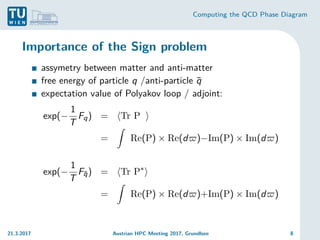
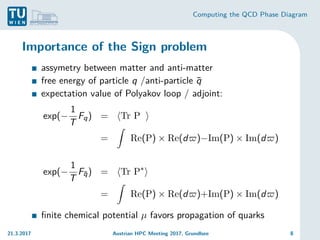
expectation value of Polyakov loop / adjoint:
exp(−
1
T
Fq) = hTr P i
=
Z
Re(P) × Re(d$)−Im(P) × Im(d$)
exp(−
1
T
Fq̄) = hTr P∗
i
=
Z
Re(P) × Re(d$)+Im(P) × Im(d$)
21.3.2017 Austrian HPC Meeting 2017, Grundlsee 8
Computing the QCD Phase Diagram
Importance of the Sign problem
assymetry between matter and anti-matter
free energy of particle q /anti-particle q̄
expectation value of Polyakov loop / adjoint:
exp(−
1
T
Fq) = hTr P i
=
Z
Re(P) × Re(d$)−Im(P) × Im(d$)
exp(−
1
T
Fq̄) = hTr P∗
i
=
Z
Re(P) × Re(d$)+Im(P) × Im(d$)
finite chemical potential µ favors propagation of quarks
21.3.2017 Austrian HPC Meeting 2017, Grundlsee 8
Computing the QCD Phase Diagram
Possible Solutions of the Sign problem
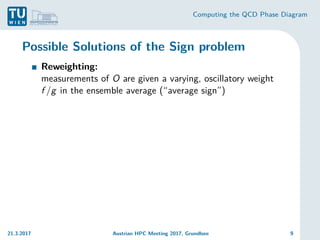
Reweighting:
measurements of O are given a varying, oscillatory weight
f /g in the ensemble average (“average sign”)
21.3.2017 Austrian HPC Meeting 2017, Grundlsee 9
Computing the QCD Phase Diagram
Possible Solutions of the Sign problem
Reweighting:
measurements of O are given a varying, oscillatory weight
f /g in the ensemble average (“average sign”)
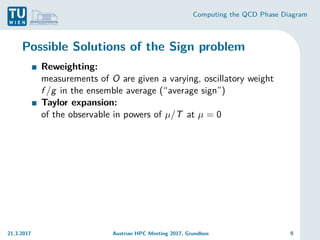
Taylor expansion:
of the observable in powers of µ/T at µ = 0
21.3.2017 Austrian HPC Meeting 2017, Grundlsee 9
Computing the QCD Phase Diagram
Possible Solutions of the Sign problem
Reweighting:
measurements of O are given a varying, oscillatory weight
f /g in the ensemble average (“average sign”)
Taylor expansion:
of the observable in powers of µ/T at µ = 0
Imaginary µ: analytic continuation of results to real µ
21.3.2017 Austrian HPC Meeting 2017, Grundlsee 9
Computing the QCD Phase Diagram
Possible Solutions of the Sign problem
Reweighting:
measurements of O are given a varying, oscillatory weight
f /g in the ensemble average (“average sign”)
Taylor expansion:
of the observable in powers of µ/T at µ = 0
Imaginary µ: analytic continuation of results to real µ
|QCD|:
detM = |detM|eiφ, simulations without eiφ + reweighting
21.3.2017 Austrian HPC Meeting 2017, Grundlsee 9
Computing the QCD Phase Diagram
Possible Solutions of the Sign problem
Reweighting:
measurements of O are given a varying, oscillatory weight
f /g in the ensemble average (“average sign”)
Taylor expansion:
of the observable in powers of µ/T at µ = 0
Imaginary µ: analytic continuation of results to real µ
|QCD|:
detM = |detM|eiφ, simulations without eiφ + reweighting
Complex Langevin: stochastic quantization - evolution of
fields in a fictitious time with Brownian noise and search
for stationary solutions with correct measure
21.3.2017 Austrian HPC Meeting 2017, Grundlsee 9
Computing the QCD Phase Diagram
Possible Solutions of the Sign problem
Reweighting:
measurements of O are given a varying, oscillatory weight
f /g in the ensemble average (“average sign”)
Taylor expansion:
of the observable in powers of µ/T at µ = 0
Imaginary µ: analytic continuation of results to real µ
|QCD|:
detM = |detM|eiφ, simulations without eiφ + reweighting
Complex Langevin: stochastic quantization - evolution of
fields in a fictitious time with Brownian noise and search
for stationary solutions with correct measure
Worldline formalism and strong coupling limit:
change order of integration, partial integration over loops
and hopping parameter expansion
21.3.2017 Austrian HPC Meeting 2017, Grundlsee 9
Computing the QCD Phase Diagram
Effective Polyakov Line Action
Indirect approach: Polyakov line action (SU(3) spin) model
21.3.2017 Austrian HPC Meeting 2017, Grundlsee 10
Computing the QCD Phase Diagram
Effective Polyakov Line Action
Indirect approach: Polyakov line action (SU(3) spin) model
fix Polyakov line holonomies U0(~
x, 0) = Ux (temporal
gauge) and integrate out all other d.o.f.
21.3.2017 Austrian HPC Meeting 2017, Grundlsee 10
Computing the QCD Phase Diagram
Effective Polyakov Line Action
Indirect approach: Polyakov line action (SU(3) spin) model
fix Polyakov line holonomies U0(~
x, 0) = Ux (temporal
gauge) and integrate out all other d.o.f.
eSP (Ux ) =
R
DU0(~
x, 0)DUkDψ
Q
x δ[Ux − U0(~
x, 0)]eSL
21.3.2017 Austrian HPC Meeting 2017, Grundlsee 10
Computing the QCD Phase Diagram
Effective Polyakov Line Action
Indirect approach: Polyakov line action (SU(3) spin) model
fix Polyakov line holonomies U0(~
x, 0) = Ux (temporal
gauge) and integrate out all other d.o.f.
eSP (Ux ) =
R
DU0(~
x, 0)DUkDψ
Q
x δ[Ux − U0(~
x, 0)]eSL
derive SP at µ = 0, for µ > 0 we have (true to all orders of
strong coupling/hopping parameter expansion)
21.3.2017 Austrian HPC Meeting 2017, Grundlsee 10
Computing the QCD Phase Diagram
Effective Polyakov Line Action
Indirect approach: Polyakov line action (SU(3) spin) model
fix Polyakov line holonomies U0(~
x, 0) = Ux (temporal
gauge) and integrate out all other d.o.f.
eSP (Ux ) =
R
DU0(~
x, 0)DUkDψ
Q
x δ[Ux − U0(~
x, 0)]eSL
derive SP at µ = 0, for µ > 0 we have (true to all orders of
strong coupling/hopping parameter expansion)
Sµ
P(Ux , U†
x ) = Sµ=0
P [eNt µUx , e−Nt µU†
x ]
21.3.2017 Austrian HPC Meeting 2017, Grundlsee 10
Computing the QCD Phase Diagram
Effective Polyakov Line Action
Indirect approach: Polyakov line action (SU(3) spin) model
fix Polyakov line holonomies U0(~
x, 0) = Ux (temporal
gauge) and integrate out all other d.o.f.
eSP (Ux ) =
R
DU0(~
x, 0)DUkDψ
Q
x δ[Ux − U0(~
x, 0)]eSL
derive SP at µ = 0, for µ > 0 we have (true to all orders of
strong coupling/hopping parameter expansion)
Sµ
P(Ux , U†
x ) = Sµ=0
P [eNt µUx , e−Nt µU†
x ]
hard to compute exp[SP(Ux )], use relative weights...
21.3.2017 Austrian HPC Meeting 2017, Grundlsee 10
Computing the QCD Phase Diagram
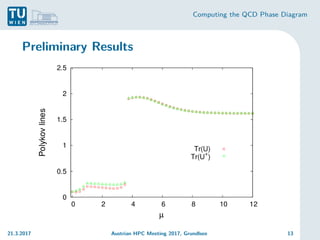
Preliminary Results
21.3.2017 Austrian HPC Meeting 2017, Grundlsee 11
Computing the QCD Phase Diagram
Preliminary Results
21.3.2017 Austrian HPC Meeting 2017, Grundlsee 12
Computing the QCD Phase Diagram
Preliminary Results
21.3.2017 Austrian HPC Meeting 2017, Grundlsee 13
Computing the QCD Phase Diagram
Conclusions & Outlook
determined effective Polyakov line action for asqtad
staggered fermions with ma = 0.3 and Symanzik one loop
improved gauge action at β = 7.0 on 163 × 6 lattices
21.3.2017 Austrian HPC Meeting 2017, Grundlsee 14
Computing the QCD Phase Diagram
Conclusions & Outlook
determined effective Polyakov line action for asqtad
staggered fermions with ma = 0.3 and Symanzik one loop
improved gauge action at β = 7.0 on 163 × 6 lattices
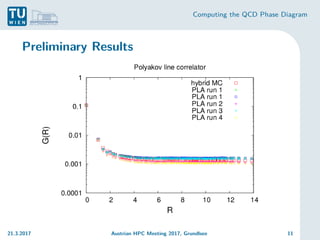
good agreement for the Polyakov line correlators computed
in the effective theory and underlying lattice gauge theory
21.3.2017 Austrian HPC Meeting 2017, Grundlsee 14
Computing the QCD Phase Diagram
Conclusions & Outlook
determined effective Polyakov line action for asqtad
staggered fermions with ma = 0.3 and Symanzik one loop
improved gauge action at β = 7.0 on 163 × 6 lattices
good agreement for the Polyakov line correlators computed
in the effective theory and underlying lattice gauge theory
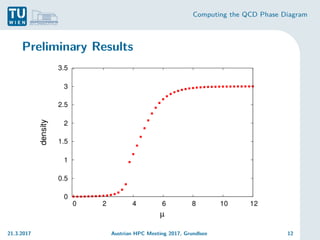
solved sign problem for the effective theory by mean field
and find a phase transition and correct density limit
21.3.2017 Austrian HPC Meeting 2017, Grundlsee 14
Computing the QCD Phase Diagram
Conclusions & Outlook
determined effective Polyakov line action for asqtad
staggered fermions with ma = 0.3 and Symanzik one loop
improved gauge action at β = 7.0 on 163 × 6 lattices
good agreement for the Polyakov line correlators computed
in the effective theory and underlying lattice gauge theory
solved sign problem for the effective theory by mean field
and find a phase transition and correct density limit
...
21.3.2017 Austrian HPC Meeting 2017, Grundlsee 14
Computing the QCD Phase Diagram
Conclusions & Outlook
determined effective Polyakov line action for asqtad
staggered fermions with ma = 0.3 and Symanzik one loop
improved gauge action at β = 7.0 on 163 × 6 lattices
good agreement for the Polyakov line correlators computed
in the effective theory and underlying lattice gauge theory
solved sign problem for the effective theory by mean field
and find a phase transition and correct density limit
...
determine quadratic, quasi-local center symmetry breaking
terms which may be important at finite chemical
potential...
21.3.2017 Austrian HPC Meeting 2017, Grundlsee 14
Computing the QCD Phase Diagram
Conclusions & Outlook
determined effective Polyakov line action for asqtad
staggered fermions with ma = 0.3 and Symanzik one loop
improved gauge action at β = 7.0 on 163 × 6 lattices
good agreement for the Polyakov line correlators computed
in the effective theory and underlying lattice gauge theory
solved sign problem for the effective theory by mean field
and find a phase transition and correct density limit
...
determine quadratic, quasi-local center symmetry breaking
terms which may be important at finite chemical
potential...
go on to smaller quark masses...
21.3.2017 Austrian HPC Meeting 2017, Grundlsee 14
Computing the QCD Phase Diagram
Work Group & Collaborations & Sponsors
Thank You &
Derar Altarawneh, Michael Engelhardt, Manfried Faber, Martin Gal,
Jeff Greensite, Urs M. Heller, James Hettrick, Andrei Ivanov, Thomas
Layer, Štefan Olejnik, Luis Oxman, Mario Pitschmann, Jesus Saenz,
Thomas Schweigler, Wolfgang Söldner, David Vercauteren, Markus
Wellenzohn, MILC, USQCD & VSC team
21.3.2017 Austrian HPC Meeting 2017, Grundlsee 15
VIENNA young SCIENTISTS SYMPOSIUM
Computing the QCD Phase Diagram from
Efective Polyakov Line Actions via Relative
Weights and Mean Field Theory
Roman Höllwieserab, hroman@kph.tuwien.ac.at
Jeff Greensitec, greensit@sfsu.edu
aInstitute of Atomic and Subatomic Physics, Nuclear Physics Dept.,
Vienna University of Technology, Operngasse 9, 1040 Vienna, Austria
bDepartment of Physics, New Mexico State University,
Las Cruces, NM 88003-8001, USA
c Physics and Astronomy Dept., San Francisco State University,
San Francisco, CA 94132, USA

QCD Phase Diagram

  • 1.
    VIENNA young SCIENTISTSSYMPOSIUM Computing the QCD Phase Diagram from Efective Polyakov Line Actions via Relative Weights and Mean Field Theory Roman Höllwieserab, Jeff Greensitec aInstitute of Atomic and Subatomic Physics, Nuclear Physics Dept., Vienna University of Technology, Operngasse 9, 1040 Vienna, Austria bDepartment of Physics, New Mexico State University, Las Cruces, NM 88003-8001, USA c Physics and Astronomy Dept., San Francisco State University, San Francisco, CA 94132, USA
  • 2.
    Computing the QCDPhase Diagram Agenda Motivation Quantum Chromodynamics (QCD) Lattice QCD and the Sign problem The Polyakov Line Action Preliminary Results Conclusions & Outlook Work Group & Collaborations 21.3.2017 Austrian HPC Meeting 2017, Grundlsee 1
  • 3.
    Computing the QCDPhase Diagram Quantum Chromo Dynamics The theory of strong interactions between quarks and gluons 21.3.2017 Austrian HPC Meeting 2017, Grundlsee 2
  • 4.
    Computing the QCDPhase Diagram Motivation The Phase Diagram of QCD 21.3.2017 Austrian HPC Meeting 2017, Grundlsee 3
  • 5.
    Computing the QCDPhase Diagram The phase Diagram of H2O 21.3.2017 Austrian HPC Meeting 2017, Grundlsee 4
  • 6.
    Computing the QCDPhase Diagram 21.3.2017 Austrian HPC Meeting 2017, Grundlsee 5
  • 7.
    Computing the QCDPhase Diagram Chemical Potential µ ≈ log nQ, nQ = nB/3 (density/pressure) 21.3.2017 Austrian HPC Meeting 2017, Grundlsee 5
  • 8.
    Computing the QCDPhase Diagram Lattice QCD 21.3.2017 Austrian HPC Meeting 2017, Grundlsee 6
  • 9.
    Computing the QCDPhase Diagram Lattice QCD and the Sign problem Z = R DUDψ̄Dψ e−SYM(U)−SF(U;µ) 21.3.2017 Austrian HPC Meeting 2017, Grundlsee 7
  • 10.
    Computing the QCDPhase Diagram Lattice QCD and the Sign problem Z = R DUDψ̄Dψ e−SYM(U)−SF(U;µ) SF(U; µ) = − R d4x ψ̄ M(U; µ) ψ 21.3.2017 Austrian HPC Meeting 2017, Grundlsee 7
  • 11.
    Computing the QCDPhase Diagram Lattice QCD and the Sign problem Z = R DUDψ̄Dψ e−SYM(U)−SF(U;µ) SF(U; µ) = − R d4x ψ̄ M(U; µ) ψ Z = R DU e−SYM(U) det M(U; µ) 21.3.2017 Austrian HPC Meeting 2017, Grundlsee 7
  • 12.
    Computing the QCDPhase Diagram Lattice QCD and the Sign problem Z = R DUDψ̄Dψ e−SYM(U)−SF(U;µ) SF(U; µ) = − R d4x ψ̄ M(U; µ) ψ Z = R DU e−SYM(U) det M(U; µ) numerical evaluation of bosonic integral with importance sampling, Metropolis, HMC Algorithms, MILC 21.3.2017 Austrian HPC Meeting 2017, Grundlsee 7
  • 13.
    Computing the QCDPhase Diagram Lattice QCD and the Sign problem Z = R DUDψ̄Dψ e−SYM(U)−SF(U;µ) SF(U; µ) = − R d4x ψ̄ M(U; µ) ψ Z = R DU e−SYM(U) det M(U; µ) numerical evaluation of bosonic integral with importance sampling, Metropolis, HMC Algorithms, MILC observable hOi = R DU e−SYM det M O R DU e−SYM det M 21.3.2017 Austrian HPC Meeting 2017, Grundlsee 7
  • 14.
    Computing the QCDPhase Diagram Lattice QCD and the Sign problem Z = R DUDψ̄Dψ e−SYM(U)−SF(U;µ) SF(U; µ) = − R d4x ψ̄ M(U; µ) ψ Z = R DU e−SYM(U) det M(U; µ) numerical evaluation of bosonic integral with importance sampling, Metropolis, HMC Algorithms, MILC observable hOi = R DU e−SYM det M O R DU e−SYM det M lack of γ5-hermiticity, γ5M(µ)γ5 = M†(−µ∗) 6= M†(µ) 21.3.2017 Austrian HPC Meeting 2017, Grundlsee 7
  • 15.
    Computing the QCDPhase Diagram Lattice QCD and the Sign problem Z = R DUDψ̄Dψ e−SYM(U)−SF(U;µ) SF(U; µ) = − R d4x ψ̄ M(U; µ) ψ Z = R DU e−SYM(U) det M(U; µ) numerical evaluation of bosonic integral with importance sampling, Metropolis, HMC Algorithms, MILC observable hOi = R DU e−SYM det M O R DU e−SYM det M lack of γ5-hermiticity, γ5M(µ)γ5 = M†(−µ∗) 6= M†(µ) determinant is complex and satisfies [det M(µ)]∗ = det M(−µ∗) 21.3.2017 Austrian HPC Meeting 2017, Grundlsee 7
  • 16.
    Computing the QCDPhase Diagram Importance of the Sign problem assymetry between matter and anti-matter 21.3.2017 Austrian HPC Meeting 2017, Grundlsee 8
  • 17.
    Computing the QCDPhase Diagram Importance of the Sign problem assymetry between matter and anti-matter free energy of particle q /anti-particle q̄ 21.3.2017 Austrian HPC Meeting 2017, Grundlsee 8
  • 18.
    Computing the QCDPhase Diagram Importance of the Sign problem assymetry between matter and anti-matter free energy of particle q /anti-particle q̄ expectation value of Polyakov loop / adjoint: exp(− 1 T Fq) = hTr P i = Z Re(P) × Re(d$)−Im(P) × Im(d$) exp(− 1 T Fq̄) = hTr P∗ i = Z Re(P) × Re(d$)+Im(P) × Im(d$) 21.3.2017 Austrian HPC Meeting 2017, Grundlsee 8
  • 19.
    Computing the QCDPhase Diagram Importance of the Sign problem assymetry between matter and anti-matter free energy of particle q /anti-particle q̄ expectation value of Polyakov loop / adjoint: exp(− 1 T Fq) = hTr P i = Z Re(P) × Re(d$)−Im(P) × Im(d$) exp(− 1 T Fq̄) = hTr P∗ i = Z Re(P) × Re(d$)+Im(P) × Im(d$) finite chemical potential µ favors propagation of quarks 21.3.2017 Austrian HPC Meeting 2017, Grundlsee 8
  • 20.
    Computing the QCDPhase Diagram Possible Solutions of the Sign problem Reweighting: measurements of O are given a varying, oscillatory weight f /g in the ensemble average (“average sign”) 21.3.2017 Austrian HPC Meeting 2017, Grundlsee 9
  • 21.
    Computing the QCDPhase Diagram Possible Solutions of the Sign problem Reweighting: measurements of O are given a varying, oscillatory weight f /g in the ensemble average (“average sign”) Taylor expansion: of the observable in powers of µ/T at µ = 0 21.3.2017 Austrian HPC Meeting 2017, Grundlsee 9
  • 22.
    Computing the QCDPhase Diagram Possible Solutions of the Sign problem Reweighting: measurements of O are given a varying, oscillatory weight f /g in the ensemble average (“average sign”) Taylor expansion: of the observable in powers of µ/T at µ = 0 Imaginary µ: analytic continuation of results to real µ 21.3.2017 Austrian HPC Meeting 2017, Grundlsee 9
  • 23.
    Computing the QCDPhase Diagram Possible Solutions of the Sign problem Reweighting: measurements of O are given a varying, oscillatory weight f /g in the ensemble average (“average sign”) Taylor expansion: of the observable in powers of µ/T at µ = 0 Imaginary µ: analytic continuation of results to real µ |QCD|: detM = |detM|eiφ, simulations without eiφ + reweighting 21.3.2017 Austrian HPC Meeting 2017, Grundlsee 9
  • 24.
    Computing the QCDPhase Diagram Possible Solutions of the Sign problem Reweighting: measurements of O are given a varying, oscillatory weight f /g in the ensemble average (“average sign”) Taylor expansion: of the observable in powers of µ/T at µ = 0 Imaginary µ: analytic continuation of results to real µ |QCD|: detM = |detM|eiφ, simulations without eiφ + reweighting Complex Langevin: stochastic quantization - evolution of fields in a fictitious time with Brownian noise and search for stationary solutions with correct measure 21.3.2017 Austrian HPC Meeting 2017, Grundlsee 9
  • 25.
    Computing the QCDPhase Diagram Possible Solutions of the Sign problem Reweighting: measurements of O are given a varying, oscillatory weight f /g in the ensemble average (“average sign”) Taylor expansion: of the observable in powers of µ/T at µ = 0 Imaginary µ: analytic continuation of results to real µ |QCD|: detM = |detM|eiφ, simulations without eiφ + reweighting Complex Langevin: stochastic quantization - evolution of fields in a fictitious time with Brownian noise and search for stationary solutions with correct measure Worldline formalism and strong coupling limit: change order of integration, partial integration over loops and hopping parameter expansion 21.3.2017 Austrian HPC Meeting 2017, Grundlsee 9
  • 26.
    Computing the QCDPhase Diagram Effective Polyakov Line Action Indirect approach: Polyakov line action (SU(3) spin) model 21.3.2017 Austrian HPC Meeting 2017, Grundlsee 10
  • 27.
    Computing the QCDPhase Diagram Effective Polyakov Line Action Indirect approach: Polyakov line action (SU(3) spin) model fix Polyakov line holonomies U0(~ x, 0) = Ux (temporal gauge) and integrate out all other d.o.f. 21.3.2017 Austrian HPC Meeting 2017, Grundlsee 10
  • 28.
    Computing the QCDPhase Diagram Effective Polyakov Line Action Indirect approach: Polyakov line action (SU(3) spin) model fix Polyakov line holonomies U0(~ x, 0) = Ux (temporal gauge) and integrate out all other d.o.f. eSP (Ux ) = R DU0(~ x, 0)DUkDψ Q x δ[Ux − U0(~ x, 0)]eSL 21.3.2017 Austrian HPC Meeting 2017, Grundlsee 10
  • 29.
    Computing the QCDPhase Diagram Effective Polyakov Line Action Indirect approach: Polyakov line action (SU(3) spin) model fix Polyakov line holonomies U0(~ x, 0) = Ux (temporal gauge) and integrate out all other d.o.f. eSP (Ux ) = R DU0(~ x, 0)DUkDψ Q x δ[Ux − U0(~ x, 0)]eSL derive SP at µ = 0, for µ > 0 we have (true to all orders of strong coupling/hopping parameter expansion) 21.3.2017 Austrian HPC Meeting 2017, Grundlsee 10
  • 30.
    Computing the QCDPhase Diagram Effective Polyakov Line Action Indirect approach: Polyakov line action (SU(3) spin) model fix Polyakov line holonomies U0(~ x, 0) = Ux (temporal gauge) and integrate out all other d.o.f. eSP (Ux ) = R DU0(~ x, 0)DUkDψ Q x δ[Ux − U0(~ x, 0)]eSL derive SP at µ = 0, for µ > 0 we have (true to all orders of strong coupling/hopping parameter expansion) Sµ P(Ux , U† x ) = Sµ=0 P [eNt µUx , e−Nt µU† x ] 21.3.2017 Austrian HPC Meeting 2017, Grundlsee 10
  • 31.
    Computing the QCDPhase Diagram Effective Polyakov Line Action Indirect approach: Polyakov line action (SU(3) spin) model fix Polyakov line holonomies U0(~ x, 0) = Ux (temporal gauge) and integrate out all other d.o.f. eSP (Ux ) = R DU0(~ x, 0)DUkDψ Q x δ[Ux − U0(~ x, 0)]eSL derive SP at µ = 0, for µ > 0 we have (true to all orders of strong coupling/hopping parameter expansion) Sµ P(Ux , U† x ) = Sµ=0 P [eNt µUx , e−Nt µU† x ] hard to compute exp[SP(Ux )], use relative weights... 21.3.2017 Austrian HPC Meeting 2017, Grundlsee 10
  • 32.
    Computing the QCDPhase Diagram Preliminary Results 21.3.2017 Austrian HPC Meeting 2017, Grundlsee 11
  • 33.
    Computing the QCDPhase Diagram Preliminary Results 21.3.2017 Austrian HPC Meeting 2017, Grundlsee 12
  • 34.
    Computing the QCDPhase Diagram Preliminary Results 21.3.2017 Austrian HPC Meeting 2017, Grundlsee 13
  • 35.
    Computing the QCDPhase Diagram Conclusions & Outlook determined effective Polyakov line action for asqtad staggered fermions with ma = 0.3 and Symanzik one loop improved gauge action at β = 7.0 on 163 × 6 lattices 21.3.2017 Austrian HPC Meeting 2017, Grundlsee 14
  • 36.
    Computing the QCDPhase Diagram Conclusions & Outlook determined effective Polyakov line action for asqtad staggered fermions with ma = 0.3 and Symanzik one loop improved gauge action at β = 7.0 on 163 × 6 lattices good agreement for the Polyakov line correlators computed in the effective theory and underlying lattice gauge theory 21.3.2017 Austrian HPC Meeting 2017, Grundlsee 14
  • 37.
    Computing the QCDPhase Diagram Conclusions & Outlook determined effective Polyakov line action for asqtad staggered fermions with ma = 0.3 and Symanzik one loop improved gauge action at β = 7.0 on 163 × 6 lattices good agreement for the Polyakov line correlators computed in the effective theory and underlying lattice gauge theory solved sign problem for the effective theory by mean field and find a phase transition and correct density limit 21.3.2017 Austrian HPC Meeting 2017, Grundlsee 14
  • 38.
    Computing the QCDPhase Diagram Conclusions & Outlook determined effective Polyakov line action for asqtad staggered fermions with ma = 0.3 and Symanzik one loop improved gauge action at β = 7.0 on 163 × 6 lattices good agreement for the Polyakov line correlators computed in the effective theory and underlying lattice gauge theory solved sign problem for the effective theory by mean field and find a phase transition and correct density limit ... 21.3.2017 Austrian HPC Meeting 2017, Grundlsee 14
  • 39.
    Computing the QCDPhase Diagram Conclusions & Outlook determined effective Polyakov line action for asqtad staggered fermions with ma = 0.3 and Symanzik one loop improved gauge action at β = 7.0 on 163 × 6 lattices good agreement for the Polyakov line correlators computed in the effective theory and underlying lattice gauge theory solved sign problem for the effective theory by mean field and find a phase transition and correct density limit ... determine quadratic, quasi-local center symmetry breaking terms which may be important at finite chemical potential... 21.3.2017 Austrian HPC Meeting 2017, Grundlsee 14
  • 40.
    Computing the QCDPhase Diagram Conclusions & Outlook determined effective Polyakov line action for asqtad staggered fermions with ma = 0.3 and Symanzik one loop improved gauge action at β = 7.0 on 163 × 6 lattices good agreement for the Polyakov line correlators computed in the effective theory and underlying lattice gauge theory solved sign problem for the effective theory by mean field and find a phase transition and correct density limit ... determine quadratic, quasi-local center symmetry breaking terms which may be important at finite chemical potential... go on to smaller quark masses... 21.3.2017 Austrian HPC Meeting 2017, Grundlsee 14
  • 41.
    Computing the QCDPhase Diagram Work Group & Collaborations & Sponsors Thank You & Derar Altarawneh, Michael Engelhardt, Manfried Faber, Martin Gal, Jeff Greensite, Urs M. Heller, James Hettrick, Andrei Ivanov, Thomas Layer, Štefan Olejnik, Luis Oxman, Mario Pitschmann, Jesus Saenz, Thomas Schweigler, Wolfgang Söldner, David Vercauteren, Markus Wellenzohn, MILC, USQCD & VSC team 21.3.2017 Austrian HPC Meeting 2017, Grundlsee 15
  • 42.
    VIENNA young SCIENTISTSSYMPOSIUM Computing the QCD Phase Diagram from Efective Polyakov Line Actions via Relative Weights and Mean Field Theory Roman Höllwieserab, hroman@kph.tuwien.ac.at Jeff Greensitec, greensit@sfsu.edu aInstitute of Atomic and Subatomic Physics, Nuclear Physics Dept., Vienna University of Technology, Operngasse 9, 1040 Vienna, Austria bDepartment of Physics, New Mexico State University, Las Cruces, NM 88003-8001, USA c Physics and Astronomy Dept., San Francisco State University, San Francisco, CA 94132, USA