PHARMA PRICING STRATEGY:
FINDING THE RIGHT PRICE PREMIUM
As high drug prices come under scrutiny and pricing pressures grow in many markets, finding the right price
premium for new drugs have become even more challenging for pharma companies.
Sources:
POLITICO/Harvard T.H. Chan School of Public Health, The Public’s Views of Tax Reform and Other Domestic Issues (September 2017)
State Council of China
UK Parliament
Pricing pressures grow in the world’s biggest pharma markets
Making pricing decisions
EIU Healthcare looks at market dynamics and product-related factors to help pharma companies
determine optimal price points for drugs.
Securing market access at price premium
Innovative pricing strategies and access models can help patients access new and innovative drugs.
EIU Healthcare’s pharma practice offers pricing and market
access research solutions to help support revenue maximising
pricing strategies for your brands
Negative public
sentiment
Lowering prescription drug
prices ranked by the US
general public as the most
critical domestic issue for
government action in a
2017 poll
Hard bargaining in China’s
national-level drug price
negotiations since 2016 shaved
off more than half of original
drug prices for 39 drugs on
average, and lowered prices for
another 14 cancer drugs in the
latest negotiations.
Payer
pushback
Health Technology
Assessments (HTAs) introduced
in 2018 in Japan will reduce the
prices of some drugs and could
lead to the exclusion of others
from the National Health
Insurance list.
Emphasis
on value
Following unsustainable overspending of
England’s Cancer Drugs Fund (CDF) budget, a
new approach to funding decisions was
implemented in 2016 where UK’s National
Institute for Health and Care Excellence (NICE)
makes recommendations based on
cost-effectiveness of treatments to ensure
CDF will not overspend.
Cost-containment
More launches of innovative drugs, pro-generic
policies and reforms to support biosimilar
options in many markets
Increased competition
Market archetypes
determined based on local
pricing and reimbursement
policies and practices
Level of innovation and
differentiation offered by
product
Size of patient
populations
Patients’ willingness
to pay
Prices of comparable
treatments
Price elasticity levels
in different indications
Value-based pricing Pricing to market Indication-specific pricing
Pay-for-performance
risk-sharing scheme
Financial-based
risk-sharing scheme
Affordability Studies
• Explores market ability to pay
• Indication and product agnostic
• Utilising EIU proprietary income
forecasts – the Global Income
Distribution Database
Price Simulators
• Explores market willingness to
pay
• Indication and product specific
• Primary research with payers,
clinicians and patients
For an in-depth conversation on how we can help you, please contact us at eiu_enquiries@eiu.com

Pharma premium pricing

  • 1.
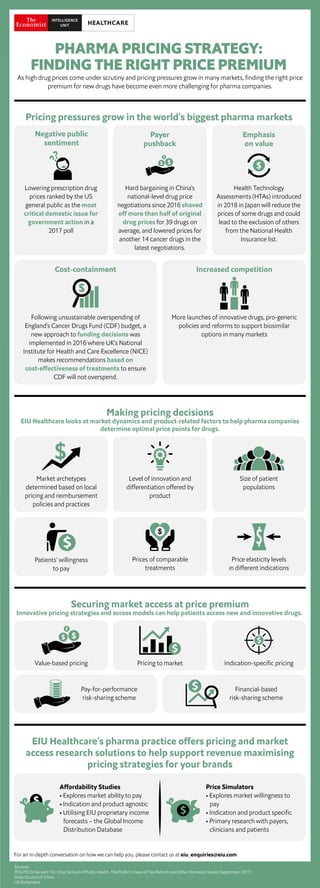
    PHARMA PRICING STRATEGY: FINDINGTHE RIGHT PRICE PREMIUM As high drug prices come under scrutiny and pricing pressures grow in many markets, finding the right price premium for new drugs have become even more challenging for pharma companies. Sources: POLITICO/Harvard T.H. Chan School of Public Health, The Public’s Views of Tax Reform and Other Domestic Issues (September 2017) State Council of China UK Parliament Pricing pressures grow in the world’s biggest pharma markets Making pricing decisions EIU Healthcare looks at market dynamics and product-related factors to help pharma companies determine optimal price points for drugs. Securing market access at price premium Innovative pricing strategies and access models can help patients access new and innovative drugs. EIU Healthcare’s pharma practice offers pricing and market access research solutions to help support revenue maximising pricing strategies for your brands Negative public sentiment Lowering prescription drug prices ranked by the US general public as the most critical domestic issue for government action in a 2017 poll Hard bargaining in China’s national-level drug price negotiations since 2016 shaved off more than half of original drug prices for 39 drugs on average, and lowered prices for another 14 cancer drugs in the latest negotiations. Payer pushback Health Technology Assessments (HTAs) introduced in 2018 in Japan will reduce the prices of some drugs and could lead to the exclusion of others from the National Health Insurance list. Emphasis on value Following unsustainable overspending of England’s Cancer Drugs Fund (CDF) budget, a new approach to funding decisions was implemented in 2016 where UK’s National Institute for Health and Care Excellence (NICE) makes recommendations based on cost-effectiveness of treatments to ensure CDF will not overspend. Cost-containment More launches of innovative drugs, pro-generic policies and reforms to support biosimilar options in many markets Increased competition Market archetypes determined based on local pricing and reimbursement policies and practices Level of innovation and differentiation offered by product Size of patient populations Patients’ willingness to pay Prices of comparable treatments Price elasticity levels in different indications Value-based pricing Pricing to market Indication-specific pricing Pay-for-performance risk-sharing scheme Financial-based risk-sharing scheme Affordability Studies • Explores market ability to pay • Indication and product agnostic • Utilising EIU proprietary income forecasts – the Global Income Distribution Database Price Simulators • Explores market willingness to pay • Indication and product specific • Primary research with payers, clinicians and patients For an in-depth conversation on how we can help you, please contact us at eiu_enquiries@eiu.com