Summarising, Paraphrasing and Quoting
for PG assignments
• Explain the difference between quoting, paraphrasing and
summarising and when to use them
• Evaluate examples of each
• Create your own paraphrases, summaries and select quotes.
Rhian Wyn-Williams, Skills@ljmu.ac.uk
Happy Maha Shivratri!
What is the
difference
between quoting,
paraphrasing and
summarising?
Summarising: Using your own words to draw out and
represent the key points of the text.
Provides a brief overview of an idea.
Paraphrasing: Putting the ideas of the author into your
own words. Use when you need to refer
to a fuller amount of information than a
summary would allow. For example, you
may need to discuss in some depth a
particular research paper and its
findings.
Quotations: Copying directly word for word from an
author. Carefully selected and kept to a
minimum.
Why should you
summarise or paraphrase?
• Academic integrity: avoiding plagiarism.
• Demonstrates your understanding of what you
have read.
• Provides support for your own claims: credibility.
• Enables you to develop your own academic
voice.
Summarising and
paraphrasing require you to
Read actively:
talk to
yourself.
Think about
what the text
means.
Write down
the key words
from the text.
Make notes in
your own
words.
Avoid writing
as you are
reading.
Step away
from the
words.
Reference the
source of the
information.
Summarising
We summarise all the time. Think about some of
the ways in which you summarise information in
your academic and your daily life.
• Read through the original text, maybe a
number of times.
• Keep notes to a minimum: try using keywords
and concentrate on the essentials at the centre
of the information.
• Write the summary directly from these
key words without re-reading the passage.
You have three possible summaries of an extract
of text on your worksheets. Can you choose
which one is the best summary?
Have a go….
• February is LGBT+ History Month. Using
the extract from Steven Dryden's (2017)
article on LGBT+ histories from the British
Library, write a brief summary of it.
• Compare it with the person next to you:
• Which key words did you use? Were they
same as your partners? Have your
summaries expressed the same point?
Here’s a possible way you could
have done it. Notice the lack of
detail but emphasis on the main
point.
A significant rise in arrests and prosecutions of homosexual men were
made after World War II. Many were from high rank and held positions
within government and national institutions, such as Alan Turing, the
cryptographer whose work played a decisive role in the breaking of the
Enigma code. The Sexual Offences Act, 1967, partially legalised same-sex
acts in the UK between men over the age of 21 conducted in private.
Scotland and Northern Ireland followed suit over a decade later, in 1980
and 1981 respectively. The Sexual Offences Act represented a stepping-
stone towards equality. The fight for sexual equality, however, was far
from over. Section 28 of the Local Government Act 1988, introduced by
the Conservative Government under Margaret Thatcher, banned local
authorities from ‘promoting homosexuality’ or ‘pretended family
relationships’, and prohibited councils from funding educational materials
and projects perceived to 'promote homosexuality'. The legislation
prevented the discussion of LGBT issues and stopped pupils getting the
support they needed. Section 28 was repealed in 2003, and Prime
Minister David Cameron apologised for the legislation in 2009. In 2004
another milestone was reached with the Civil Partnership Act 2004, which
allowed same-sex couples to legally enter into binding partnerships,
similar to marriage. The subsequent Marriage (Same-Sex Couples) Act
2013 then went further, allowing same-sex couples in England and Wales
to marry; Scotland followed suit with the Marriage and Civil Partnership
(Scotland) Act 2014. Northern Ireland is the only country in the UK which
does not have marriage equality in law. The Gender Recognition Act 2004,
which came into effect on 4 April 2005, gave transgender people full legal
recognition of their gender, allowing them to acquire a new birth
certificate – although gender options are still limited to ‘male’ or ‘female’.
The LGBT community continues to fight for equality and social
acceptance.
From S.Dryden (2017), 'A Short History of LGBT Rights in the UK'. Available
at: https://www.bl.uk/lgbtq-histories/articles/a-short-history-of-lgbt-
rights-in-the-uk
Since 1967, when same-sex acts
in the UK were first partially
legalised after two decades of
increased prosecution, numerous
laws have been passed to
promote equality for the LGBT
community, despite Section 28
(1988-2003) preventing
homosexuality’s ‘promotion’.
However, the struggle against
prejudice is not over (Dryden,
2017).
Paraphrasing
• Rephrase a text extensively. Just
rearranging the structure or using synonyms
is not enough, although that can help.
• As you read, focus on the meaning but you
will also want to note down more detailed
information than if you were summarising.
What key evidence is being presented?
• Use the same technqiue as summarising
but then go back and highlight the key
information that helps to explain the main
points.
• Write your summary from these notes.
Paraphrasing
• Read through the
original paragraph
provided on your
handout.
• Then read through the
two paraphrases.
• In pairs, decide which
paraphrase you think is
the better one and why.
Have a go...
Using the same extract from the
article on LGBT+ history that you
summarised before, write a
paraphrase of it.
What are they main differences?
Quotations
Keep quotations down to a minimum.
Remember your own voice. When your words
can make the same point as effectively, use
them.
When to quote:
• A new phrase is being coined
• New meaning is being given to an established
phrase
• The words are particularly engaging and
interesting as an expression
• When it is the only way to clarify an
ambiguous meaning
Quotations
1. On your handouts, look at
the examples of students’ work
using quotations. Should these
be quotes?​
2. Go back to the article by
Dryden and select a phrase you
think would be an appropriate
one for quoting.
"Education is the key to unlock
the golden door of freedom"
George Washington Carver
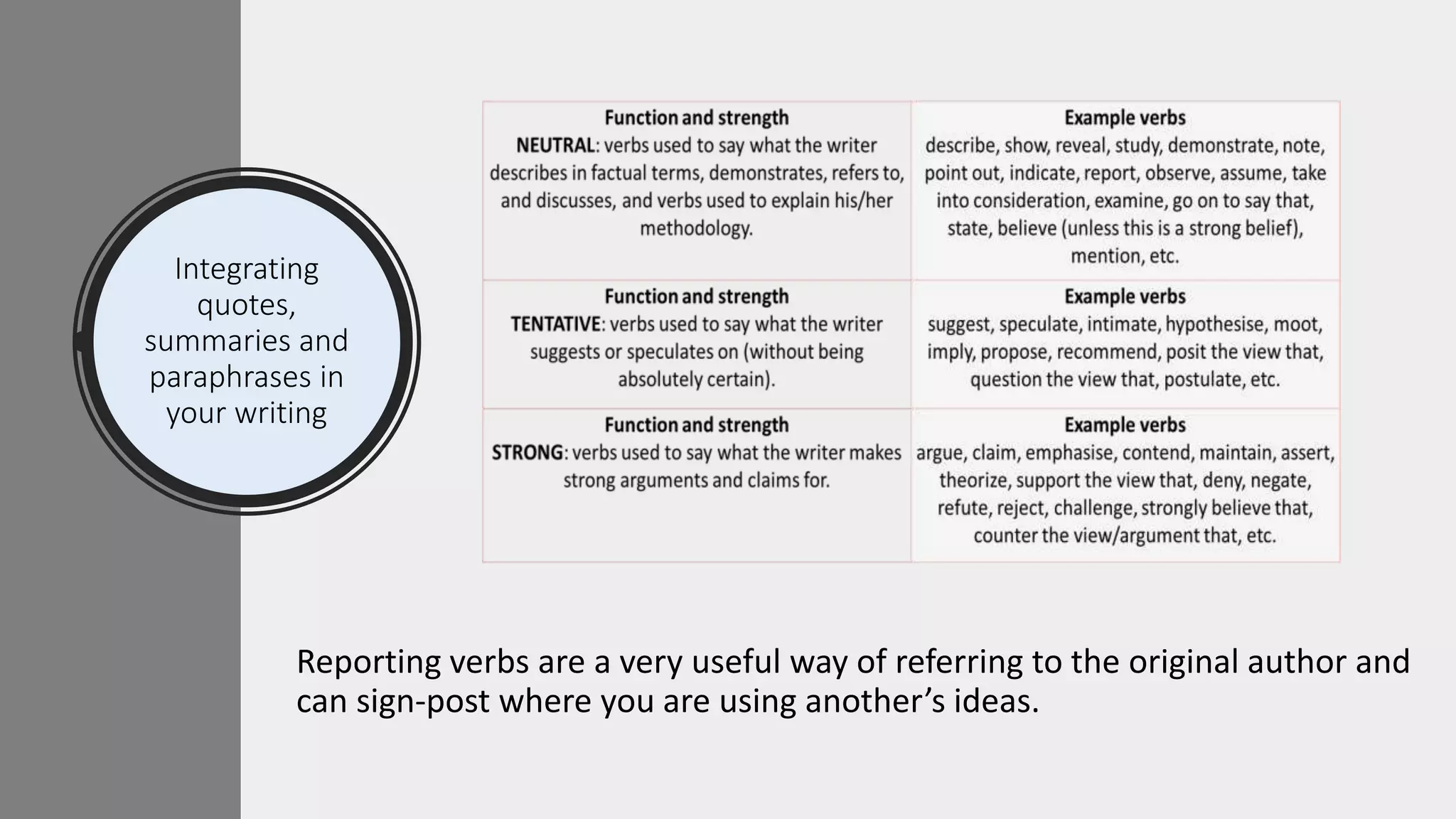
Integrating
quotes,
summaries and
paraphrases in
your writing
Reporting verbs are a very useful way of referring to the original author and
can sign-post where you are using another’s ideas.
Reflection…..
• What particular area of
quoting, summarising and
paraphrasing will you focus
on improving?
• How will you make those
improvements?
Next steps
Next week -
• Academic Writing: reflections
• Academic Writing: case studies
• Academic Writing: using your reading
(Summarising and paraphrasing is key!)

Pg summarising, paraphrasing and quoting one hour

  • 1.
    Summarising, Paraphrasing andQuoting for PG assignments • Explain the difference between quoting, paraphrasing and summarising and when to use them • Evaluate examples of each • Create your own paraphrases, summaries and select quotes. Rhian Wyn-Williams, Skills@ljmu.ac.uk Happy Maha Shivratri!
  • 2.
    What is the difference betweenquoting, paraphrasing and summarising? Summarising: Using your own words to draw out and represent the key points of the text. Provides a brief overview of an idea. Paraphrasing: Putting the ideas of the author into your own words. Use when you need to refer to a fuller amount of information than a summary would allow. For example, you may need to discuss in some depth a particular research paper and its findings. Quotations: Copying directly word for word from an author. Carefully selected and kept to a minimum.
  • 3.
    Why should you summariseor paraphrase? • Academic integrity: avoiding plagiarism. • Demonstrates your understanding of what you have read. • Provides support for your own claims: credibility. • Enables you to develop your own academic voice.
  • 4.
    Summarising and paraphrasing requireyou to Read actively: talk to yourself. Think about what the text means. Write down the key words from the text. Make notes in your own words. Avoid writing as you are reading. Step away from the words. Reference the source of the information.
  • 5.
    Summarising We summarise allthe time. Think about some of the ways in which you summarise information in your academic and your daily life. • Read through the original text, maybe a number of times. • Keep notes to a minimum: try using keywords and concentrate on the essentials at the centre of the information. • Write the summary directly from these key words without re-reading the passage. You have three possible summaries of an extract of text on your worksheets. Can you choose which one is the best summary?
  • 6.
    Have a go…. •February is LGBT+ History Month. Using the extract from Steven Dryden's (2017) article on LGBT+ histories from the British Library, write a brief summary of it. • Compare it with the person next to you: • Which key words did you use? Were they same as your partners? Have your summaries expressed the same point?
  • 7.
    Here’s a possibleway you could have done it. Notice the lack of detail but emphasis on the main point. A significant rise in arrests and prosecutions of homosexual men were made after World War II. Many were from high rank and held positions within government and national institutions, such as Alan Turing, the cryptographer whose work played a decisive role in the breaking of the Enigma code. The Sexual Offences Act, 1967, partially legalised same-sex acts in the UK between men over the age of 21 conducted in private. Scotland and Northern Ireland followed suit over a decade later, in 1980 and 1981 respectively. The Sexual Offences Act represented a stepping- stone towards equality. The fight for sexual equality, however, was far from over. Section 28 of the Local Government Act 1988, introduced by the Conservative Government under Margaret Thatcher, banned local authorities from ‘promoting homosexuality’ or ‘pretended family relationships’, and prohibited councils from funding educational materials and projects perceived to 'promote homosexuality'. The legislation prevented the discussion of LGBT issues and stopped pupils getting the support they needed. Section 28 was repealed in 2003, and Prime Minister David Cameron apologised for the legislation in 2009. In 2004 another milestone was reached with the Civil Partnership Act 2004, which allowed same-sex couples to legally enter into binding partnerships, similar to marriage. The subsequent Marriage (Same-Sex Couples) Act 2013 then went further, allowing same-sex couples in England and Wales to marry; Scotland followed suit with the Marriage and Civil Partnership (Scotland) Act 2014. Northern Ireland is the only country in the UK which does not have marriage equality in law. The Gender Recognition Act 2004, which came into effect on 4 April 2005, gave transgender people full legal recognition of their gender, allowing them to acquire a new birth certificate – although gender options are still limited to ‘male’ or ‘female’. The LGBT community continues to fight for equality and social acceptance. From S.Dryden (2017), 'A Short History of LGBT Rights in the UK'. Available at: https://www.bl.uk/lgbtq-histories/articles/a-short-history-of-lgbt- rights-in-the-uk Since 1967, when same-sex acts in the UK were first partially legalised after two decades of increased prosecution, numerous laws have been passed to promote equality for the LGBT community, despite Section 28 (1988-2003) preventing homosexuality’s ‘promotion’. However, the struggle against prejudice is not over (Dryden, 2017).
  • 8.
    Paraphrasing • Rephrase atext extensively. Just rearranging the structure or using synonyms is not enough, although that can help. • As you read, focus on the meaning but you will also want to note down more detailed information than if you were summarising. What key evidence is being presented? • Use the same technqiue as summarising but then go back and highlight the key information that helps to explain the main points. • Write your summary from these notes.
  • 9.
    Paraphrasing • Read throughthe original paragraph provided on your handout. • Then read through the two paraphrases. • In pairs, decide which paraphrase you think is the better one and why.
  • 10.
    Have a go... Usingthe same extract from the article on LGBT+ history that you summarised before, write a paraphrase of it. What are they main differences?
  • 11.
    Quotations Keep quotations downto a minimum. Remember your own voice. When your words can make the same point as effectively, use them. When to quote: • A new phrase is being coined • New meaning is being given to an established phrase • The words are particularly engaging and interesting as an expression • When it is the only way to clarify an ambiguous meaning
  • 12.
    Quotations 1. On yourhandouts, look at the examples of students’ work using quotations. Should these be quotes?​ 2. Go back to the article by Dryden and select a phrase you think would be an appropriate one for quoting. "Education is the key to unlock the golden door of freedom" George Washington Carver
  • 13.
    Integrating quotes, summaries and paraphrases in yourwriting Reporting verbs are a very useful way of referring to the original author and can sign-post where you are using another’s ideas.
  • 14.
    Reflection….. • What particulararea of quoting, summarising and paraphrasing will you focus on improving? • How will you make those improvements?
  • 15.
    Next steps Next week- • Academic Writing: reflections • Academic Writing: case studies • Academic Writing: using your reading (Summarising and paraphrasing is key!)

Editor's Notes

  • #6 Could add in the summarise your day’s activities activity
  • #9 Talk through this, highlighting how it’s been done
  • #15 Go around the class and ask each student for their area – push them on how they will action their improvement to assess their learning.