A.     OBJECTIVE
 1.  To protect the public from poisonous and harmful
  foods
 2.   To prevent the sale of substandard foods
 3.   To protect the interests of the consumers by
  eliminating fraudulent practices
 Meaning of Adulterant: Any material which is or could
    be employed for the purposes of adulteration
   Definition of Food: any article used as food or drink for
    human consumption other than drugs and water and
    includes
   a.    Any article which ordinarily enters into or is used in
    the composition or preparation of human food
   b. Any flavouring matter or condiments and
   c.    Any other article which the Central Government
    may having regard to its use, nature, substance or
    quality, declare by notification in the official gazette as
    food for the purpose of this Act.
Concept of Adulteration:-


An article of food shall be deemed to be adulterated
 If the article sold by vendor is not of the nature, substance
  or quality demanded by the purchaser
 If the article contains any other substance which affects
  the substance or quality thereof.
  If any inferior or cheaper substance has been substituted
  wholly or in part for the article so as to affect the
  nature, substance or quality of the product
 If any constituent of the article has been wholly or in part
  extracted to affect the quality thereof
 If the article has been prepared, packed or kept under
  unsanitary conditions where by it has become
  contaminated or injurious to health
 If the article consists wholly or in part of any
  filthy, putrefied, rotten decomposed or diseased
  animal or vegetable substance or is insect-infested or
  is otherwise unfit for human consumption
 If the article is obtained from a diseased animal
 If the article contains any poisonous or other ingredient
  which renders it injurious to health
 If the container of the article is
  composed, whether, wholly or in part of any poisonous or
  deleterious substance which renders its contents injurious
  to health
 If any colouring matter other than that prescribed in
  respect thereof is present in the article or if the amounts of
  the prescribed colouring matter which is present in the
  article are not within the prescribed limits
 If the article contains any prohibited preservative or
  permitted preservative in excess of the prescribed limits
 If the quality or purity of the Article falls below the
  prescribed limits of variability which renders it injurious
  to health
 If the quality or purity of the article falls below the
  prescribed standard or its constituents are present in
  quantities not within the prescribed limits of variability
  which renders it injurious to health
(ii) Central Food Laboratory means any laboratory or institute
  established or specified under section 4;

  (iii) Committee means the Central Committee for Food Standards
  constituted under Section 3;

  (iv) Director of the Central Food Laboratory means the person
  appointed by the Central Government by notification in the
  Official Gazette as the Director of the Central Food Laboratory
  and includes any person appointed by the Central Government in
  like manner to perform all or any of the functions of the Director
  under this Act;
Provided that no person who has any financial interest in the
  manufacture, import or sale of any article of food shall be
  appointed to be a Director under this clause;
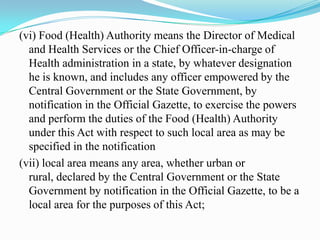
(vi) Food (Health) Authority means the Director of Medical
  and Health Services or the Chief Officer-in-charge of
  Health administration in a state, by whatever designation
  he is known, and includes any officer empowered by the
  Central Government or the State Government, by
  notification in the Official Gazette, to exercise the powers
  and perform the duties of the Food (Health) Authority
  under this Act with respect to such local area as may be
  specified in the notification
(vii) local area means any area, whether urban or
  rural, declared by the Central Government or the State
  Government by notification in the Official Gazette, to be a
  local area for the purposes of this Act;
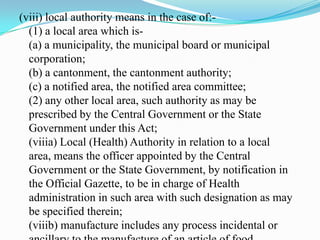
(viii) local authority means in the case of:-
  (1) a local area which is-
  (a) a municipality, the municipal board or municipal
  corporation;
  (b) a cantonment, the cantonment authority;
  (c) a notified area, the notified area committee;
  (2) any other local area, such authority as may be
  prescribed by the Central Government or the State
  Government under this Act;
  (viiia) Local (Health) Authority in relation to a local
  area, means the officer appointed by the Central
  Government or the State Government, by notification in
  the Official Gazette, to be in charge of Health
  administration in such area with such designation as may
  be specified therein;
  (viiib) manufacture includes any process incidental or
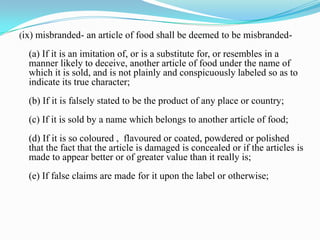
(ix) misbranded- an article of food shall be deemed to be misbranded-

  (a) If it is an imitation of, or is a substitute for, or resembles in a
  manner likely to deceive, another article of food under the name of
  which it is sold, and is not plainly and conspicuously labeled so as to
  indicate its true character;
  (b) If it is falsely stated to be the product of any place or country;
  (c) If it is sold by a name which belongs to another article of food;
  (d) If it is so coloured , flavoured or coated, powdered or polished
  that the fact that the article is damaged is concealed or if the articles is
  made to appear better or of greater value than it really is;
  (e) If false claims are made for it upon the label or otherwise;
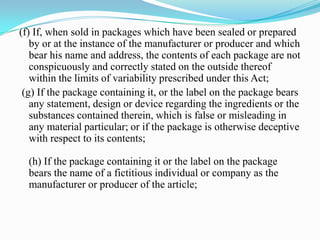
(f) If, when sold in packages which have been sealed or prepared
   by or at the instance of the manufacturer or producer and which
   bear his name and address, the contents of each package are not
   conspicuously and correctly stated on the outside thereof
   within the limits of variability prescribed under this Act;
 (g) If the package containing it, or the label on the package bears
   any statement, design or device regarding the ingredients or the
   substances contained therein, which is false or misleading in
   any material particular; or if the package is otherwise deceptive
   with respect to its contents;

  (h) If the package containing it or the label on the package
  bears the name of a fictitious individual or company as the
  manufacturer or producer of the article;
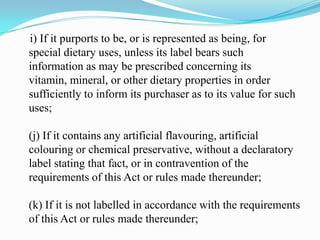
i) If it purports to be, or is represented as being, for
special dietary uses, unless its label bears such
information as may be prescribed concerning its
vitamin, mineral, or other dietary properties in order
sufficiently to inform its purchaser as to its value for such
uses;

(j) If it contains any artificial flavouring, artificial
colouring or chemical preservative, without a declaratory
label stating that fact, or in contravention of the
requirements of this Act or rules made thereunder;

(k) If it is not labelled in accordance with the requirements
of this Act or rules made thereunder;
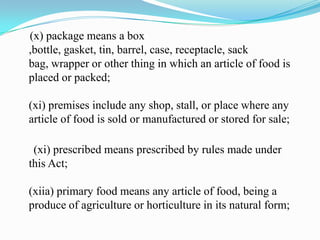
(x) package means a box
,bottle, gasket, tin, barrel, case, receptacle, sack
bag, wrapper or other thing in which an article of food is
placed or packed;

(xi) premises include any shop, stall, or place where any
article of food is sold or manufactured or stored for sale;

 (xi) prescribed means prescribed by rules made under
this Act;

(xiia) primary food means any article of food, being a
produce of agriculture or horticulture in its natural form;
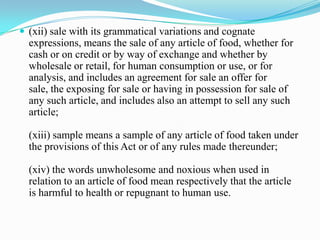
 (xii) sale with its grammatical variations and cognate
  expressions, means the sale of any article of food, whether for
  cash or on credit or by way of exchange and whether by
  wholesale or retail, for human consumption or use, or for
  analysis, and includes an agreement for sale an offer for
  sale, the exposing for sale or having in possession for sale of
  any such article, and includes also an attempt to sell any such
  article;

  (xiii) sample means a sample of any article of food taken under
  the provisions of this Act or of any rules made thereunder;

  (xiv) the words unwholesome and noxious when used in
  relation to an article of food mean respectively that the article
  is harmful to health or repugnant to human use.
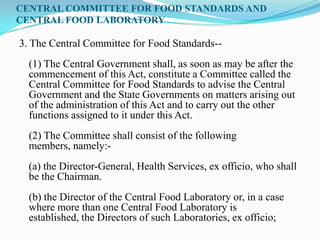
CENTRAL COMMITTEE FOR FOOD STANDARDS AND
CENTRAL FOOD LABORATORY

3. The Central Committee for Food Standards--
  (1) The Central Government shall, as soon as may be after the
  commencement of this Act, constitute a Committee called the
  Central Committee for Food Standards to advise the Central
  Government and the State Governments on matters arising out
  of the administration of this Act and to carry out the other
  functions assigned to it under this Act.
  (2) The Committee shall consist of the following
  members, namely:-
  (a) the Director-General, Health Services, ex officio, who shall
  be the Chairman.
  (b) the Director of the Central Food Laboratory or, in a case
  where more than one Central Food Laboratory is
  established, the Directors of such Laboratories, ex officio;
 (c ) two experts nominated by the Central Government;

  (d) one representative each of the Departments of Food and
  Agriculture in the Central Ministry of Food and Agriculture
  and one representative each of the Central Ministries of
  Commerce, Defence, Industry and Supply and
  Railways, nominated by the Central Government;
   e) one representative each nominated by the Government
  of each State;

  (f ) two representatives nominated by the Central
  Government to represent the [Union territories];
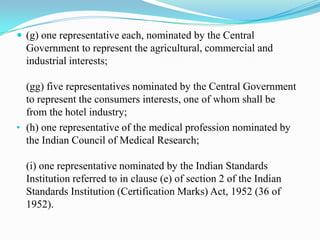
 (g) one representative each, nominated by the Central
  Government to represent the agricultural, commercial and
  industrial interests;

  (gg) five representatives nominated by the Central Government
  to represent the consumers interests, one of whom shall be
  from the hotel industry;
• (h) one representative of the medical profession nominated by
  the Indian Council of Medical Research;

  (i) one representative nominated by the Indian Standards
  Institution referred to in clause (e) of section 2 of the Indian
  Standards Institution (Certification Marks) Act, 1952 (36 of
  1952).
 (3) The members of the Committee referred to in clauses
  (c),(d),(e),(f),6[7[(g), (gg),] (h) and (i)] of sub-section (2) shall, unless
  their seats become vacant earlier by registration, death or otherwise, be
  entitled to hold office for three years and shall be eligible for re-
  nomination.
  (4) The functions of the Committee may be exercised notwithstanding
  any vacancy therein.
  (5) The Committee may appoint such and so many sub-committees as
  it deems fit and may appoint to them persons who are not members of
  the Committee to exercise such powers and perform such duties as
  may, subject to such conditions, if any, as the Committee may
  impose, be delegated to them by the Committee.
  (6) The Committee may, subject to the previous approval of the
  Central Government, make bye-laws for the purpose of regulating its
  own procedure and the transaction of its business.
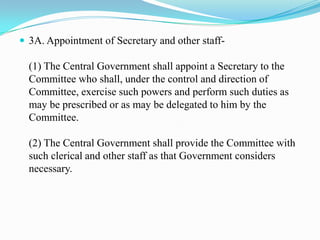
 3A. Appointment of Secretary and other staff-

  (1) The Central Government shall appoint a Secretary to the
  Committee who shall, under the control and direction of
  Committee, exercise such powers and perform such duties as
  may be prescribed or as may be delegated to him by the
  Committee.

  (2) The Central Government shall provide the Committee with
  such clerical and other staff as that Government considers
  necessary.
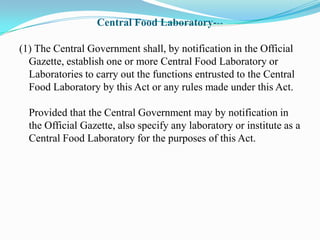
Central Food Laboratory---

(1) The Central Government shall, by notification in the Official
  Gazette, establish one or more Central Food Laboratory or
  Laboratories to carry out the functions entrusted to the Central
  Food Laboratory by this Act or any rules made under this Act.

  Provided that the Central Government may by notification in
  the Official Gazette, also specify any laboratory or institute as a
  Central Food Laboratory for the purposes of this Act.
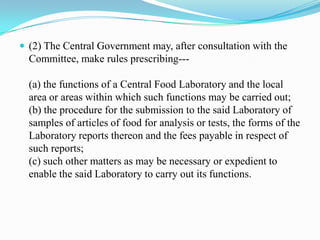
 (2) The Central Government may, after consultation with the
  Committee, make rules prescribing---

  (a) the functions of a Central Food Laboratory and the local
  area or areas within which such functions may be carried out;
  (b) the procedure for the submission to the said Laboratory of
  samples of articles of food for analysis or tests, the forms of the
  Laboratory reports thereon and the fees payable in respect of
  such reports;
  (c) such other matters as may be necessary or expedient to
  enable the said Laboratory to carry out its functions.
FUNCTIONS
 To analyse the samples of food sent by any authorized officer
  for the purpose, submission of the certificate of analysis to the
  authorities concerned.
 To investigate for the purpose of fixation of standard of any
  article of food.
 To investigate for the purpose of standardizing method of
  analysis.
 List of central food laboratories
1.Central Food Laboratory.Calcutta,
2.Central Food Laoratory,Ghaziabad
3.Central food Laboratory,Mysore
4.Central Food Laboratory,Pune
ANALYSIS OF FOOD

 Public Analysts -- The Central Government or the State
  Government may, by notification in the Official
  Gazette, appoint such persons as it thinks fit, having the
  prescribed qualifications to be public analysts for such local
  area as may be assigned to them by the Central Government or
  the State Government as the case may be.

  Provided that no person who has any financial interest in the
  manufacture, import or sale of any article of food shall be
  appointed to be a public analyst under this section.

  Provided further that different public analysts may be
  appointed for different article of food.
Qualification of Public Analyst
 i) Degree in science with Chemistry or Biochemistry or Food
  Technology or Food and Drugs from a recognized university or
  its equivalent qualification with minimum Five years
  experience in the analysis of Food, or
 Master’s Degree in Chemistry or Biochemistry or Food
  Technology or Microbiology or Food and Drugs from a
  recognized university or its equivalent qualifications with at
  least three years experience in the analysis of Food , or
 An Associate of the Institution of Chemist (India) by
  examination in the section of analysis of Food or it’s equivalent
  qualification with at least three years experience in the analysis
  of food.
 ii) Has been declared qualified by a Board appointed for this
  purpose by Central Government Duties of Public analyst:
a) To compare on receipt of a package containing a sample for
   analysis from a Food Inspector , the seals on the container
   and the outer cover with specimen impression received
   separately and to note the condition of the seals thereon.
b) To analyse or to cause to be analyzed the sample sent to him
   by food inspector or any other person under this act.
c) To give the report of the result of such analysis to the
   concerned authority within forty days from the date of receipt
   of the sample for analysis.
Food Inspectors ----
 (1) The Central Government or the State Government may, by
  notification in the Official Gazette, appoint such person as it
  thinks fit, having the prescribed qualifications to be food
  inspectors for such local areas as may be assigned to them by
  the Central Government or the State Government, as the case
  may be.

  Provided that no person who has any financial interest in the
  manufacture, import or sale of any article of food shall be
  appointed to be a food inspector under this section.

  (2) Every food inspector shall be deemed to be a public servant
  within the meaning of section 21 of the Indian Penal Code (45
  of 1860) and shall be officially subordinate to such authority as
  the Government appointing him, may specify in this behalf.
QUALIFICATION FOR FOOD INSPECTOR
1) A graduate in medicine with one month’s training in food
   inspector and sampling work approved for the purpose by the
   central Government or State Government or
2) A graduate in Science with Chemistry as one of the subject ,or
   a graduate in Agriculture or Public Health or Pharmacy or in
   Veterinary Science or a graduate in Food Technology or Dairy
   Technology or a Diploma in Food technology or Dairy
   Technology from a University or Institution established in
   India by law or equivalent recognized, and notified by the
   Central Government for the purpose with three month’s
   satisfactory training in food inspection and sampling work
   under a Food Authority or in an institution approved for the
   purpose by the Central Government.
DUTIES OF FOOD INSPECTOR

i)   To inspect all establishments licensed for the
     manufacture, storage or sale of an article of food with in the area
     assigned to him.
ii) To satisfy himself that the conditions of the licenses are being
     observed.
iii) To procure and send the samples of any article of food for
     analysis when he has reason to suspect that such articles are
     being manufactured , stocked or sold or exhibited for sale in
     contravention of the provision of the Act or rules thereunder.
iv) To investigate any complaint made to him in writing regarding
     any contravention of the provision of the Act ,or rules
     thereunder.
v) To maintain a record of all inspections made and actions taken
  by him while performing his duties and submit such record to
  the health officer or the food authority.
vi) To make enquiries and inspections necessary to find out the
  manufacture , storage or sale of articles of food in
  contravention of the Act or rules .
vii) To detain imported packages suspected to contain food the
  import or sale of which is prohibited.
viii) To perform such other duties entrusted to him by the
  concerned health officer.
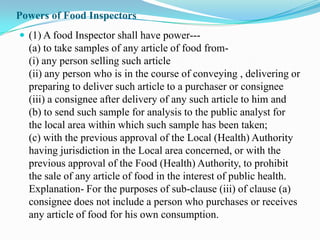
Powers of Food Inspectors
 (1) A food Inspector shall have power---
  (a) to take samples of any article of food from-
  (i) any person selling such article
  (ii) any person who is in the course of conveying , delivering or
  preparing to deliver such article to a purchaser or consignee
  (iii) a consignee after delivery of any such article to him and
  (b) to send such sample for analysis to the public analyst for
  the local area within which such sample has been taken;
  (c) with the previous approval of the Local (Health) Authority
  having jurisdiction in the Local area concerned, or with the
  previous approval of the Food (Health) Authority, to prohibit
  the sale of any article of food in the interest of public health.
  Explanation- For the purposes of sub-clause (iii) of clause (a)
  consignee does not include a person who purchases or receives
  any article of food for his own consumption.
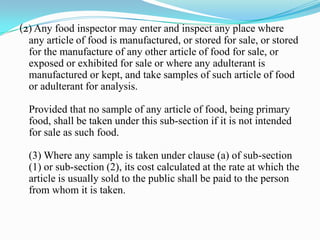
(2) Any food inspector may enter and inspect any place where
  any article of food is manufactured, or stored for sale, or stored
  for the manufacture of any other article of food for sale, or
  exposed or exhibited for sale or where any adulterant is
  manufactured or kept, and take samples of such article of food
  or adulterant for analysis.

  Provided that no sample of any article of food, being primary
  food, shall be taken under this sub-section if it is not intended
  for sale as such food.

  (3) Where any sample is taken under clause (a) of sub-section
  (1) or sub-section (2), its cost calculated at the rate at which the
  article is usually sold to the public shall be paid to the person
  from whom it is taken.
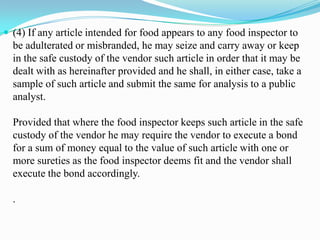
 (4) If any article intended for food appears to any food inspector to
  be adulterated or misbranded, he may seize and carry away or keep
  in the safe custody of the vendor such article in order that it may be
  dealt with as hereinafter provided and he shall, in either case, take a
  sample of such article and submit the same for analysis to a public
  analyst.

  Provided that where the food inspector keeps such article in the safe
  custody of the vendor he may require the vendor to execute a bond
  for a sum of money equal to the value of such article with one or
  more sureties as the food inspector deems fit and the vendor shall
  execute the bond accordingly.

  .
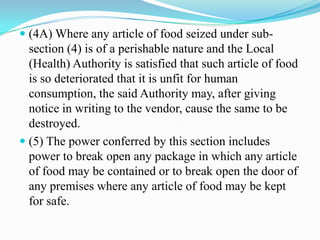
 (4A) Where any article of food seized under sub-
  section (4) is of a perishable nature and the Local
  (Health) Authority is satisfied that such article of food
  is so deteriorated that it is unfit for human
  consumption, the said Authority may, after giving
  notice in writing to the vendor, cause the same to be
  destroyed.
 (5) The power conferred by this section includes
  power to break open any package in which any article
  of food may be contained or to break open the door of
  any premises where any article of food may be kept
  for safe.
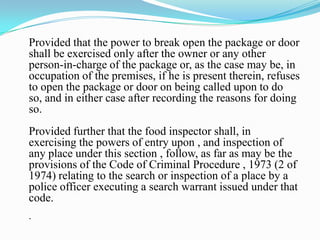
Provided that the power to break open the package or door
shall be exercised only after the owner or any other
person-in-charge of the package or, as the case may be, in
occupation of the premises, if he is present therein, refuses
to open the package or door on being called upon to do
so, and in either case after recording the reasons for doing
so.
Provided further that the food inspector shall, in
exercising the powers of entry upon , and inspection of
any place under this section , follow, as far as may be the
provisions of the Code of Criminal Procedure , 1973 (2 of
1974) relating to the search or inspection of a place by a
police officer executing a search warrant issued under that
code.
.
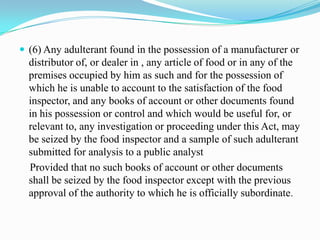
 (6) Any adulterant found in the possession of a manufacturer or
  distributor of, or dealer in , any article of food or in any of the
  premises occupied by him as such and for the possession of
  which he is unable to account to the satisfaction of the food
  inspector, and any books of account or other documents found
  in his possession or control and which would be useful for, or
  relevant to, any investigation or proceeding under this Act, may
  be seized by the food inspector and a sample of such adulterant
  submitted for analysis to a public analyst
  Provided that no such books of account or other documents
  shall be seized by the food inspector except with the previous
  approval of the authority to which he is officially subordinate.
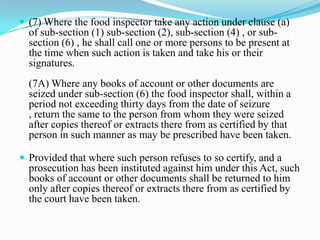
 (7) Where the food inspector take any action under clause (a)
  of sub-section (1) sub-section (2), sub-section (4) , or sub-
  section (6) , he shall call one or more persons to be present at
  the time when such action is taken and take his or their
  signatures.
  (7A) Where any books of account or other documents are
  seized under sub-section (6) the food inspector shall, within a
  period not exceeding thirty days from the date of seizure
  , return the same to the person from whom they were seized
  after copies thereof or extracts there from as certified by that
  person in such manner as may be prescribed have been taken.

 Provided that where such person refuses to so certify, and a
  prosecution has been instituted against him under this Act, such
  books of account or other documents shall be returned to him
  only after copies thereof or extracts there from as certified by
  the court have been taken.
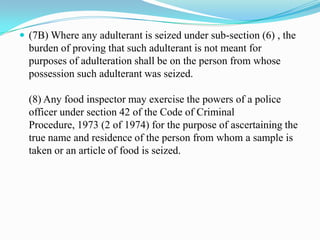
 (7B) Where any adulterant is seized under sub-section (6) , the
  burden of proving that such adulterant is not meant for
  purposes of adulteration shall be on the person from whose
  possession such adulterant was seized.

  (8) Any food inspector may exercise the powers of a police
  officer under section 42 of the Code of Criminal
  Procedure, 1973 (2 of 1974) for the purpose of ascertaining the
  true name and residence of the person from whom a sample is
  taken or an article of food is seized.
 (9) Any food inspector exercising powers under this Act or
  under the rules made thereunder who-

  (a) vexatiously and without any reasonable grounds of
  suspicion seizes any articles of food or adulterant or
  (b) commits any other act to the injury of any person without
  having reason to believe that such act is necessary for the
  execution of his duty.

  Shall be guilty of an offence under this Act and shall be
  punishable for such offence with fine which shall not be less
  than five hundred rupees but which may extend to one
  thousand rupees.
Procedure to be followed by food Inspectors---
 (1) When a food Inspector takes a sample of food for
 analysis, he shall-
 (a) give notice in writing then and thereof his intention to have
 it so analyzed to the person from whom he has taken the
 sample and to the person, if any, whose name, address and
 other particulars have been disclosed under section 14A.
 (b) except in special cases provided by rules under this
 Act, divide the sample into three parts and mark and seal or
 fasten up each part in such a manner as its nature permits and
 take the signature or thumb impression of the person from
 whom the sample has been taken in such place and in such
 manner as may be prescribed.
 Provided that where such person refuses to sign or put his
  thumb impression the food inspector shall call upon one or
  more witnesses and take his or their signatures or thumb
  impressions, as the case may be in lieu of the signature or
  thumb impression of such person.
(c) (i) send one of the parts for analysis to the public analyst
  under intimation to the Local (Health) Authority; and

  (ii) send the remaining two parts to the Local (Health)
  Authority for the purposes of sub-section (2) of this section and
  sub sections(2A) and (2E) of section 13.
(2) Where the part of the sample sent to the public analyst
under sub-clause (I) of clause (c) of sub-section (1) is lost or
damaged, the Local (Health) Authority shall, on a requisition
made to it by the public analyst or the food inspector, dispatch
one of the parts of the sample sent to it under sub-clause (ii) of
the said clause (c) to the public analyst for analysis.

(3) When a sample of any article of food or adulterant is taken
under sub-section (1) or sub-section (2) of section 10, the food
inspector shall, by the immediately succeeding working
day, send a sample of the article of food or adulterant or
both, as the case may be, in accordance with the rules
prescribed for sampling to the public analyst for the local area
concerned.
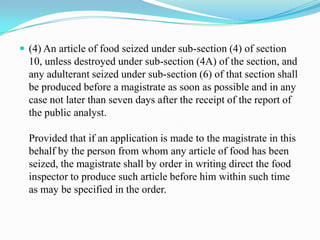
 (4) An article of food seized under sub-section (4) of section
  10, unless destroyed under sub-section (4A) of the section, and
  any adulterant seized under sub-section (6) of that section shall
  be produced before a magistrate as soon as possible and in any
  case not later than seven days after the receipt of the report of
  the public analyst.

  Provided that if an application is made to the magistrate in this
  behalf by the person from whom any article of food has been
  seized, the magistrate shall by order in writing direct the food
  inspector to produce such article before him within such time
  as may be specified in the order.
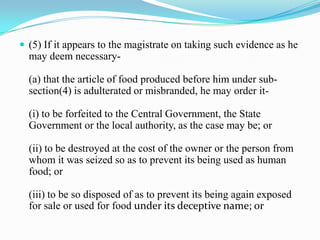
 (5) If it appears to the magistrate on taking such evidence as he
  may deem necessary-

  (a) that the article of food produced before him under sub-
  section(4) is adulterated or misbranded, he may order it-

  (i) to be forfeited to the Central Government, the State
  Government or the local authority, as the case may be; or

  (ii) to be destroyed at the cost of the owner or the person from
  whom it was seized so as to prevent its being used as human
  food; or

  (iii) to be so disposed of as to prevent its being again exposed
  for sale or used for food under its deceptive name; or
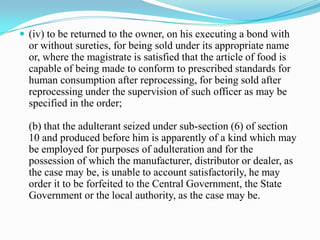
 (iv) to be returned to the owner, on his executing a bond with
  or without sureties, for being sold under its appropriate name
  or, where the magistrate is satisfied that the article of food is
  capable of being made to conform to prescribed standards for
  human consumption after reprocessing, for being sold after
  reprocessing under the supervision of such officer as may be
  specified in the order;

  (b) that the adulterant seized under sub-section (6) of section
  10 and produced before him is apparently of a kind which may
  be employed for purposes of adulteration and for the
  possession of which the manufacturer, distributor or dealer, as
  the case may be, is unable to account satisfactorily, he may
  order it to be forfeited to the Central Government, the State
  Government or the local authority, as the case may be.
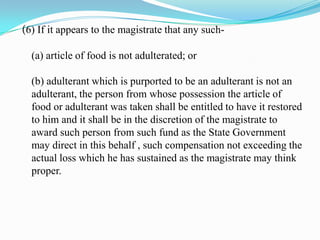
(6) If it appears to the magistrate that any such-

  (a) article of food is not adulterated; or

  (b) adulterant which is purported to be an adulterant is not an
  adulterant, the person from whose possession the article of
  food or adulterant was taken shall be entitled to have it restored
  to him and it shall be in the discretion of the magistrate to
  award such person from such fund as the State Government
  may direct in this behalf , such compensation not exceeding the
  actual loss which he has sustained as the magistrate may think
  proper.
PROHIBITION OF IMPORT OF CERTAIN FOOD ARTICLES


 Import of the following types of food articles is prohibited
i)   Adulterated food article
ii) Misbranded food article
iii) Food articles , where the license for import is prescribed
     except in accordance with the conditions of license.
iv) Any food article in contravention of any other provisions of
     this Act and rules there under.
PROHIBITION OF SALE,MANUFACTURE ETC,OF
CERTAIN FOOD ARTICLES

 Manufacture and sale of the following articles are prohibited
i)     Adulterated food article
ii)    Misbranded food article
iii)   Food articles , where the license for sale is prescribed except
       in accordance with the conditions of license
iv)    Any food article in contravention of any other provisions of
       this Act and rules there under.
v)     Any adulterant
vi)    Food article , the sale of which is time being prohibited by
       the Food Authority in the interest of public health.
OFFENCES AND PENALTIES
a) Manufacture ,sale , storage or distribution of adulterated food
     articles or other food articles in contravention of the
     provisions of this Act.
b)   Import ,manufacture for sale , storage or distribution of any
     non-injurious adulterant
c)   Preventing a food inspector from taking a sample and
     exercising any other power.
d)   Possession of any adulterant which is not injurious to health
     by manufacturer of an article of food.
e)   Use of any report or certificate of a test or analysis for the
     purpose of advertising any article of food.
f)   Giving to the vendor a false warranty in writing in respect of
     any sold food article are punishable with imprisonment for at
     least six months which can be extended to three years and
     with minimum one thousand rupees fine.
MISCELLANEOUS
 Manufacturers, distributors and dealers to give warranty----
 No manufacturer or distributor of, or dealer in any article of
  food shall sell such article to any vendor unless he also give a
  warranty in writing in the prescribed form about the nature and
  quality of such article to the vendor.
  Provided that a bill, cash memorandum or invoice in respect of
  the sale of any article of food given by a manufacturer or
  distributor of, or dealer in, such article to the vendor thereof shall
  be deemed to be a warranty given by such
  manufacturer, distributor or dealer under this section.
 Vendor to disclose the name, etc, of the person from whom the
  article of food was purchased- Every vendor of an article of food
  shall, is so required, disclose to the food inspector the
  name, address and other particulars of the person from whom he
  purchased the article of food.
 Forfeiture of property:
   The food article in respect to which the contravention of any
  of the provision of this Act or any rule there under , has been
  committed may be fortified to the government.
   However if the court is satisfied that the said food article can
  be reprocessed to such a article conforming to prescribed
  standard for human consumption , the court may order the
  article conforming to prescribed standard for human
  consumption , the court may order the article of food to be
  returned to the owner on his executing a necessary bond.

Pfa 1954 class

  • 2.
    A. OBJECTIVE  1. To protect the public from poisonous and harmful foods  2. To prevent the sale of substandard foods  3. To protect the interests of the consumers by eliminating fraudulent practices
  • 3.
     Meaning ofAdulterant: Any material which is or could be employed for the purposes of adulteration  Definition of Food: any article used as food or drink for human consumption other than drugs and water and includes  a. Any article which ordinarily enters into or is used in the composition or preparation of human food  b. Any flavouring matter or condiments and  c. Any other article which the Central Government may having regard to its use, nature, substance or quality, declare by notification in the official gazette as food for the purpose of this Act.
  • 4.
    Concept of Adulteration:- Anarticle of food shall be deemed to be adulterated  If the article sold by vendor is not of the nature, substance or quality demanded by the purchaser  If the article contains any other substance which affects the substance or quality thereof. If any inferior or cheaper substance has been substituted wholly or in part for the article so as to affect the nature, substance or quality of the product  If any constituent of the article has been wholly or in part extracted to affect the quality thereof  If the article has been prepared, packed or kept under unsanitary conditions where by it has become contaminated or injurious to health
  • 5.
     If thearticle consists wholly or in part of any filthy, putrefied, rotten decomposed or diseased animal or vegetable substance or is insect-infested or is otherwise unfit for human consumption  If the article is obtained from a diseased animal  If the article contains any poisonous or other ingredient which renders it injurious to health  If the container of the article is composed, whether, wholly or in part of any poisonous or deleterious substance which renders its contents injurious to health  If any colouring matter other than that prescribed in respect thereof is present in the article or if the amounts of the prescribed colouring matter which is present in the article are not within the prescribed limits
  • 6.
     If thearticle contains any prohibited preservative or permitted preservative in excess of the prescribed limits  If the quality or purity of the Article falls below the prescribed limits of variability which renders it injurious to health  If the quality or purity of the article falls below the prescribed standard or its constituents are present in quantities not within the prescribed limits of variability which renders it injurious to health
  • 7.
    (ii) Central FoodLaboratory means any laboratory or institute established or specified under section 4; (iii) Committee means the Central Committee for Food Standards constituted under Section 3; (iv) Director of the Central Food Laboratory means the person appointed by the Central Government by notification in the Official Gazette as the Director of the Central Food Laboratory and includes any person appointed by the Central Government in like manner to perform all or any of the functions of the Director under this Act; Provided that no person who has any financial interest in the manufacture, import or sale of any article of food shall be appointed to be a Director under this clause;
  • 8.
    (vi) Food (Health)Authority means the Director of Medical and Health Services or the Chief Officer-in-charge of Health administration in a state, by whatever designation he is known, and includes any officer empowered by the Central Government or the State Government, by notification in the Official Gazette, to exercise the powers and perform the duties of the Food (Health) Authority under this Act with respect to such local area as may be specified in the notification (vii) local area means any area, whether urban or rural, declared by the Central Government or the State Government by notification in the Official Gazette, to be a local area for the purposes of this Act;
  • 9.
    (viii) local authoritymeans in the case of:- (1) a local area which is- (a) a municipality, the municipal board or municipal corporation; (b) a cantonment, the cantonment authority; (c) a notified area, the notified area committee; (2) any other local area, such authority as may be prescribed by the Central Government or the State Government under this Act; (viiia) Local (Health) Authority in relation to a local area, means the officer appointed by the Central Government or the State Government, by notification in the Official Gazette, to be in charge of Health administration in such area with such designation as may be specified therein; (viiib) manufacture includes any process incidental or
  • 10.
    (ix) misbranded- anarticle of food shall be deemed to be misbranded- (a) If it is an imitation of, or is a substitute for, or resembles in a manner likely to deceive, another article of food under the name of which it is sold, and is not plainly and conspicuously labeled so as to indicate its true character; (b) If it is falsely stated to be the product of any place or country; (c) If it is sold by a name which belongs to another article of food; (d) If it is so coloured , flavoured or coated, powdered or polished that the fact that the article is damaged is concealed or if the articles is made to appear better or of greater value than it really is; (e) If false claims are made for it upon the label or otherwise;
  • 11.
    (f) If, whensold in packages which have been sealed or prepared by or at the instance of the manufacturer or producer and which bear his name and address, the contents of each package are not conspicuously and correctly stated on the outside thereof within the limits of variability prescribed under this Act; (g) If the package containing it, or the label on the package bears any statement, design or device regarding the ingredients or the substances contained therein, which is false or misleading in any material particular; or if the package is otherwise deceptive with respect to its contents; (h) If the package containing it or the label on the package bears the name of a fictitious individual or company as the manufacturer or producer of the article;
  • 12.
    i) If itpurports to be, or is represented as being, for special dietary uses, unless its label bears such information as may be prescribed concerning its vitamin, mineral, or other dietary properties in order sufficiently to inform its purchaser as to its value for such uses; (j) If it contains any artificial flavouring, artificial colouring or chemical preservative, without a declaratory label stating that fact, or in contravention of the requirements of this Act or rules made thereunder; (k) If it is not labelled in accordance with the requirements of this Act or rules made thereunder;
  • 13.
    (x) package meansa box ,bottle, gasket, tin, barrel, case, receptacle, sack bag, wrapper or other thing in which an article of food is placed or packed; (xi) premises include any shop, stall, or place where any article of food is sold or manufactured or stored for sale; (xi) prescribed means prescribed by rules made under this Act; (xiia) primary food means any article of food, being a produce of agriculture or horticulture in its natural form;
  • 14.
     (xii) salewith its grammatical variations and cognate expressions, means the sale of any article of food, whether for cash or on credit or by way of exchange and whether by wholesale or retail, for human consumption or use, or for analysis, and includes an agreement for sale an offer for sale, the exposing for sale or having in possession for sale of any such article, and includes also an attempt to sell any such article; (xiii) sample means a sample of any article of food taken under the provisions of this Act or of any rules made thereunder; (xiv) the words unwholesome and noxious when used in relation to an article of food mean respectively that the article is harmful to health or repugnant to human use.
  • 15.
    CENTRAL COMMITTEE FORFOOD STANDARDS AND CENTRAL FOOD LABORATORY 3. The Central Committee for Food Standards-- (1) The Central Government shall, as soon as may be after the commencement of this Act, constitute a Committee called the Central Committee for Food Standards to advise the Central Government and the State Governments on matters arising out of the administration of this Act and to carry out the other functions assigned to it under this Act. (2) The Committee shall consist of the following members, namely:- (a) the Director-General, Health Services, ex officio, who shall be the Chairman. (b) the Director of the Central Food Laboratory or, in a case where more than one Central Food Laboratory is established, the Directors of such Laboratories, ex officio;
  • 16.
     (c )two experts nominated by the Central Government; (d) one representative each of the Departments of Food and Agriculture in the Central Ministry of Food and Agriculture and one representative each of the Central Ministries of Commerce, Defence, Industry and Supply and Railways, nominated by the Central Government; e) one representative each nominated by the Government of each State; (f ) two representatives nominated by the Central Government to represent the [Union territories];
  • 17.
     (g) onerepresentative each, nominated by the Central Government to represent the agricultural, commercial and industrial interests; (gg) five representatives nominated by the Central Government to represent the consumers interests, one of whom shall be from the hotel industry; • (h) one representative of the medical profession nominated by the Indian Council of Medical Research; (i) one representative nominated by the Indian Standards Institution referred to in clause (e) of section 2 of the Indian Standards Institution (Certification Marks) Act, 1952 (36 of 1952).
  • 18.
     (3) Themembers of the Committee referred to in clauses (c),(d),(e),(f),6[7[(g), (gg),] (h) and (i)] of sub-section (2) shall, unless their seats become vacant earlier by registration, death or otherwise, be entitled to hold office for three years and shall be eligible for re- nomination. (4) The functions of the Committee may be exercised notwithstanding any vacancy therein. (5) The Committee may appoint such and so many sub-committees as it deems fit and may appoint to them persons who are not members of the Committee to exercise such powers and perform such duties as may, subject to such conditions, if any, as the Committee may impose, be delegated to them by the Committee. (6) The Committee may, subject to the previous approval of the Central Government, make bye-laws for the purpose of regulating its own procedure and the transaction of its business.
  • 19.
     3A. Appointmentof Secretary and other staff- (1) The Central Government shall appoint a Secretary to the Committee who shall, under the control and direction of Committee, exercise such powers and perform such duties as may be prescribed or as may be delegated to him by the Committee. (2) The Central Government shall provide the Committee with such clerical and other staff as that Government considers necessary.
  • 20.
    Central Food Laboratory--- (1)The Central Government shall, by notification in the Official Gazette, establish one or more Central Food Laboratory or Laboratories to carry out the functions entrusted to the Central Food Laboratory by this Act or any rules made under this Act. Provided that the Central Government may by notification in the Official Gazette, also specify any laboratory or institute as a Central Food Laboratory for the purposes of this Act.
  • 21.
     (2) TheCentral Government may, after consultation with the Committee, make rules prescribing--- (a) the functions of a Central Food Laboratory and the local area or areas within which such functions may be carried out; (b) the procedure for the submission to the said Laboratory of samples of articles of food for analysis or tests, the forms of the Laboratory reports thereon and the fees payable in respect of such reports; (c) such other matters as may be necessary or expedient to enable the said Laboratory to carry out its functions.
  • 22.
    FUNCTIONS  To analysethe samples of food sent by any authorized officer for the purpose, submission of the certificate of analysis to the authorities concerned.  To investigate for the purpose of fixation of standard of any article of food.  To investigate for the purpose of standardizing method of analysis.  List of central food laboratories 1.Central Food Laboratory.Calcutta, 2.Central Food Laoratory,Ghaziabad 3.Central food Laboratory,Mysore 4.Central Food Laboratory,Pune
  • 23.
    ANALYSIS OF FOOD Public Analysts -- The Central Government or the State Government may, by notification in the Official Gazette, appoint such persons as it thinks fit, having the prescribed qualifications to be public analysts for such local area as may be assigned to them by the Central Government or the State Government as the case may be. Provided that no person who has any financial interest in the manufacture, import or sale of any article of food shall be appointed to be a public analyst under this section. Provided further that different public analysts may be appointed for different article of food.
  • 24.
    Qualification of PublicAnalyst  i) Degree in science with Chemistry or Biochemistry or Food Technology or Food and Drugs from a recognized university or its equivalent qualification with minimum Five years experience in the analysis of Food, or  Master’s Degree in Chemistry or Biochemistry or Food Technology or Microbiology or Food and Drugs from a recognized university or its equivalent qualifications with at least three years experience in the analysis of Food , or  An Associate of the Institution of Chemist (India) by examination in the section of analysis of Food or it’s equivalent qualification with at least three years experience in the analysis of food.
  • 25.
     ii) Hasbeen declared qualified by a Board appointed for this purpose by Central Government Duties of Public analyst: a) To compare on receipt of a package containing a sample for analysis from a Food Inspector , the seals on the container and the outer cover with specimen impression received separately and to note the condition of the seals thereon. b) To analyse or to cause to be analyzed the sample sent to him by food inspector or any other person under this act. c) To give the report of the result of such analysis to the concerned authority within forty days from the date of receipt of the sample for analysis.
  • 26.
    Food Inspectors ---- (1) The Central Government or the State Government may, by notification in the Official Gazette, appoint such person as it thinks fit, having the prescribed qualifications to be food inspectors for such local areas as may be assigned to them by the Central Government or the State Government, as the case may be. Provided that no person who has any financial interest in the manufacture, import or sale of any article of food shall be appointed to be a food inspector under this section. (2) Every food inspector shall be deemed to be a public servant within the meaning of section 21 of the Indian Penal Code (45 of 1860) and shall be officially subordinate to such authority as the Government appointing him, may specify in this behalf.
  • 27.
    QUALIFICATION FOR FOODINSPECTOR 1) A graduate in medicine with one month’s training in food inspector and sampling work approved for the purpose by the central Government or State Government or 2) A graduate in Science with Chemistry as one of the subject ,or a graduate in Agriculture or Public Health or Pharmacy or in Veterinary Science or a graduate in Food Technology or Dairy Technology or a Diploma in Food technology or Dairy Technology from a University or Institution established in India by law or equivalent recognized, and notified by the Central Government for the purpose with three month’s satisfactory training in food inspection and sampling work under a Food Authority or in an institution approved for the purpose by the Central Government.
  • 28.
    DUTIES OF FOODINSPECTOR i) To inspect all establishments licensed for the manufacture, storage or sale of an article of food with in the area assigned to him. ii) To satisfy himself that the conditions of the licenses are being observed. iii) To procure and send the samples of any article of food for analysis when he has reason to suspect that such articles are being manufactured , stocked or sold or exhibited for sale in contravention of the provision of the Act or rules thereunder. iv) To investigate any complaint made to him in writing regarding any contravention of the provision of the Act ,or rules thereunder.
  • 29.
    v) To maintaina record of all inspections made and actions taken by him while performing his duties and submit such record to the health officer or the food authority. vi) To make enquiries and inspections necessary to find out the manufacture , storage or sale of articles of food in contravention of the Act or rules . vii) To detain imported packages suspected to contain food the import or sale of which is prohibited. viii) To perform such other duties entrusted to him by the concerned health officer.
  • 30.
    Powers of FoodInspectors  (1) A food Inspector shall have power--- (a) to take samples of any article of food from- (i) any person selling such article (ii) any person who is in the course of conveying , delivering or preparing to deliver such article to a purchaser or consignee (iii) a consignee after delivery of any such article to him and (b) to send such sample for analysis to the public analyst for the local area within which such sample has been taken; (c) with the previous approval of the Local (Health) Authority having jurisdiction in the Local area concerned, or with the previous approval of the Food (Health) Authority, to prohibit the sale of any article of food in the interest of public health. Explanation- For the purposes of sub-clause (iii) of clause (a) consignee does not include a person who purchases or receives any article of food for his own consumption.
  • 31.
    (2) Any foodinspector may enter and inspect any place where any article of food is manufactured, or stored for sale, or stored for the manufacture of any other article of food for sale, or exposed or exhibited for sale or where any adulterant is manufactured or kept, and take samples of such article of food or adulterant for analysis. Provided that no sample of any article of food, being primary food, shall be taken under this sub-section if it is not intended for sale as such food. (3) Where any sample is taken under clause (a) of sub-section (1) or sub-section (2), its cost calculated at the rate at which the article is usually sold to the public shall be paid to the person from whom it is taken.
  • 32.
     (4) Ifany article intended for food appears to any food inspector to be adulterated or misbranded, he may seize and carry away or keep in the safe custody of the vendor such article in order that it may be dealt with as hereinafter provided and he shall, in either case, take a sample of such article and submit the same for analysis to a public analyst. Provided that where the food inspector keeps such article in the safe custody of the vendor he may require the vendor to execute a bond for a sum of money equal to the value of such article with one or more sureties as the food inspector deems fit and the vendor shall execute the bond accordingly. .
  • 33.
     (4A) Whereany article of food seized under sub- section (4) is of a perishable nature and the Local (Health) Authority is satisfied that such article of food is so deteriorated that it is unfit for human consumption, the said Authority may, after giving notice in writing to the vendor, cause the same to be destroyed.  (5) The power conferred by this section includes power to break open any package in which any article of food may be contained or to break open the door of any premises where any article of food may be kept for safe.
  • 34.
    Provided that thepower to break open the package or door shall be exercised only after the owner or any other person-in-charge of the package or, as the case may be, in occupation of the premises, if he is present therein, refuses to open the package or door on being called upon to do so, and in either case after recording the reasons for doing so. Provided further that the food inspector shall, in exercising the powers of entry upon , and inspection of any place under this section , follow, as far as may be the provisions of the Code of Criminal Procedure , 1973 (2 of 1974) relating to the search or inspection of a place by a police officer executing a search warrant issued under that code. .
  • 35.
     (6) Anyadulterant found in the possession of a manufacturer or distributor of, or dealer in , any article of food or in any of the premises occupied by him as such and for the possession of which he is unable to account to the satisfaction of the food inspector, and any books of account or other documents found in his possession or control and which would be useful for, or relevant to, any investigation or proceeding under this Act, may be seized by the food inspector and a sample of such adulterant submitted for analysis to a public analyst Provided that no such books of account or other documents shall be seized by the food inspector except with the previous approval of the authority to which he is officially subordinate.
  • 36.
     (7) Wherethe food inspector take any action under clause (a) of sub-section (1) sub-section (2), sub-section (4) , or sub- section (6) , he shall call one or more persons to be present at the time when such action is taken and take his or their signatures. (7A) Where any books of account or other documents are seized under sub-section (6) the food inspector shall, within a period not exceeding thirty days from the date of seizure , return the same to the person from whom they were seized after copies thereof or extracts there from as certified by that person in such manner as may be prescribed have been taken.  Provided that where such person refuses to so certify, and a prosecution has been instituted against him under this Act, such books of account or other documents shall be returned to him only after copies thereof or extracts there from as certified by the court have been taken.
  • 37.
     (7B) Whereany adulterant is seized under sub-section (6) , the burden of proving that such adulterant is not meant for purposes of adulteration shall be on the person from whose possession such adulterant was seized. (8) Any food inspector may exercise the powers of a police officer under section 42 of the Code of Criminal Procedure, 1973 (2 of 1974) for the purpose of ascertaining the true name and residence of the person from whom a sample is taken or an article of food is seized.
  • 38.
     (9) Anyfood inspector exercising powers under this Act or under the rules made thereunder who- (a) vexatiously and without any reasonable grounds of suspicion seizes any articles of food or adulterant or (b) commits any other act to the injury of any person without having reason to believe that such act is necessary for the execution of his duty. Shall be guilty of an offence under this Act and shall be punishable for such offence with fine which shall not be less than five hundred rupees but which may extend to one thousand rupees.
  • 39.
    Procedure to befollowed by food Inspectors--- (1) When a food Inspector takes a sample of food for analysis, he shall- (a) give notice in writing then and thereof his intention to have it so analyzed to the person from whom he has taken the sample and to the person, if any, whose name, address and other particulars have been disclosed under section 14A. (b) except in special cases provided by rules under this Act, divide the sample into three parts and mark and seal or fasten up each part in such a manner as its nature permits and take the signature or thumb impression of the person from whom the sample has been taken in such place and in such manner as may be prescribed.
  • 40.
     Provided thatwhere such person refuses to sign or put his thumb impression the food inspector shall call upon one or more witnesses and take his or their signatures or thumb impressions, as the case may be in lieu of the signature or thumb impression of such person. (c) (i) send one of the parts for analysis to the public analyst under intimation to the Local (Health) Authority; and (ii) send the remaining two parts to the Local (Health) Authority for the purposes of sub-section (2) of this section and sub sections(2A) and (2E) of section 13.
  • 41.
    (2) Where thepart of the sample sent to the public analyst under sub-clause (I) of clause (c) of sub-section (1) is lost or damaged, the Local (Health) Authority shall, on a requisition made to it by the public analyst or the food inspector, dispatch one of the parts of the sample sent to it under sub-clause (ii) of the said clause (c) to the public analyst for analysis. (3) When a sample of any article of food or adulterant is taken under sub-section (1) or sub-section (2) of section 10, the food inspector shall, by the immediately succeeding working day, send a sample of the article of food or adulterant or both, as the case may be, in accordance with the rules prescribed for sampling to the public analyst for the local area concerned.
  • 42.
     (4) Anarticle of food seized under sub-section (4) of section 10, unless destroyed under sub-section (4A) of the section, and any adulterant seized under sub-section (6) of that section shall be produced before a magistrate as soon as possible and in any case not later than seven days after the receipt of the report of the public analyst. Provided that if an application is made to the magistrate in this behalf by the person from whom any article of food has been seized, the magistrate shall by order in writing direct the food inspector to produce such article before him within such time as may be specified in the order.
  • 43.
     (5) Ifit appears to the magistrate on taking such evidence as he may deem necessary- (a) that the article of food produced before him under sub- section(4) is adulterated or misbranded, he may order it- (i) to be forfeited to the Central Government, the State Government or the local authority, as the case may be; or (ii) to be destroyed at the cost of the owner or the person from whom it was seized so as to prevent its being used as human food; or (iii) to be so disposed of as to prevent its being again exposed for sale or used for food under its deceptive name; or
  • 44.
     (iv) tobe returned to the owner, on his executing a bond with or without sureties, for being sold under its appropriate name or, where the magistrate is satisfied that the article of food is capable of being made to conform to prescribed standards for human consumption after reprocessing, for being sold after reprocessing under the supervision of such officer as may be specified in the order; (b) that the adulterant seized under sub-section (6) of section 10 and produced before him is apparently of a kind which may be employed for purposes of adulteration and for the possession of which the manufacturer, distributor or dealer, as the case may be, is unable to account satisfactorily, he may order it to be forfeited to the Central Government, the State Government or the local authority, as the case may be.
  • 45.
    (6) If itappears to the magistrate that any such- (a) article of food is not adulterated; or (b) adulterant which is purported to be an adulterant is not an adulterant, the person from whose possession the article of food or adulterant was taken shall be entitled to have it restored to him and it shall be in the discretion of the magistrate to award such person from such fund as the State Government may direct in this behalf , such compensation not exceeding the actual loss which he has sustained as the magistrate may think proper.
  • 46.
    PROHIBITION OF IMPORTOF CERTAIN FOOD ARTICLES  Import of the following types of food articles is prohibited i) Adulterated food article ii) Misbranded food article iii) Food articles , where the license for import is prescribed except in accordance with the conditions of license. iv) Any food article in contravention of any other provisions of this Act and rules there under.
  • 47.
    PROHIBITION OF SALE,MANUFACTUREETC,OF CERTAIN FOOD ARTICLES  Manufacture and sale of the following articles are prohibited i) Adulterated food article ii) Misbranded food article iii) Food articles , where the license for sale is prescribed except in accordance with the conditions of license iv) Any food article in contravention of any other provisions of this Act and rules there under. v) Any adulterant vi) Food article , the sale of which is time being prohibited by the Food Authority in the interest of public health.
  • 48.
    OFFENCES AND PENALTIES a)Manufacture ,sale , storage or distribution of adulterated food articles or other food articles in contravention of the provisions of this Act. b) Import ,manufacture for sale , storage or distribution of any non-injurious adulterant c) Preventing a food inspector from taking a sample and exercising any other power. d) Possession of any adulterant which is not injurious to health by manufacturer of an article of food. e) Use of any report or certificate of a test or analysis for the purpose of advertising any article of food. f) Giving to the vendor a false warranty in writing in respect of any sold food article are punishable with imprisonment for at least six months which can be extended to three years and with minimum one thousand rupees fine.
  • 49.
    MISCELLANEOUS  Manufacturers, distributorsand dealers to give warranty----  No manufacturer or distributor of, or dealer in any article of food shall sell such article to any vendor unless he also give a warranty in writing in the prescribed form about the nature and quality of such article to the vendor. Provided that a bill, cash memorandum or invoice in respect of the sale of any article of food given by a manufacturer or distributor of, or dealer in, such article to the vendor thereof shall be deemed to be a warranty given by such manufacturer, distributor or dealer under this section.  Vendor to disclose the name, etc, of the person from whom the article of food was purchased- Every vendor of an article of food shall, is so required, disclose to the food inspector the name, address and other particulars of the person from whom he purchased the article of food.
  • 50.
     Forfeiture ofproperty: The food article in respect to which the contravention of any of the provision of this Act or any rule there under , has been committed may be fortified to the government. However if the court is satisfied that the said food article can be reprocessed to such a article conforming to prescribed standard for human consumption , the court may order the article conforming to prescribed standard for human consumption , the court may order the article of food to be returned to the owner on his executing a necessary bond.