Peyronie’s Disease
Basic Anatomy
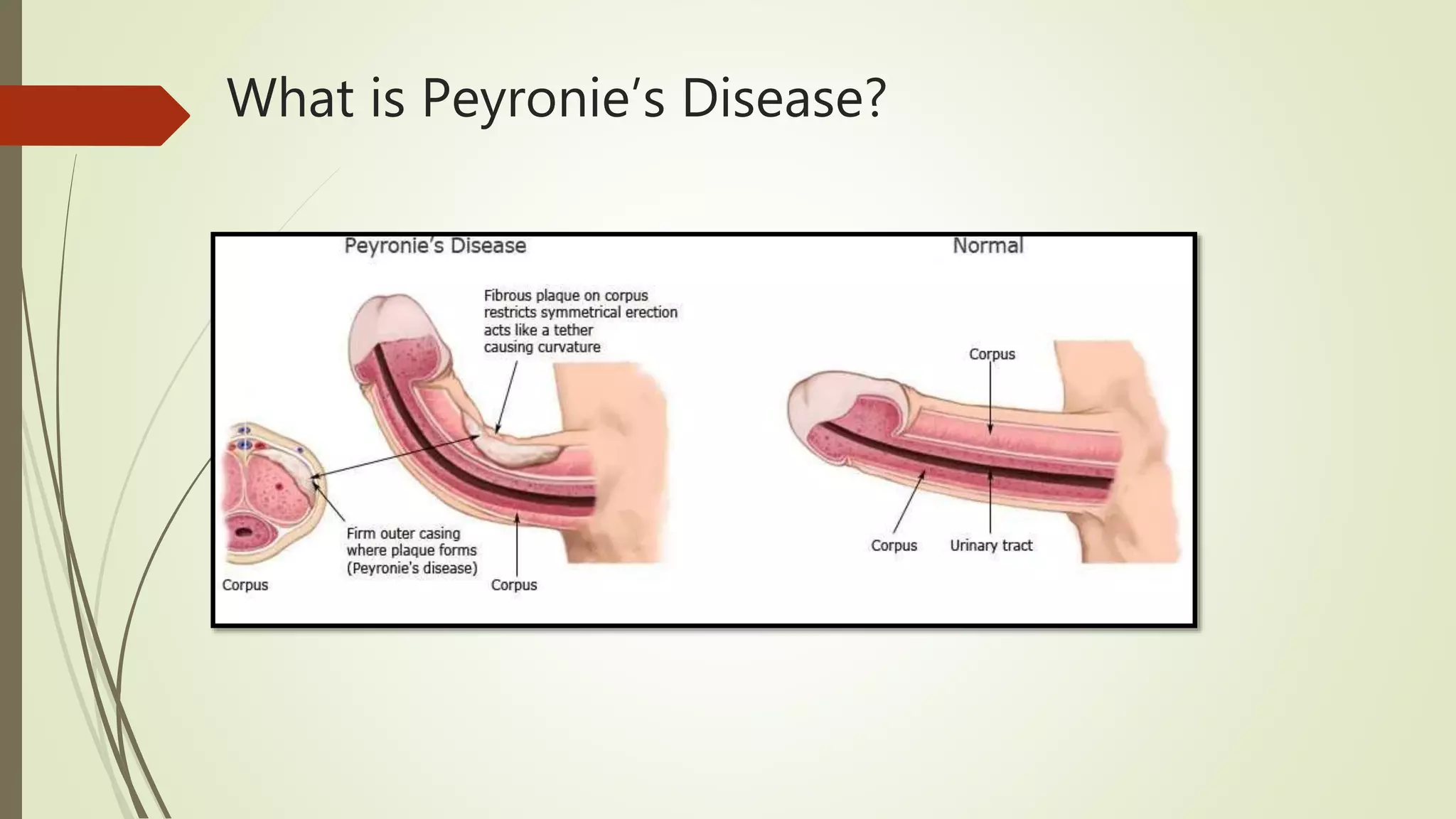
What is Peyronie’s Disease?
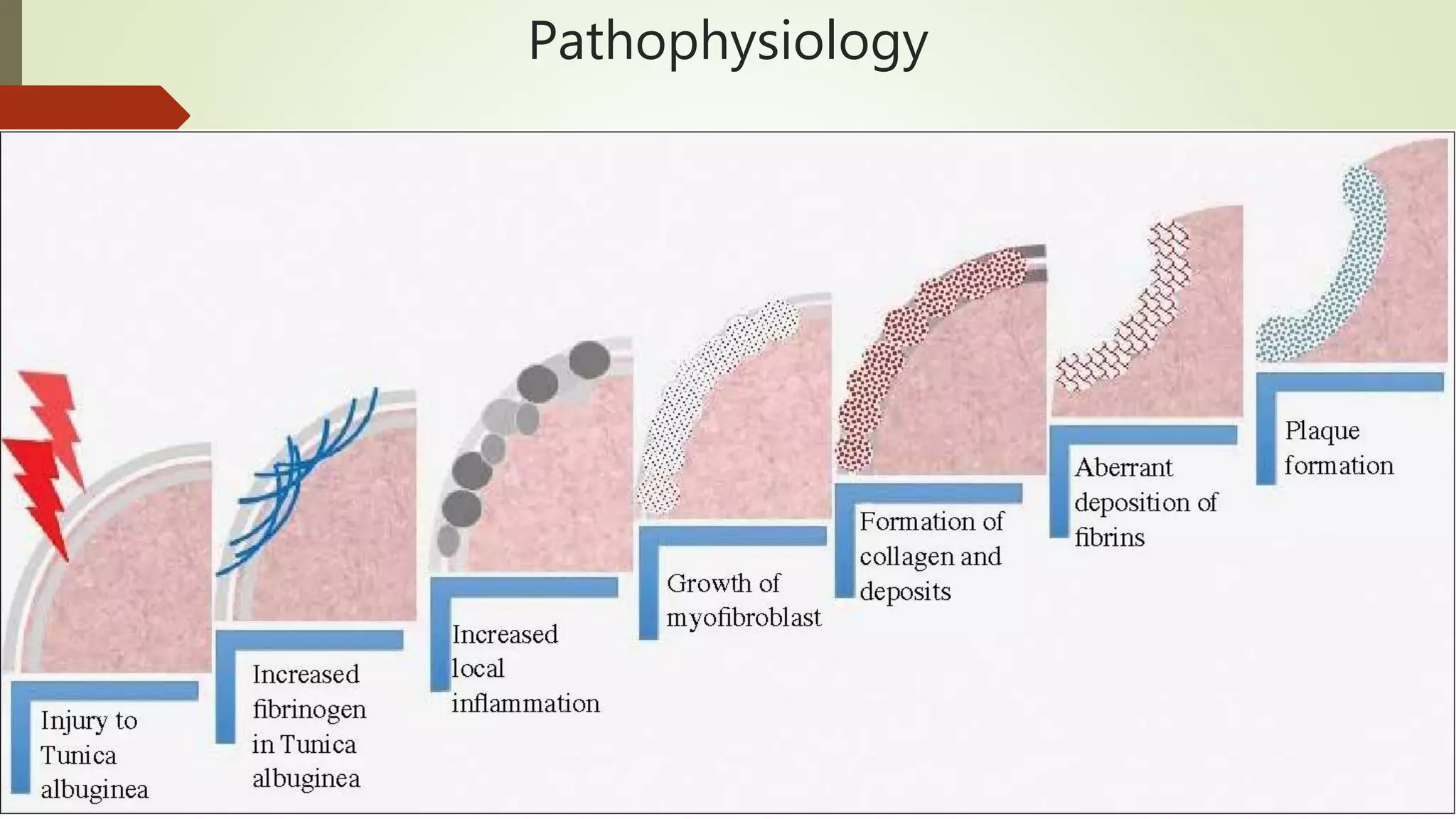
Pathophysiology
Signs & Symptoms
The curvature and penile shortening associated with Peyronie's disease might gradually worsen. At
some point, however, the condition typically stabilizes after three to 12 months or so.
Causes and risk factor for Peyronie’s
disease?
Stages of the
disease
Chronic
Other Factors
 Not all men who suffer mild trauma to the penis get Peyronie's disease. For this
reason, most researchers believe there must be genetic or environmental reasons
Peyronie's disease plaques form. Men with certain connective tissue disorders
(such as Dupuytren's contractures or tympanosclerosis) and men who have a
close family member with Peyronie's disease have a greater risk of getting it.
 Certain health issues, such as
 High blood sugar
 Tobacco use, or
 Past pelvic trauma,
 may also lead to wound healing problems and may help cause Peyronie's disease.
Diagnosis
 A physical exam is often sufficient to identify the presence of scar tissue in the penis and
diagnose Peyronie's disease. Rarely, other conditions cause similar symptoms and need to be
ruled out.
 Tests to diagnose Peyronie's disease and understand exactly what's causing your symptoms
might include the following:
• Physical exam.
• Other tests. Your doctor might order an ultrasound or other tests to examine your penis when
it's erect. Before testing, you'll likely receive an injection directly into the penis that causes it to
become erect.
• Ultrasound is the most commonly used test for penis abnormalities. Ultrasound tests
use sound waves to produce images of soft tissues. These tests can show the presence of
scar tissue, blood flow to the penis and any other abnormalities.
Treatment
 Treatment recommendations for Peyronie's disease depend on how long it's been since you
began having symptoms.
 For the acute phase of the disease, treatments range from:
• Recommended. When used early in the disease process, penile traction therapy prevents
length loss and minimizes the extent of curvature that occurs.
• Optional. Medical and injection therapies are optional in this phase, with some more effective
than others.
• Not recommended. Surgery isn't recommended until the disease stabilizes, to avoid the need
for repeat surgery.
Treatment
 For the chronic phase of the disease, several potential treatments are available. They may
be done alone or in combination:
• Watchful waiting
• Injection treatments
• Traction therapy
• Surgery
 Oral medications aren't recommended in the chronic phase, as they haven't been shown to be
effective at this stage of the disease. Shock wave therapy, stem cells and platelet-rich plasma
also haven't been shown to be effective in human studies.
Surgery
 Surgery usually isn't recommended until you've had the condition for nine to 12 months and
the curvature of your penis stops increasing and stabilizes for at least three to six months.
Plication of the Penis Graft Repair of Penis
Traction Therapy
Thank you for your attention!
References :
 https://www.mayoclinic.org/diseases-conditions/peyronies-disease/diagnosis-
treatment/drc-20353473
 https://www.urologyhealth.org/urology-a-z/p/peyronies-disease
 https://www.hopkinsmedicine.org/health/conditions-and-diseases/dupuytrens-
contracture#:~:text=Dupuytren's%20contracture%20(also%20called%20Dupuytren'
s,or%20in%20toward%20your%20palm.

Peyronie’s disease01

  • 1.
  • 2.
  • 3.
  • 4.
  • 5.
    Signs & Symptoms Thecurvature and penile shortening associated with Peyronie's disease might gradually worsen. At some point, however, the condition typically stabilizes after three to 12 months or so.
  • 6.
    Causes and riskfactor for Peyronie’s disease? Stages of the disease Chronic
  • 7.
    Other Factors  Notall men who suffer mild trauma to the penis get Peyronie's disease. For this reason, most researchers believe there must be genetic or environmental reasons Peyronie's disease plaques form. Men with certain connective tissue disorders (such as Dupuytren's contractures or tympanosclerosis) and men who have a close family member with Peyronie's disease have a greater risk of getting it.  Certain health issues, such as  High blood sugar  Tobacco use, or  Past pelvic trauma,  may also lead to wound healing problems and may help cause Peyronie's disease.
  • 8.
    Diagnosis  A physicalexam is often sufficient to identify the presence of scar tissue in the penis and diagnose Peyronie's disease. Rarely, other conditions cause similar symptoms and need to be ruled out.  Tests to diagnose Peyronie's disease and understand exactly what's causing your symptoms might include the following: • Physical exam. • Other tests. Your doctor might order an ultrasound or other tests to examine your penis when it's erect. Before testing, you'll likely receive an injection directly into the penis that causes it to become erect. • Ultrasound is the most commonly used test for penis abnormalities. Ultrasound tests use sound waves to produce images of soft tissues. These tests can show the presence of scar tissue, blood flow to the penis and any other abnormalities.
  • 9.
    Treatment  Treatment recommendationsfor Peyronie's disease depend on how long it's been since you began having symptoms.  For the acute phase of the disease, treatments range from: • Recommended. When used early in the disease process, penile traction therapy prevents length loss and minimizes the extent of curvature that occurs. • Optional. Medical and injection therapies are optional in this phase, with some more effective than others. • Not recommended. Surgery isn't recommended until the disease stabilizes, to avoid the need for repeat surgery.
  • 10.
    Treatment  For thechronic phase of the disease, several potential treatments are available. They may be done alone or in combination: • Watchful waiting • Injection treatments • Traction therapy • Surgery  Oral medications aren't recommended in the chronic phase, as they haven't been shown to be effective at this stage of the disease. Shock wave therapy, stem cells and platelet-rich plasma also haven't been shown to be effective in human studies.
  • 11.
    Surgery  Surgery usuallyisn't recommended until you've had the condition for nine to 12 months and the curvature of your penis stops increasing and stabilizes for at least three to six months. Plication of the Penis Graft Repair of Penis
  • 12.
  • 13.
    Thank you foryour attention! References :  https://www.mayoclinic.org/diseases-conditions/peyronies-disease/diagnosis- treatment/drc-20353473  https://www.urologyhealth.org/urology-a-z/p/peyronies-disease  https://www.hopkinsmedicine.org/health/conditions-and-diseases/dupuytrens- contracture#:~:text=Dupuytren's%20contracture%20(also%20called%20Dupuytren' s,or%20in%20toward%20your%20palm.