Petroleum and its occurrences in Rajasthan
Kunwar Shruten Chauhan
Department of Geology
University of Rajasthan
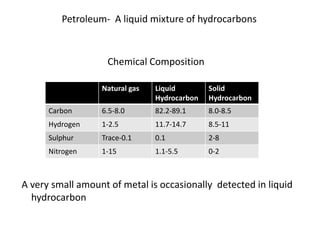
Chemical Composition
A very small amount of metal is occasionally detected in liquid
hydrocarbon
Natural gas Liquid
Hydrocarbon
Solid
Hydrocarbon
Carbon 6.5-8.0 82.2-89.1 8.0-8.5
Hydrogen 1-2.5 11.7-14.7 8.5-11
Sulphur Trace-0.1 0.1 2-8
Nitrogen 1-15 1.1-5.5 0-2
Petroleum- A liquid mixture of hydrocarbons
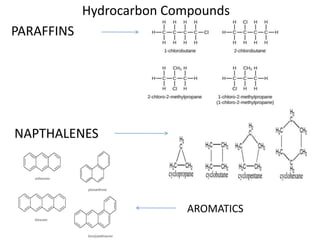
Hydrocarbon Compounds
PARAFFINS
NAPTHALENES
AROMATICS
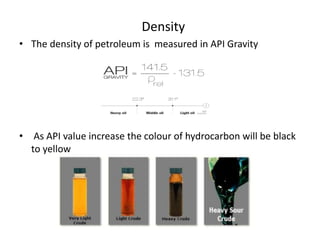
Density
• The density of petroleum is measured in API Gravity
• As API value increase the colour of hydrocarbon will be black
to yellow
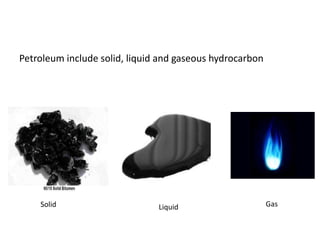
Petroleum include solid, liquid and gaseous hydrocarbon
Solid Liquid Gas
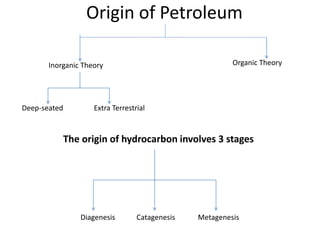
Origin of Petroleum
Inorganic Theory Organic Theory
Deep-seated Extra Terrestrial
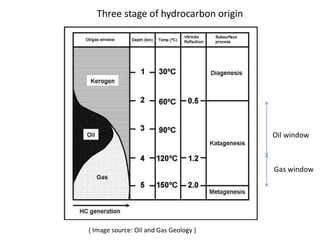
The origin of hydrocarbon involves 3 stages
Catagenesis MetagenesisDiagenesis
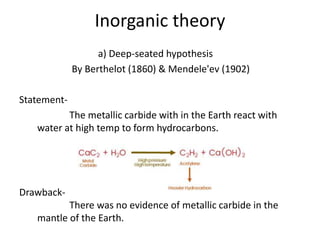
Inorganic theory
a) Deep-seated hypothesis
By Berthelot (1860) & Mendele'ev (1902)
Statement-
The metallic carbide with in the Earth react with
water at high temp to form hydrocarbons.
Drawback-
There was no evidence of metallic carbide in the
mantle of the Earth.
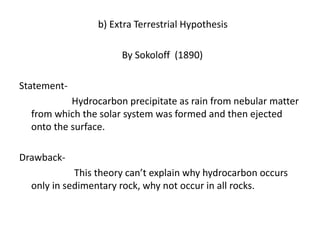
b) Extra Terrestrial Hypothesis
By Sokoloff (1890)
Statement-
Hydrocarbon precipitate as rain from nebular matter
from which the solar system was formed and then ejected
onto the surface.
Drawback-
This theory can’t explain why hydrocarbon occurs
only in sedimentary rock, why not occur in all rocks.
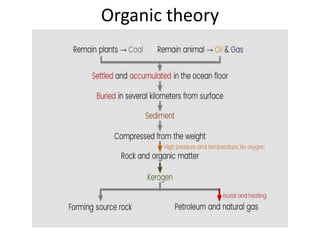
Organic theory
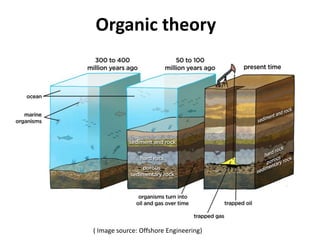
Organic theory
( Image source: Offshore Engineering)
Three stage of hydrocarbon origin
Oil window
Gas window
( Image source: Oil and Gas Geology )
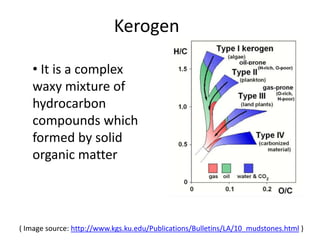
Kerogen
• It is a complex
waxy mixture of
hydrocarbon
compounds which
formed by solid
organic matter
( Image source: http://www.kgs.ku.edu/Publications/Bulletins/LA/10_mudstones.html )
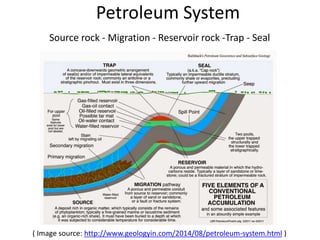
Petroleum System
Source rock - Migration - Reservoir rock -Trap - Seal
( Image source: http://www.geologyin.com/2014/08/petroleum-system.html )
Indian occurrences
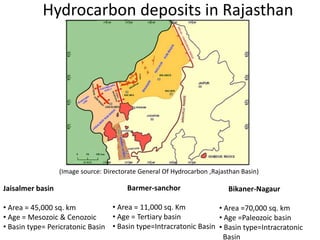
Hydrocarbon deposits in Rajasthan
Jaisalmer basin
• Area = 45,000 sq. km
• Age = Mesozoic & Cenozoic
• Basin type= Pericratonic Basin
Barmer-sanchor
• Area = 11,000 sq. Km
• Age = Tertiary basin
• Basin type=Intracratonic Basin
Bikaner-Nagaur
• Area =70,000 sq. km
• Age =Paleozoic basin
• Basin type=Intracratonic
Basin
(Image source: Directorate General Of Hydrocarbon ,Rajasthan Basin)
• Rajasthan basin is discovered in 1967
• The commercial production of oil and gas was started in
2009 from Barmer-Sachore Basin
• In Rajasthan, total 990 wells were drilled till May 2018
• Out of which 783 wells in District Barmer & Jalore
• 207 wells in Districts Jaisalmer, Ganganagar & Bikaner
• 38 Oil & Gas fields discovered in Barmer-Sanchore Basin
Hydrocarbon deposits in Rajasthan
Mangla Oil field
• Mangla Oil discovery is the one of the biggest on-
land discovery of the country in last two decades.
• At present oil produced mainly from Mangala,
Bhagyam, Aishwariya, Raageshwari and Saraswati
fields.
• 16 separate oil and gas fields of which the majority of
the reserves are located in the three fields of
Mangala, Bhagyam and Aishwariya.
Most Recent discoveries
• Oil and gas discoveries in Madhya Pradesh and West Bengal
• Gas deposits in Vindhyan basin in Madhya Pradesh
• In Ashok Nagar of 24 Parganas district in West Bengal
• Kutch offshore
Reference
• Bjørlykke K. (2015) Petroleum Geoscience: From Sedimentary
Environments to Rock Physics, 2nd edition, Heidelberg New York
Dordrecht London, Springer.
• Leverson A.L. (1956) Geology of Petroleum, W. H. Freeman & Co.
• e pathshala website:https://epgp.inflibnet.ac.in/
• Directorate of Petroleum website:
http://petroleum.rajasthan.gov.in/landmark-development.htm
• Directorate General of Hydrocarbons (DGH) website:
• http://www.infraline.com/ong/Upstream/NELP-
VII/Rajasthan_Basin_NELP_VII.pdf
• Cairn India Website: www.cairnindia.com/our-business/rajasthan
Thank you

Petroleum ( Hydrocarbon )

  • 1.
    Petroleum and itsoccurrences in Rajasthan Kunwar Shruten Chauhan Department of Geology University of Rajasthan
  • 2.
    Chemical Composition A verysmall amount of metal is occasionally detected in liquid hydrocarbon Natural gas Liquid Hydrocarbon Solid Hydrocarbon Carbon 6.5-8.0 82.2-89.1 8.0-8.5 Hydrogen 1-2.5 11.7-14.7 8.5-11 Sulphur Trace-0.1 0.1 2-8 Nitrogen 1-15 1.1-5.5 0-2 Petroleum- A liquid mixture of hydrocarbons
  • 3.
  • 4.
    Density • The densityof petroleum is measured in API Gravity • As API value increase the colour of hydrocarbon will be black to yellow
  • 5.
    Petroleum include solid,liquid and gaseous hydrocarbon Solid Liquid Gas
  • 6.
    Origin of Petroleum InorganicTheory Organic Theory Deep-seated Extra Terrestrial The origin of hydrocarbon involves 3 stages Catagenesis MetagenesisDiagenesis
  • 7.
    Inorganic theory a) Deep-seatedhypothesis By Berthelot (1860) & Mendele'ev (1902) Statement- The metallic carbide with in the Earth react with water at high temp to form hydrocarbons. Drawback- There was no evidence of metallic carbide in the mantle of the Earth.
  • 8.
    b) Extra TerrestrialHypothesis By Sokoloff (1890) Statement- Hydrocarbon precipitate as rain from nebular matter from which the solar system was formed and then ejected onto the surface. Drawback- This theory can’t explain why hydrocarbon occurs only in sedimentary rock, why not occur in all rocks.
  • 9.
  • 10.
    Organic theory ( Imagesource: Offshore Engineering)
  • 11.
    Three stage ofhydrocarbon origin Oil window Gas window ( Image source: Oil and Gas Geology )
  • 12.
    Kerogen • It isa complex waxy mixture of hydrocarbon compounds which formed by solid organic matter ( Image source: http://www.kgs.ku.edu/Publications/Bulletins/LA/10_mudstones.html )
  • 13.
    Petroleum System Source rock- Migration - Reservoir rock -Trap - Seal ( Image source: http://www.geologyin.com/2014/08/petroleum-system.html )
  • 14.
  • 15.
    Hydrocarbon deposits inRajasthan Jaisalmer basin • Area = 45,000 sq. km • Age = Mesozoic & Cenozoic • Basin type= Pericratonic Basin Barmer-sanchor • Area = 11,000 sq. Km • Age = Tertiary basin • Basin type=Intracratonic Basin Bikaner-Nagaur • Area =70,000 sq. km • Age =Paleozoic basin • Basin type=Intracratonic Basin (Image source: Directorate General Of Hydrocarbon ,Rajasthan Basin)
  • 16.
    • Rajasthan basinis discovered in 1967 • The commercial production of oil and gas was started in 2009 from Barmer-Sachore Basin • In Rajasthan, total 990 wells were drilled till May 2018 • Out of which 783 wells in District Barmer & Jalore • 207 wells in Districts Jaisalmer, Ganganagar & Bikaner • 38 Oil & Gas fields discovered in Barmer-Sanchore Basin Hydrocarbon deposits in Rajasthan
  • 17.
    Mangla Oil field •Mangla Oil discovery is the one of the biggest on- land discovery of the country in last two decades. • At present oil produced mainly from Mangala, Bhagyam, Aishwariya, Raageshwari and Saraswati fields. • 16 separate oil and gas fields of which the majority of the reserves are located in the three fields of Mangala, Bhagyam and Aishwariya.
  • 18.
    Most Recent discoveries •Oil and gas discoveries in Madhya Pradesh and West Bengal • Gas deposits in Vindhyan basin in Madhya Pradesh • In Ashok Nagar of 24 Parganas district in West Bengal • Kutch offshore
  • 19.
    Reference • Bjørlykke K.(2015) Petroleum Geoscience: From Sedimentary Environments to Rock Physics, 2nd edition, Heidelberg New York Dordrecht London, Springer. • Leverson A.L. (1956) Geology of Petroleum, W. H. Freeman & Co. • e pathshala website:https://epgp.inflibnet.ac.in/ • Directorate of Petroleum website: http://petroleum.rajasthan.gov.in/landmark-development.htm • Directorate General of Hydrocarbons (DGH) website: • http://www.infraline.com/ong/Upstream/NELP- VII/Rajasthan_Basin_NELP_VII.pdf • Cairn India Website: www.cairnindia.com/our-business/rajasthan
  • 20.