Laura Mª Corps Ricardo. 2ºD.
Sandra Mora Carrascoso. 2ºD.
Yara Romero del Hombrebueno Gómez del
Pulgar. 2ºC.
OIL
 An homogenous mix of organic components, mainly
  hydrocarbons insoluble in water.

 It is formed by the deposition of zooplacton and algae
  over millions of years in layers of the bottom of the
  ocean without oxygen mixed with mud.

 It replaces coal in the 20th century.

 It’s a non-renewable resource of energy.
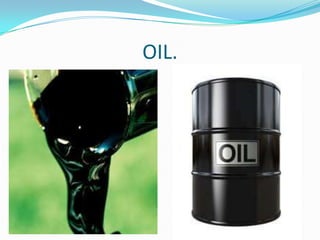
OIL.
OIL
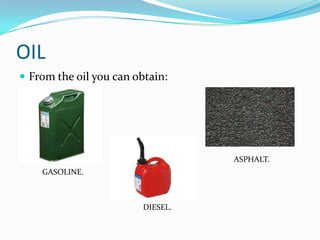
 From the oil you can obtain:


                                   ASPHALT.
    GASOLINE.


                         DIESEL.
OIL-ENERGY.
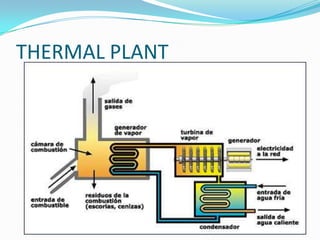
 The oil can be transformed into energy by the
 combustion of the oil.

 Then when the oil is hot it heats water that transform
 into vapour moving turbines.

 All of this things and more occur in a thermal plant.
REFINERY & THERMAL PLANT.
 They are a type of factory where the crude oil is
  transformed into diesel and gasoline, then they are
  burn to be transformed into energy.
 The steps are:


 PETROLEUM PLANT - OIL TANKERS – REFINERY –
 LORRY – THERMNAL PLANT – THE VAPUOR
 MOVES THE TURBINES – GENERATOR –
 TRANSFORMER – PYLON – TRANSFORMER -
 HOUSE – SWITCH – BULB.
THERMAL PLANT
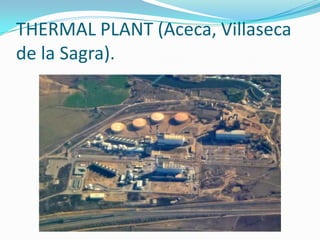
THERMAL PLANT (Aceca, Villaseca
de la Sagra).
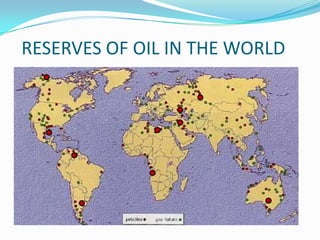
RESERVES OF OIL IN THE WORLD
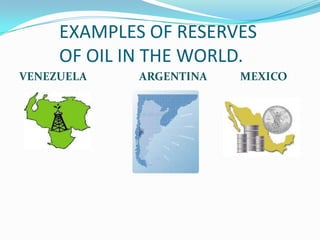
EXAMPLES OF RESERVES
     OF OIL IN THE WORLD.
VENEZUELA    ARGENTINA   MEXICO
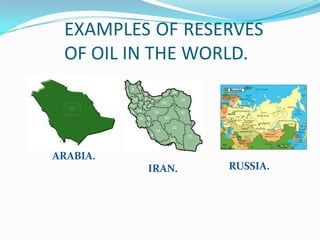
EXAMPLES OF RESERVES
 OF OIL IN THE WORLD.


ARABIA.
          IRAN.   RUSSIA.
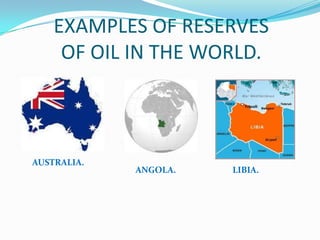
EXAMPLES OF RESERVES
     OF OIL IN THE WORLD.


AUSTRALIA.
             ANGOLA.   LIBIA.
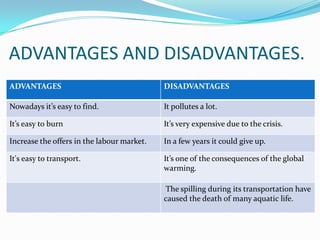
ADVANTAGES AND DISADVANTAGES.
ADVANTAGES                                  DISADVANTAGES

Nowadays it’s easy to find.                 It pollutes a lot.

It’s easy to burn                           It’s very expensive due to the crisis.

Increase the offers in the labour market.   In a few years it could give up.

It's easy to transport.                     It’s one of the consequences of the global
                                            warming.

                                            The spilling during its transportation have
                                            caused the death of many aquatic life.
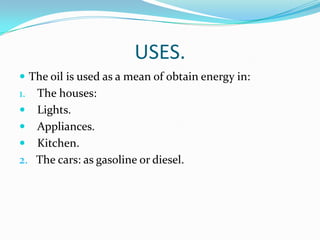
USES.
 The oil is used as a mean of obtain energy in:
1.   The houses:
    Lights.
    Appliances.
    Kitchen.
2.   The cars: as gasoline or diesel.
VIDEO.


http://www.youtube.com/watch?v=-EkM6B-
  mIBQ&feature=related
Petroleo

Petroleo

  • 1.
    Laura Mª CorpsRicardo. 2ºD. Sandra Mora Carrascoso. 2ºD. Yara Romero del Hombrebueno Gómez del Pulgar. 2ºC.
  • 2.
    OIL  An homogenousmix of organic components, mainly hydrocarbons insoluble in water.  It is formed by the deposition of zooplacton and algae over millions of years in layers of the bottom of the ocean without oxygen mixed with mud.  It replaces coal in the 20th century.  It’s a non-renewable resource of energy.
  • 3.
  • 4.
    OIL  From theoil you can obtain: ASPHALT. GASOLINE. DIESEL.
  • 5.
    OIL-ENERGY.  The oilcan be transformed into energy by the combustion of the oil.  Then when the oil is hot it heats water that transform into vapour moving turbines.  All of this things and more occur in a thermal plant.
  • 6.
    REFINERY & THERMALPLANT.  They are a type of factory where the crude oil is transformed into diesel and gasoline, then they are burn to be transformed into energy.  The steps are: PETROLEUM PLANT - OIL TANKERS – REFINERY – LORRY – THERMNAL PLANT – THE VAPUOR MOVES THE TURBINES – GENERATOR – TRANSFORMER – PYLON – TRANSFORMER - HOUSE – SWITCH – BULB.
  • 7.
  • 8.
    THERMAL PLANT (Aceca,Villaseca de la Sagra).
  • 9.
    RESERVES OF OILIN THE WORLD
  • 10.
    EXAMPLES OF RESERVES OF OIL IN THE WORLD. VENEZUELA ARGENTINA MEXICO
  • 11.
    EXAMPLES OF RESERVES OF OIL IN THE WORLD. ARABIA. IRAN. RUSSIA.
  • 12.
    EXAMPLES OF RESERVES OF OIL IN THE WORLD. AUSTRALIA. ANGOLA. LIBIA.
  • 13.
    ADVANTAGES AND DISADVANTAGES. ADVANTAGES DISADVANTAGES Nowadays it’s easy to find. It pollutes a lot. It’s easy to burn It’s very expensive due to the crisis. Increase the offers in the labour market. In a few years it could give up. It's easy to transport. It’s one of the consequences of the global warming. The spilling during its transportation have caused the death of many aquatic life.
  • 14.
    USES.  The oilis used as a mean of obtain energy in: 1. The houses:  Lights.  Appliances.  Kitchen. 2. The cars: as gasoline or diesel.
  • 15.