Creating a Sustainable Built Environment through
Education and Collaboration
University of Ulster: 8th May 2013
The Importance of Collaboration in Achieving Sustainable
Development
Professor Peter Roberts
Vice Chairman
Northern Ireland Housing Executive
Introduction and Structure
• There is little really new about sustainable
development in terms of fundamentals
• Essential to define sustainable development at
the outset:
• What is it?
• What can it achieve?
• What form will it take?
• How can it be implemented?
• How to translate sustainable development through a
place-based approach
• Sectoral and spatial dimensions
• Actions and resources
• The Sustainable Communities model
• Institutions, actors and individuals – inter and intra-
organisation dimensions
• Partnership and collaboration
• Some case study illustrations
• Summary and conclusions
Sustainable Development: Antecedents
• This is an idea and an ideal with a long history.
• Ebenezer Howard’s “social city” encapsulated many of
the elements of sustainable development, such as
“pro-municipal work” in order to develop and
implement what we now call sustainable places.
• Patrick Geddes viewed the city as a product of the
interaction between “nature”
(environment), “economics” and “the people” (society)
articulated through civic education and active
engagement.
• Artur Glikson’s term “human environment”
described what he called “the space which
surrounds human
movement, work, habitation, rest and
interaction”.
• By the 1960’s these items were beginning to
be seen as important in the wider debates on
development and growth and the limits to
growth – the Club of Rome report was very
influential in framing the subsequent debate.
Sustainable Development: Definition
• There are many definitions (or interpretations)
of sustainable development, but the only
universally accepted one is Brundtland’s
“development that meets the needs of the
present without compromising the ability of
future generations to meet their own needs”
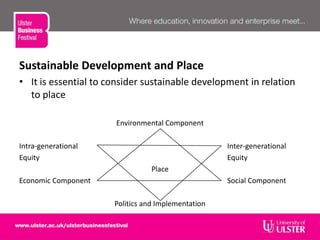
• This definition has three primary components:
• Environmental
• Social
• Economic
• And two elements of application:
• Intra-generational equity
• Inter-generational equity
• In considering the application of these
components and elements it is also essential
to consider politics and implementation
Sustainable Development: Key Considerations
• What is it? – it is the integrated consideration of the
environmental, social and economic dimensions of
development – this is essential in order to avoid
creating inequity or undesired “burdens”
• What can it achieve? – through a comprehensive and
integrated approach the intended outcome is an
informed and understood “balanced” decision which
reflects immediate and long-term considerations
• What form will it take: - whatever form is desired and
appropriate eg. a sectoral action, a city strategy, an
investment programme – the very essence of
sustainable development is that there is no “one-
size-fits-all”, but there are guiding principles and
shared objectives.
• How can it be implemented? – through applying the
principles and shared objectives to individual
decisions as well as strategies and long-term plans.
Sustainable Development and Place
• It is essential to consider sustainable development in relation
to place
Environmental Component
Intra-generational Inter-generational
Equity Equity
Place
Economic Component Social Component
Politics and Implementation
A Place-Based Approach
• This is the essence of a sustainable built environment
• Three main aspects and considerations:
• It is essential to intermesh spatial and sectoral dimensions through
the development and implementation of strategies
• But strategy alone will not deliver a sustainable built
environment, it is also essential to align actions and resources
• The above considerations have driven the development of the
Sustainable Communities approach – this is sustainable
development for places
Sustainable Communities
• A whole of place, whole of time, whole of community
approach that works across sectors and between places:
• Sustainable Communities model has eight basic components:
 Active, inclusive and safe
 Well run
 Environmentally sensitive
 Well designed and built
 Well connected
 Thriving
 Well served
 Fair for everyone
 And an extra essential component - placemaking
• By definition, the Sustainable Communities
model involves a wide range of people and
organisations collaborating through formal
partnerships and territorial coalitions
Institutions, Actors and Individuals
• Important to consider both inter-institutional
and intra-institutional elements – in large
public (or private) organisations different
departments don’t always collaborate
• Actors in the built environment range from
major public and private bodies to small
community-based organisations and
individuals – they all have a legitimate “voice”
• Essential to consider the role of the individual as a
citizen and as a stakeholder – the role of individuals
is frequently ignored by professionals and this can
hinder long-term community “ownership”
• Democratic legitimacy and accountability are
important because interventions in the built
environment frequently involve public interests and
goods – government and governance are essential
considerations in order to ensure that the public
interest is best served
Partnership and Collaboration
• In the past (when funding was readily
available) some partnerships reflected the
“temporary suspension of mutual loathing in
pursuit of public funding”
• But nowadays partnerships and collaborations
have to be much more meaningful, deeper
and permanent, but they don’t have to be
legal or formal entities
• Some key characteristics of partnership and collaboration:
 Need for strategic agreement, plan and objectives – these create
certainty and confidence
 Role of rules of engagement – equal partners and the allocation of
responsibilities
 Belonging is as important as leading – shared leadership helps with
delivery and generating trust
 Data and resource pooling – immediate and succession planning are
equally important
 Short-term structures and long-term capacity building – area-
based, multi-purpose collaboration works best
 Need to go beyond short-term professional intervention in order to
ensure long-term management
Some case study illustrations 1
• These are illustrations and reflect the
principles and good practice of collaboration –
they are NOT “one-size-fits-all” models
• Beautiful North – “not an organisation – a
movement”
North Liverpool – an area subject to a massive
range of environment interventions over a fifty
year period
Most recently an abandoned Housing Market Renewal
Area programme –
voids, abandonment, dereliction, deprivation, degraded
environment and social distress
Wide collaboration – Liverpool City Council, Liverpool
Housing Trust, Merseyside Police, Everton FC, Liverpool
FC, Aurora Media, Liverpool Mutual Homes, Plus
Dane, Tesco and many more
Ten principles – delivery led, collaboration not
competition, willing partners, mandated leaders, asks and
offers, participation not consultation, multi-agency
teams, no budget, positive place marketing, less on
running and more on doing
Some Case Study Illustrations 2
• Stewartstown Road Project – not just a
partnership but a coming together of
opposing communities
West Belfast – an interface area subject to
distrust, violence and confrontation
Initial joint working between Northern Ireland
Housing Executive and Suffolk Community Forum,
this then extended to Lenadoon Community
Forum and also involved Belfast Interface Project
Extensive collaboration – both community forums,
Belfast City Council, NIHE, International Fund for
Ireland, EU Peace Fund, Lidl, Mivan Development
and others
Principles of working – regenerate and revitalise,
create and manage an attractive and vibrant
environment, generate a secure place, enhance
social and economic development, provide
commercial and retail facilities, promote cross-
community working and trust, equal partners
Some Case Study Illustrations 3
• Resurgam Trust – a development trust that embraces
community and other partners to deliver youth,
social, economic and physical development.
• Broadly based partnership structure which
encourages collaboration from central and local
government, agencies, community organisations and
others in Lisburn and beyond.
• Engages in regeneration activities including built
environment, social enterprise, training, wellbeing,
youth, senior citizen, children and families and other
projects.
• Keen to extend collaboration to include community –
to – community mentoring and support.
Conclusions and Guiding Principles
• Partnership and collaboration have now
become essential elements of the policy and
practice landscape
• In an era of austerity it is even more essential
to collaborate in order to: create a shared
vision, agree actions and outputs, co-ordinate
activities and pool resources – the partnership
is more than the sum of the parts.
Leadership is essential, but this must be
mandated from the grass root and has to be
shared throughout the collaboration.
Collaboration should be about much more than
an individual project or just the built
environment, it should be area-wide, inclusive and
lasting.
Some partners will require time and assistance in
order to develop capacity – this is essential to
ensure effective succession and progression and
can be enhanced through training and mentoring.

Creating a Sustainable Built Environment through Education and Collaboration (Peter Roberts)

  • 1.
    Creating a SustainableBuilt Environment through Education and Collaboration University of Ulster: 8th May 2013 The Importance of Collaboration in Achieving Sustainable Development Professor Peter Roberts Vice Chairman Northern Ireland Housing Executive
  • 2.
    Introduction and Structure •There is little really new about sustainable development in terms of fundamentals • Essential to define sustainable development at the outset: • What is it? • What can it achieve? • What form will it take? • How can it be implemented?
  • 3.
    • How totranslate sustainable development through a place-based approach • Sectoral and spatial dimensions • Actions and resources • The Sustainable Communities model • Institutions, actors and individuals – inter and intra- organisation dimensions • Partnership and collaboration • Some case study illustrations • Summary and conclusions
  • 4.
    Sustainable Development: Antecedents •This is an idea and an ideal with a long history. • Ebenezer Howard’s “social city” encapsulated many of the elements of sustainable development, such as “pro-municipal work” in order to develop and implement what we now call sustainable places. • Patrick Geddes viewed the city as a product of the interaction between “nature” (environment), “economics” and “the people” (society) articulated through civic education and active engagement.
  • 5.
    • Artur Glikson’sterm “human environment” described what he called “the space which surrounds human movement, work, habitation, rest and interaction”. • By the 1960’s these items were beginning to be seen as important in the wider debates on development and growth and the limits to growth – the Club of Rome report was very influential in framing the subsequent debate.
  • 6.
    Sustainable Development: Definition •There are many definitions (or interpretations) of sustainable development, but the only universally accepted one is Brundtland’s “development that meets the needs of the present without compromising the ability of future generations to meet their own needs”
  • 7.
    • This definitionhas three primary components: • Environmental • Social • Economic • And two elements of application: • Intra-generational equity • Inter-generational equity • In considering the application of these components and elements it is also essential to consider politics and implementation
  • 8.
    Sustainable Development: KeyConsiderations • What is it? – it is the integrated consideration of the environmental, social and economic dimensions of development – this is essential in order to avoid creating inequity or undesired “burdens” • What can it achieve? – through a comprehensive and integrated approach the intended outcome is an informed and understood “balanced” decision which reflects immediate and long-term considerations
  • 9.
    • What formwill it take: - whatever form is desired and appropriate eg. a sectoral action, a city strategy, an investment programme – the very essence of sustainable development is that there is no “one- size-fits-all”, but there are guiding principles and shared objectives. • How can it be implemented? – through applying the principles and shared objectives to individual decisions as well as strategies and long-term plans.
  • 10.
    Sustainable Development andPlace • It is essential to consider sustainable development in relation to place Environmental Component Intra-generational Inter-generational Equity Equity Place Economic Component Social Component Politics and Implementation
  • 11.
    A Place-Based Approach •This is the essence of a sustainable built environment • Three main aspects and considerations: • It is essential to intermesh spatial and sectoral dimensions through the development and implementation of strategies • But strategy alone will not deliver a sustainable built environment, it is also essential to align actions and resources • The above considerations have driven the development of the Sustainable Communities approach – this is sustainable development for places
  • 12.
    Sustainable Communities • Awhole of place, whole of time, whole of community approach that works across sectors and between places: • Sustainable Communities model has eight basic components:  Active, inclusive and safe  Well run  Environmentally sensitive  Well designed and built  Well connected  Thriving  Well served  Fair for everyone  And an extra essential component - placemaking
  • 13.
    • By definition,the Sustainable Communities model involves a wide range of people and organisations collaborating through formal partnerships and territorial coalitions
  • 14.
    Institutions, Actors andIndividuals • Important to consider both inter-institutional and intra-institutional elements – in large public (or private) organisations different departments don’t always collaborate • Actors in the built environment range from major public and private bodies to small community-based organisations and individuals – they all have a legitimate “voice”
  • 15.
    • Essential toconsider the role of the individual as a citizen and as a stakeholder – the role of individuals is frequently ignored by professionals and this can hinder long-term community “ownership” • Democratic legitimacy and accountability are important because interventions in the built environment frequently involve public interests and goods – government and governance are essential considerations in order to ensure that the public interest is best served
  • 16.
    Partnership and Collaboration •In the past (when funding was readily available) some partnerships reflected the “temporary suspension of mutual loathing in pursuit of public funding” • But nowadays partnerships and collaborations have to be much more meaningful, deeper and permanent, but they don’t have to be legal or formal entities
  • 17.
    • Some keycharacteristics of partnership and collaboration:  Need for strategic agreement, plan and objectives – these create certainty and confidence  Role of rules of engagement – equal partners and the allocation of responsibilities  Belonging is as important as leading – shared leadership helps with delivery and generating trust  Data and resource pooling – immediate and succession planning are equally important  Short-term structures and long-term capacity building – area- based, multi-purpose collaboration works best  Need to go beyond short-term professional intervention in order to ensure long-term management
  • 18.
    Some case studyillustrations 1 • These are illustrations and reflect the principles and good practice of collaboration – they are NOT “one-size-fits-all” models • Beautiful North – “not an organisation – a movement” North Liverpool – an area subject to a massive range of environment interventions over a fifty year period
  • 19.
    Most recently anabandoned Housing Market Renewal Area programme – voids, abandonment, dereliction, deprivation, degraded environment and social distress Wide collaboration – Liverpool City Council, Liverpool Housing Trust, Merseyside Police, Everton FC, Liverpool FC, Aurora Media, Liverpool Mutual Homes, Plus Dane, Tesco and many more Ten principles – delivery led, collaboration not competition, willing partners, mandated leaders, asks and offers, participation not consultation, multi-agency teams, no budget, positive place marketing, less on running and more on doing
  • 20.
    Some Case StudyIllustrations 2 • Stewartstown Road Project – not just a partnership but a coming together of opposing communities West Belfast – an interface area subject to distrust, violence and confrontation Initial joint working between Northern Ireland Housing Executive and Suffolk Community Forum, this then extended to Lenadoon Community Forum and also involved Belfast Interface Project
  • 21.
    Extensive collaboration –both community forums, Belfast City Council, NIHE, International Fund for Ireland, EU Peace Fund, Lidl, Mivan Development and others Principles of working – regenerate and revitalise, create and manage an attractive and vibrant environment, generate a secure place, enhance social and economic development, provide commercial and retail facilities, promote cross- community working and trust, equal partners
  • 22.
    Some Case StudyIllustrations 3 • Resurgam Trust – a development trust that embraces community and other partners to deliver youth, social, economic and physical development. • Broadly based partnership structure which encourages collaboration from central and local government, agencies, community organisations and others in Lisburn and beyond. • Engages in regeneration activities including built environment, social enterprise, training, wellbeing, youth, senior citizen, children and families and other projects. • Keen to extend collaboration to include community – to – community mentoring and support.
  • 23.
    Conclusions and GuidingPrinciples • Partnership and collaboration have now become essential elements of the policy and practice landscape • In an era of austerity it is even more essential to collaborate in order to: create a shared vision, agree actions and outputs, co-ordinate activities and pool resources – the partnership is more than the sum of the parts.
  • 24.
    Leadership is essential,but this must be mandated from the grass root and has to be shared throughout the collaboration. Collaboration should be about much more than an individual project or just the built environment, it should be area-wide, inclusive and lasting. Some partners will require time and assistance in order to develop capacity – this is essential to ensure effective succession and progression and can be enhanced through training and mentoring.