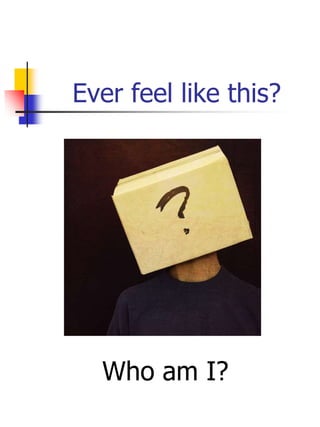
Ever feel like this?
Who am I?
The dreaded question…
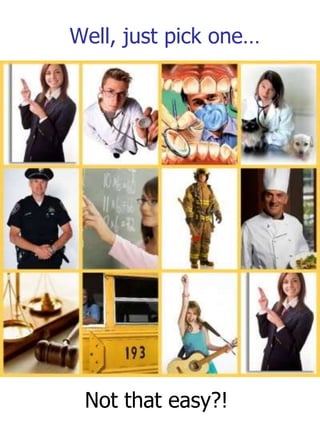
Well, just pick one…
Not that easy?!
Fine… I’ll make it easy for you!
What?!
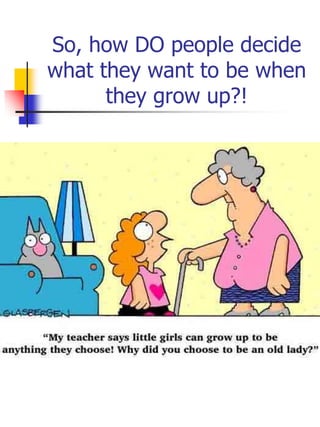
So, how DO people decide
what they want to be when
they grow up?!
As quick as you can!
Don’t over-think these!
“Personality is to a
man what perfume is
to a flower.”
~Charles M. Schwab
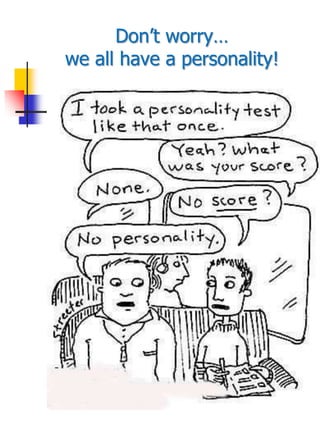
Don’t worry…
we all have a personality!
This mini-assessment
does NOT measure…
 Stress
 Emotions
 Maturity
 Intelligence
 Psychiatric Disturbance
 Career Potential
 Level of Skill
This mini-assessment
DOES tell you about…
 Your PREFERRED way of thinking
and behaving
 Understanding your preferences
can help you…
 Be more successful
 Deal with other people better
 Contribute more to a team
 Reduce stress
 Enjoy work more
 Get more out of your life
This is not about ability or
“being” something or not…
 This is about PREFERENCES!
 Let’s try this to illustrate my point:
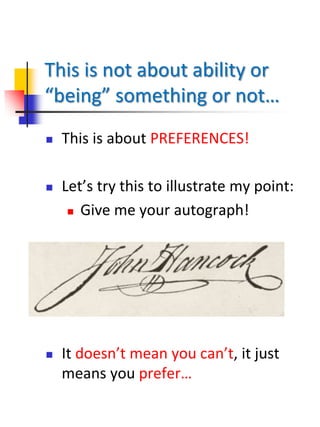
 Give me your autograph!
 It doesn’t mean you can’t, it just
means you prefer…
 The farther to one side or the other (E or I, S or N, etc.) the
more strongly you identify with that letter. It also indicates
that it is harder for you to identify with the opposite letter.
 What if you fall in the middle? This means you are equally
divided between the two and they are of equal strength for
you; the advantage of equal scores is that you can relate
well to both sides, the disadvantage is that it may cause
confusion at times.
 We tend to be attracted to our opposites. We also tend to
least understand our opposites – this is our biggest
challenge!
 If we begin to understand what makes us act, feel, and
make decisions as we do, it possible to know our strengths
and weaknesses.
 If we can understand ourselves – then we can begin to
understand, predict, and appreciate how someone else
may behave and make decisions.
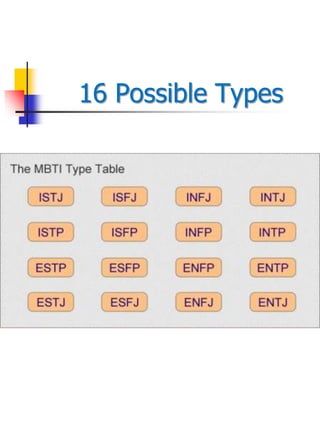
16 Possible Types
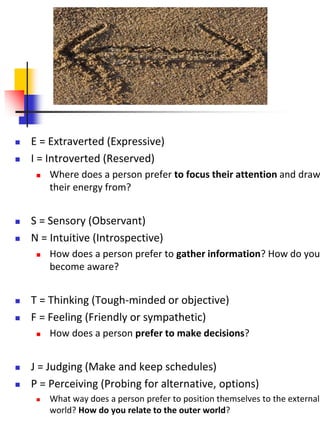
 E = Extraverted (Expressive)
 I = Introverted (Reserved)
 Where does a person prefer to focus their attention and draw
their energy from?
 S = Sensory (Observant)
 N = Intuitive (Introspective)
 How does a person prefer to gather information? How do you
become aware?
 T = Thinking (Tough-minded or objective)
 F = Feeling (Friendly or sympathetic)
 How does a person prefer to make decisions?
 J = Judging (Make and keep schedules)
 P = Perceiving (Probing for alternative, options)
 What way does a person prefer to position themselves to the external
world? How do you relate to the outer world?
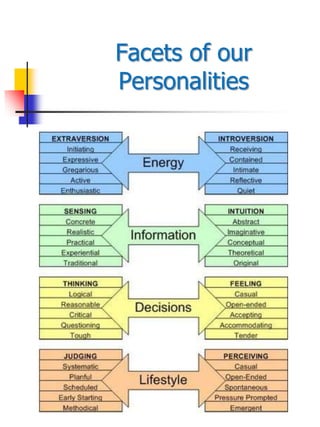
Facets of our
Personalities
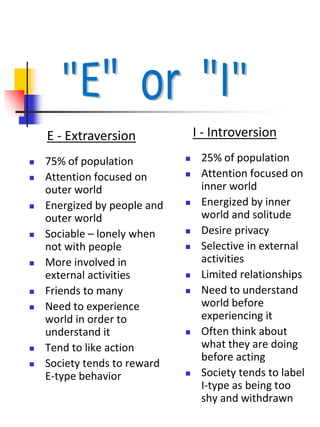
 75% of population
 Attention focused on
outer world
 Energized by people and
outer world
 Sociable – lonely when
not with people
 More involved in
external activities
 Friends to many
 Need to experience
world in order to
understand it
 Tend to like action
 Society tends to reward
E-type behavior
 25% of population
 Attention focused on
inner world
 Energized by inner
world and solitude
 Desire privacy
 Selective in external
activities
 Limited relationships
 Need to understand
world before
experiencing it
 Often think about
what they are doing
before acting
 Society tends to label
I-type as being too
shy and withdrawn
E - Extraversion I - Introversion
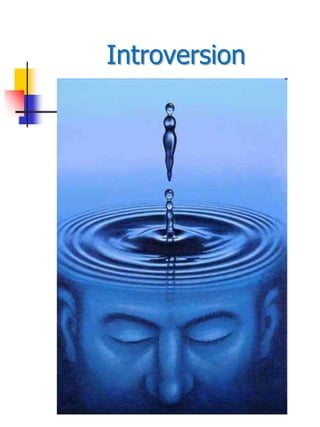
Introversion
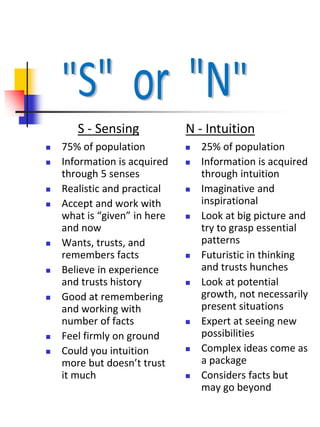
 75% of population
 Information is acquired
through 5 senses
 Realistic and practical
 Accept and work with
what is “given” in here
and now
 Wants, trusts, and
remembers facts
 Believe in experience
and trusts history
 Good at remembering
and working with
number of facts
 Feel firmly on ground
 Could you intuition
more but doesn’t trust
it much
 25% of population
 Information is acquired
through intuition
 Imaginative and
inspirational
 Look at big picture and
try to grasp essential
patterns
 Futuristic in thinking
and trusts hunches
 Look at potential
growth, not necessarily
present situations
 Expert at seeing new
possibilities
 Complex ideas come as
a package
 Considers facts but
may go beyond
S - Sensing N - Intuition
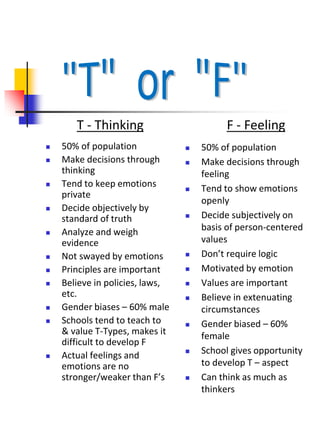
 50% of population
 Make decisions through
thinking
 Tend to keep emotions
private
 Decide objectively by
standard of truth
 Analyze and weigh
evidence
 Not swayed by emotions
 Principles are important
 Believe in policies, laws,
etc.
 Gender biases – 60% male
 Schools tend to teach to
& value T-Types, makes it
difficult to develop F
 Actual feelings and
emotions are no
stronger/weaker than F’s
 50% of population
 Make decisions through
feeling
 Tend to show emotions
openly
 Decide subjectively on
basis of person-centered
values
 Don’t require logic
 Motivated by emotion
 Values are important
 Believe in extenuating
circumstances
 Gender biased – 60%
female
 School gives opportunity
to develop T – aspect
 Can think as much as
thinkers
T - Thinking F - Feeling
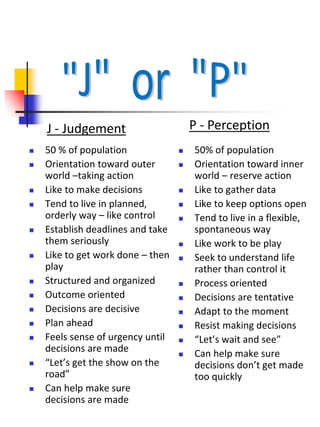
 50 % of population
 Orientation toward outer
world –taking action
 Like to make decisions
 Tend to live in planned,
orderly way – like control
 Establish deadlines and take
them seriously
 Like to get work done – then
play
 Structured and organized
 Outcome oriented
 Decisions are decisive
 Plan ahead
 Feels sense of urgency until
decisions are made
 “Let’s get the show on the
road”
 Can help make sure
decisions are made
 50% of population
 Orientation toward inner
world – reserve action
 Like to gather data
 Like to keep options open
 Tend to live in a flexible,
spontaneous way
 Like work to be play
 Seek to understand life
rather than control it
 Process oriented
 Decisions are tentative
 Adapt to the moment
 Resist making decisions
 “Let’s wait and see”
 Can help make sure
decisions don’t get made
too quickly
J - Judgement P - Perception
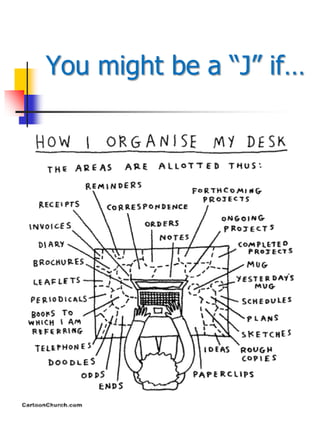
You might be a “J” if…
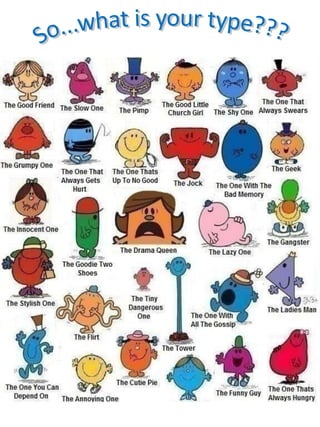
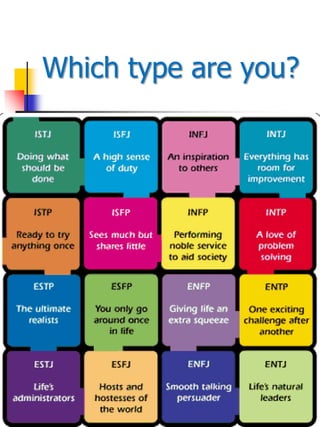
Which type are you?
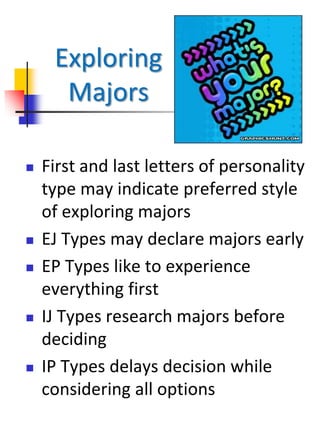
Exploring
Majors
 First and last letters of personality
type may indicate preferred style
of exploring majors
 EJ Types may declare majors early
 EP Types like to experience
everything first
 IJ Types research majors before
deciding
 IP Types delays decision while
considering all options
 Each preference and
each type has its own
gifts and strengths
 It is up to you to decide
whether the results are
accurate
 Type should be used to
understand yourself, not
as an excuse for doing or
not doing something
 This indicates your
preferences, not your
abilities
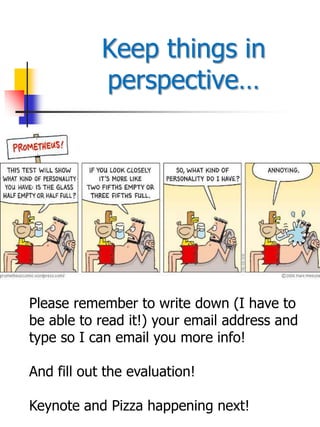
Keep things in
perspective…
Please remember to write down (I have to
be able to read it!) your email address and
type so I can email you more info!
And fill out the evaluation!
Keynote and Pizza happening next!

Personality Presentation for Success Day - SCTCC

  • 2.
    Ever feel likethis? Who am I?
  • 3.
  • 4.
    Well, just pickone… Not that easy?!
  • 5.
    Fine… I’ll makeit easy for you!
  • 6.
  • 7.
    So, how DOpeople decide what they want to be when they grow up?!
  • 8.
    As quick asyou can! Don’t over-think these!
  • 9.
    “Personality is toa man what perfume is to a flower.” ~Charles M. Schwab
  • 10.
    Don’t worry… we allhave a personality!
  • 11.
    This mini-assessment does NOTmeasure…  Stress  Emotions  Maturity  Intelligence  Psychiatric Disturbance  Career Potential  Level of Skill
  • 12.
    This mini-assessment DOES tellyou about…  Your PREFERRED way of thinking and behaving  Understanding your preferences can help you…  Be more successful  Deal with other people better  Contribute more to a team  Reduce stress  Enjoy work more  Get more out of your life
  • 13.
    This is notabout ability or “being” something or not…  This is about PREFERENCES!  Let’s try this to illustrate my point:  Give me your autograph!  It doesn’t mean you can’t, it just means you prefer…
  • 14.
     The fartherto one side or the other (E or I, S or N, etc.) the more strongly you identify with that letter. It also indicates that it is harder for you to identify with the opposite letter.  What if you fall in the middle? This means you are equally divided between the two and they are of equal strength for you; the advantage of equal scores is that you can relate well to both sides, the disadvantage is that it may cause confusion at times.  We tend to be attracted to our opposites. We also tend to least understand our opposites – this is our biggest challenge!  If we begin to understand what makes us act, feel, and make decisions as we do, it possible to know our strengths and weaknesses.  If we can understand ourselves – then we can begin to understand, predict, and appreciate how someone else may behave and make decisions.
  • 16.
  • 17.
     E =Extraverted (Expressive)  I = Introverted (Reserved)  Where does a person prefer to focus their attention and draw their energy from?  S = Sensory (Observant)  N = Intuitive (Introspective)  How does a person prefer to gather information? How do you become aware?  T = Thinking (Tough-minded or objective)  F = Feeling (Friendly or sympathetic)  How does a person prefer to make decisions?  J = Judging (Make and keep schedules)  P = Perceiving (Probing for alternative, options)  What way does a person prefer to position themselves to the external world? How do you relate to the outer world?
  • 18.
  • 19.
     75% ofpopulation  Attention focused on outer world  Energized by people and outer world  Sociable – lonely when not with people  More involved in external activities  Friends to many  Need to experience world in order to understand it  Tend to like action  Society tends to reward E-type behavior  25% of population  Attention focused on inner world  Energized by inner world and solitude  Desire privacy  Selective in external activities  Limited relationships  Need to understand world before experiencing it  Often think about what they are doing before acting  Society tends to label I-type as being too shy and withdrawn E - Extraversion I - Introversion
  • 20.
  • 21.
     75% ofpopulation  Information is acquired through 5 senses  Realistic and practical  Accept and work with what is “given” in here and now  Wants, trusts, and remembers facts  Believe in experience and trusts history  Good at remembering and working with number of facts  Feel firmly on ground  Could you intuition more but doesn’t trust it much  25% of population  Information is acquired through intuition  Imaginative and inspirational  Look at big picture and try to grasp essential patterns  Futuristic in thinking and trusts hunches  Look at potential growth, not necessarily present situations  Expert at seeing new possibilities  Complex ideas come as a package  Considers facts but may go beyond S - Sensing N - Intuition
  • 22.
     50% ofpopulation  Make decisions through thinking  Tend to keep emotions private  Decide objectively by standard of truth  Analyze and weigh evidence  Not swayed by emotions  Principles are important  Believe in policies, laws, etc.  Gender biases – 60% male  Schools tend to teach to & value T-Types, makes it difficult to develop F  Actual feelings and emotions are no stronger/weaker than F’s  50% of population  Make decisions through feeling  Tend to show emotions openly  Decide subjectively on basis of person-centered values  Don’t require logic  Motivated by emotion  Values are important  Believe in extenuating circumstances  Gender biased – 60% female  School gives opportunity to develop T – aspect  Can think as much as thinkers T - Thinking F - Feeling
  • 23.
     50 %of population  Orientation toward outer world –taking action  Like to make decisions  Tend to live in planned, orderly way – like control  Establish deadlines and take them seriously  Like to get work done – then play  Structured and organized  Outcome oriented  Decisions are decisive  Plan ahead  Feels sense of urgency until decisions are made  “Let’s get the show on the road”  Can help make sure decisions are made  50% of population  Orientation toward inner world – reserve action  Like to gather data  Like to keep options open  Tend to live in a flexible, spontaneous way  Like work to be play  Seek to understand life rather than control it  Process oriented  Decisions are tentative  Adapt to the moment  Resist making decisions  “Let’s wait and see”  Can help make sure decisions don’t get made too quickly J - Judgement P - Perception
  • 24.
    You might bea “J” if…
  • 25.
  • 26.
    Exploring Majors  First andlast letters of personality type may indicate preferred style of exploring majors  EJ Types may declare majors early  EP Types like to experience everything first  IJ Types research majors before deciding  IP Types delays decision while considering all options
  • 27.
     Each preferenceand each type has its own gifts and strengths  It is up to you to decide whether the results are accurate  Type should be used to understand yourself, not as an excuse for doing or not doing something  This indicates your preferences, not your abilities
  • 28.
    Keep things in perspective… Pleaseremember to write down (I have to be able to read it!) your email address and type so I can email you more info! And fill out the evaluation! Keynote and Pizza happening next!