Defense mechanism
NASSAR SHAH
SLP
THREE TYPES OF
ANXIETY
• Freud identified three types of anxiety:
• Neurotic anxiety is the unconscious worry that we will lose
control of the id's urges, resulting in punishment for
inappropriate behavior.
• Reality anxiety is fear of real-world events. The cause of this
anxiety is usually easily identified. For example, a person
might fear receiving a dog bite when they are near a
menacing dog. The most common way of reducing this
anxiety is to avoid the threatening object.
• Moral anxiety involves a fear of violating our own
moral principles.
• In order to deal with this anxiety, Freud believed
that defense mechanisms helped shield the ego
from the conflicts created by the id, superego and
reality.
Defense mechanisms
• Defense mechanisms are a type of process or
coping that results in automatic psychological
responses exhibited as a means of protecting the
individual against anxiety.
• Defense mechanism is the shield that we use to
protect ourselves from anxiety.
• Defense mechanisms mediate the individual's reaction to
emotional conflicts and to internal and external stressors.
• Internal Stressors are:
o Thoughts / feelings / emotions / memories (TFEM) that are in
conflict with other TFEM resulting in:
• Friction – It’s like mental resistance, where your thoughts don’t
flow smoothly because they’re pulling in different directions.
• Confusion – You feel unsure about what to do because your
thoughts and feelings don’t agree on the best action.
• Fragmentation – Your emotions feel scattered or divided,
making it hard to focus or stay calm because your energy is
split between different feelings.
• External Stressors are influences from the external
world (i.e. people, places, things) that exert pressure
on an individual. This pressure creates stress, internal
confusion, internal/external conflicts, and an
imbalance within the bio psychosocial system.
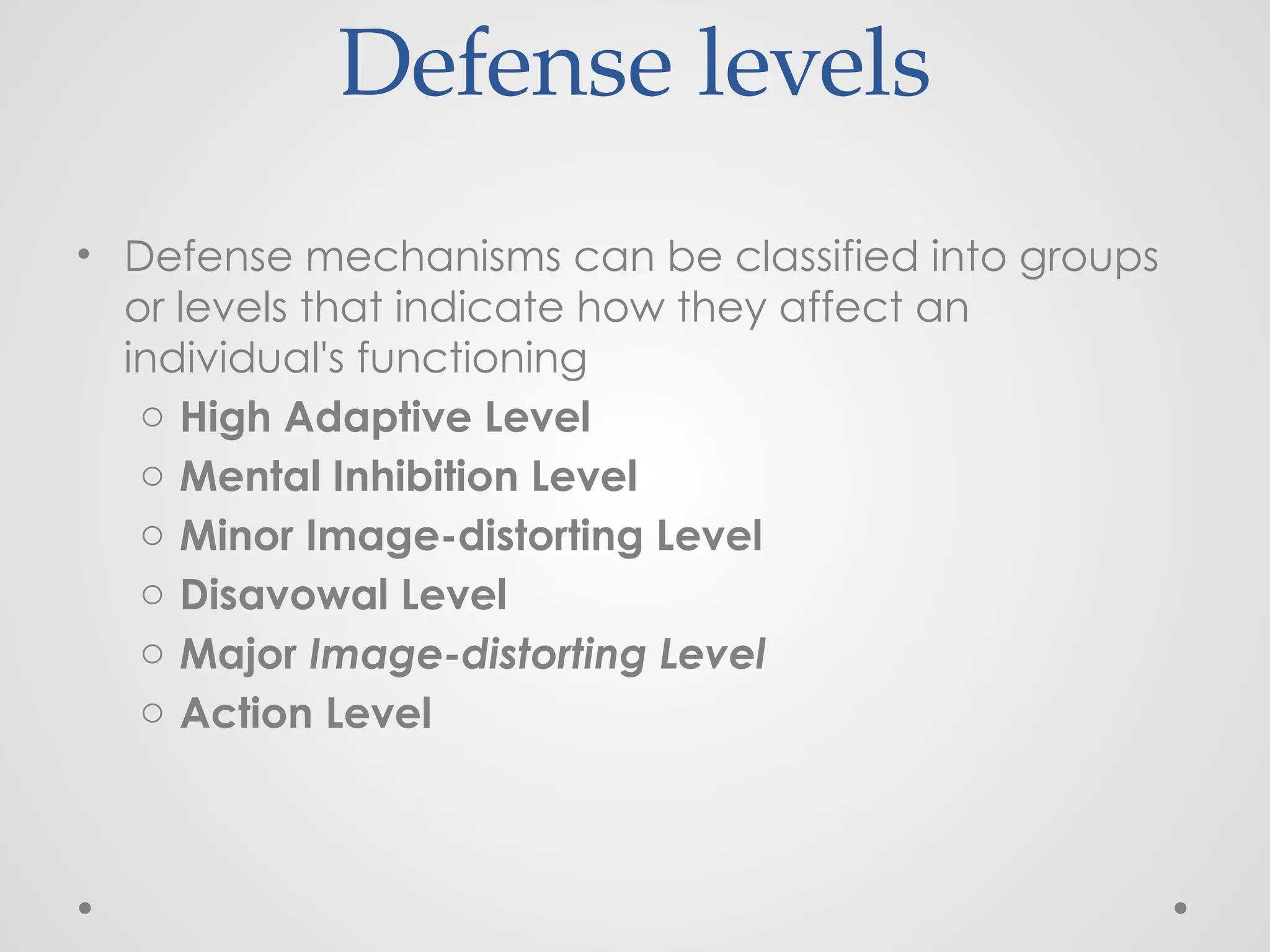
Defense levels
• Defense mechanisms can be classified into groups
or levels that indicate how they affect an
individual's functioning
o High Adaptive Level
o Mental Inhibition Level
o Minor Image-distorting Level
o Disavowal Level
o Major Image-distorting Level
o Action Level
 High Adaptive Level: Defense mechanisms in this
group result in optimal adaptation to stress.
• The defenses usually maximize feelings of well being
and allow the conscious awareness of feelings,
ideas, and their consequences.
• Promote an optimum balance among conflicting
motives.
High Adaptive Level
o Affiliation - involves dealing with stressors by turning to others
for help or support. This involves sharing problems with others
but not trying to make someone else responsible for them.
 Altruism - involves dealing with stressors by dedicating yourself to
meeting the needs of others. The individual receives satisfaction
vicariously or from the response of others.
 •Anticipation - involves dealing with stressors by anticipating the
consequences and feelings associated with possible future
events and considering realistic solutions. eg If you know you
have a big test coming up, you might feel anxious about
failing......
•Humor - involves dealing with stress by emphasizing the amusing or ironic
aspects of the situation.
•Self-Assertion - involves dealing with stress by expressing your feelings and
thoughts directly in a way that is not aggressive, coercive, or manipulative.or
example: If a friend keeps borrowing your things without asking, instead of
staying silent or getting angry, you calmly say, "I feel uncomfortable when
you take my stuff without asking. I’d appreciate it if you ask me first next time."
•Self-Observation - involves dealing with stress by reflecting on your own
thoughts, feelings, motivation, and behavior, and then responding
appropriately.
•Sublimation - involves dealing with stress by channeling potentially
disruptive feelings or impulses into socially acceptable behavior (e.g., decide
to go for a run or hit the gym to release that anger in a positive way.
•Suppression involves dealing with stress by intentionally avoiding thinking
about disturbing problems, wishes, feelings, or experiences. (If you're feeling
upset about a personal issue but have an important work presentation........)
 Mental Inhibition Level: Defense mechanisms in this group
keep potentially threatening ideas, feelings, memories, wishes,
or fears out of awareness. Diminished awareness can affect
the person's ability to relate to others.
 Displacement - involves dealing with stress by transferring
strong feelings about on situation onto another (usually less
threatening) substitute situation.
 Dissociation - involves dealing with stress by breaking off part
of memory, consciousness, or perception of self or the
environment to avoid a problem situation (e.g., amnesia).
[bhoolnay kii bemarii] After experiencing a traumatic
accident, a person might develop amnesia and be unable to
recall the details of the event. This is the mind’s way of
protecting them from the overwhelming stress or pain
associated with the memory.
 Intellectualization - involves dealing with stress by excessively
using abstract thinking and generalizations to avoid or minimize
unpleasant feelings.
 Intellectualization can be a useful way of explaining and understanding
negative events. For example, if person A is rude to person B, person B
may think about the possible reasons for person A's behavior
 Reaction - Formation involves dealing with stress by substituting
behavior, thoughts, or feelings that are the exact opposite of your
own unacceptable thoughts or feelings (which the person is
usually not aware of).
 If someone feels angry or jealous of a coworker’s success but
thinks those feelings are wrong or inappropriate, they might act
overly friendly and supportive toward that coworker, even though
their real emotions are negative.
 In this case, the person hides their true feelings by doing the
opposite of what they actually feel, which helps them cope with
the internal conflict.
 Repression - involves dealing with stress by removing
disturbing wishes, thoughts, or experiences from conscious
awareness..For example: If someone had a traumatic
experience, like being bullied in school, they might repress
those painful memories, making them unable to remember
the bullying in detail. However, the emotional impact of the
experience (like low self-esteem or anxiety) may still
influence their behavior, even though they don’t consciously
remember the event.
 Undoing - involves dealing with stress by using words or
behaviors designed to negate or make amends symbolically
for unacceptable thoughts, feelings, or actions.For example:
If someone says something hurtful to a friend in a moment of
anger, they might later feel guilty and try to undo it by being
overly nice, giving gifts, or doing favors for that friend to
make up for their earlier behavior.
 Minor image-distorting level. This level is characterized
by distortions in the image of the self, body, or others
that may be employed to regulate self-esteem.
Examples are
• Devaluation - Involves dealing with emotional conflict
or internal or external stressors by attributing
exaggerated negative qualities to self or others.
• Imagine someone doesn’t get a promotion they were
hoping for. To cope with the disappointment, they
might start thinking, “That job wasn’t worth it anyway;
the people in management are incompetent.” By
devaluing the position and the people in charge, they
protect themselves from feeling the full weight of the
rejection or failure.
Idealization - Involves dealing with emotional conflict or
internal or external stressors by attributing exaggerated
positive qualities to others.social influencers
Omnipotence - Involves dealing with emotional conflict
or internal or external stressors by feeling or acting as if
he or she possesses special powers or abilities and is
superior to others.A manager dealing with stress at
work might start believing, “I’m the only one who
knows how to fix these problems,” and begin acting as
if they are the only capable person in the team. They
take control of everything and dismiss others' input,
thinking they are superior and possess special abilities
to handle things better than anyone else.
 Disavowal level. This level is characterized by
keeping unpleasant or unacceptable stressors,
impulses, ideas, affects, or responsibility out of
awareness with or without a misattribution of these
to external causes. Examples are
• Denial - involves dealing with stress by refusing to
acknowledge some painful aspect of reality or
experience that is apparent to others.
 Projection - involves dealing with stress by falsely attributing your
own unacceptable feelings, impulses, or thoughts to another
person.A person who is feeling jealous of a friend’s success
might unconsciously project that jealousy onto the friend by
saying, “They are so jealous of me.” In reality, it’s the person who
feels jealous, but by projecting that emotion onto the friend,
they avoid acknowledging their own uncomfortable feelings.
 Rationalization - involves dealing with stress by concealing the
true motivations for a thought, action, or feeling by using
elaborate, reassuring, and self-serving (but incorrect)
explanations.If someone fails an important exam, instead of
facing the reality that they didn’t study enough, they might
rationalize by saying, “The test was unfair, and the questions
weren’t clear.” This explanation reassures them and conceals
the true reason for their failure, which might be their lack of
preparation.
• Major image-distorting level. This level is
characterized by gross distortion or misattribution of
the image of self or others. Examples are
• Autistic fantasy - Involves dealing with emotional
conflict or internal or external stressors by excessive
daydreaming as a substitute for human
relationships, more effective action, or problem
solving.
 Splitting - Involves dealing with emotional conflict
or internal or external stressors by
compartmentalizing opposite affect states and
failing to integrate the positive and negative
qualities of the self or others into organized images.
Self and object images tend to alternate between
polar opposites: exclusively loving, powerful,
worthy, nurturing, and kind or exclusively bad,
hateful, angry, destructive, rejecting, or worthless.
• Imagine an employee who initially views their boss as a
perfect leader—always supportive, wise, and kind.
However, after receiving critical feedback or facing a
disagreement, the employee suddenly views the boss as
entirely incompetent, unfair, and malicious. The boss goes
from being idealized to being entirely devalued, without
any recognition of the boss’s human complexities, such as
being both supportive and occasionally critical.
• This all-or-nothing thinking helps the employee cope with
the emotional discomfort of the situation, but it prevents
them from understanding that people can have both
strengths and weaknesses.
 Action Level: This level is characterized by defenses
that deal with internal or external stressors by action
or withdrawal.
 Acting Out - involves dealing with stress by using
action rather than reflection or feeling. Defensive
acting out is often associated with "bad behavior"
when there are underlying emotional conflicts.
 Help-Rejecting Complaining - involves dealing with stress by
complaining and making repeated requests for help that
disguise hidden feelings of hostility toward others, which is then
expressed by rejecting the suggestions, advice, or help that
others offer. The complaints may involve physical or
psychological symptoms or life problems.
 •Passive Aggression - involves dealing with stress by indirectly
and unassertively expressing aggression toward others. The
person displays an outward superficial cooperativeness that
masks the underlying resistance, resentment, and hostility. This
defense may be adaptive in situations where direct and
assertive communication is punished A friend, Lisa, invites Jane
to her birthday party. Jane is upset with Lisa for not supporting
her during a recent argument but doesn’t express her feelings
directly. Instead, Jane says, "Sure, I’ll come!" but shows up
hours late, saying, "I figured it wasn’t that big of a deal since
you had so many other friends there."
 Level of defensive dysregulation. This level is
characterized by failure of defensive regulation to
contain the individual's reaction to stressors,
• Leads into a pronounced break with objective
reality. Examples are
• delusional projection
• psychotic denial
• psychotic distortion

Defense mechanism.pptxpschology second semste

  • 1.
  • 2.
    THREE TYPES OF ANXIETY •Freud identified three types of anxiety: • Neurotic anxiety is the unconscious worry that we will lose control of the id's urges, resulting in punishment for inappropriate behavior. • Reality anxiety is fear of real-world events. The cause of this anxiety is usually easily identified. For example, a person might fear receiving a dog bite when they are near a menacing dog. The most common way of reducing this anxiety is to avoid the threatening object.
  • 3.
    • Moral anxietyinvolves a fear of violating our own moral principles. • In order to deal with this anxiety, Freud believed that defense mechanisms helped shield the ego from the conflicts created by the id, superego and reality.
  • 4.
    Defense mechanisms • Defensemechanisms are a type of process or coping that results in automatic psychological responses exhibited as a means of protecting the individual against anxiety. • Defense mechanism is the shield that we use to protect ourselves from anxiety.
  • 5.
    • Defense mechanismsmediate the individual's reaction to emotional conflicts and to internal and external stressors. • Internal Stressors are: o Thoughts / feelings / emotions / memories (TFEM) that are in conflict with other TFEM resulting in: • Friction – It’s like mental resistance, where your thoughts don’t flow smoothly because they’re pulling in different directions. • Confusion – You feel unsure about what to do because your thoughts and feelings don’t agree on the best action. • Fragmentation – Your emotions feel scattered or divided, making it hard to focus or stay calm because your energy is split between different feelings.
  • 6.
    • External Stressorsare influences from the external world (i.e. people, places, things) that exert pressure on an individual. This pressure creates stress, internal confusion, internal/external conflicts, and an imbalance within the bio psychosocial system.
  • 7.
    Defense levels • Defensemechanisms can be classified into groups or levels that indicate how they affect an individual's functioning o High Adaptive Level o Mental Inhibition Level o Minor Image-distorting Level o Disavowal Level o Major Image-distorting Level o Action Level
  • 8.
     High AdaptiveLevel: Defense mechanisms in this group result in optimal adaptation to stress. • The defenses usually maximize feelings of well being and allow the conscious awareness of feelings, ideas, and their consequences. • Promote an optimum balance among conflicting motives.
  • 9.
    High Adaptive Level oAffiliation - involves dealing with stressors by turning to others for help or support. This involves sharing problems with others but not trying to make someone else responsible for them.  Altruism - involves dealing with stressors by dedicating yourself to meeting the needs of others. The individual receives satisfaction vicariously or from the response of others.  •Anticipation - involves dealing with stressors by anticipating the consequences and feelings associated with possible future events and considering realistic solutions. eg If you know you have a big test coming up, you might feel anxious about failing......
  • 10.
    •Humor - involvesdealing with stress by emphasizing the amusing or ironic aspects of the situation. •Self-Assertion - involves dealing with stress by expressing your feelings and thoughts directly in a way that is not aggressive, coercive, or manipulative.or example: If a friend keeps borrowing your things without asking, instead of staying silent or getting angry, you calmly say, "I feel uncomfortable when you take my stuff without asking. I’d appreciate it if you ask me first next time." •Self-Observation - involves dealing with stress by reflecting on your own thoughts, feelings, motivation, and behavior, and then responding appropriately. •Sublimation - involves dealing with stress by channeling potentially disruptive feelings or impulses into socially acceptable behavior (e.g., decide to go for a run or hit the gym to release that anger in a positive way. •Suppression involves dealing with stress by intentionally avoiding thinking about disturbing problems, wishes, feelings, or experiences. (If you're feeling upset about a personal issue but have an important work presentation........)
  • 11.
     Mental InhibitionLevel: Defense mechanisms in this group keep potentially threatening ideas, feelings, memories, wishes, or fears out of awareness. Diminished awareness can affect the person's ability to relate to others.  Displacement - involves dealing with stress by transferring strong feelings about on situation onto another (usually less threatening) substitute situation.  Dissociation - involves dealing with stress by breaking off part of memory, consciousness, or perception of self or the environment to avoid a problem situation (e.g., amnesia). [bhoolnay kii bemarii] After experiencing a traumatic accident, a person might develop amnesia and be unable to recall the details of the event. This is the mind’s way of protecting them from the overwhelming stress or pain associated with the memory.
  • 12.
     Intellectualization -involves dealing with stress by excessively using abstract thinking and generalizations to avoid or minimize unpleasant feelings.  Intellectualization can be a useful way of explaining and understanding negative events. For example, if person A is rude to person B, person B may think about the possible reasons for person A's behavior  Reaction - Formation involves dealing with stress by substituting behavior, thoughts, or feelings that are the exact opposite of your own unacceptable thoughts or feelings (which the person is usually not aware of).  If someone feels angry or jealous of a coworker’s success but thinks those feelings are wrong or inappropriate, they might act overly friendly and supportive toward that coworker, even though their real emotions are negative.  In this case, the person hides their true feelings by doing the opposite of what they actually feel, which helps them cope with the internal conflict.
  • 13.
     Repression -involves dealing with stress by removing disturbing wishes, thoughts, or experiences from conscious awareness..For example: If someone had a traumatic experience, like being bullied in school, they might repress those painful memories, making them unable to remember the bullying in detail. However, the emotional impact of the experience (like low self-esteem or anxiety) may still influence their behavior, even though they don’t consciously remember the event.  Undoing - involves dealing with stress by using words or behaviors designed to negate or make amends symbolically for unacceptable thoughts, feelings, or actions.For example: If someone says something hurtful to a friend in a moment of anger, they might later feel guilty and try to undo it by being overly nice, giving gifts, or doing favors for that friend to make up for their earlier behavior.
  • 14.
     Minor image-distortinglevel. This level is characterized by distortions in the image of the self, body, or others that may be employed to regulate self-esteem. Examples are • Devaluation - Involves dealing with emotional conflict or internal or external stressors by attributing exaggerated negative qualities to self or others. • Imagine someone doesn’t get a promotion they were hoping for. To cope with the disappointment, they might start thinking, “That job wasn’t worth it anyway; the people in management are incompetent.” By devaluing the position and the people in charge, they protect themselves from feeling the full weight of the rejection or failure.
  • 15.
    Idealization - Involvesdealing with emotional conflict or internal or external stressors by attributing exaggerated positive qualities to others.social influencers Omnipotence - Involves dealing with emotional conflict or internal or external stressors by feeling or acting as if he or she possesses special powers or abilities and is superior to others.A manager dealing with stress at work might start believing, “I’m the only one who knows how to fix these problems,” and begin acting as if they are the only capable person in the team. They take control of everything and dismiss others' input, thinking they are superior and possess special abilities to handle things better than anyone else.
  • 16.
     Disavowal level.This level is characterized by keeping unpleasant or unacceptable stressors, impulses, ideas, affects, or responsibility out of awareness with or without a misattribution of these to external causes. Examples are • Denial - involves dealing with stress by refusing to acknowledge some painful aspect of reality or experience that is apparent to others.
  • 17.
     Projection -involves dealing with stress by falsely attributing your own unacceptable feelings, impulses, or thoughts to another person.A person who is feeling jealous of a friend’s success might unconsciously project that jealousy onto the friend by saying, “They are so jealous of me.” In reality, it’s the person who feels jealous, but by projecting that emotion onto the friend, they avoid acknowledging their own uncomfortable feelings.  Rationalization - involves dealing with stress by concealing the true motivations for a thought, action, or feeling by using elaborate, reassuring, and self-serving (but incorrect) explanations.If someone fails an important exam, instead of facing the reality that they didn’t study enough, they might rationalize by saying, “The test was unfair, and the questions weren’t clear.” This explanation reassures them and conceals the true reason for their failure, which might be their lack of preparation.
  • 18.
    • Major image-distortinglevel. This level is characterized by gross distortion or misattribution of the image of self or others. Examples are • Autistic fantasy - Involves dealing with emotional conflict or internal or external stressors by excessive daydreaming as a substitute for human relationships, more effective action, or problem solving.
  • 19.
     Splitting -Involves dealing with emotional conflict or internal or external stressors by compartmentalizing opposite affect states and failing to integrate the positive and negative qualities of the self or others into organized images. Self and object images tend to alternate between polar opposites: exclusively loving, powerful, worthy, nurturing, and kind or exclusively bad, hateful, angry, destructive, rejecting, or worthless.
  • 20.
    • Imagine anemployee who initially views their boss as a perfect leader—always supportive, wise, and kind. However, after receiving critical feedback or facing a disagreement, the employee suddenly views the boss as entirely incompetent, unfair, and malicious. The boss goes from being idealized to being entirely devalued, without any recognition of the boss’s human complexities, such as being both supportive and occasionally critical. • This all-or-nothing thinking helps the employee cope with the emotional discomfort of the situation, but it prevents them from understanding that people can have both strengths and weaknesses.
  • 21.
     Action Level:This level is characterized by defenses that deal with internal or external stressors by action or withdrawal.  Acting Out - involves dealing with stress by using action rather than reflection or feeling. Defensive acting out is often associated with "bad behavior" when there are underlying emotional conflicts.
  • 22.
     Help-Rejecting Complaining- involves dealing with stress by complaining and making repeated requests for help that disguise hidden feelings of hostility toward others, which is then expressed by rejecting the suggestions, advice, or help that others offer. The complaints may involve physical or psychological symptoms or life problems.  •Passive Aggression - involves dealing with stress by indirectly and unassertively expressing aggression toward others. The person displays an outward superficial cooperativeness that masks the underlying resistance, resentment, and hostility. This defense may be adaptive in situations where direct and assertive communication is punished A friend, Lisa, invites Jane to her birthday party. Jane is upset with Lisa for not supporting her during a recent argument but doesn’t express her feelings directly. Instead, Jane says, "Sure, I’ll come!" but shows up hours late, saying, "I figured it wasn’t that big of a deal since you had so many other friends there."
  • 23.
     Level ofdefensive dysregulation. This level is characterized by failure of defensive regulation to contain the individual's reaction to stressors, • Leads into a pronounced break with objective reality. Examples are • delusional projection • psychotic denial • psychotic distortion