Created by Jeff Crawford
www.linkedin.com/in/crawdoctor/ Last updated on 6/2/2014
* The term “understanding” encompasses both knowing and do-ing.
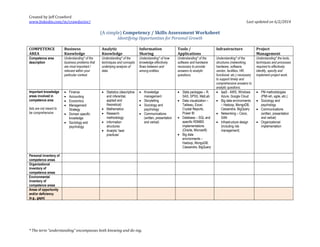
(A simple) Competency / Skills Assessment Worksheet
Identifying Opportunities for Personal Growth
COMPETENCE
AREA
Business
Knowledge
Analytic
Knowledge
Information
Sharing
Tools /
Applications
Infrastructure Project
Management
Competence area
description
Understanding* of the
business problems that
are most important /
relevant within your
particular context.
Understanding* of the
techniques and concepts
underlying analysis of
data.
Understanding* of how
knowledge effectively
flows between and
among entities.
Understanding* of the
software and hardware
necessary to provide
answers to analytic
questions.
Understanding* of the
structures (networking,
hardware, software,
vendor, facilities, HR,
functional, etc.) necessary
to support timely and
comprehensive answers to
analytic questions.
Understanding* the tools,
techniques and processes
required to effectively
identify, specify and
implement project work.
Important knowledge
areas involved in
competence area
lists are not meant to
be comprehensive
 Finance
 Accounting
 Economics
 Management
Strategy
 Domain specific
knowledge
 Sociology and
psychology
 Statistics (descriptive
and inferential,
applied and
theoretical)
 Mathematics
 Research
methodology
 Information
structures
 Analytic ‘best
practices’
 Knowledge
management
 Storytelling
 Sociology and
psychology
 Communications
(written, presentation
and verbal)
 Stats packages – R,
SAS, SPSS, MatLab
 Data visualization –
Tableau, Excel,
Crystal Reports,
Power BI
 Database – SQL and
specific RDMBS
implementations
(Oracle, Microsoft)
 Big data
environments –
Hadoop, MongoDB,
Cassandra, BigQuery
 IaaS - AWS, Windows
Azure, Google Cloud
 Big data environments
– Hadoop, MongoDB,
Cassandra, BigQuery
 Networking – Cisco,
SAN
 Infrastructure design
(including risk
management)
 PM methodologies
(PMI-ish, agile, etc.)
 Sociology and
psychology
 Communications
(written, presentation
and verbal)
 Organizational
implementation
Personal inventory of
competence areas
Organizational
inventory of
competence areas
Environmental
inventory of
competence areas
Areas of opportunity
and/or deficiency
(e.g., gaps)

(A simple) Analytics Competency / Skills Assessment Worksheet - Identifying Opportunities for Personal Growth

  • 1.
    Created by JeffCrawford www.linkedin.com/in/crawdoctor/ Last updated on 6/2/2014 * The term “understanding” encompasses both knowing and do-ing. (A simple) Competency / Skills Assessment Worksheet Identifying Opportunities for Personal Growth COMPETENCE AREA Business Knowledge Analytic Knowledge Information Sharing Tools / Applications Infrastructure Project Management Competence area description Understanding* of the business problems that are most important / relevant within your particular context. Understanding* of the techniques and concepts underlying analysis of data. Understanding* of how knowledge effectively flows between and among entities. Understanding* of the software and hardware necessary to provide answers to analytic questions. Understanding* of the structures (networking, hardware, software, vendor, facilities, HR, functional, etc.) necessary to support timely and comprehensive answers to analytic questions. Understanding* the tools, techniques and processes required to effectively identify, specify and implement project work. Important knowledge areas involved in competence area lists are not meant to be comprehensive  Finance  Accounting  Economics  Management Strategy  Domain specific knowledge  Sociology and psychology  Statistics (descriptive and inferential, applied and theoretical)  Mathematics  Research methodology  Information structures  Analytic ‘best practices’  Knowledge management  Storytelling  Sociology and psychology  Communications (written, presentation and verbal)  Stats packages – R, SAS, SPSS, MatLab  Data visualization – Tableau, Excel, Crystal Reports, Power BI  Database – SQL and specific RDMBS implementations (Oracle, Microsoft)  Big data environments – Hadoop, MongoDB, Cassandra, BigQuery  IaaS - AWS, Windows Azure, Google Cloud  Big data environments – Hadoop, MongoDB, Cassandra, BigQuery  Networking – Cisco, SAN  Infrastructure design (including risk management)  PM methodologies (PMI-ish, agile, etc.)  Sociology and psychology  Communications (written, presentation and verbal)  Organizational implementation Personal inventory of competence areas Organizational inventory of competence areas Environmental inventory of competence areas Areas of opportunity and/or deficiency (e.g., gaps)