PROJECT MANAGEMENT INSTITUTE, NORTH INDIA CHAPTER, NATIONAL CONFERENCE, INDIA 2013 1
Abstract In the global economy, IT firms are becoming more and more aware of the need to have competent
employees with appropriate skills and domain/business knowledge to cater to global clients. Providing the clients with
competent resources is the need of the hour given the present weather of the global economy. Nonetheless
understanding the nuances of competency mapping is critical while organizations implement their competency mapping
model. The rising in competency mapping is direct fallout of the systematic changes that the corporates are witnessing
today. Competency mapping is the process of identifying skill requirement and mapping them with the right resource
which in turn becomes the underlying criteria to create a potential room for succeeding in a project
One of the core challenges IT companies are facing today is the increase in manpower cost. Coupled with that is the
pressure to downsize and manage with fewer people, thus increasing efficiency and productivity per resource. IT
Organizations are also realizing the need to identify and retain the competent people to perform various critical roles.
Competency mapping consists of breaking a given role or job into constituent tasks or activities and identifying the
competencies (technical, managerial, behavioral, conceptual knowledge, an attitudes, skills etc.,) needed to perform the
same successfully.
This paper showcases the assessment maturity model for Competency Mapping. In this journey, the research
addresses the practical difficulties in implementing the model for a Competency Mapping in the IT space. The
implementation recipe comprises some innovative solutions towards execution.
Keyword — Competency Mapping, Assessment Maturity Model. Talent Management
I. INTRODUCTION1
ompetency Mapping is a process of identifying key
competencies for a company or an organization
and the jobs and functions within it. A well-managed
organization should have well defined roles and list of
competencies required to perform each role effectively.
Competency mapping analyzes an individual’s SWOT
for better understanding and this helps to improve his
career growth. This identifies the gap for improving
ones’ knowledge to align to the organizations goal.
Every IT organization in the present scenario is trying
to achieve high efficiency and effectiveness in order to
survive the cutthroat competition. IT Industry is
basically classified into software development and
service sector. All the methods and approaches for
improving the performance and efficiency of their
operations points to a basic key factor – Skill and
Competency.
Every industry, especially production industries,
emphasizes on skill and competency. It becomes
mandatory for any production company, aiming at
improving their performance, to map the skill level of
their workers.
Skills mapping is a technique of studying and
analyzing and comprehensively understanding the skills
possessed by a resource and identifying the gray areas
where improvement can be made by training or by other
means.
Skill mapping, thus, is fast becoming an important,
buzzword for any industry aiming at revamping them-
selves to the present competitive situation. It is
becoming popular day by day and many companies are
showing keen interest in using this technique to
improve their efficiency.
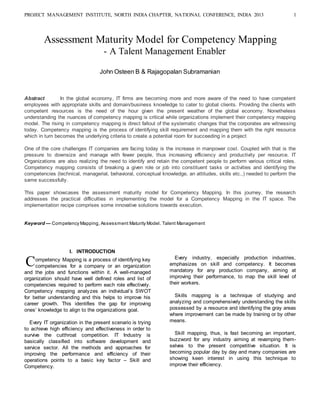
Assessment Maturity Model for Competency Mapping
- A Talent Management Enabler
John Osteen B & Rajagopalan Subramanian
C
Companies are vastly shifting their approach of having
multi-skilled employees. Organizations focus, in
identifying the strategies for multi skilling program to
equip potential resources to operate at a higher
capacity if need be.
The competence approach focuses on linking
business strategies to individual performance efforts. It
also encourages employees to develop competencies
which can be used in diverse work situations rather
than being boxed into the job. In this way they can
develop capabilities useful throughout the organization
as it changes and evolves.
Competency mapping is one of the most accurate
means to identify the job and behavioral competencies
of an individual in an organization.
Objectives of Competency Mapping & Assessment:
 To ensure that right people are identified and placed
in the right role
 Employee potential is understood, developed and
utilized to the fullest extent.
 To analyze how the competencies are aligned to
strategies, business performance and goals.
 To analyze the impact of Competency Mapping in
relation to individual and consulting organization
objectives.
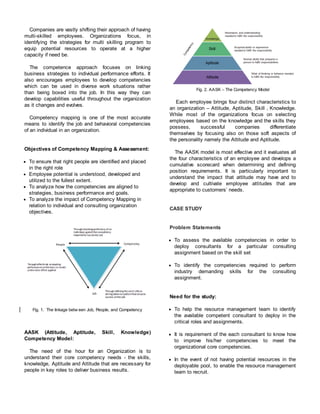
Fig. 1. The linkage betw een Job, People, and Competency
AASK (Attitude, Aptitude, Skill, Knowledge)
Competency Model:
The need of the hour for an Organization is to
understand their core competency needs - the skills,
knowledge, Aptitude and Attitude that are necessary for
people in key roles to deliver business results.
Fig. 2. AASK – The Competency Model
Each employee brings four distinct characteristics to
an organization – Attitude, Aptitude, Skill , Knowledge.
While most of the organizations focus on selecting
employees based on the knowledge and the skills they
possess, successful companies differentiate
themselves by focusing also on those soft aspects of
the personality namely the Attitude and Aptitude.
The AASK model is most effective and it evaluates all
the four characteristics of an employee and develops a
cumulative scorecard when determining and defining
position requirements. It is particularly important to
understand the impact that attitude may have and to
develop and cultivate employee attitudes that are
appropriate to customers’ needs.
CASE STUDY
Problem Statements
 To assess the available competencies in order to
deploy consultants for a particular consulting
assignment based on the skill set
 To identify the competencies required to perform
industry demanding skills for the consulting
assignment.
Need for the study:
 To help the resource management team to identify
the available competent consultant to deploy in the
critical roles and assignments.
 It is requirement of the each consultant to know how
to improve his/her competencies to meet the
organizational core competencies.
 In the event of not having potential resources in the
deployable pool, to enable the resource management
team to recruit.
PROJECT MANAGEMENT INSTITUTE, NORTH INDIA CHAPTER, NATIONAL CONFERENCE, INDIA 2013 3
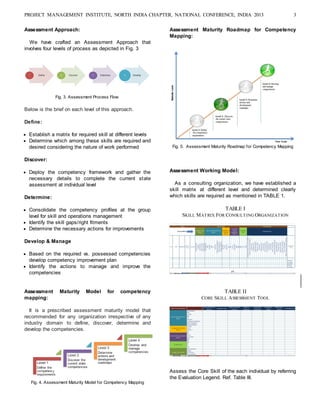
Assessment Approach:
We have crafted an Assessment Approach that
involves four levels of process as depicted in Fig. 3
Fig. 3. Assessment Process Flow
Below is the brief on each level of this approach.
Define:
 Establish a matrix for required skill at different levels
 Determine which among these skills are required and
desired considering the nature of work performed
Discover:
 Deploy the competency framework and gather the
necessary details to complete the current state
assessment at individual level
Determine:
 Consolidate the competency profiles at the group
level for skill and operations management
 Identify the skill gaps/right fitments
 Determine the necessary actions for improvements
Develop & Manage
 Based on the required vs. possessed competencies
develop competency improvement plan
 Identify the actions to manage and improve the
competencies
Assessment Maturity Model for competency
mapping:
It is a prescribed assessment maturity model that
recommended for any organization irrespective of any
industry domain to define, discover, determine and
develop the competencies.
Fig. 4. Assessment Maturity Model for Competency Mapping
Assessment Maturity Roadmap for Competency
Mapping:
Fig. 5. Assessment Maturity Roadmap for Competency Mapping
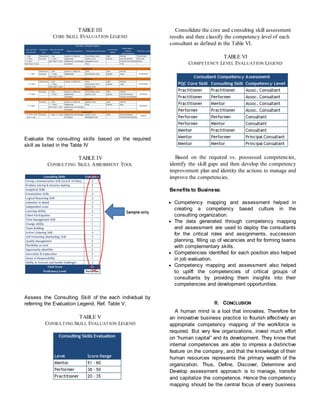
Assessment Working Model:
As a consulting organization, we have established a
skill matrix at different level and determined clearly
which skills are required as mentioned in TABLE 1.
TABLE I
SKILL MATRIX FOR CONSULTING ORGANIZATION
TABLE II
CORE SKILL ASSESSMENT TOOL
Assess the Core Skill of the each individual by referring
the Evaluation Legend. Ref. Table III.
TABLE III
CORE SKILL EVALUATION LEGEND
Evaluate the consulting skills based on the required
skill as listed in the Table IV
TABLE IV
CONSULTING SKILL ASSESSMENT TOOL
Assess the Consulting Skill of the each individual by
referring the Evaluation Legend. Ref. Table V.
TABLE V
CONSULTING SKILL EVALUATION LEGEND
Consolidate the core and consulting skill assessment
results and then classify the competency level of each
consultant as defined in the Table VI.
TABLE VI
COMPETENCY LEVEL EVALUATION LEGEND
Based on the required vs. possessed competencies,
identify the skill gaps and then develop the competency
improvement plan and identity the actions to manage and
improve the competencies.
Benefits to Business:
 Competency mapping and assessment helped in
creating a competency based culture in the
consulting organization.
 The data generated through competency mapping
and assessment are used to deploy the consultants
for the critical roles and assignments, succession
planning, filling up of vacancies and for forming teams
with complementary skills.
 Competencies identified for each position also helped
in job evaluation.
 Competency mapping and assessment also helped
to uplift the competencies of critical groups of
consultants by providing them insights into their
competencies and development opportunities.
II. CONCLUSION
A human mind is a tool that innovates. Therefore for
an innovative business practice to flourish effectively an
appropriate competency mapping of the workforce is
required. But very few organizations, invest much effort
on “human capital” and its development. They know that
internal competences are able to impress a distinctive
feature on the company, and that the knowledge of their
human resources represents the primary wealth of the
organization. Thus, Define, Discover, Determine and
Develop assessment approach is to manage, transfer
and capitalize the competence. Hence the competency
mapping should be the central focus of every business
PROJECT MANAGEMENT INSTITUTE, NORTH INDIA CHAPTER, NATIONAL CONFERENCE, INDIA 2013 5
system; yet, it is conspicuously absent in many Indian
organizations.
ACKNOWLEDGMENT
We sincerely express our gratitude to our sponsors
Mr. Naresh Arumugam, Sr. Manager - Consulting, CTS
and Mr. Karthik Padmanabhan, Director - Consulting,
CTS. Thanks to our colleague Mrs. Nandini Krishnan for
her extensive support in this research paper.
REFERENCES
[1] Boyatzis, Richard E, The Competent Manager: New
York
[2] Berger, The Talent Management Handbook
[3] Lyle M. Spencer, Signe M. Spencer, Competence at
Work Models for Superior Performance
[4] Seema Sanghi, The Handbook of Competency
Mapping
ABOUT AUTHORS
John Osteen B works as a Consultant at Business
Consulting practice at Cognizant Technology Solutions. He
has over 7yrs of IT process quality consulting experience.
John Osteen B holds Masters in Business Administration
and he is certified Six Sigma Green Belt, Certified
PRINCE2 Practitioner and also a certified ITIL v3
Intermediate professional. He has also published a paper
at ITNG 2013 conference on “Cost of Software Quality - A
Path to Delivery Excellence” and submitted another paper
at The ACM / IEEE International Symposium on Empirical
Software Engineering and Measurement (ESEM)
conference on “Metrics Driven Continual Service
Improvement using Agile concepts”.
Email Id: John.B@cognizant.com
Mobile: 99414 45318
Rajagopalan Subramanian is a Senior Consultant
from the Business Consulting practice of Cognizant
Technology Solutions. He has over 16 years of IT
process consulting experience focusing on ITIL Service
management, CMMI Implementation, process maturity
and continual improvement initiatives. Rajagopalan
Subramanian is certified ITIL v3 professional, Sarbanes
–Oxley professional and also he is certified in Six
Sigma Black Belt.
Email Id: Rajagopalan.Subramanian2@cognizant.com
Mobile: 98404 50870

John osteenb rajagopalansubramanian

  • 1.
    PROJECT MANAGEMENT INSTITUTE,NORTH INDIA CHAPTER, NATIONAL CONFERENCE, INDIA 2013 1 Abstract In the global economy, IT firms are becoming more and more aware of the need to have competent employees with appropriate skills and domain/business knowledge to cater to global clients. Providing the clients with competent resources is the need of the hour given the present weather of the global economy. Nonetheless understanding the nuances of competency mapping is critical while organizations implement their competency mapping model. The rising in competency mapping is direct fallout of the systematic changes that the corporates are witnessing today. Competency mapping is the process of identifying skill requirement and mapping them with the right resource which in turn becomes the underlying criteria to create a potential room for succeeding in a project One of the core challenges IT companies are facing today is the increase in manpower cost. Coupled with that is the pressure to downsize and manage with fewer people, thus increasing efficiency and productivity per resource. IT Organizations are also realizing the need to identify and retain the competent people to perform various critical roles. Competency mapping consists of breaking a given role or job into constituent tasks or activities and identifying the competencies (technical, managerial, behavioral, conceptual knowledge, an attitudes, skills etc.,) needed to perform the same successfully. This paper showcases the assessment maturity model for Competency Mapping. In this journey, the research addresses the practical difficulties in implementing the model for a Competency Mapping in the IT space. The implementation recipe comprises some innovative solutions towards execution. Keyword — Competency Mapping, Assessment Maturity Model. Talent Management I. INTRODUCTION1 ompetency Mapping is a process of identifying key competencies for a company or an organization and the jobs and functions within it. A well-managed organization should have well defined roles and list of competencies required to perform each role effectively. Competency mapping analyzes an individual’s SWOT for better understanding and this helps to improve his career growth. This identifies the gap for improving ones’ knowledge to align to the organizations goal. Every IT organization in the present scenario is trying to achieve high efficiency and effectiveness in order to survive the cutthroat competition. IT Industry is basically classified into software development and service sector. All the methods and approaches for improving the performance and efficiency of their operations points to a basic key factor – Skill and Competency. Every industry, especially production industries, emphasizes on skill and competency. It becomes mandatory for any production company, aiming at improving their performance, to map the skill level of their workers. Skills mapping is a technique of studying and analyzing and comprehensively understanding the skills possessed by a resource and identifying the gray areas where improvement can be made by training or by other means. Skill mapping, thus, is fast becoming an important, buzzword for any industry aiming at revamping them- selves to the present competitive situation. It is becoming popular day by day and many companies are showing keen interest in using this technique to improve their efficiency. Assessment Maturity Model for Competency Mapping - A Talent Management Enabler John Osteen B & Rajagopalan Subramanian C
  • 2.
    Companies are vastlyshifting their approach of having multi-skilled employees. Organizations focus, in identifying the strategies for multi skilling program to equip potential resources to operate at a higher capacity if need be. The competence approach focuses on linking business strategies to individual performance efforts. It also encourages employees to develop competencies which can be used in diverse work situations rather than being boxed into the job. In this way they can develop capabilities useful throughout the organization as it changes and evolves. Competency mapping is one of the most accurate means to identify the job and behavioral competencies of an individual in an organization. Objectives of Competency Mapping & Assessment:  To ensure that right people are identified and placed in the right role  Employee potential is understood, developed and utilized to the fullest extent.  To analyze how the competencies are aligned to strategies, business performance and goals.  To analyze the impact of Competency Mapping in relation to individual and consulting organization objectives. Fig. 1. The linkage betw een Job, People, and Competency AASK (Attitude, Aptitude, Skill, Knowledge) Competency Model: The need of the hour for an Organization is to understand their core competency needs - the skills, knowledge, Aptitude and Attitude that are necessary for people in key roles to deliver business results. Fig. 2. AASK – The Competency Model Each employee brings four distinct characteristics to an organization – Attitude, Aptitude, Skill , Knowledge. While most of the organizations focus on selecting employees based on the knowledge and the skills they possess, successful companies differentiate themselves by focusing also on those soft aspects of the personality namely the Attitude and Aptitude. The AASK model is most effective and it evaluates all the four characteristics of an employee and develops a cumulative scorecard when determining and defining position requirements. It is particularly important to understand the impact that attitude may have and to develop and cultivate employee attitudes that are appropriate to customers’ needs. CASE STUDY Problem Statements  To assess the available competencies in order to deploy consultants for a particular consulting assignment based on the skill set  To identify the competencies required to perform industry demanding skills for the consulting assignment. Need for the study:  To help the resource management team to identify the available competent consultant to deploy in the critical roles and assignments.  It is requirement of the each consultant to know how to improve his/her competencies to meet the organizational core competencies.  In the event of not having potential resources in the deployable pool, to enable the resource management team to recruit.
  • 3.
    PROJECT MANAGEMENT INSTITUTE,NORTH INDIA CHAPTER, NATIONAL CONFERENCE, INDIA 2013 3 Assessment Approach: We have crafted an Assessment Approach that involves four levels of process as depicted in Fig. 3 Fig. 3. Assessment Process Flow Below is the brief on each level of this approach. Define:  Establish a matrix for required skill at different levels  Determine which among these skills are required and desired considering the nature of work performed Discover:  Deploy the competency framework and gather the necessary details to complete the current state assessment at individual level Determine:  Consolidate the competency profiles at the group level for skill and operations management  Identify the skill gaps/right fitments  Determine the necessary actions for improvements Develop & Manage  Based on the required vs. possessed competencies develop competency improvement plan  Identify the actions to manage and improve the competencies Assessment Maturity Model for competency mapping: It is a prescribed assessment maturity model that recommended for any organization irrespective of any industry domain to define, discover, determine and develop the competencies. Fig. 4. Assessment Maturity Model for Competency Mapping Assessment Maturity Roadmap for Competency Mapping: Fig. 5. Assessment Maturity Roadmap for Competency Mapping Assessment Working Model: As a consulting organization, we have established a skill matrix at different level and determined clearly which skills are required as mentioned in TABLE 1. TABLE I SKILL MATRIX FOR CONSULTING ORGANIZATION TABLE II CORE SKILL ASSESSMENT TOOL Assess the Core Skill of the each individual by referring the Evaluation Legend. Ref. Table III.
  • 4.
    TABLE III CORE SKILLEVALUATION LEGEND Evaluate the consulting skills based on the required skill as listed in the Table IV TABLE IV CONSULTING SKILL ASSESSMENT TOOL Assess the Consulting Skill of the each individual by referring the Evaluation Legend. Ref. Table V. TABLE V CONSULTING SKILL EVALUATION LEGEND Consolidate the core and consulting skill assessment results and then classify the competency level of each consultant as defined in the Table VI. TABLE VI COMPETENCY LEVEL EVALUATION LEGEND Based on the required vs. possessed competencies, identify the skill gaps and then develop the competency improvement plan and identity the actions to manage and improve the competencies. Benefits to Business:  Competency mapping and assessment helped in creating a competency based culture in the consulting organization.  The data generated through competency mapping and assessment are used to deploy the consultants for the critical roles and assignments, succession planning, filling up of vacancies and for forming teams with complementary skills.  Competencies identified for each position also helped in job evaluation.  Competency mapping and assessment also helped to uplift the competencies of critical groups of consultants by providing them insights into their competencies and development opportunities. II. CONCLUSION A human mind is a tool that innovates. Therefore for an innovative business practice to flourish effectively an appropriate competency mapping of the workforce is required. But very few organizations, invest much effort on “human capital” and its development. They know that internal competences are able to impress a distinctive feature on the company, and that the knowledge of their human resources represents the primary wealth of the organization. Thus, Define, Discover, Determine and Develop assessment approach is to manage, transfer and capitalize the competence. Hence the competency mapping should be the central focus of every business
  • 5.
    PROJECT MANAGEMENT INSTITUTE,NORTH INDIA CHAPTER, NATIONAL CONFERENCE, INDIA 2013 5 system; yet, it is conspicuously absent in many Indian organizations. ACKNOWLEDGMENT We sincerely express our gratitude to our sponsors Mr. Naresh Arumugam, Sr. Manager - Consulting, CTS and Mr. Karthik Padmanabhan, Director - Consulting, CTS. Thanks to our colleague Mrs. Nandini Krishnan for her extensive support in this research paper. REFERENCES [1] Boyatzis, Richard E, The Competent Manager: New York [2] Berger, The Talent Management Handbook [3] Lyle M. Spencer, Signe M. Spencer, Competence at Work Models for Superior Performance [4] Seema Sanghi, The Handbook of Competency Mapping ABOUT AUTHORS John Osteen B works as a Consultant at Business Consulting practice at Cognizant Technology Solutions. He has over 7yrs of IT process quality consulting experience. John Osteen B holds Masters in Business Administration and he is certified Six Sigma Green Belt, Certified PRINCE2 Practitioner and also a certified ITIL v3 Intermediate professional. He has also published a paper at ITNG 2013 conference on “Cost of Software Quality - A Path to Delivery Excellence” and submitted another paper at The ACM / IEEE International Symposium on Empirical Software Engineering and Measurement (ESEM) conference on “Metrics Driven Continual Service Improvement using Agile concepts”. Email Id: John.B@cognizant.com Mobile: 99414 45318 Rajagopalan Subramanian is a Senior Consultant from the Business Consulting practice of Cognizant Technology Solutions. He has over 16 years of IT process consulting experience focusing on ITIL Service management, CMMI Implementation, process maturity and continual improvement initiatives. Rajagopalan Subramanian is certified ITIL v3 professional, Sarbanes –Oxley professional and also he is certified in Six Sigma Black Belt. Email Id: Rajagopalan.Subramanian2@cognizant.com Mobile: 98404 50870