lOMoAR cPSD|24851617
1
LIST OF CONTENTS
S.No Topic Page no.
1. Aim 2
2. Introduction 3-7
3. Apparatus and Materials Required 8
4. Theory 9
5. Procedure 10
6. Observation Table and Calculation 11
7. Result 12
8. Precautions and Sources of error 12
9. Bibliography 13
lOMoAR cPSD|24851617
2
AIM:
To study the Earth’s magnetic field using a
compass needle bar magnet by plotting magnetic
field line and tangent galvanometer.
Tangent Galvanometer
lOMoAR cPSD|24851617
3
INTRODUCTION:
Earth’s magnetic field also known as the geomagnetic field, is the
magnetic field that extends from the earth’s interior to where it
meets the solar wind, a stream of charged particles emanating
from the sun. Its magnitudeatthe Earth’ssurface ranges from25 to
65 micro teslas 90.23 to 0.65 gauss). Roughly speaking it is the field
of magnetic dipole currently tilted at an angle of about 10 degrees
with respect toEarth’s rotational axis as if these were a bar magnet
placed at that angle at the centre of the Earth.
Unlike a bar magnet, however Earth’s magnetic field changes over
time because it is generated by a geodynamic.
The North andSouth magnetic poles wanderwidely, but sufficiently
slowly for ordinary compasses to remain useful for navigation.
However at irregular intervals averaging several hundred,
thousand years, the Earth’s field reverses and the North and South
magnetic poles relatively abruptly switch places. These reversals
of the geomagnetic poles leave a record in rocks that are of value to
paleomagnetists in calculatinggeomagneticfields in the past.Such
information in turn is helpful in studying the motions of continents
and ocean floors in the process of plate tectonics. The
magnetosphere is the region above the ionosphere and extends
several tens of thousands of kilometres into space, protecting the
earth from the charged particles of the solar wind and cosmic rays
that would otherwise strip away the upper atmosphere including
the ozone layer one stripping mechanism is for gas to be caught in
bubbles of magnetic field which are ripped off by solar winds.
lOMoAR cPSD|24851617
4
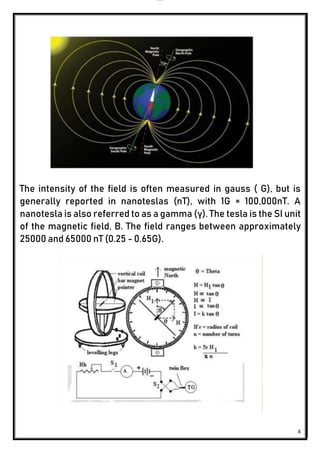
The intensity of the field is often measured in gauss ( G), but is
generally reported in nanoteslas (nT), with 1G = 100,000nT. A
nanotesla is also referred to as a gamma (γ). The tesla is the SI unit
of the magnetic field, B. The field ranges between approximately
25000 and 65000 nT (0.25 - 0.65G).
lOMoAR cPSD|24851617
5
Near the surface of the Earth, its magnetic field can be closely
approximated by the field of a magnetic dipole positioned at the
centre of the earth and tilted at an angle of about 10° with respect to
the rotational axis of the Earth. The dipole is roughly equivalent to a
powerful bar magnet, with its South Pole pointing towards the
geomagnetic North Pole. The North Pole of a magnet is so defined
because if allowed to rotate freely, it points roughly northward (in
thegeographicsense).Sincethenorthpoleofamagnetattractsthe
south poles of other magnet and repels the north pole, it must be
attracted to the south pole.
Bar magnet compass:
A magnetic field is invisible,but it can be detected using a magnetic
compass.Acompasscontainsasmallbarmagnetonapivotsothat
it can rotate. The compass needle points in the direction of the
Earth’s magnetic field or the magnetic field of the magnet.
Magneticfieldscanbe mappedout using smallplottingcompasses:
 Place the plotting compass near the magnet on a piece of
paper.
 Mark the direction of the compass needle points.
 Move the plotting compass to many different positions in
themagneticfield,markingtheneedledirectioneachtime.
 Join the points to show the field lines.
 The needle of a plotting compass points to the south pole
of the magnet.
The Earth’s Magnetic field:
lOMoAR cPSD|24851617
6
The behaviour of a compass shows that the earth has a magnetic
field. Scientists believe that this field is produced by convection
currents in the Earth’s core, which is made from iron and nickel.
When a plotting compass is placed in the Earth’s magnetic field, the
northpoleofthecompasswilllineupwiththeEarth’smagneticfield
lines and point to the magnetic south.
Drawing a Magnetic field:
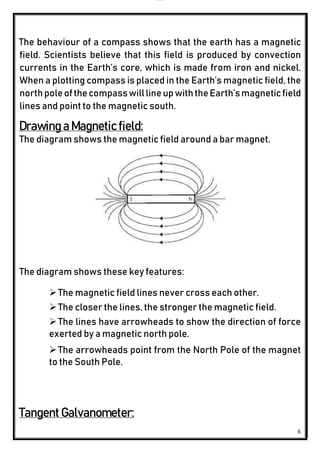
The diagram shows the magnetic field around a bar magnet.
The diagram shows these key features:
The magnetic field lines never cross each other.
The closer the lines, the stronger the magnetic field.
The lines have arrowheads to show the direction of force
exerted by a magnetic north pole.
The arrowheads point from the North Pole of the magnet
to the South Pole.
Tangent Galvanometer:
lOMoAR cPSD|24851617
7
Definition
 Tangent galvanometer is the device which was used to
measure small amounts of electric current.
Principle
The tangent galvanometer works on the principle of tangent law.
Tangent law of Magnetism
 The tangent law of magnetism states that the tangent of the
angleofacompassneedlewhichisduetothemovementunder
the influence of magnetic field is directly proportional to the
ratio of strengths of two perpendicular magnetic fields.
 In simpler words, the tangent of the angle made by the moving
needle under the magnetic field directly indicates the strength
of the perpendicular magnetic fields.
lOMoAR cPSD|24851617
8
APPARATUS AND MATERIALS REQUIRED:
 Accumulator
 Rheostat
 Ammeter
 Commutator
 Tangent galvanometer
 White paper sheet
 Drawing board
 Adhesive tape
 Bar magnet
 Iron fillings
 Magnetic compass
lOMoAR cPSD|24851617
9
THEORY:
 The reduction factor of tangent galvanometer is K= I / tan θ
where I is the current flowing through tangent
galvanometer which produces the deflection θ.
 The horizontal intensity of earth’s magnetic field at a place
Bh = µonK/2r, where n is the number of turns of coil, µo = 4π x
10-7
N A-2
isthepermeability of free space,Kisthe reduction
factor of the tangent galvanometer and r is the radius of the
coil of the tangent galvanometer.
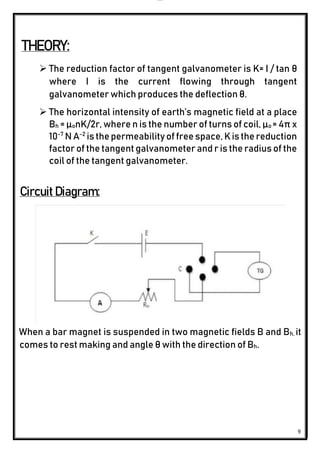
Circuit Diagram:
When a bar magnet is suspended in two magnetic fields B and Bh, it
comes to rest making and angle θ with the direction of Bh.
lOMoAR cPSD|24851617
10
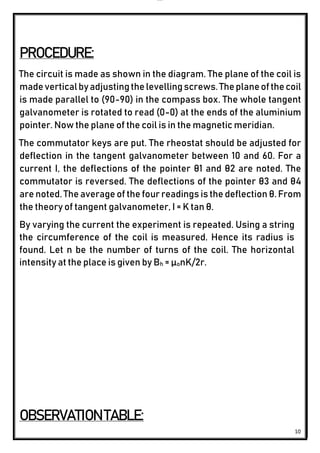
PROCEDURE:
The circuit is made as shown in the diagram. The plane of the coil is
madeverticalbyadjustingthelevellingscrews.Theplaneofthecoil
is made parallel to (90-90) in the compass box. The whole tangent
galvanometer is rotated to read (0-0) at the ends of the aluminium
pointer. Now the plane of the coil is in the magnetic meridian.
The commutator keys are put. The rheostat should be adjusted for
deflection in the tangent galvanometer between 10 and 60. For a
current I, the deflections of the pointer θ1 and θ2 are noted. The
commutator is reversed. The deflections of the pointer θ3 and θ4
are noted. The average of the four readings is the deflection θ. From
the theory of tangent galvanometer, I = K tan θ.
By varying the current the experiment is repeated. Using a string
the circumference of the coil is measured. Hence its radius is
found. Let n be the number of turns of the coil. The horizontal
intensity at the place is given by Bh = µonK/2r.
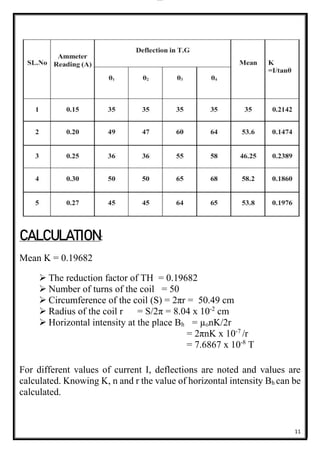
OBSERVATION TABLE:
lOMoAR cPSD|24851617
11
CALCULATION:
Mean K = 0.19682
 The reduction factor of TH = 0.19682
 Number of turns of the coil = 50
 Circumference of the coil (S) = 2πr = 50.49 cm
 Radius of the coil r = S/2π = 8.04 x 10⁻²
cm
 Horizontal intensity at the place Bh = µonK/2r
= 2πnK x 10-7
/r
= 7.6867 x 10⁻⁸
T
For different values of current I, deflections are noted and values are
calculated. Knowing K, n and r the value of horizontal intensity Bh can be
calculated.
lOMoAR cPSD|24851617
12
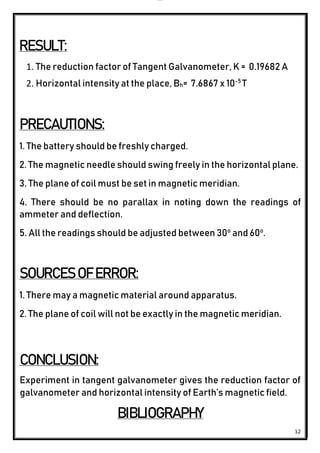
RESULT:
1. The reduction factor of Tangent Galvanometer, K = 0.19682 A
2. Horizontal intensity at the place, Bh= 7.6867 x 10⁻⁵
T
PRECAUTIONS:
1. The battery should be freshly charged.
2. The magnetic needle should swing freely in the horizontal plane.
3. The plane of coil must be set in magnetic meridian.
4. There should be no parallax in noting down the readings of
ammeter and deflection.
5. All the readings should be adjusted between 30o
and 60o
.
SOURCES OF ERROR:
1. There may a magnetic material around apparatus.
2. The plane of coil will not be exactly in the magnetic meridian.
CONCLUSION:
Experiment in tangent galvanometer gives the reduction factor of
galvanometer and horizontal intensity of Earth’s magnetic field.
BIBLIOGRAPHY
lOMoAR cPSD|24851617
13
 Tangent Galvanometer (Procedure):Comprehensive Physics
Activities Volume I :Laxmi Publications Pvt Ltd.
 Tangent Galvanometer (Theory): Comprehensive Physics
Activities Volume I : Laxmi Publications Pvt Ltd.
 Tangent Galvanometer (Precautions and Sources of
error):Comprehensive Physics Activities Volume I : Laxmi
Publications Pvt Ltd.
 Galvanometer:http://physics.kenyon.edu/EarlyApparatus/El
ectrical_Measurements/Tangent_Galvanometer/Tangent_Gal
vanometer.html
 Galvanometer:Wikipedia,thefreeencyclopediaen.wikipedia.or
g/wiki/Galvanometer

Phy invest. (1).docx

  • 1.
    lOMoAR cPSD|24851617 1 LIST OFCONTENTS S.No Topic Page no. 1. Aim 2 2. Introduction 3-7 3. Apparatus and Materials Required 8 4. Theory 9 5. Procedure 10 6. Observation Table and Calculation 11 7. Result 12 8. Precautions and Sources of error 12 9. Bibliography 13
  • 2.
    lOMoAR cPSD|24851617 2 AIM: To studythe Earth’s magnetic field using a compass needle bar magnet by plotting magnetic field line and tangent galvanometer. Tangent Galvanometer
  • 3.
    lOMoAR cPSD|24851617 3 INTRODUCTION: Earth’s magneticfield also known as the geomagnetic field, is the magnetic field that extends from the earth’s interior to where it meets the solar wind, a stream of charged particles emanating from the sun. Its magnitudeatthe Earth’ssurface ranges from25 to 65 micro teslas 90.23 to 0.65 gauss). Roughly speaking it is the field of magnetic dipole currently tilted at an angle of about 10 degrees with respect toEarth’s rotational axis as if these were a bar magnet placed at that angle at the centre of the Earth. Unlike a bar magnet, however Earth’s magnetic field changes over time because it is generated by a geodynamic. The North andSouth magnetic poles wanderwidely, but sufficiently slowly for ordinary compasses to remain useful for navigation. However at irregular intervals averaging several hundred, thousand years, the Earth’s field reverses and the North and South magnetic poles relatively abruptly switch places. These reversals of the geomagnetic poles leave a record in rocks that are of value to paleomagnetists in calculatinggeomagneticfields in the past.Such information in turn is helpful in studying the motions of continents and ocean floors in the process of plate tectonics. The magnetosphere is the region above the ionosphere and extends several tens of thousands of kilometres into space, protecting the earth from the charged particles of the solar wind and cosmic rays that would otherwise strip away the upper atmosphere including the ozone layer one stripping mechanism is for gas to be caught in bubbles of magnetic field which are ripped off by solar winds.
  • 4.
    lOMoAR cPSD|24851617 4 The intensityof the field is often measured in gauss ( G), but is generally reported in nanoteslas (nT), with 1G = 100,000nT. A nanotesla is also referred to as a gamma (γ). The tesla is the SI unit of the magnetic field, B. The field ranges between approximately 25000 and 65000 nT (0.25 - 0.65G).
  • 5.
    lOMoAR cPSD|24851617 5 Near thesurface of the Earth, its magnetic field can be closely approximated by the field of a magnetic dipole positioned at the centre of the earth and tilted at an angle of about 10° with respect to the rotational axis of the Earth. The dipole is roughly equivalent to a powerful bar magnet, with its South Pole pointing towards the geomagnetic North Pole. The North Pole of a magnet is so defined because if allowed to rotate freely, it points roughly northward (in thegeographicsense).Sincethenorthpoleofamagnetattractsthe south poles of other magnet and repels the north pole, it must be attracted to the south pole. Bar magnet compass: A magnetic field is invisible,but it can be detected using a magnetic compass.Acompasscontainsasmallbarmagnetonapivotsothat it can rotate. The compass needle points in the direction of the Earth’s magnetic field or the magnetic field of the magnet. Magneticfieldscanbe mappedout using smallplottingcompasses:  Place the plotting compass near the magnet on a piece of paper.  Mark the direction of the compass needle points.  Move the plotting compass to many different positions in themagneticfield,markingtheneedledirectioneachtime.  Join the points to show the field lines.  The needle of a plotting compass points to the south pole of the magnet. The Earth’s Magnetic field:
  • 6.
    lOMoAR cPSD|24851617 6 The behaviourof a compass shows that the earth has a magnetic field. Scientists believe that this field is produced by convection currents in the Earth’s core, which is made from iron and nickel. When a plotting compass is placed in the Earth’s magnetic field, the northpoleofthecompasswilllineupwiththeEarth’smagneticfield lines and point to the magnetic south. Drawing a Magnetic field: The diagram shows the magnetic field around a bar magnet. The diagram shows these key features: The magnetic field lines never cross each other. The closer the lines, the stronger the magnetic field. The lines have arrowheads to show the direction of force exerted by a magnetic north pole. The arrowheads point from the North Pole of the magnet to the South Pole. Tangent Galvanometer:
  • 7.
    lOMoAR cPSD|24851617 7 Definition  Tangentgalvanometer is the device which was used to measure small amounts of electric current. Principle The tangent galvanometer works on the principle of tangent law. Tangent law of Magnetism  The tangent law of magnetism states that the tangent of the angleofacompassneedlewhichisduetothemovementunder the influence of magnetic field is directly proportional to the ratio of strengths of two perpendicular magnetic fields.  In simpler words, the tangent of the angle made by the moving needle under the magnetic field directly indicates the strength of the perpendicular magnetic fields.
  • 8.
    lOMoAR cPSD|24851617 8 APPARATUS ANDMATERIALS REQUIRED:  Accumulator  Rheostat  Ammeter  Commutator  Tangent galvanometer  White paper sheet  Drawing board  Adhesive tape  Bar magnet  Iron fillings  Magnetic compass
  • 9.
    lOMoAR cPSD|24851617 9 THEORY:  Thereduction factor of tangent galvanometer is K= I / tan θ where I is the current flowing through tangent galvanometer which produces the deflection θ.  The horizontal intensity of earth’s magnetic field at a place Bh = µonK/2r, where n is the number of turns of coil, µo = 4π x 10-7 N A-2 isthepermeability of free space,Kisthe reduction factor of the tangent galvanometer and r is the radius of the coil of the tangent galvanometer. Circuit Diagram: When a bar magnet is suspended in two magnetic fields B and Bh, it comes to rest making and angle θ with the direction of Bh.
  • 10.
    lOMoAR cPSD|24851617 10 PROCEDURE: The circuitis made as shown in the diagram. The plane of the coil is madeverticalbyadjustingthelevellingscrews.Theplaneofthecoil is made parallel to (90-90) in the compass box. The whole tangent galvanometer is rotated to read (0-0) at the ends of the aluminium pointer. Now the plane of the coil is in the magnetic meridian. The commutator keys are put. The rheostat should be adjusted for deflection in the tangent galvanometer between 10 and 60. For a current I, the deflections of the pointer θ1 and θ2 are noted. The commutator is reversed. The deflections of the pointer θ3 and θ4 are noted. The average of the four readings is the deflection θ. From the theory of tangent galvanometer, I = K tan θ. By varying the current the experiment is repeated. Using a string the circumference of the coil is measured. Hence its radius is found. Let n be the number of turns of the coil. The horizontal intensity at the place is given by Bh = µonK/2r. OBSERVATION TABLE:
  • 11.
    lOMoAR cPSD|24851617 11 CALCULATION: Mean K= 0.19682  The reduction factor of TH = 0.19682  Number of turns of the coil = 50  Circumference of the coil (S) = 2πr = 50.49 cm  Radius of the coil r = S/2π = 8.04 x 10⁻² cm  Horizontal intensity at the place Bh = µonK/2r = 2πnK x 10-7 /r = 7.6867 x 10⁻⁸ T For different values of current I, deflections are noted and values are calculated. Knowing K, n and r the value of horizontal intensity Bh can be calculated.
  • 12.
    lOMoAR cPSD|24851617 12 RESULT: 1. Thereduction factor of Tangent Galvanometer, K = 0.19682 A 2. Horizontal intensity at the place, Bh= 7.6867 x 10⁻⁵ T PRECAUTIONS: 1. The battery should be freshly charged. 2. The magnetic needle should swing freely in the horizontal plane. 3. The plane of coil must be set in magnetic meridian. 4. There should be no parallax in noting down the readings of ammeter and deflection. 5. All the readings should be adjusted between 30o and 60o . SOURCES OF ERROR: 1. There may a magnetic material around apparatus. 2. The plane of coil will not be exactly in the magnetic meridian. CONCLUSION: Experiment in tangent galvanometer gives the reduction factor of galvanometer and horizontal intensity of Earth’s magnetic field. BIBLIOGRAPHY
  • 13.
    lOMoAR cPSD|24851617 13  TangentGalvanometer (Procedure):Comprehensive Physics Activities Volume I :Laxmi Publications Pvt Ltd.  Tangent Galvanometer (Theory): Comprehensive Physics Activities Volume I : Laxmi Publications Pvt Ltd.  Tangent Galvanometer (Precautions and Sources of error):Comprehensive Physics Activities Volume I : Laxmi Publications Pvt Ltd.  Galvanometer:http://physics.kenyon.edu/EarlyApparatus/El ectrical_Measurements/Tangent_Galvanometer/Tangent_Gal vanometer.html  Galvanometer:Wikipedia,thefreeencyclopediaen.wikipedia.or g/wiki/Galvanometer