PERMEABILITY OF
ROCKS
Permeability
The permeability of rock is a measure of the ease
with which the rock will permit the passage of fluids.
The fundamental physical law which governs this is
the Navier-Stokes equation.
We assume the flow of fluids in rock as laminar.
Calculation of permeability
The fluid flow through a cylindrical tube is given by the simplified
Navier-Stokes equation for laminar flow and uncompressible fluids.
The equation can be expressed as:-
About 150 years ago, Darcy carried out several experiments and then
developed an empirical formula that remains the main permeability
formula. Darcy's formula is given as:-
Where
Q= the flow rate
r = the radius of the tube (cm /m)
= the outlet fluid pressure(Pa)
= the inlet fluid pressure(Pa)
m= the dynamic viscosity of the fluid(Pa)
L= length of the tube(cm or m)
k = permeability of the sample(darcy)
A = area of the sample
Absolute permeability:-Absolute permeability is an ability to flow
fluid through a permeable rock when only one type of fluid is in the
rock pore spaces.
Effective permeability:-Effective permeability of rock to a fluid phase
(oil, gas, or water) in porous medium is a measure of the ability of that
phase to flow in the presence of other fluid phases.
Relative permeability:-Relative permeability is the ratio of effective
permeability of a particular fluid at a particular saturation to absolute
permeability of that fluid at total saturation. If a single fluid is present
in a rock, its relative permeability is 1.0.
There are three types of permeability:-
1.
2.
3.
Types of Permeability
Textural properties-
Amount, distribution and type of clays
Overburden pressure
Impurities in water
High velocity flow effects
Numerous factors affect the magnitude & or direction of the
permeability:-
a. Pore size b. Grain size distribution
c. shape of grains d. Packing of grains
F A C T O R S A F F E C T I N G P E R M E A B I L I T Y O F R O C K S
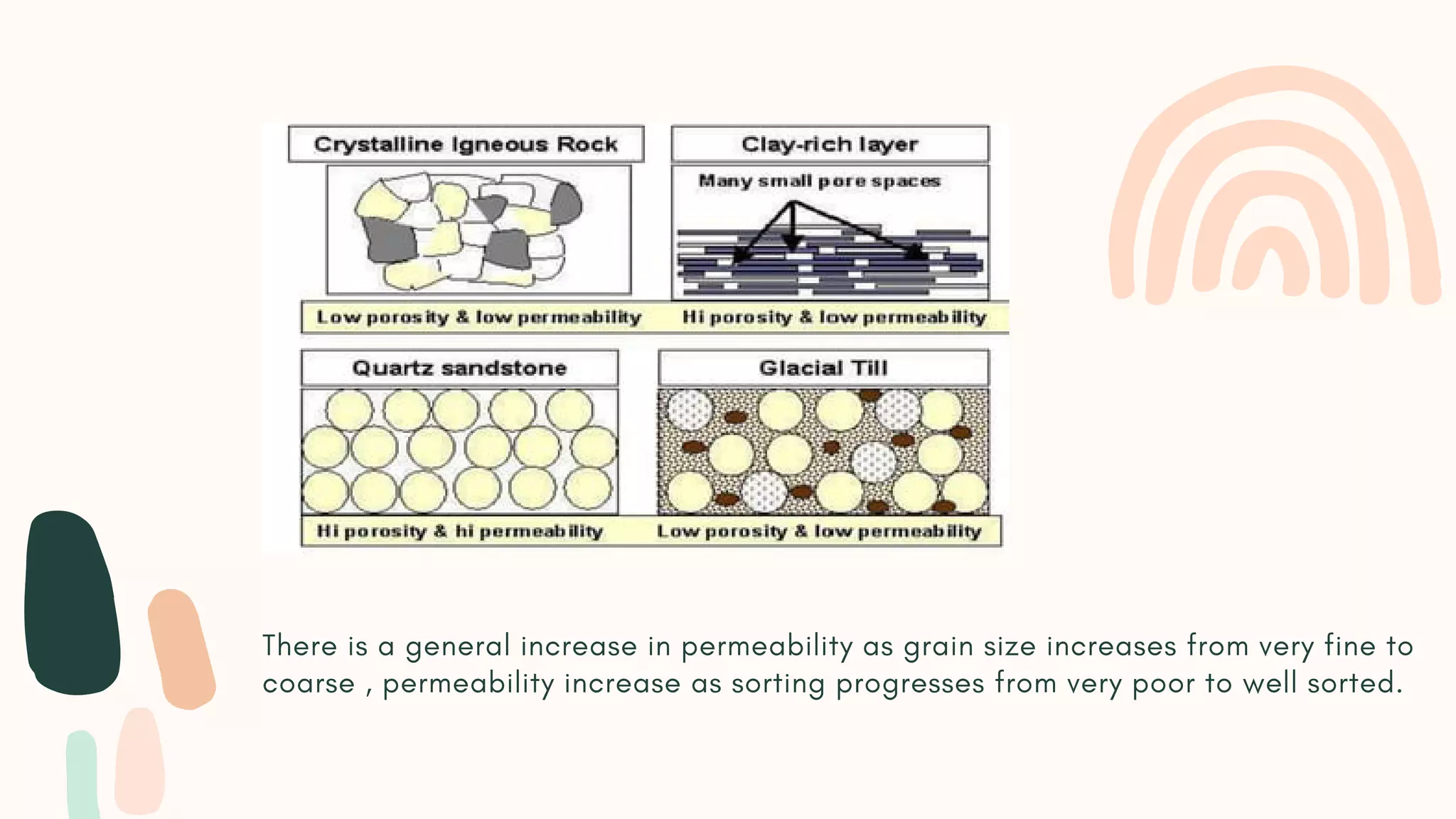
There is a general increase in permeability as grain size increases from very fine to
coarse , permeability increase as sorting progresses from very poor to well sorted.
SI unit for permeability is
A particle unit for permeability is darcy(d) or more
commonly the millidarcy(md).(1 darcy = )
UNIT:
Thank
you

Permeability of rocks.pdf

  • 1.
  • 2.
    Permeability The permeability ofrock is a measure of the ease with which the rock will permit the passage of fluids. The fundamental physical law which governs this is the Navier-Stokes equation. We assume the flow of fluids in rock as laminar.
  • 3.
    Calculation of permeability Thefluid flow through a cylindrical tube is given by the simplified Navier-Stokes equation for laminar flow and uncompressible fluids. The equation can be expressed as:- About 150 years ago, Darcy carried out several experiments and then developed an empirical formula that remains the main permeability formula. Darcy's formula is given as:- Where Q= the flow rate r = the radius of the tube (cm /m) = the outlet fluid pressure(Pa) = the inlet fluid pressure(Pa) m= the dynamic viscosity of the fluid(Pa) L= length of the tube(cm or m) k = permeability of the sample(darcy) A = area of the sample
  • 4.
    Absolute permeability:-Absolute permeabilityis an ability to flow fluid through a permeable rock when only one type of fluid is in the rock pore spaces. Effective permeability:-Effective permeability of rock to a fluid phase (oil, gas, or water) in porous medium is a measure of the ability of that phase to flow in the presence of other fluid phases. Relative permeability:-Relative permeability is the ratio of effective permeability of a particular fluid at a particular saturation to absolute permeability of that fluid at total saturation. If a single fluid is present in a rock, its relative permeability is 1.0. There are three types of permeability:- 1. 2. 3. Types of Permeability
  • 5.
    Textural properties- Amount, distributionand type of clays Overburden pressure Impurities in water High velocity flow effects Numerous factors affect the magnitude & or direction of the permeability:- a. Pore size b. Grain size distribution c. shape of grains d. Packing of grains F A C T O R S A F F E C T I N G P E R M E A B I L I T Y O F R O C K S
  • 6.
    There is ageneral increase in permeability as grain size increases from very fine to coarse , permeability increase as sorting progresses from very poor to well sorted.
  • 7.
    SI unit forpermeability is A particle unit for permeability is darcy(d) or more commonly the millidarcy(md).(1 darcy = ) UNIT:
  • 8.