PERIODONTAL DISEASE
ETIOLOGY, PROGRESSION, AND PROCEDURES
INTRODUCTION
 The periodontist specializes in diseases of the tissue
around the root of the tooth
 This specialty deals with symptoms, probable causes,
diagnoses, and treatment of periodontal disease
PERIODONTAL TEAM
 The team in a periodontal office includes the periodontist,
dental assistants, dental hygienists, and business staff
 The periodontist coordinates treatment with the general
dentists In the overall care of the patient
 The periodontist screens the patient, performs the surgical
care, and provides continual care according to the patient’s
needs
PERIODONTAL TEAM
 The Dental Assistant
 Performs chairside assisting duties and expanded functions allowed by
state Dental Practice Acts
 Placing and removing periodontal dressing
 Removing sutures
 Performing coronal polishes
 Takes radiographs, takes impressions for study models, places
sealants, and administers fluoride treatments
PERIODONTAL TEAM
 Dental Assistant continued…
 Gives pre and postoperative instructions and prepares the treatment
room for surgery
 All in addition to treatment room preparation and maintenance and
sterilization procedures
 Involved in educating and motivating the patient throughout the
treatment
 Also may perform lab tasks, such as pouring study models
PERIODONTAL TEAM CONTINUED
 The Dental Hygienist
 Performs traditional hygiene procedures and, depending on the
state, administer local anesthetic
 In a periodontal practice, the hygienist often sees patients who
have more advanced periodontal disease; therefore,
responsibilities include root planning and clinical examination
procedures
PERIODONTAL DISEASE
 According to the American Academy of Periodontology,
three out of four adults will experience, to some degree,
periodontal problems at some time in their lives
 Periodontal disease occurs in children and adolescents
with marginal gingivitis and gingival recession
 The most prevalent conditions
 Periodontal disease involves the periodontium, which
represents the tissues that support the teeth
PERIODONTIUM
 Periodontium: the tissues that support the teeth
 *Gingiva—tissues that surround the teeth
 *Periodontal ligaments—fibers that surround the root
of the tooth and attach the cementum to the bone
 *Cementum—hard surface that covers the dentin on
the root of the tooth
PERIODONTIUM
 *Alveolar Bone—bone that forms the socket that
encases the root of the tooth
 Sulcus—space between the tooth and the free
gingiva. In healthy mouths, the sulcus is 1 to 3 mm
deep
 Epithelial Attachment—area at the bottom of the
sulcus where the gingiva attaches to the tooth
SYMPTOMS OF PERIODONTAL DISEASE
 Bleeding gums
 Loose teeth (mobility)
 Inflamed gingiva
 Abnormal contour of the
gingiva
 Periodontal pocket formation
 Malocclusions
 Halitosis
 Pain and tenderness
 Recession and discoloration
 All of these symptoms may be
present or the symptoms may
vary
CAUSES OF PERIODONTAL DISEASE
 Local irritants are a significate cause of periodontal disease
 One irritant, bacterial plaque, is a common cause of the inflammation
of the gingival tissues
 Bacterial plaque forms around the margin of the gingiva and, if left
undisturbed, mineralizes and appears as a yellow or brown deposit on
the teeth
 The mineralized, hard deposit is called calculus
 If plaque and calculus are not removed, they continue to grow and
develop on both supragingival and subgingival surfaces
CAUSES OF PERIODONTAL DISEASE CONT…
 Poor oral hygiene results in the buildup of plaque and
calculus
 When we do not brush and floss daily this can lead to plaque
formation and debris build up on the teeth
 Improper nutrition leads to overall poor health, which
often is evident in the gingival tissues
 When we eat a balanced diet, including foods that keep teeth
strong and the tissues free of disease, this can aid in maintaining
healthy mouth
CAUSES OF PERIODONTAL DISEASE CONT…
 Malocclusions can be a factor in periodontal disease
 Improper tooth alignment and occlusion can lead to
plaque and calculus formation in areas where food and
debris are not removed easily
 Patients with sensitive teeth or who need dental
restorations will favor these areas and alter chewing
patterns, putting additional pressure on periodontal
structures
CAUSES OF PERIODONTAL DISEASE CONT…
 Stress can lead to bruxism (grinding of teeth), which
puts pressure on the teeth and surrounding tissues
 The patient may not eat healthy foods or maintain
proper oral hygiene at a time of stress
CAUSES OF PERIODONTAL DISEASE CONT…
Systemic factors, including hormonal imbalances, hereditary
predispositions, and certain disease and medications, are often
reflected in the gingival tissues
 Hormonal changes due to
pregnancy
 Diabetes
 Cardiovascular disease
 Such as hypertension
 Blood disease
 Such as leukemia
 HIV infection
 Genetic conditions
 Such as down syndrome
 Emotional disorders,
 Systemic drugs
 Such as Dilantin or
immunosuppressant's
 Thyroid deficiencies
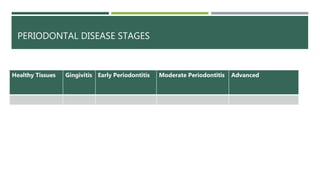
PERIODONTAL DISEASE STAGES
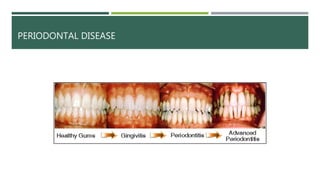
Healthy Tissues Gingivitis Early Periodontitis Moderate Periodontitis Advanced
PERIODONTAL DISEASE
CLASSIFICATIONS OF PERIODONTAL DISEASE
 There are two main classifications of periodontal disease
1. Gingivitis
2. Periodontitis
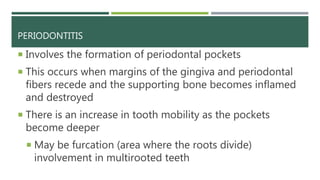
GINGIVITIS
 Inflammation of the gingival
tissues
 Common in all ages
 Causes may include
 Buildup of plaque and
calculus
 Poor-fitting appliances
 Poor occlusion
 Condition may occur in
association with
 Certain systemic diseases
(scurvy)
 Hormonal changes (pregnancy)
 Prolonged drug therapy
GINGIVITIS CONT…
 The tissues become reddish in color
 Interdental papilla may be swollen and bulbous
 Tissues may bleed after brushing and flossing
 Gingivitis precedes periodontitis but does not always
progress to it
 Proper brushing and flossing can reverse this condition in
some cases by removing the plaque
GINGIVITS
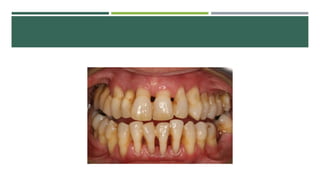
PERIODONTITIS
 Involves the formation of periodontal pockets
 This occurs when margins of the gingiva and periodontal
fibers recede and the supporting bone becomes inflamed
and destroyed
 There is an increase in tooth mobility as the pockets
become deeper
 May be furcation (area where the roots divide)
involvement in multirooted teeth
PERIODONTITIS
 Chronic periodontitis
 A progressive disease process with the patient experiencing loss
of tissue attachment and bone
 Aggressive periodontitis
 Form of periodontitis that acts rapidly and aggressively destroys
the tissue attachment and bone
PERIODONTITIS
 Necrotizing Ulcerative Gingivitis (NUG)
 Occurs most frequently in your adults 16-30
 Causes include stress, smoking, inadequate diet, and poor oral
hygiene
 Characteristics are inflamed gingiva, metallic taste, halitosis, pain,
and hemorrhage of the tissues
 Also knows as Vincent's disease and trench mouth
 Appears in individuals in the same unhealthy state and
frequently occurs in the college students around the time of final
examinations
PERIODONTITIS
 Necrotizing Ulcerative Periodontitis (NUP)
 HIV periodontitis
 Not limited to HIV patients, but is also seen in patients who are
severely malnourished and immunosuppressed
 Often in severe pain, sites bleed easily, and tissue and bone
destruction is extensive
PERIODONTAL DIAGNOSTIC PROCEDURES
 The first appointment with the periodontist is often an information-gathering appointment
 After completing the medical history, the patient is seated in the treatment room for an extraoral
and intraoral examination
 Radiographs and impressions are taken and periodontal screening is completed
 Developing rapport with the patient is essential for successful treatment; the patient must have
confidence in the dentist and the staff
 The patient has responsibility in the treatment of periodontal disease and should be educated
and motivated
 Importance of following OHI
 Diet suggestions and modifications
 Personal habit changes
 Routine office visits
MEDICAL DENTAL HISTORY
 Gives the operator and the patient the opportunity to learn about each other
 The operator gains information about
 Why the patient is seeking treatment
 If there is a systemic condition
 TB, HIV, AIDS, or diabetes
 How the patient feels about his or her teeth
 Previous dental treatment
 If the patient has any oral habits that have contributed to the present oral
condition
MEDICAL DENTAL HISTORY
 The patient has the opportunity to ask questions of the dentist and
gain an understanding of what is involved with periodontal
treatment
 The patients history must be accurate and complete
 A history checklist should open the way for significant conversation
between the patient, the DA, and/or the dentist
MEDICAL HISTORY
 Chief complaints
 Why did you come to the periodontist?
 What areas of your mouth are causing you concern?
 Any pain?
MEDICAL HISTORY
 Medical history
 Are you ill at this time?
 Currently undergoing any medical treatments?
 Medications?
 Allergies?
 List of conditions, diseases, ect to choose from
MEDICAL HISTORY
 Oral History
 Extractions? Restorations?
 Any problems after dental treatment?
 Any problems with your teeth, such as bleeding gums, pain,
mobility, sensitivity?
MEDICAL HISTORY
 Oral Habits
 Grinding, clenching, or mouth breathing?
 Do you smoke?
 Do you use alcohol or drugs?
MEDICAL HISTORY
 Family History
 History of periodontal disease?
 Oral Hygiene
 Which brushing technique do you use?
 Do you floss?
 What type of toothbrush and toothpaste do you use?
 Any kind of oral hygiene aids?
CLINICAL EXAMINATION
 Includes
 An extraoral exanimation of the face and neck
 An intraoral examination of the tongue, palate, buccal
mucosa, the teeth, and the oropharynx area
 The periodontal examination
EXTRAORAL EXAMINATION
 Includes observation of the skin and lips and
palpation of the lymph nodes and the
temporomandibular joint
INTRAORAL EXAMINATION
 Combines viewing and palpitating the tissues in the oral cavity
 The operator looks for abnormalities in the color, size, texture, and
consistency of all tissues
 Includes an oral cancer screening
 The condition of the teeth and any prosthetic appliances are
examined, noting any areas that might cause or contribute to
periodontal disease
 Any necessary treatment is recorded in the patients chart
 https://www.youtube.com/watch?v=yY9-7pOTROM
PERIODONTAL EXAMINATION
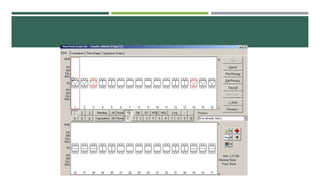
 A thorough examination of the periodontium using
periodontal charts
 Theses depict the condition of the patient’s periodontal
tissues
 Charting is either completed manually or on a computer
 The oral cavity is examined, and information is gathered
by the dentist or hygienist while the DA records the
information on the periodontal chart
PERIODONTAL EXAMINATION
 Patient oral hygiene is evaluated
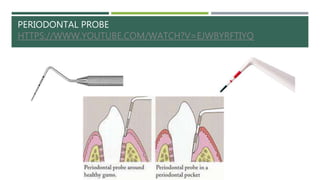
 Periodontal probing measures the depth of the periodontal pocket
(depth of the sulcus) with a periodontal probe
 When the depth is greater than 3mm, it is termed a periodontal
pocket
 Six sites are probed and recorded on each tooth
 3 sites on the facial, and 3 sites on the lingual
 Probe is inserted unto the sulcus until the operator feels
resistance
 Calibrations on the probe measure the depth of the pocket
PERIODONTAL EXAMINATION
 Tooth mobility measures movement of the tooth within the socket
 Furcation involvement measures destruction of interradicular bone
in the furcation area of the multirooted teeth
 Appearance of the gingiva is evaluated in terms of color, size,
shape, texture, positon, consistency, bleeding, and amount of
exudate
 Bleeding during probing
 Recession of the gingival margin
 Occlusion is evaluated and described
PERIODONTAL SCREENING AND RECORDING SYSTEM (PSR)
 Another method that is used to evaluate the periodontal health of
a patient
 Designed to provide a simple, standardized system to effectively
screen and provide for detection of periodontal disease
 Not meant to replace the traditional periodontal exam, but it does
indicate when a partial or full periodontal eval is needed
 Involved dividing the mouth into sextant sections
 A specially designed probe is used
 All six areas on each tooth are probed, but only the highest
screening score in each sextant is recorded
RADIOGRAPHIC INTERPRETATION
 Radiographs show the teeth and the level and position of
the alveolar bone
 When periodontal disease is present, the alveolar bone
recedes both vertically and/or horizontally
 X-rays must be as dimensionally accurate as possible
 Usually, a full-mouth series is taken; panoramic
radiographs are also taken as an adjunct
PRESENTATION OF TREATMENT PLAN
 Periodontist determines the appropriate treatment plan
for the patient
 Charts, radiographs, study models, and photographs are
used to educate the patient at a consultation appointment
 The patients role in the treatment in discussed
 Must be actively involved in the treatment and
motivated to follow the home-care plan and keep
treatment appointments
CHEMOTHERAPEUTIC AGENTS
 Most patients have an excellent response to mechanical removal of plaque
and calculus from the tooth root surface
 For those that do not respond to the removal of deposits, and/or for those
that have aggressive forms of perio, the periodontist may also prescribe
therapeutic agents
 Including antibiotics and nonsteroidal anti-inflammatory agents
 Administered days to weeks before surgical procedures and during and after
nonsurgical treatments
 The anti-inflammatory drugs reduce the level of inflammation
 Ibuprofen and aspirin
PERIODONTAL INSTRUMENTS
 Periodontal instruments are designed to probe, scrape,
file, and cut the hard surfaces of the teeth, alveolar bone,
and soft tissues of the gingiva
 Must be kept sharp
 Usually the hygienist is responsible for maintaining
periodontal hand instruments
INSTRUMENT SHARPENING
 Sharp edges make the operators work easier and faster,
improve the quality of the procedures, and enhance
patient comfort
 Can be done manually or mechanically
PERIODONTAL PROBES
 The primary instrument used in the periodontal
examination
 Is used to measure the depth of the periodontal pockets
 Also, recession, bleeding, or exudate
 Calibrations on the probe are in millimeters and vary
depending on the manufacturer and operators preference
 Marking may be indentations or color coded
PERIODONTAL PROBE
HTTPS://WWW.YOUTUBE.COM/WATCH?V=EJWBYRFTIYQ
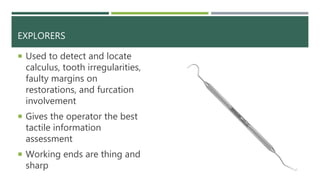
EXPLORERS
 Used to detect and locate
calculus, tooth irregularities,
faulty margins on
restorations, and furcation
involvement
 Gives the operator the best
tactile information
assessment
 Working ends are thing and
sharp
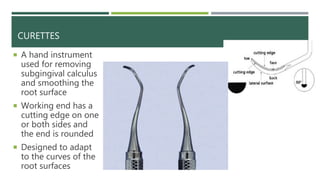
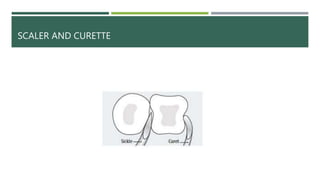
CURETTES
 A hand instrument
used for removing
subgingival calculus
and smoothing the
root surface
 Working end has a
cutting edge on one
or both sides and
the end is rounded
 Designed to adapt
to the curves of the
root surfaces
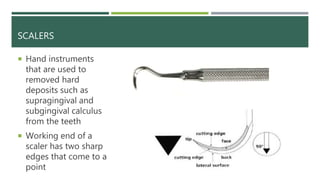
SCALERS
 Hand instruments
that are used to
removed hard
deposits such as
supragingival and
subgingival calculus
from the teeth
 Working end of a
scaler has two sharp
edges that come to a
point
SCALER AND CURETTE
FILES
 Used in a pulling motion interproximally to remove
calculus and for root planning
 Also used to remove overhanging margins of dental
restoration
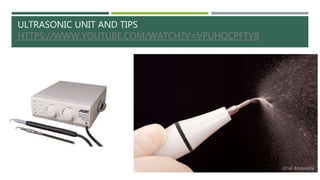
ULTRASONIC INSTRUMENTS
 Used to remove hard deposits, stains, and debris during scaling,
and root-planning procedures
 Typically used as an adjunct to manual scaling procedures
 They generate high-power vibrations to a headpiece with a variety
of tips
 These vibrations cause calculus to fracture and be dislodged
 Cause heat, the units have cooling systems that circulate water
through the hand pieces and out openings at the tip
 The water spray cools and also flushes the area
ULTRASONIC UNIT AND TIPS
HTTPS://WWW.YOUTUBE.COM/WATCH?V=VPUHQCPFTV8
AIR POLISHING SYSTEMS
 Method used by the dentist or the hygienist to polish the
teeth following a prophy
 Primary objective of polishing is to remove extrinsic stain,
supragingival plaque and soft debris while polishing the tooth
surface
 Also used to clean the tooth prior to sealant placement and
bonding procedures
 Uses a fine powder abrasive, air that is delivered under
pressure, and water through the nozzle of the hand piece
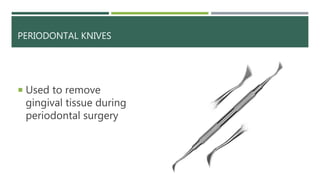
PERIODONTAL KNIVES
 Used to remove
gingival tissue during
periodontal surgery
INTERDENTAL KNIVES
 These are periodontal knives that are used to remove soft
tissue interproximally
SURGICAL SCALPEL
 Used to periodontal surgical procures to remove gingival
tissue
ELECTROSURGERY
 Uses tiny electrical currents to incise the gingival tissue
and also coagulate the blood during the procure
PERIOSTEAL ELEVATORS
 Used to reflect soft tissue away from the bone
PERIODONTAL SCISSORS, RONGEURS, AND FORCEPS
 Periodontal scissors: used during periodontal surgery,
mainly to remove tags of tissue and to trim margins
 Rongeurs: hinged pliers used to shape the soft tissue
 Tissue forceps: used to retract tissue or to hold the tissue
in place
LASERS
 A medical device that generates a precise beam of
concentrated light energy
 Dentist must complete training to become qualified to use
lasers
 Uses include procedures on hard and soft tissues
NONSURGICAL PERIODONTAL PROCEDURES
 Occlusal Adjustment
 Scaling and Polishing
 Root Planing
 Gingival Curettage
 Postoperative Treatment
OCCLUSAL ADJUSTMENT
 Involve adjustment of the occlusal surface to
eliminate detrimental forces and to provide
functional forces for stimulation of a healthy
periodontium
SCALING AND POLISHING
 Purpose is to remove plaque, calculus, and stains
 This procedure is called prophylaxis
 Can be performed by the dentist or hygienist
 Depending on the state Dental Practice Act, DA’s can
remove supragingival deposits and/or perform the coronal
polish
ROOT PLANING
HTTPS://WWW.YOUTUBE.COM/WATCH?V=87M28IRWEQM
 After the plaque and calculus are removed from the periodontal
pocket and root surface, the cementum is often rough and
irregular
 This provides a surface ideal for accumulation of plaque and
calculus formation
 The roughness is removed by root planning
 This is a process of planning or shaving the root surface with
curettes and other periodontal instruments to leave a smooth root
surface
 Anesthetic is sometimes given to the patients for comfort
GINGIVAL CURETTAGE
 A procedure that involves scraping the inner gingival walls
of the periodontal pockets to removed inflamed tissue and
debris
POSTOPERATIVE TREATMENT
 The DA, following the dentists directions, will give the patient
postoperative instructions including:
 Pain control: depending on the extent of the procedure and
tissues involved
 Oral hygiene
 Antibacterial therapy: rinse; also fluorides because they have
bactericidal effects against the formation of plaque
 Diet and smoking: avoid spicy foods, citrus fruits, and alcohol; no
smoking-irritates the tissues and delays the healing process
SURGICAL PERIODONTAL PROCEDURES
 Preoperative instructions
 Gingivectomy
 Gingivoplasty
 Periodontal Flap Surgery
 Osseous Surgery
 Mucogingival Surgery
 Gingival Grafting
 Frenectomy
 Guided Tissue Regeneration
GINGIVECTOMY
 Surgical removal of diseased gingival tissue that forms the
periodontal pocket
 The pocket must be eliminated to prevent the
accumulation of debris and bacteria
 Performed by a periodontist
GINGIVOPLASTY
 Reshaping the gingival tissue to remove deformities such
as clefts, craters, and enlargements
 Does not involve the removal of periodontal pockets; it is
completed to recontour the gingiva and often
immediately follows a gingivectomy
PERIODONTAL FLAP SURGERY
 Involves surgically separating the gingiva from the underlying
tissue
 Once the tissue is retraced, the periodontist has good visibility
and access to bone, tooth, and the tooth roots
 When the flap is retracted, the diseased tissue and debris are
removed, the roots are planed, and the alveolar bone is
trimmed and contoured
 A periodontal dressing may be applied to protect the surgical
site
OSSEOUS SURGERY
 Removes defects/deformities in the bone cause by periodontal disease and
other related conditions
 Bone grafting: offers some hope to restore lost bone and regeneration of a
functional attachment of the periodontium
 Several types of bone replacement grafts
 Autogenous: cortical can cancellous bone extracted from intraoral and extraoral sites
 Allogeneic: tissue transplanted between people of the same species
 Xenogeneic: tissues from a different species (cows and pigs are most often used for
humans)
 Alloplastic: various synthetic materials
 Autogenous have the best results
MUCOGINGIVAL SURGERY
 Reconstructive surgery on the gingiva and/or mucosa
tissues
 Two common examples of mucogingival surgery are
gingival grafting and the frenectomy
GINGIVAL GRAFTING
 Tissue is taken from one site and placed on another
 A graft is the then obtained from the donor site, often the palate
area
 This graft is positioned carefully and sutured securely in place
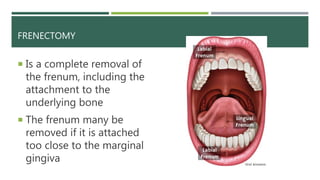
FRENECTOMY
 Is a complete removal of
the frenum, including the
attachment to the
underlying bone
 The frenum many be
removed if it is attached
too close to the marginal
gingiva
GUIDED TISSUE REGENERATION
 Uses barrier membranes to maintain a space between the
gingival flap and the root surface of the tooth in order for
tissues to regenerate in a periodontal defect
PERIODONTAL DRESSING
 Are placed after periodontal surgical procedures
 Do not have any medicinal qualities; they are bandages used to
protect the tissue during the healing process
 Objective of the periodontal dressing
 Minimizing postoperative infection and hemorrhage
 Protecting the tissues during mastication
 Covering the surgical site in order to reduce pain due to trauma or
irritation
 Providing support for teeth that are mobile
 Helping to hold flaps in position
TYPES OF PERIODONTAL DRESSINGS
 Zinc Oxide-Eugenol Materials
 Powder or liquid form that can be mixed before the procedure and stored for later use
 Eugenol can cause an allergic reaction
 Noneugenol Materials
 Two-paste system: one tube of base and one tube of accelerator
 Do not cause sensitivity problems
 Light-cured Periodontal Dressing
 Comes in syringes
 Placed over the tissues and then light cured
 Gelatin-base Dressings
 Good stability and dissolve in 24-48 hours
PERIODONTAL MAINTENANCE PROCEDURES
 The patient determines the success of the treatment by
being committed and following the designed therapy
 Perio disease is an ongoing process, but continual care
maintains the status of periodontal health after surgery
 Dedicated home oral-hygiene routines and periodic visits
to the dentist are necessary for successful periodontal care

Periodontal Disease PowerPoint

  • 1.
  • 2.
    INTRODUCTION  The periodontistspecializes in diseases of the tissue around the root of the tooth  This specialty deals with symptoms, probable causes, diagnoses, and treatment of periodontal disease
  • 3.
    PERIODONTAL TEAM  Theteam in a periodontal office includes the periodontist, dental assistants, dental hygienists, and business staff  The periodontist coordinates treatment with the general dentists In the overall care of the patient  The periodontist screens the patient, performs the surgical care, and provides continual care according to the patient’s needs
  • 4.
    PERIODONTAL TEAM  TheDental Assistant  Performs chairside assisting duties and expanded functions allowed by state Dental Practice Acts  Placing and removing periodontal dressing  Removing sutures  Performing coronal polishes  Takes radiographs, takes impressions for study models, places sealants, and administers fluoride treatments
  • 5.
    PERIODONTAL TEAM  DentalAssistant continued…  Gives pre and postoperative instructions and prepares the treatment room for surgery  All in addition to treatment room preparation and maintenance and sterilization procedures  Involved in educating and motivating the patient throughout the treatment  Also may perform lab tasks, such as pouring study models
  • 6.
    PERIODONTAL TEAM CONTINUED The Dental Hygienist  Performs traditional hygiene procedures and, depending on the state, administer local anesthetic  In a periodontal practice, the hygienist often sees patients who have more advanced periodontal disease; therefore, responsibilities include root planning and clinical examination procedures
  • 7.
    PERIODONTAL DISEASE  Accordingto the American Academy of Periodontology, three out of four adults will experience, to some degree, periodontal problems at some time in their lives  Periodontal disease occurs in children and adolescents with marginal gingivitis and gingival recession  The most prevalent conditions  Periodontal disease involves the periodontium, which represents the tissues that support the teeth
  • 8.
    PERIODONTIUM  Periodontium: thetissues that support the teeth  *Gingiva—tissues that surround the teeth  *Periodontal ligaments—fibers that surround the root of the tooth and attach the cementum to the bone  *Cementum—hard surface that covers the dentin on the root of the tooth
  • 9.
    PERIODONTIUM  *Alveolar Bone—bonethat forms the socket that encases the root of the tooth  Sulcus—space between the tooth and the free gingiva. In healthy mouths, the sulcus is 1 to 3 mm deep  Epithelial Attachment—area at the bottom of the sulcus where the gingiva attaches to the tooth
  • 10.
    SYMPTOMS OF PERIODONTALDISEASE  Bleeding gums  Loose teeth (mobility)  Inflamed gingiva  Abnormal contour of the gingiva  Periodontal pocket formation  Malocclusions  Halitosis  Pain and tenderness  Recession and discoloration  All of these symptoms may be present or the symptoms may vary
  • 11.
    CAUSES OF PERIODONTALDISEASE  Local irritants are a significate cause of periodontal disease  One irritant, bacterial plaque, is a common cause of the inflammation of the gingival tissues  Bacterial plaque forms around the margin of the gingiva and, if left undisturbed, mineralizes and appears as a yellow or brown deposit on the teeth  The mineralized, hard deposit is called calculus  If plaque and calculus are not removed, they continue to grow and develop on both supragingival and subgingival surfaces
  • 12.
    CAUSES OF PERIODONTALDISEASE CONT…  Poor oral hygiene results in the buildup of plaque and calculus  When we do not brush and floss daily this can lead to plaque formation and debris build up on the teeth  Improper nutrition leads to overall poor health, which often is evident in the gingival tissues  When we eat a balanced diet, including foods that keep teeth strong and the tissues free of disease, this can aid in maintaining healthy mouth
  • 13.
    CAUSES OF PERIODONTALDISEASE CONT…  Malocclusions can be a factor in periodontal disease  Improper tooth alignment and occlusion can lead to plaque and calculus formation in areas where food and debris are not removed easily  Patients with sensitive teeth or who need dental restorations will favor these areas and alter chewing patterns, putting additional pressure on periodontal structures
  • 14.
    CAUSES OF PERIODONTALDISEASE CONT…  Stress can lead to bruxism (grinding of teeth), which puts pressure on the teeth and surrounding tissues  The patient may not eat healthy foods or maintain proper oral hygiene at a time of stress
  • 15.
    CAUSES OF PERIODONTALDISEASE CONT… Systemic factors, including hormonal imbalances, hereditary predispositions, and certain disease and medications, are often reflected in the gingival tissues  Hormonal changes due to pregnancy  Diabetes  Cardiovascular disease  Such as hypertension  Blood disease  Such as leukemia  HIV infection  Genetic conditions  Such as down syndrome  Emotional disorders,  Systemic drugs  Such as Dilantin or immunosuppressant's  Thyroid deficiencies
  • 16.
    PERIODONTAL DISEASE STAGES HealthyTissues Gingivitis Early Periodontitis Moderate Periodontitis Advanced
  • 17.
  • 18.
    CLASSIFICATIONS OF PERIODONTALDISEASE  There are two main classifications of periodontal disease 1. Gingivitis 2. Periodontitis
  • 19.
    GINGIVITIS  Inflammation ofthe gingival tissues  Common in all ages  Causes may include  Buildup of plaque and calculus  Poor-fitting appliances  Poor occlusion  Condition may occur in association with  Certain systemic diseases (scurvy)  Hormonal changes (pregnancy)  Prolonged drug therapy
  • 20.
    GINGIVITIS CONT…  Thetissues become reddish in color  Interdental papilla may be swollen and bulbous  Tissues may bleed after brushing and flossing  Gingivitis precedes periodontitis but does not always progress to it  Proper brushing and flossing can reverse this condition in some cases by removing the plaque
  • 21.
  • 22.
    PERIODONTITIS  Involves theformation of periodontal pockets  This occurs when margins of the gingiva and periodontal fibers recede and the supporting bone becomes inflamed and destroyed  There is an increase in tooth mobility as the pockets become deeper  May be furcation (area where the roots divide) involvement in multirooted teeth
  • 23.
    PERIODONTITIS  Chronic periodontitis A progressive disease process with the patient experiencing loss of tissue attachment and bone  Aggressive periodontitis  Form of periodontitis that acts rapidly and aggressively destroys the tissue attachment and bone
  • 25.
    PERIODONTITIS  Necrotizing UlcerativeGingivitis (NUG)  Occurs most frequently in your adults 16-30  Causes include stress, smoking, inadequate diet, and poor oral hygiene  Characteristics are inflamed gingiva, metallic taste, halitosis, pain, and hemorrhage of the tissues  Also knows as Vincent's disease and trench mouth  Appears in individuals in the same unhealthy state and frequently occurs in the college students around the time of final examinations
  • 26.
    PERIODONTITIS  Necrotizing UlcerativePeriodontitis (NUP)  HIV periodontitis  Not limited to HIV patients, but is also seen in patients who are severely malnourished and immunosuppressed  Often in severe pain, sites bleed easily, and tissue and bone destruction is extensive
  • 27.
    PERIODONTAL DIAGNOSTIC PROCEDURES The first appointment with the periodontist is often an information-gathering appointment  After completing the medical history, the patient is seated in the treatment room for an extraoral and intraoral examination  Radiographs and impressions are taken and periodontal screening is completed  Developing rapport with the patient is essential for successful treatment; the patient must have confidence in the dentist and the staff  The patient has responsibility in the treatment of periodontal disease and should be educated and motivated  Importance of following OHI  Diet suggestions and modifications  Personal habit changes  Routine office visits
  • 28.
    MEDICAL DENTAL HISTORY Gives the operator and the patient the opportunity to learn about each other  The operator gains information about  Why the patient is seeking treatment  If there is a systemic condition  TB, HIV, AIDS, or diabetes  How the patient feels about his or her teeth  Previous dental treatment  If the patient has any oral habits that have contributed to the present oral condition
  • 29.
    MEDICAL DENTAL HISTORY The patient has the opportunity to ask questions of the dentist and gain an understanding of what is involved with periodontal treatment  The patients history must be accurate and complete  A history checklist should open the way for significant conversation between the patient, the DA, and/or the dentist
  • 30.
    MEDICAL HISTORY  Chiefcomplaints  Why did you come to the periodontist?  What areas of your mouth are causing you concern?  Any pain?
  • 31.
    MEDICAL HISTORY  Medicalhistory  Are you ill at this time?  Currently undergoing any medical treatments?  Medications?  Allergies?  List of conditions, diseases, ect to choose from
  • 32.
    MEDICAL HISTORY  OralHistory  Extractions? Restorations?  Any problems after dental treatment?  Any problems with your teeth, such as bleeding gums, pain, mobility, sensitivity?
  • 33.
    MEDICAL HISTORY  OralHabits  Grinding, clenching, or mouth breathing?  Do you smoke?  Do you use alcohol or drugs?
  • 34.
    MEDICAL HISTORY  FamilyHistory  History of periodontal disease?  Oral Hygiene  Which brushing technique do you use?  Do you floss?  What type of toothbrush and toothpaste do you use?  Any kind of oral hygiene aids?
  • 35.
    CLINICAL EXAMINATION  Includes An extraoral exanimation of the face and neck  An intraoral examination of the tongue, palate, buccal mucosa, the teeth, and the oropharynx area  The periodontal examination
  • 36.
    EXTRAORAL EXAMINATION  Includesobservation of the skin and lips and palpation of the lymph nodes and the temporomandibular joint
  • 37.
    INTRAORAL EXAMINATION  Combinesviewing and palpitating the tissues in the oral cavity  The operator looks for abnormalities in the color, size, texture, and consistency of all tissues  Includes an oral cancer screening  The condition of the teeth and any prosthetic appliances are examined, noting any areas that might cause or contribute to periodontal disease  Any necessary treatment is recorded in the patients chart  https://www.youtube.com/watch?v=yY9-7pOTROM
  • 38.
    PERIODONTAL EXAMINATION  Athorough examination of the periodontium using periodontal charts  Theses depict the condition of the patient’s periodontal tissues  Charting is either completed manually or on a computer  The oral cavity is examined, and information is gathered by the dentist or hygienist while the DA records the information on the periodontal chart
  • 39.
    PERIODONTAL EXAMINATION  Patientoral hygiene is evaluated  Periodontal probing measures the depth of the periodontal pocket (depth of the sulcus) with a periodontal probe  When the depth is greater than 3mm, it is termed a periodontal pocket  Six sites are probed and recorded on each tooth  3 sites on the facial, and 3 sites on the lingual  Probe is inserted unto the sulcus until the operator feels resistance  Calibrations on the probe measure the depth of the pocket
  • 40.
    PERIODONTAL EXAMINATION  Toothmobility measures movement of the tooth within the socket  Furcation involvement measures destruction of interradicular bone in the furcation area of the multirooted teeth  Appearance of the gingiva is evaluated in terms of color, size, shape, texture, positon, consistency, bleeding, and amount of exudate  Bleeding during probing  Recession of the gingival margin  Occlusion is evaluated and described
  • 41.
    PERIODONTAL SCREENING ANDRECORDING SYSTEM (PSR)  Another method that is used to evaluate the periodontal health of a patient  Designed to provide a simple, standardized system to effectively screen and provide for detection of periodontal disease  Not meant to replace the traditional periodontal exam, but it does indicate when a partial or full periodontal eval is needed  Involved dividing the mouth into sextant sections  A specially designed probe is used  All six areas on each tooth are probed, but only the highest screening score in each sextant is recorded
  • 42.
    RADIOGRAPHIC INTERPRETATION  Radiographsshow the teeth and the level and position of the alveolar bone  When periodontal disease is present, the alveolar bone recedes both vertically and/or horizontally  X-rays must be as dimensionally accurate as possible  Usually, a full-mouth series is taken; panoramic radiographs are also taken as an adjunct
  • 43.
    PRESENTATION OF TREATMENTPLAN  Periodontist determines the appropriate treatment plan for the patient  Charts, radiographs, study models, and photographs are used to educate the patient at a consultation appointment  The patients role in the treatment in discussed  Must be actively involved in the treatment and motivated to follow the home-care plan and keep treatment appointments
  • 44.
    CHEMOTHERAPEUTIC AGENTS  Mostpatients have an excellent response to mechanical removal of plaque and calculus from the tooth root surface  For those that do not respond to the removal of deposits, and/or for those that have aggressive forms of perio, the periodontist may also prescribe therapeutic agents  Including antibiotics and nonsteroidal anti-inflammatory agents  Administered days to weeks before surgical procedures and during and after nonsurgical treatments  The anti-inflammatory drugs reduce the level of inflammation  Ibuprofen and aspirin
  • 45.
    PERIODONTAL INSTRUMENTS  Periodontalinstruments are designed to probe, scrape, file, and cut the hard surfaces of the teeth, alveolar bone, and soft tissues of the gingiva  Must be kept sharp  Usually the hygienist is responsible for maintaining periodontal hand instruments
  • 46.
    INSTRUMENT SHARPENING  Sharpedges make the operators work easier and faster, improve the quality of the procedures, and enhance patient comfort  Can be done manually or mechanically
  • 47.
    PERIODONTAL PROBES  Theprimary instrument used in the periodontal examination  Is used to measure the depth of the periodontal pockets  Also, recession, bleeding, or exudate  Calibrations on the probe are in millimeters and vary depending on the manufacturer and operators preference  Marking may be indentations or color coded
  • 48.
  • 50.
    EXPLORERS  Used todetect and locate calculus, tooth irregularities, faulty margins on restorations, and furcation involvement  Gives the operator the best tactile information assessment  Working ends are thing and sharp
  • 51.
    CURETTES  A handinstrument used for removing subgingival calculus and smoothing the root surface  Working end has a cutting edge on one or both sides and the end is rounded  Designed to adapt to the curves of the root surfaces
  • 52.
    SCALERS  Hand instruments thatare used to removed hard deposits such as supragingival and subgingival calculus from the teeth  Working end of a scaler has two sharp edges that come to a point
  • 53.
  • 54.
    FILES  Used ina pulling motion interproximally to remove calculus and for root planning  Also used to remove overhanging margins of dental restoration
  • 55.
    ULTRASONIC INSTRUMENTS  Usedto remove hard deposits, stains, and debris during scaling, and root-planning procedures  Typically used as an adjunct to manual scaling procedures  They generate high-power vibrations to a headpiece with a variety of tips  These vibrations cause calculus to fracture and be dislodged  Cause heat, the units have cooling systems that circulate water through the hand pieces and out openings at the tip  The water spray cools and also flushes the area
  • 56.
    ULTRASONIC UNIT ANDTIPS HTTPS://WWW.YOUTUBE.COM/WATCH?V=VPUHQCPFTV8
  • 57.
    AIR POLISHING SYSTEMS Method used by the dentist or the hygienist to polish the teeth following a prophy  Primary objective of polishing is to remove extrinsic stain, supragingival plaque and soft debris while polishing the tooth surface  Also used to clean the tooth prior to sealant placement and bonding procedures  Uses a fine powder abrasive, air that is delivered under pressure, and water through the nozzle of the hand piece
  • 58.
    PERIODONTAL KNIVES  Usedto remove gingival tissue during periodontal surgery
  • 59.
    INTERDENTAL KNIVES  Theseare periodontal knives that are used to remove soft tissue interproximally
  • 60.
    SURGICAL SCALPEL  Usedto periodontal surgical procures to remove gingival tissue
  • 61.
    ELECTROSURGERY  Uses tinyelectrical currents to incise the gingival tissue and also coagulate the blood during the procure
  • 62.
    PERIOSTEAL ELEVATORS  Usedto reflect soft tissue away from the bone
  • 63.
    PERIODONTAL SCISSORS, RONGEURS,AND FORCEPS  Periodontal scissors: used during periodontal surgery, mainly to remove tags of tissue and to trim margins  Rongeurs: hinged pliers used to shape the soft tissue  Tissue forceps: used to retract tissue or to hold the tissue in place
  • 64.
    LASERS  A medicaldevice that generates a precise beam of concentrated light energy  Dentist must complete training to become qualified to use lasers  Uses include procedures on hard and soft tissues
  • 65.
    NONSURGICAL PERIODONTAL PROCEDURES Occlusal Adjustment  Scaling and Polishing  Root Planing  Gingival Curettage  Postoperative Treatment
  • 66.
    OCCLUSAL ADJUSTMENT  Involveadjustment of the occlusal surface to eliminate detrimental forces and to provide functional forces for stimulation of a healthy periodontium
  • 67.
    SCALING AND POLISHING Purpose is to remove plaque, calculus, and stains  This procedure is called prophylaxis  Can be performed by the dentist or hygienist  Depending on the state Dental Practice Act, DA’s can remove supragingival deposits and/or perform the coronal polish
  • 68.
    ROOT PLANING HTTPS://WWW.YOUTUBE.COM/WATCH?V=87M28IRWEQM  Afterthe plaque and calculus are removed from the periodontal pocket and root surface, the cementum is often rough and irregular  This provides a surface ideal for accumulation of plaque and calculus formation  The roughness is removed by root planning  This is a process of planning or shaving the root surface with curettes and other periodontal instruments to leave a smooth root surface  Anesthetic is sometimes given to the patients for comfort
  • 69.
    GINGIVAL CURETTAGE  Aprocedure that involves scraping the inner gingival walls of the periodontal pockets to removed inflamed tissue and debris
  • 70.
    POSTOPERATIVE TREATMENT  TheDA, following the dentists directions, will give the patient postoperative instructions including:  Pain control: depending on the extent of the procedure and tissues involved  Oral hygiene  Antibacterial therapy: rinse; also fluorides because they have bactericidal effects against the formation of plaque  Diet and smoking: avoid spicy foods, citrus fruits, and alcohol; no smoking-irritates the tissues and delays the healing process
  • 71.
    SURGICAL PERIODONTAL PROCEDURES Preoperative instructions  Gingivectomy  Gingivoplasty  Periodontal Flap Surgery  Osseous Surgery  Mucogingival Surgery  Gingival Grafting  Frenectomy  Guided Tissue Regeneration
  • 72.
    GINGIVECTOMY  Surgical removalof diseased gingival tissue that forms the periodontal pocket  The pocket must be eliminated to prevent the accumulation of debris and bacteria  Performed by a periodontist
  • 73.
    GINGIVOPLASTY  Reshaping thegingival tissue to remove deformities such as clefts, craters, and enlargements  Does not involve the removal of periodontal pockets; it is completed to recontour the gingiva and often immediately follows a gingivectomy
  • 74.
    PERIODONTAL FLAP SURGERY Involves surgically separating the gingiva from the underlying tissue  Once the tissue is retraced, the periodontist has good visibility and access to bone, tooth, and the tooth roots  When the flap is retracted, the diseased tissue and debris are removed, the roots are planed, and the alveolar bone is trimmed and contoured  A periodontal dressing may be applied to protect the surgical site
  • 75.
    OSSEOUS SURGERY  Removesdefects/deformities in the bone cause by periodontal disease and other related conditions  Bone grafting: offers some hope to restore lost bone and regeneration of a functional attachment of the periodontium  Several types of bone replacement grafts  Autogenous: cortical can cancellous bone extracted from intraoral and extraoral sites  Allogeneic: tissue transplanted between people of the same species  Xenogeneic: tissues from a different species (cows and pigs are most often used for humans)  Alloplastic: various synthetic materials  Autogenous have the best results
  • 76.
    MUCOGINGIVAL SURGERY  Reconstructivesurgery on the gingiva and/or mucosa tissues  Two common examples of mucogingival surgery are gingival grafting and the frenectomy
  • 77.
    GINGIVAL GRAFTING  Tissueis taken from one site and placed on another  A graft is the then obtained from the donor site, often the palate area  This graft is positioned carefully and sutured securely in place
  • 78.
    FRENECTOMY  Is acomplete removal of the frenum, including the attachment to the underlying bone  The frenum many be removed if it is attached too close to the marginal gingiva
  • 79.
    GUIDED TISSUE REGENERATION Uses barrier membranes to maintain a space between the gingival flap and the root surface of the tooth in order for tissues to regenerate in a periodontal defect
  • 80.
    PERIODONTAL DRESSING  Areplaced after periodontal surgical procedures  Do not have any medicinal qualities; they are bandages used to protect the tissue during the healing process  Objective of the periodontal dressing  Minimizing postoperative infection and hemorrhage  Protecting the tissues during mastication  Covering the surgical site in order to reduce pain due to trauma or irritation  Providing support for teeth that are mobile  Helping to hold flaps in position
  • 81.
    TYPES OF PERIODONTALDRESSINGS  Zinc Oxide-Eugenol Materials  Powder or liquid form that can be mixed before the procedure and stored for later use  Eugenol can cause an allergic reaction  Noneugenol Materials  Two-paste system: one tube of base and one tube of accelerator  Do not cause sensitivity problems  Light-cured Periodontal Dressing  Comes in syringes  Placed over the tissues and then light cured  Gelatin-base Dressings  Good stability and dissolve in 24-48 hours
  • 82.
    PERIODONTAL MAINTENANCE PROCEDURES The patient determines the success of the treatment by being committed and following the designed therapy  Perio disease is an ongoing process, but continual care maintains the status of periodontal health after surgery  Dedicated home oral-hygiene routines and periodic visits to the dentist are necessary for successful periodontal care