Periodic Table Project
Landon Stokes & Sydney Hight
Group 18 Trends
•

•
•

•
•

•

Atomic radii: Atomic radius decreases from left to right within a period because of
effective nuclear charge. As you move from left to right in a period, you are still in
the same energy level, which means the electron is still the same distance from
the nucleus.
Ionic Radii: The Noble Gases do not have an ionic radius. This is because they don't
form ions.
Reactivity: Noble Gases are extremely unreactive. This is because non-metals gain
electrons. Since the noble gases do not need to gain any electrons because of their
"stable octet", they don't react often.
Electronegativity: Electronegativity is the ability of an atom to gain an electron.
Since electronegativity measures the amount of attraction between an atom and
an electron, noble gases do not have electronegativity.
Ionization Energy: Noble Gases have a very stable electron configuration,
therefore, they have the highest amount of ionization energy within their periods.
It decreases down a family because electrons farther from the nucleus are easier
to remove.
Valence Electrons: The noble gases contain eight valence electrons.

INTERESTING FACT: Most Noble Gases are used for lighting around the world.
Group 18 Elements
1.
2.
3.
4.
5.
6.

Helium (He)
Neon (Ne)
Argon (Ar)
Krypton (Kr)
Xenon (Xe)
Radon (Rn)
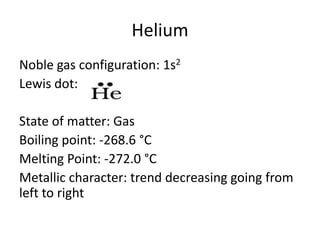
Helium
Noble gas configuration: 1s2
Lewis dot:
State of matter: Gas
Boiling point: -268.6 °C
Melting Point: -272.0 °C
Metallic character: trend decreasing going from
left to right
Neon
Noble gas configuration: [He] 2s2 2p6
Lewis dot:
State of matter: Gas
Boiling point: -246.1 °C
Melting Point: -248.6 °C
Metallic character: trend decreasing going from
left to right
Argon
Noble gas configuration: [Ne] 3s2 3p6
Lewis dot:
State of matter: Gas
Boiling point: -186.0 °C
Melting point: -189.3 °C
Metallic character: trend decreasing going from
left to right
Krypton
Noble gas configuration: [Ar] 3d10 4s2 4p6
Lewis dot:
State of matter: Gas
Boiling point: -153.4 °C
Melting point: -157.2 °C
Metallic character: trend decreasing going from
left to right
Radon
Noble Gas Configuration: [Xe]6s25d6p6
Lewis dot:
State of Matter: Gas
Boiling Point: -62°C
Melting Point: -71°C
Metallic Character: trend decreasing going from
left to right
Period 6 Elements
1.Cesium (Cs)
2. Barium (Ba)
3. Lutetium (Lu)
4. Hafnium (Gf)
5. Tantalum (Ta)
6. Tungsten (W)
7. Rhenium (Re)
8. Osmium (Os)
9. Iridium (Ir)
10. Platinum (Pt)
11. Gold (Au)
12. Mercury (Hg)

13. Thallium (Tl)
14. Lead (Pb)
15. Bismuth (Bi)
16. Polonium (Po)
17. Astatine (At)
Period 6 Trends
•

•

•

•

•
•

Atomic radii: distance from nucleus to boundary of outermost electron level general
decrease from Cesium  Radon
Ionic radii: distance of nucleus to outermost electron level of ions; when an atom is an
anion, the electrons are more attached to the nucleus making the atom smaller, and a
cation makes the electrons repel against the nucleus’ charge and make the atom bigger;
general decrease from Cesium  Radon
Reactivity: outer electron levels try to gain electrons to fill them to the highest capacity
and be “stable,” like the Noble Gases; metals have the most “room” for more electrons,
while non-metals and Noble Gases do not. Radon is the most unreactive element in
Period 6 because its outer level is full; increase from Cesium  Radon
Electronegativity: an ability of an atom to gain electrons; high electronegativity means
the atom attracts many electrons, therefore forming a negative ion; metals on the left
side of the table do not have the energy levels filled completely, attracting electrons
while the non-metals and noble gases are almost completely/completely filled; general
increase from Cesium (least electronegative element)  Radon
Ionization Energy: energy needed to remove 1+ electrons from an ion; alkali metals only
have 1 valence electron so it’s hard to give them up, while noble gases have closed
shells so they give no electrons up; general increase from Cesium  Radon
Valence Electrons: general increase from Cesium  Radon
Cesium
Noble gas configuration: [Xe] 6s1
State of matter: solid
Boiling point: 671 ºC
Melting point: 28.5 ºC
Metallic character: trend decreasing going from
left to right
Barium
Noble gas configuration: [Xe] 6s2
State of matter: solid
Boiling point: 1897ºC
Melting point: 727ºC
Metallic character: trend decreasing going from
left to right
Lutetium
Noble gas configuration: [Xe] 6s2 5d1
State of matter: solid
Boiling point: 3402°C
Melting point: 1663°C
Metallic character: trend decreasing going from
left to right
Hafnium
Noble gas configuration: [Xe] 6s2 5d2
State of matter: solid
Boiling point: 4603°C
Melting point: 2233°C
Metallic character: trend decreasing going from
left to right
Tantalum
Noble gas configuration: [Xe] 6s2 5d3
State of matter: solid
Boiling point: 5458°C
Melting point: 3017°C
Metallic character: trend decreasing going from
left to right
Tungsten
Noble gas configuration: [Xe] 6s2 5d4
State of matter: solid
Boiling point: 5555°C
Melting point: 3422°C
Metallic character: trend decreasing going from
left to right
Rhenium
•
•
•
•
•

Noble gas configuration: [Xe] 6s2 5d5
State of matter: solid
Boiling point: 5596°C
Melting point: 3186°C
Metallic character: trend decreasing going
from left to right
Osmium
Noble gas configuration: [Xe] 6s2 5d6
State of matter: solid
Boiling point: 5012°C
Melting point: 3033°C
Metallic character: trend decreasing going from
left to right
Iridium
Noble gas configuration: [Xe] 6s2 5d7
State of matter: solid
Boiling point: 4428°C
Melting point: 2446°C
Metallic character: trend decreasing going from
left to right
Platinum
Noble Gas Configuration: [Xe]6s25d8
State of Matter: Solid
Boiling Point: 3800°C
Melting Point: 1772°C
Metallic Character: trend decreasing going from
left to right
Gold
Noble Gas Configuration: [Xe]6s25d9
State of Matter: Solid
Boiling Point: 2000°C
Melting Point: 1062°C
Metallic Character: trend decreasing from left to
right
Mercury
Noble Gas Configuration: [Xe]6s25d10
State of Matter: Liquid
Boiling Point: 356.6°C
Melting Point: -38.9°C
Metallic Character: trend decreasing from left to
right
Thallium
Noble Gas Configuration: [Xe]6s25d106p1
State of Matter: Solid
Boiling Point: 1473°C
Melting Point: 304°C
Metallic Character: trend decreasing from left to
right
Lead
Noble Gas Configuration: [Xe]6s25d106p2
State of Matter: Lead
Boiling point: 1755°C
Melting Point: 327°C
Metallic Character: trend decreasing from left to
right
Bismuth
Noble Gas Configuration: [Xe]6s25d106p3
State of Matter: Solid
Boiling Point: 1420°C
Melting Point: 271°C
Metallic Character: trend decreasing from left to
right
Polonium
Noble Gas Configuration: [Xe]6s25d106p4
State of Matter: Solid
Boiling Point: 962°C
Melting Point: 254°C
Metallic Character: trend decreasing from left to
right
Astatine
Noble Gas Configuration: [Xe]6s25d106p5
State of Matter: Solid
Boiling Point: 337°C (estimate)
Melting Point: 302°C
Metallic Character: trend decreasing from left to
right

Periodic Table Project

  • 1.
    Periodic Table Project LandonStokes & Sydney Hight
  • 2.
    Group 18 Trends • • • • • • Atomicradii: Atomic radius decreases from left to right within a period because of effective nuclear charge. As you move from left to right in a period, you are still in the same energy level, which means the electron is still the same distance from the nucleus. Ionic Radii: The Noble Gases do not have an ionic radius. This is because they don't form ions. Reactivity: Noble Gases are extremely unreactive. This is because non-metals gain electrons. Since the noble gases do not need to gain any electrons because of their "stable octet", they don't react often. Electronegativity: Electronegativity is the ability of an atom to gain an electron. Since electronegativity measures the amount of attraction between an atom and an electron, noble gases do not have electronegativity. Ionization Energy: Noble Gases have a very stable electron configuration, therefore, they have the highest amount of ionization energy within their periods. It decreases down a family because electrons farther from the nucleus are easier to remove. Valence Electrons: The noble gases contain eight valence electrons. INTERESTING FACT: Most Noble Gases are used for lighting around the world.
  • 3.
    Group 18 Elements 1. 2. 3. 4. 5. 6. Helium(He) Neon (Ne) Argon (Ar) Krypton (Kr) Xenon (Xe) Radon (Rn)
  • 4.
    Helium Noble gas configuration:1s2 Lewis dot: State of matter: Gas Boiling point: -268.6 °C Melting Point: -272.0 °C Metallic character: trend decreasing going from left to right
  • 5.
    Neon Noble gas configuration:[He] 2s2 2p6 Lewis dot: State of matter: Gas Boiling point: -246.1 °C Melting Point: -248.6 °C Metallic character: trend decreasing going from left to right
  • 6.
    Argon Noble gas configuration:[Ne] 3s2 3p6 Lewis dot: State of matter: Gas Boiling point: -186.0 °C Melting point: -189.3 °C Metallic character: trend decreasing going from left to right
  • 7.
    Krypton Noble gas configuration:[Ar] 3d10 4s2 4p6 Lewis dot: State of matter: Gas Boiling point: -153.4 °C Melting point: -157.2 °C Metallic character: trend decreasing going from left to right
  • 8.
    Radon Noble Gas Configuration:[Xe]6s25d6p6 Lewis dot: State of Matter: Gas Boiling Point: -62°C Melting Point: -71°C Metallic Character: trend decreasing going from left to right
  • 9.
    Period 6 Elements 1.Cesium(Cs) 2. Barium (Ba) 3. Lutetium (Lu) 4. Hafnium (Gf) 5. Tantalum (Ta) 6. Tungsten (W) 7. Rhenium (Re) 8. Osmium (Os) 9. Iridium (Ir) 10. Platinum (Pt) 11. Gold (Au) 12. Mercury (Hg) 13. Thallium (Tl) 14. Lead (Pb) 15. Bismuth (Bi) 16. Polonium (Po) 17. Astatine (At)
  • 10.
    Period 6 Trends • • • • • • Atomicradii: distance from nucleus to boundary of outermost electron level general decrease from Cesium  Radon Ionic radii: distance of nucleus to outermost electron level of ions; when an atom is an anion, the electrons are more attached to the nucleus making the atom smaller, and a cation makes the electrons repel against the nucleus’ charge and make the atom bigger; general decrease from Cesium  Radon Reactivity: outer electron levels try to gain electrons to fill them to the highest capacity and be “stable,” like the Noble Gases; metals have the most “room” for more electrons, while non-metals and Noble Gases do not. Radon is the most unreactive element in Period 6 because its outer level is full; increase from Cesium  Radon Electronegativity: an ability of an atom to gain electrons; high electronegativity means the atom attracts many electrons, therefore forming a negative ion; metals on the left side of the table do not have the energy levels filled completely, attracting electrons while the non-metals and noble gases are almost completely/completely filled; general increase from Cesium (least electronegative element)  Radon Ionization Energy: energy needed to remove 1+ electrons from an ion; alkali metals only have 1 valence electron so it’s hard to give them up, while noble gases have closed shells so they give no electrons up; general increase from Cesium  Radon Valence Electrons: general increase from Cesium  Radon
  • 11.
    Cesium Noble gas configuration:[Xe] 6s1 State of matter: solid Boiling point: 671 ºC Melting point: 28.5 ºC Metallic character: trend decreasing going from left to right
  • 12.
    Barium Noble gas configuration:[Xe] 6s2 State of matter: solid Boiling point: 1897ºC Melting point: 727ºC Metallic character: trend decreasing going from left to right
  • 13.
    Lutetium Noble gas configuration:[Xe] 6s2 5d1 State of matter: solid Boiling point: 3402°C Melting point: 1663°C Metallic character: trend decreasing going from left to right
  • 14.
    Hafnium Noble gas configuration:[Xe] 6s2 5d2 State of matter: solid Boiling point: 4603°C Melting point: 2233°C Metallic character: trend decreasing going from left to right
  • 15.
    Tantalum Noble gas configuration:[Xe] 6s2 5d3 State of matter: solid Boiling point: 5458°C Melting point: 3017°C Metallic character: trend decreasing going from left to right
  • 16.
    Tungsten Noble gas configuration:[Xe] 6s2 5d4 State of matter: solid Boiling point: 5555°C Melting point: 3422°C Metallic character: trend decreasing going from left to right
  • 17.
    Rhenium • • • • • Noble gas configuration:[Xe] 6s2 5d5 State of matter: solid Boiling point: 5596°C Melting point: 3186°C Metallic character: trend decreasing going from left to right
  • 18.
    Osmium Noble gas configuration:[Xe] 6s2 5d6 State of matter: solid Boiling point: 5012°C Melting point: 3033°C Metallic character: trend decreasing going from left to right
  • 19.
    Iridium Noble gas configuration:[Xe] 6s2 5d7 State of matter: solid Boiling point: 4428°C Melting point: 2446°C Metallic character: trend decreasing going from left to right
  • 20.
    Platinum Noble Gas Configuration:[Xe]6s25d8 State of Matter: Solid Boiling Point: 3800°C Melting Point: 1772°C Metallic Character: trend decreasing going from left to right
  • 21.
    Gold Noble Gas Configuration:[Xe]6s25d9 State of Matter: Solid Boiling Point: 2000°C Melting Point: 1062°C Metallic Character: trend decreasing from left to right
  • 22.
    Mercury Noble Gas Configuration:[Xe]6s25d10 State of Matter: Liquid Boiling Point: 356.6°C Melting Point: -38.9°C Metallic Character: trend decreasing from left to right
  • 23.
    Thallium Noble Gas Configuration:[Xe]6s25d106p1 State of Matter: Solid Boiling Point: 1473°C Melting Point: 304°C Metallic Character: trend decreasing from left to right
  • 24.
    Lead Noble Gas Configuration:[Xe]6s25d106p2 State of Matter: Lead Boiling point: 1755°C Melting Point: 327°C Metallic Character: trend decreasing from left to right
  • 25.
    Bismuth Noble Gas Configuration:[Xe]6s25d106p3 State of Matter: Solid Boiling Point: 1420°C Melting Point: 271°C Metallic Character: trend decreasing from left to right
  • 26.
    Polonium Noble Gas Configuration:[Xe]6s25d106p4 State of Matter: Solid Boiling Point: 962°C Melting Point: 254°C Metallic Character: trend decreasing from left to right
  • 27.
    Astatine Noble Gas Configuration:[Xe]6s25d106p5 State of Matter: Solid Boiling Point: 337°C (estimate) Melting Point: 302°C Metallic Character: trend decreasing from left to right