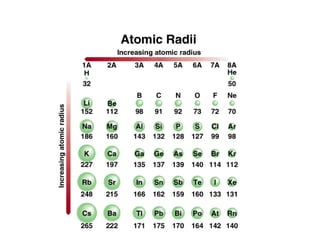
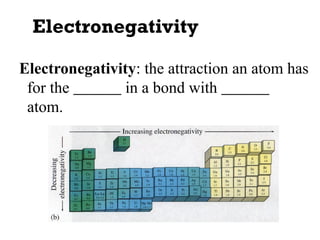
Chapter 8 :Periodic Relationships Among
the Elements
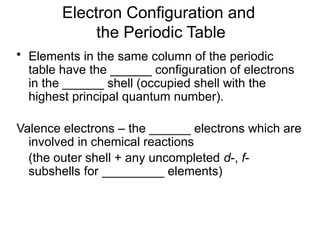
2.
Electron Configuration and
thePeriodic Table
• Elements in the same column of the periodic
table have the ______ configuration of electrons
in the ______ shell (occupied shell with the
highest principal quantum number).
Valence electrons – the ______ electrons which are
involved in chemical reactions
(the outer shell + any uncompleted d-, f-
subshells for _________ elements)
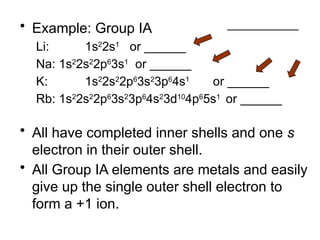
3.
• Example: GroupIA
Li: 1s2
2s1
or ______
Na: 1s2
2s2
2p6
3s1
or ______
K: 1s2
2s2
2p6
3s2
3p6
4s1
or ______
Rb: 1s2
2s2
2p6
3s2
3p6
4s2
3d10
4p6
5s1
or ______
• All have completed inner shells and one s
electron in their outer shell.
• All Group IA elements are metals and easily
give up the single outer shell electron to
form a +1 ion.
__________
5.
Electron Configurations ofIons
Cations from representative elements:
Na (11 e–
): [Ne]3s1
[Ne]
Mg (12 e–
): [Ne]3s2
Al (13 e–
): [Ne]3s2
3p1
[Ne]
[Ne]
All have stable ______ gas electron configurations.
__________
Na+
:
Mg2+
:
Al3+
:
6.
Electron Configurations ofIons
• Anions from representative elements:
H 1s1
F 1s2
2s2
2p5
O 1s2
2s2
2p4
N 1s2
2s2
2p3
1s2
or [He]
1s2
2s2
2p6
or [Ne]
1s2
2s2
2p6
or [Ne]
1s2
2s2
2p6
or [Ne]
All have stable ______ electron configurations.
_________
H–
F–
O2–
N3–
7.
Electron Configurations ofIons
• Cations from transition metals:
In general,
• write a configuration for a neutral atom,
• remove e–
from outermost n s orbital first.
• then remove e–
from underlying (n-1) d orbitals.
Mn [Ar] ______ Mn2+
[Ar] 3d5
Cu [Ar] ______
Cu+
[Ar] ______
Cu2+
[Ar] 3d9
8.
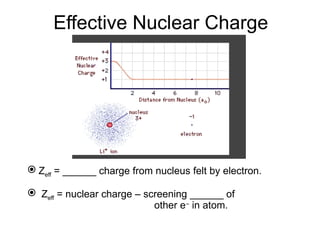
Effective Nuclear Charge
Zeff = ______ charge from nucleus felt by electron.
Zeff = nuclear charge – screening ______ of
other e–
in atom.
QuickTime™ and a
Graphics decompressor
are needed to see this picture.
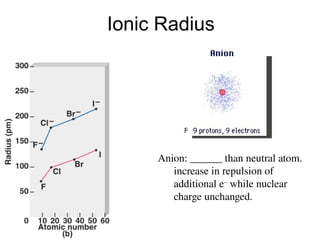
Ionic Radius
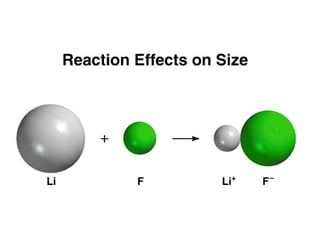
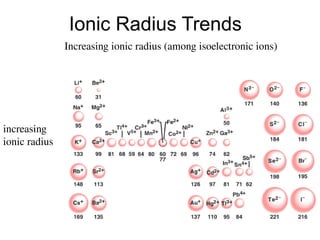
Anion: ______than neutral atom.
increase in repulsion of
additional e–
while nuclear
charge unchanged.
QuickTime™ and a
Graphics decompressor
are needed to see this picture.
14.
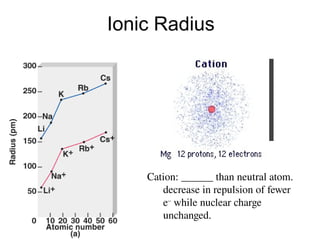
Ionic Radius
Cation: ______than neutral atom.
decrease in repulsion of fewer
e–
while nuclear charge
unchanged.
QuickTime™ and a
Graphics decompressor
are needed to see this picture.
Ionization Energy
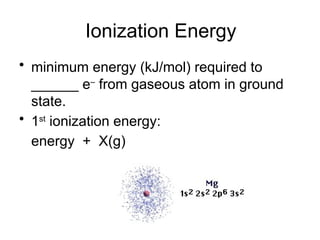
• minimumenergy (kJ/mol) required to
______ e–
from gaseous atom in ground
state.
• 1st
ionization energy:
energy + X(g) X+
(g) + e–
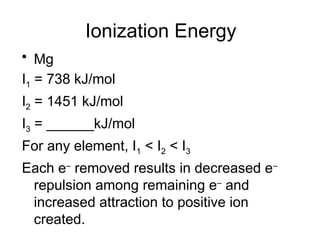
Ionization Energy
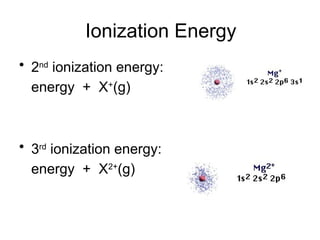
• Mg
I1= 738 kJ/mol
I2 = 1451 kJ/mol
I3 = ______kJ/mol
For any element, I1 < I2 < I3
Each e–
removed results in decreased e–
repulsion among remaining e–
and
increased attraction to positive ion
created.
21.
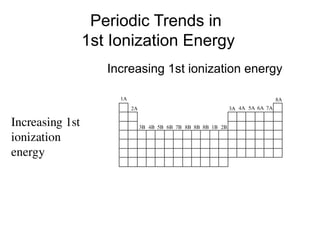
Periodic Trends in
1stIonization Energy
Increasing 1st ionization energy
1A
2A
3B 4B 5B 6B 7B 8B 8B 8B 1B 2B
3A 4A 5A 6A 7A
8A
Increasing 1st
ionization
energy
22.
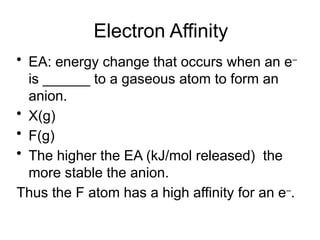
Electron Affinity
• EA:energy change that occurs when an e–
is ______ to a gaseous atom to form an
anion.
• X(g) + e–
X –
(g)
• F(g) + e–
F –
(g) EA = 328 kJ/mol released
• The higher the EA (kJ/mol released) the
more stable the anion.
Thus the F atom has a high affinity for an e–
.
23.
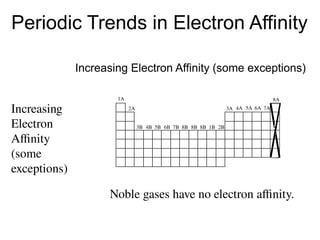
Periodic Trends inElectron Affinity
Increasing Electron Affinity (some exceptions)
Increasing
Electron
Affinity
(some
exceptions)
1A
2A
3B 4B 5B 6B 7B 8B 8B 8B 1B 2B
3A 4A 5A 6A 7A
8A
Noble gases have no electron affinity.
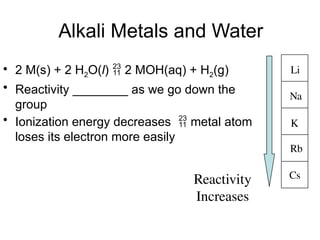
Alkali Metals andWater
• 2 M(s) + 2 H2O(l) 2 MOH(aq) + H2(g)
• Reactivity ________ as we go down the
group
• Ionization energy decreases metal atom
loses its electron more easily)
Reactivity
Increases
Li
Na
K
Rb
Cs
26.
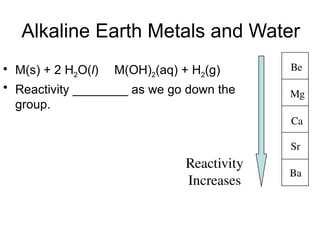
Alkaline Earth Metalsand Water
• M(s) + 2 H2O(l) M(OH)2(aq) + H2(g)
• Reactivity ________ as we go down the
group.
Reactivity
Increases
Be
Mg
Ca
Sr
Ba
27.
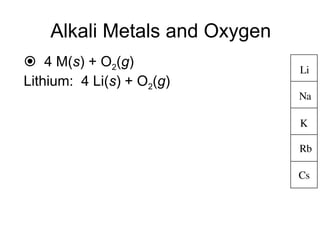
Alkali Metals andOxygen
4 M(s) + O2(g) 2 M2O(s)
Lithium: 4 Li(s) + O2(g) 2 Li2O(s)
Li
Na
K
Rb
Cs
28.
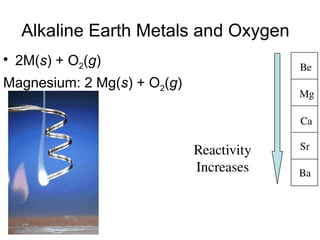
Alkaline Earth Metalsand Oxygen
• 2M(s) + O2(g) 2 MO(s)
Magnesium: 2 Mg(s) + O2(g) 2 MgO(s)
Reactivity
Increases
Be
Mg
Ca
Sr
Ba
29.
Metal Oxides andWater
• Metal oxides and water react to form
common ______.
• Na2O(s) + H2O(l) 2 NaOH(aq)
30.
Nonmetal Oxides andWater
Nonmetal oxides and water react to form
common acids.
N2O5(s) + H2O(l) 2 HNO3(aq) (nitric acid)
SO2(g) + H2O(l) H2SO3(aq) (sulfurous acid)
SO3(g) + H2O(l) H2SO4(aq) (sulfuric acid)
These reactions are important in the
formation of acid rain.
![Electron Configurations of Ions
Cations from representative elements:
Na (11 e–
): [Ne]3s1
[Ne]
Mg (12 e–
): [Ne]3s2
Al (13 e–
): [Ne]3s2
3p1
[Ne]
[Ne]
All have stable ______ gas electron configurations.
__________
Na+
:
Mg2+
:
Al3+
:](https://image.slidesharecdn.com/chap8noteschang13-250417203257-a69f0fcd/85/Chap-8-Notes-Chang-13-pptxddddddddddddddd-5-320.jpg)
![Electron Configurations of Ions
• Anions from representative elements:
H 1s1
F 1s2
2s2
2p5
O 1s2
2s2
2p4
N 1s2
2s2
2p3
1s2
or [He]
1s2
2s2
2p6
or [Ne]
1s2
2s2
2p6
or [Ne]
1s2
2s2
2p6
or [Ne]
All have stable ______ electron configurations.
_________
H–
F–
O2–
N3–](https://image.slidesharecdn.com/chap8noteschang13-250417203257-a69f0fcd/85/Chap-8-Notes-Chang-13-pptxddddddddddddddd-6-320.jpg)
![Electron Configurations of Ions
• Cations from transition metals:
In general,
• write a configuration for a neutral atom,
• remove e–
from outermost n s orbital first.
• then remove e–
from underlying (n-1) d orbitals.
Mn [Ar] ______ Mn2+
[Ar] 3d5
Cu [Ar] ______
Cu+
[Ar] ______
Cu2+
[Ar] 3d9](https://image.slidesharecdn.com/chap8noteschang13-250417203257-a69f0fcd/85/Chap-8-Notes-Chang-13-pptxddddddddddddddd-7-320.jpg)