Pay Structure: 
Grades & Ranges 
www.payscale.com
• Why Pay Structure? 
• Elements of a Pay Structure 
• Building a Pay Structure 
• Step 1: Identify Multiple Schedules 
• Step 2: Determine Pay Grades 
• Step 3: Develop Ranges 
• Step 4: Assign Grades to Positions & Adjust for Internal Equity 
• Using Pay Ranges 
• Compa-ratio 
• Maintaining Structure 2
Why Pay Structure? 
3
Why Pay Structure? 
• Clarifies the market and internal value for each job, and provides a 
way to manage employee pay effectively 
• Quantifies compensation costs & enables budget decisions 
• Validates compensation strategy & aligns to business goals 
• Provides a tool to talk with employees about development 
• Ensures pay equity 
• Determines pay for non-benchmark jobs 
• Allows ease of administration 4
Elements of a Pay 
Structure 
5
Elements of a Pay Structure 
Pay Schedules 
• Sets of Pay Grades, multiple markets grouped (geography, industry, 
etc) 
Pay Grades 
• A label for a group of jobs with similar relative internal value 
• Associated with a pay range 
Pay Ranges 
• The upper and lower bounds of compensation, includes a range 
minimum, midpoint, and maximum 
6
Pay Schedules 
7 
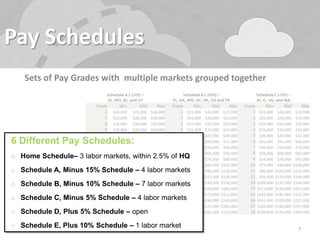
Sets of Pay Grades with multiple markets grouped together 
6 Different Pay Schedules: 
o Home Schedule– 3 labor markets, within 2.5% of HQ 
o Schedule A, Minus 15% Schedule – 4 labor markets 
o Schedule B, Minus 10% Schedule – 7 labor markets 
o Schedule C, Minus 5% Schedule – 4 labor markets 
o Schedule D, Plus 5% Schedule – open 
o Schedule E, Plus 10% Schedule – 1 labor market
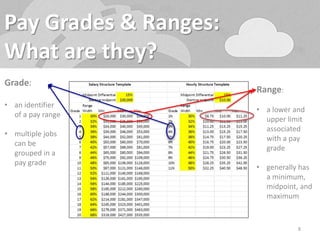
Pay Grades & Ranges: 
What are they? 
8 
Range: 
• a lower and 
upper limit 
associated 
with a pay 
grade 
• generally has 
a minimum, 
midpoint, and 
maximum 
Grade: 
• an identifier 
of a pay range 
• multiple jobs 
can be 
grouped in a 
pay grade
Building a Pay 
Structure 
9
Step 1: Identify Multiple 
Schedules 
• Provides a way of grouping together multiple labor markets, using the 
same set of pay grades 
• Streamlines pay structure 
• Consideration: how complex is your organization? 
• Industries and/or lines of business 
• Retail & Social Services 
• Sales 
• Engineers vs Admin 
• Locations
Step 2: Determine Pay Grade 
• There are no fixed rules for every organization 
• Decide how many grades you will have. Number of pay grades varies in 
response to: 
• The size of the organization 
• The vertical distance between the highest and lowest level job 
• How finely the organization defines jobs and differentiates between them (i.e. levels) 
• The pay increase and promotion policy of the organization. 
• Determine the definition of each grade
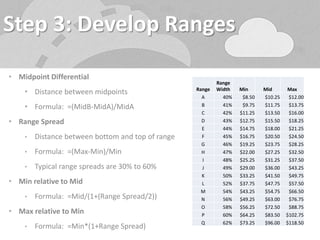
Step 3: Develop Ranges 
• Midpoint Differential 
• Distance between midpoints 
• Formula: =(MidB-MidA)/MidA 
• Range Spread 
• Distance between bottom and top of range 
• Formula: =(Max-Min)/Min 
• Typical range spreads are 30% to 60% 
• Min relative to Mid 
• Formula: =Mid/(1+(Range Spread/2)) 
• Max relative to Min 
• Formula: =Min*(1+Range Spread) 
Range 
Range 
Width Min Mid Max 
A 40% $8.50 $10.25 $12.00 
B 41% $9.75 $11.75 $13.75 
C 42% $11.25 $13.50 $16.00 
D 43% $12.75 $15.50 $18.25 
E 44% $14.75 $18.00 $21.25 
F 45% $16.75 $20.50 $24.50 
G 46% $19.25 $23.75 $28.25 
H 47% $22.00 $27.25 $32.50 
I 48% $25.25 $31.25 $37.50 
J 49% $29.00 $36.00 $43.25 
K 50% $33.25 $41.50 $49.75 
L 52% $37.75 $47.75 $57.50 
M 54% $43.25 $54.75 $66.50 
N 56% $49.25 $63.00 $76.75 
O 58% $56.25 $72.50 $88.75 
P 60% $64.25 $83.50 $102.75 
Q 62% $73.25 $96.00 $118.50
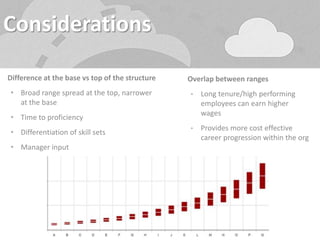
Considerations 
Difference at the base vs top of the structure 
• Broad range spread at the top, narrower 
at the base 
• Time to proficiency 
• Differentiation of skill sets 
• Manager input 
Overlap between ranges 
• Long tenure/high performing 
employees can earn higher 
wages 
• Provides more cost effective 
career progression within the org
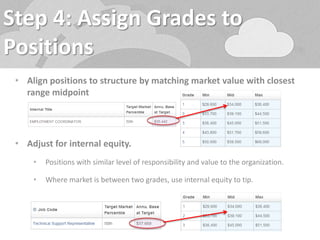
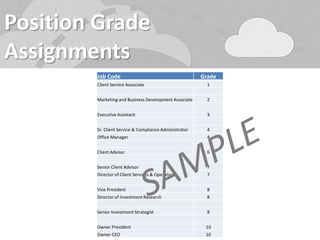
Step 4: Assign Grades to 
Positions 
• Align positions to structure by matching market value with closest 
range midpoint 
• Adjust for internal equity. 
• Positions with similar level of responsibility and value to the organization. 
• Where market is between two grades, use internal equity to tip.
Position Grade 
Assignments 
Job Code Grade 
Client Service Associate 1 
Marketing and Business Development Associate 2 
Executive Assistant 3 
Sr. Client Service & Compliance Administrator 4 
Office Manager 4 
Client Advisor 6 
Senior Client Advisor 7 
Director of Client Services & Operations 7 
Vice President 8 
Director of Investment Research 8 
Senior Investment Strategist 9 
Owner President 10 
Owner CEO 10
Using Pay Ranges
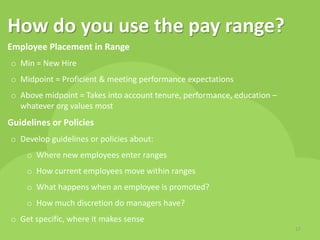
How do you use the pay range? 
Employee Placement in Range 
o Min = New Hire 
o Midpoint = Proficient & meeting performance expectations 
o Above midpoint = Takes into account tenure, performance, education – 
whatever org values most 
Guidelines or Policies 
o Develop guidelines or policies about: 
o Where new employees enter ranges 
o How current employees move within ranges 
o What happens when an employee is promoted? 
o How much discretion do managers have? 
o Get specific, where it makes sense 
17
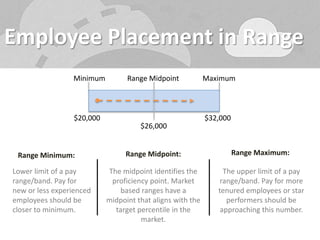
Employee Placement in Range 
Minimum Range Midpoint Maximum 
$20,000 $32,000 
$26,000 
Range Minimum: Range Midpoint: Range Maximum: 
Lower limit of a pay 
range/band. Pay for 
new or less experienced 
employees should be 
closer to minimum. 
The midpoint identifies the 
proficiency point. Market 
based ranges have a 
midpoint that aligns with the 
target percentile in the 
market. 
The upper limit of a pay 
range/band. Pay for more 
tenured employees or star 
performers should be 
approaching this number.
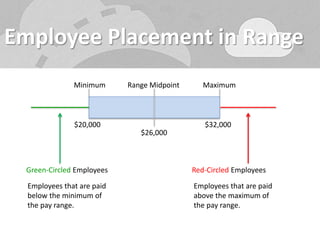
Employee Placement in Range 
Minimum Range Midpoint Maximum 
$20,000 $32,000 
$26,000 
Green-Circled Employees Red-Circled Employees 
Employees that are paid 
below the minimum of 
the pay range. 
Employees that are paid 
above the maximum of 
the pay range.
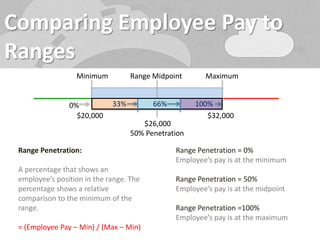
Comparing Employee Pay to 
Ranges 
Minimum Range Midpoint Maximum 
0% 33% 66% 100% 
$20,000 $32,000 
$26,000 
50% Penetration 
Range Penetration: 
A percentage that shows an 
employee’s position in the range. The 
percentage shows a relative 
comparison to the minimum of the 
range. 
= (Employee Pay – Min) / (Max – Min) 
Range Penetration = 0% 
Employee’s pay is at the minimum 
Range Penetration = 50% 
Employee’s pay is at the midpoint 
Range Penetration =100% 
Employee’s pay is at the maximum
Comparing Employee Pay to 
Ranges 
Minimum Range Midpoint Maximum 
$20,000 $32,000 
$26,000 
> 1.0 
=1.0 compa-ratio 
< 1.0 
Compa-Ratio: 
A quick number to identify 
employee’s pay relative to 
the midpoint of the range. 
Calculated by: 
= Employee Pay / Midpoint 
Compa-Ratio < 1.0 
EE Pay is below proficiency point 
Compa-Ratio = 1.0 
EE Pay is at the proficiency point 
Compa-Ratio > 1.0 
EE Pay is above the proficiency point
Maintaining a 
Compensation Structure
Maintaining a Compensation 
Structure 
• New positions 
• Benchmark and assign grades based on market value 
• Evaluate ranges to market 
• Annually based on market research 
• Shift ranges as necessary (2-3 yrs) 
• Evaluate Grade Assignments 
• Revised job duties 
• Hot Jobs
Grade-Based Ranges 
vs. 
Job-Based Ranges
What are Grade-Based 
Ranges? 
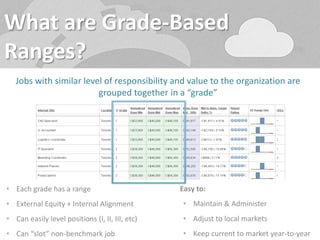
Jobs with similar level of responsibility and value to the organization are 
grouped together in a “grade” 
Easy to: 
• Maintain & Administer 
• Adjust to local markets 
• Keep current to market year-to-year 
• Each grade has a range 
• External Equity + Internal Alignment 
• Can easily level positions (I, II, III, etc) 
• Can “slot” non-benchmark job
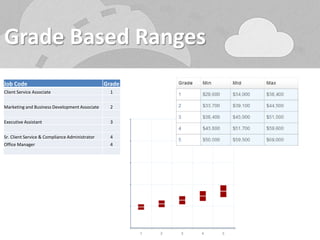
Grade Based Ranges 
Job Code Grade 
Client Service Associate 1 
Marketing and Business Development Associate 2 
Executive Assistant 3 
Sr. Client Service & Compliance Administrator 4 
Office Manager 4
What are Job-Based 
Ranges? 
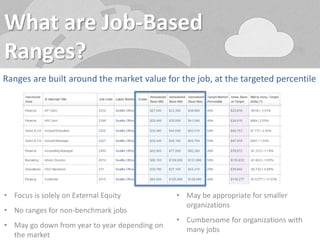
Ranges are built around the market value for the job, at the targeted percentile 
• Focus is solely on External Equity 
• No ranges for non-benchmark jobs 
• May go down from year to year depending on 
the market 
• May be appropriate for smaller 
organizations 
• Cumbersome for organizations with 
many jobs

Pay structure: Grades & Ranges

  • 1.
    Pay Structure: Grades& Ranges www.payscale.com
  • 2.
    • Why PayStructure? • Elements of a Pay Structure • Building a Pay Structure • Step 1: Identify Multiple Schedules • Step 2: Determine Pay Grades • Step 3: Develop Ranges • Step 4: Assign Grades to Positions & Adjust for Internal Equity • Using Pay Ranges • Compa-ratio • Maintaining Structure 2
  • 3.
  • 4.
    Why Pay Structure? • Clarifies the market and internal value for each job, and provides a way to manage employee pay effectively • Quantifies compensation costs & enables budget decisions • Validates compensation strategy & aligns to business goals • Provides a tool to talk with employees about development • Ensures pay equity • Determines pay for non-benchmark jobs • Allows ease of administration 4
  • 5.
    Elements of aPay Structure 5
  • 6.
    Elements of aPay Structure Pay Schedules • Sets of Pay Grades, multiple markets grouped (geography, industry, etc) Pay Grades • A label for a group of jobs with similar relative internal value • Associated with a pay range Pay Ranges • The upper and lower bounds of compensation, includes a range minimum, midpoint, and maximum 6
  • 7.
    Pay Schedules 7 Sets of Pay Grades with multiple markets grouped together 6 Different Pay Schedules: o Home Schedule– 3 labor markets, within 2.5% of HQ o Schedule A, Minus 15% Schedule – 4 labor markets o Schedule B, Minus 10% Schedule – 7 labor markets o Schedule C, Minus 5% Schedule – 4 labor markets o Schedule D, Plus 5% Schedule – open o Schedule E, Plus 10% Schedule – 1 labor market
  • 8.
    Pay Grades &Ranges: What are they? 8 Range: • a lower and upper limit associated with a pay grade • generally has a minimum, midpoint, and maximum Grade: • an identifier of a pay range • multiple jobs can be grouped in a pay grade
  • 9.
    Building a Pay Structure 9
  • 10.
    Step 1: IdentifyMultiple Schedules • Provides a way of grouping together multiple labor markets, using the same set of pay grades • Streamlines pay structure • Consideration: how complex is your organization? • Industries and/or lines of business • Retail & Social Services • Sales • Engineers vs Admin • Locations
  • 11.
    Step 2: DeterminePay Grade • There are no fixed rules for every organization • Decide how many grades you will have. Number of pay grades varies in response to: • The size of the organization • The vertical distance between the highest and lowest level job • How finely the organization defines jobs and differentiates between them (i.e. levels) • The pay increase and promotion policy of the organization. • Determine the definition of each grade
  • 12.
    Step 3: DevelopRanges • Midpoint Differential • Distance between midpoints • Formula: =(MidB-MidA)/MidA • Range Spread • Distance between bottom and top of range • Formula: =(Max-Min)/Min • Typical range spreads are 30% to 60% • Min relative to Mid • Formula: =Mid/(1+(Range Spread/2)) • Max relative to Min • Formula: =Min*(1+Range Spread) Range Range Width Min Mid Max A 40% $8.50 $10.25 $12.00 B 41% $9.75 $11.75 $13.75 C 42% $11.25 $13.50 $16.00 D 43% $12.75 $15.50 $18.25 E 44% $14.75 $18.00 $21.25 F 45% $16.75 $20.50 $24.50 G 46% $19.25 $23.75 $28.25 H 47% $22.00 $27.25 $32.50 I 48% $25.25 $31.25 $37.50 J 49% $29.00 $36.00 $43.25 K 50% $33.25 $41.50 $49.75 L 52% $37.75 $47.75 $57.50 M 54% $43.25 $54.75 $66.50 N 56% $49.25 $63.00 $76.75 O 58% $56.25 $72.50 $88.75 P 60% $64.25 $83.50 $102.75 Q 62% $73.25 $96.00 $118.50
  • 13.
    Considerations Difference atthe base vs top of the structure • Broad range spread at the top, narrower at the base • Time to proficiency • Differentiation of skill sets • Manager input Overlap between ranges • Long tenure/high performing employees can earn higher wages • Provides more cost effective career progression within the org
  • 14.
    Step 4: AssignGrades to Positions • Align positions to structure by matching market value with closest range midpoint • Adjust for internal equity. • Positions with similar level of responsibility and value to the organization. • Where market is between two grades, use internal equity to tip.
  • 15.
    Position Grade Assignments Job Code Grade Client Service Associate 1 Marketing and Business Development Associate 2 Executive Assistant 3 Sr. Client Service & Compliance Administrator 4 Office Manager 4 Client Advisor 6 Senior Client Advisor 7 Director of Client Services & Operations 7 Vice President 8 Director of Investment Research 8 Senior Investment Strategist 9 Owner President 10 Owner CEO 10
  • 16.
  • 17.
    How do youuse the pay range? Employee Placement in Range o Min = New Hire o Midpoint = Proficient & meeting performance expectations o Above midpoint = Takes into account tenure, performance, education – whatever org values most Guidelines or Policies o Develop guidelines or policies about: o Where new employees enter ranges o How current employees move within ranges o What happens when an employee is promoted? o How much discretion do managers have? o Get specific, where it makes sense 17
  • 18.
    Employee Placement inRange Minimum Range Midpoint Maximum $20,000 $32,000 $26,000 Range Minimum: Range Midpoint: Range Maximum: Lower limit of a pay range/band. Pay for new or less experienced employees should be closer to minimum. The midpoint identifies the proficiency point. Market based ranges have a midpoint that aligns with the target percentile in the market. The upper limit of a pay range/band. Pay for more tenured employees or star performers should be approaching this number.
  • 19.
    Employee Placement inRange Minimum Range Midpoint Maximum $20,000 $32,000 $26,000 Green-Circled Employees Red-Circled Employees Employees that are paid below the minimum of the pay range. Employees that are paid above the maximum of the pay range.
  • 20.
    Comparing Employee Payto Ranges Minimum Range Midpoint Maximum 0% 33% 66% 100% $20,000 $32,000 $26,000 50% Penetration Range Penetration: A percentage that shows an employee’s position in the range. The percentage shows a relative comparison to the minimum of the range. = (Employee Pay – Min) / (Max – Min) Range Penetration = 0% Employee’s pay is at the minimum Range Penetration = 50% Employee’s pay is at the midpoint Range Penetration =100% Employee’s pay is at the maximum
  • 21.
    Comparing Employee Payto Ranges Minimum Range Midpoint Maximum $20,000 $32,000 $26,000 > 1.0 =1.0 compa-ratio < 1.0 Compa-Ratio: A quick number to identify employee’s pay relative to the midpoint of the range. Calculated by: = Employee Pay / Midpoint Compa-Ratio < 1.0 EE Pay is below proficiency point Compa-Ratio = 1.0 EE Pay is at the proficiency point Compa-Ratio > 1.0 EE Pay is above the proficiency point
  • 22.
  • 23.
    Maintaining a Compensation Structure • New positions • Benchmark and assign grades based on market value • Evaluate ranges to market • Annually based on market research • Shift ranges as necessary (2-3 yrs) • Evaluate Grade Assignments • Revised job duties • Hot Jobs
  • 24.
    Grade-Based Ranges vs. Job-Based Ranges
  • 25.
    What are Grade-Based Ranges? Jobs with similar level of responsibility and value to the organization are grouped together in a “grade” Easy to: • Maintain & Administer • Adjust to local markets • Keep current to market year-to-year • Each grade has a range • External Equity + Internal Alignment • Can easily level positions (I, II, III, etc) • Can “slot” non-benchmark job
  • 26.
    Grade Based Ranges Job Code Grade Client Service Associate 1 Marketing and Business Development Associate 2 Executive Assistant 3 Sr. Client Service & Compliance Administrator 4 Office Manager 4
  • 27.
    What are Job-Based Ranges? Ranges are built around the market value for the job, at the targeted percentile • Focus is solely on External Equity • No ranges for non-benchmark jobs • May go down from year to year depending on the market • May be appropriate for smaller organizations • Cumbersome for organizations with many jobs

Editor's Notes

  • #25 What do we mean by flexibility? Why it’s important is on the next couple slides.