Contents
The Value Chain............................................................................................................................ 1
Activities......................................................................................................................................1
Types.......................................................................................................................................2
Primary activities................................................................................................................... 2
Support activities .................................................................................................................. 3
Value ChainAnalysis..................................................................................................................... 3
Steps to perform....................................................................................................................... 3
Competitive Advantage............................................................................................................. 4
Strategy ...................................................................................................................................4
Indian Pharma Industry................................................................................................................. 5
LAZOR......................................................................................................................................5
Merck’s Value Chain.................................................................................................................. 6
Future of PharmaValue Chain...................................................................................................7
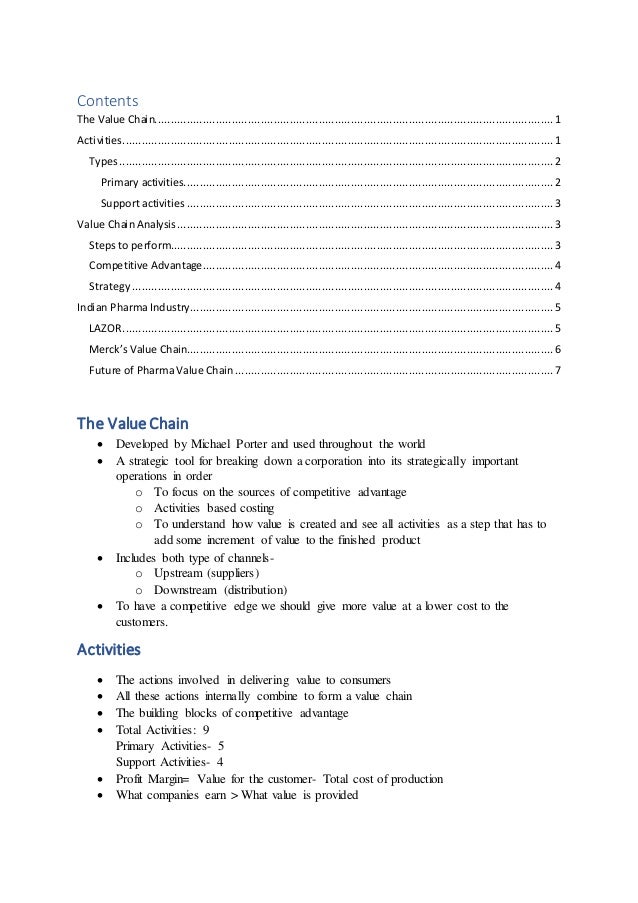
The Value Chain
ď‚· Developed by Michael Porter and used throughout the world
ď‚· A strategic tool for breaking down a corporation into its strategically important
operations in order
o To focus on the sources of competitive advantage
o Activities based costing
o To understand how value is created and see all activities as a step that has to
add some increment of value to the finished product
ď‚· Includes both type of channels-
o Upstream (suppliers)
o Downstream (distribution)
ď‚· To have a competitive edge we should give more value at a lower cost to the
customers.
Activities
ď‚· The actions involved in delivering value to consumers
ď‚· All these actions internally combine to form a value chain
ď‚· The building blocks of competitive advantage
ď‚· Total Activities: 9
Primary Activities- 5
Support Activities- 4
ď‚· Profit Margin= Value for the customer- Total cost of production
ď‚· What companies earn > What value is provided
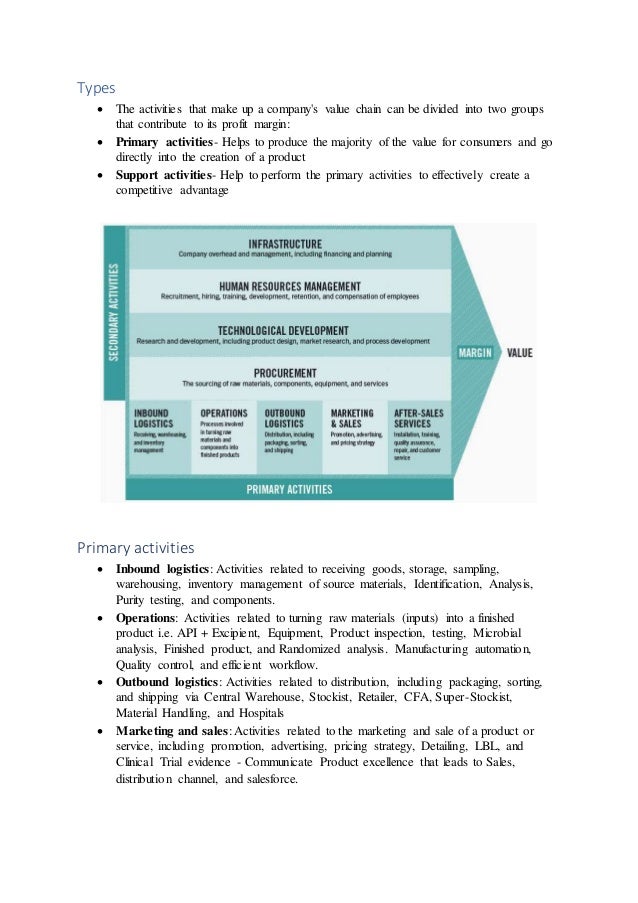
Types
ď‚· The activities that make up a company's value chain can be divided into two groups
that contribute to its profit margin:
ď‚· Primary activities- Helps to produce the majority of the value for consumers and go
directly into the creation of a product
ď‚· Support activities- Help to perform the primary activities to effectively create a
competitive advantage
Primary activities
ď‚· Inbound logistics: Activities related to receiving goods, storage, sampling,
warehousing, inventory management of source materials, Identification, Analysis,
Purity testing, and components.
ď‚· Operations: Activities related to turning raw materials (inputs) into a finished
product i.e. API + Excipient, Equipment, Product inspection, testing, Microbial
analysis, Finished product, and Randomized analysis. Manufacturing automation,
Quality control, and efficient workflow.
ď‚· Outbound logistics: Activities related to distribution, including packaging, sorting,
and shipping via Central Warehouse, Stockist, Retailer, CFA, Super-Stockist,
Material Handling, and Hospitals
ď‚· Marketing and sales:Activities related to the marketing and sale of a product or
service, including promotion, advertising, pricing strategy, Detailing, LBL, and
Clinical Trial evidence - Communicate Product excellence that leads to Sales,
distribution channel, and salesforce.
ď‚· After-sales services: Activities that take place after a sale has been finalized,
including installation, training, quality assurance, repair, customer feedback, and
customer service. Add value for the customer Continuing Medical education
Samples/Coupons- insulin pens. In medical devices and surgical there is more service
element.
Support activities
ď‚· Procurement: Activities related to the sourcing of raw materials, maintaining
relations with the suppliers, Buy Vs lease decision, Machinery, vehicles for transport,
components, equipment, and services
ď‚· Technological development: Activities related to research and development,
including product design, market research, and process development in Production
line, manufacturing time, and knowledge management information systems.
ď‚· Human resources management: Activities related to the recruitment, hiring,
training, development, Dealing with trade unions, retention, motivation via incentive
programs, and compensation of employees
 Infrastructure: Activities related to the company’s overhead and management,
including financing and QA planning.
Value Chain Analysis
 Value chain analysis is a means of evaluating each of the activities in a company’s
value chain to understand where opportunities for improvement lie.
ď‚· A firm is profitable if the value it receives i.e. revenue exceeds the total costs
ď‚· Helps to understand the inner workings of a firm, optimize the business model, to be
profitable at lower prices, aid in activity-based costing, and build a competitive edge.
Steps to perform
1. Identify Value Chain Activities- all of the primary and secondary activities
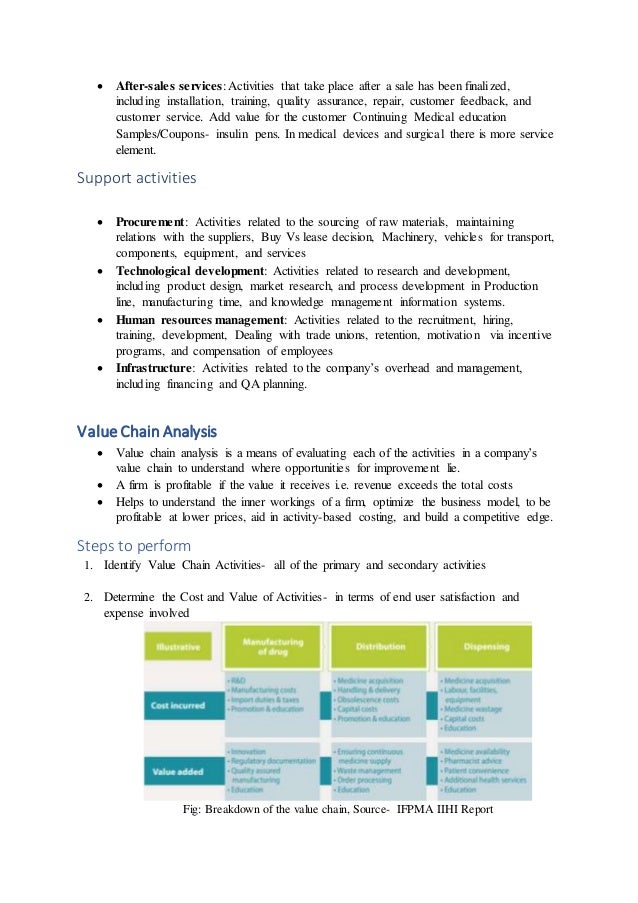
2. Determine the Cost and Value of Activities- in terms of end user satisfaction and
expense involved
Fig: Breakdown of the value chain, Source- IFPMA IIHI Report
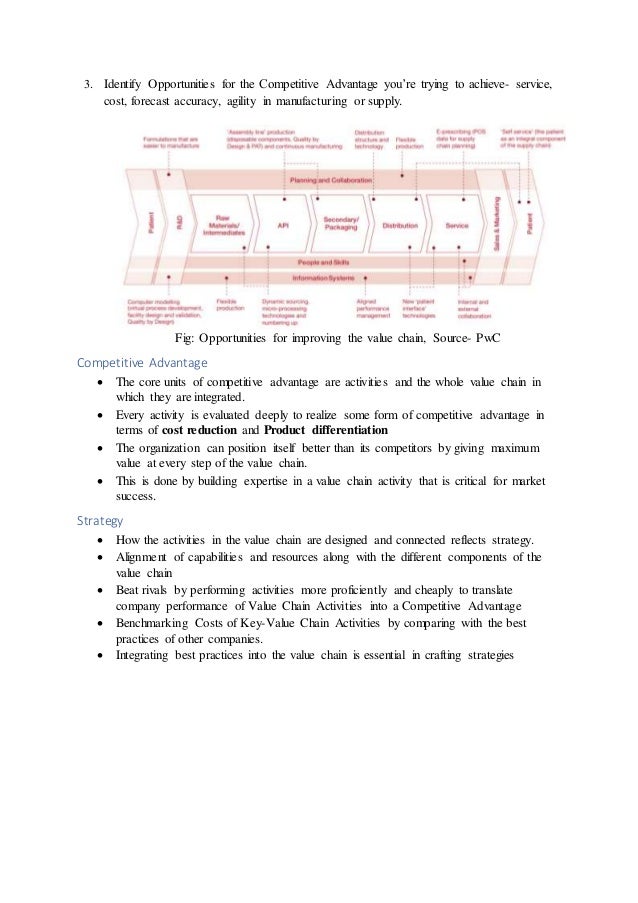
3. Identify Opportunities for the Competitive Advantage you’re trying to achieve- service,
cost, forecast accuracy, agility in manufacturing or supply.
Fig: Opportunities for improving the value chain, Source- PwC
Competitive Advantage
ď‚· The core units of competitive advantage are activities and the whole value chain in
which they are integrated.
ď‚· Every activity is evaluated deeply to realize some form of competitive advantage in
terms of cost reduction and Product differentiation
ď‚· The organization can position itself better than its competitors by giving maximum
value at every step of the value chain.
ď‚· This is done by building expertise in a value chain activity that is critical for market
success.
Strategy
ď‚· How the activities in the value chain are designed and connected reflects strategy.
ď‚· Alignment of capabilities and resources along with the different components of the
value chain
ď‚· Beat rivals by performing activities more proficiently and cheaply to translate
company performance of Value Chain Activities into a Competitive Advantage
ď‚· Benchmarking Costs of Key-Value Chain Activities by comparing with the best
practices of other companies.
ď‚· Integrating best practices into the value chain is essential in crafting strategies
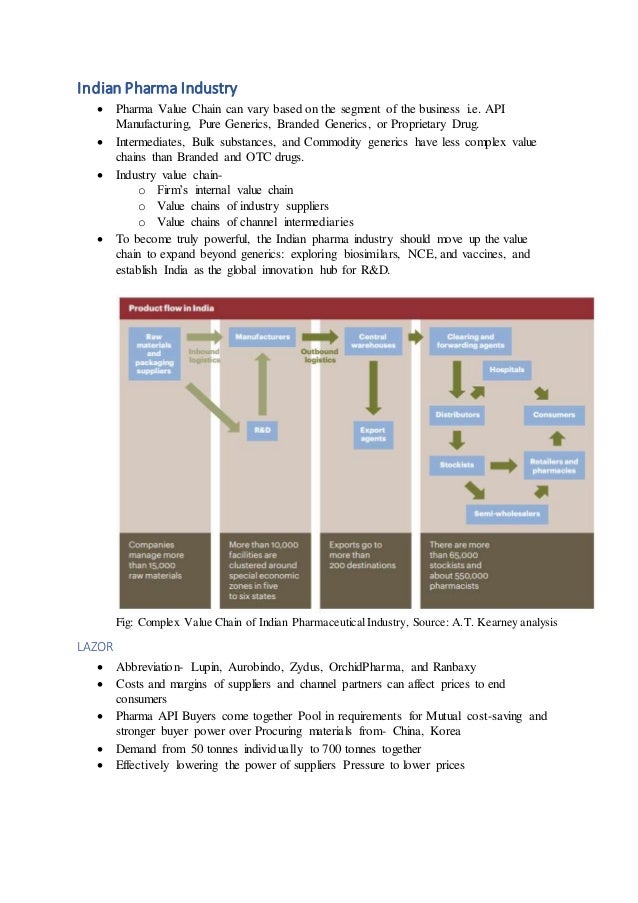
Indian Pharma Industry
ď‚· Pharma Value Chain can vary based on the segment of the business i.e. API
Manufacturing, Pure Generics, Branded Generics, or Proprietary Drug.
ď‚· Intermediates, Bulk substances, and Commodity generics have less complex value
chains than Branded and OTC drugs.
ď‚· Industry value chain-
o Firm’s internal value chain
o Value chains of industry suppliers
o Value chains of channel intermediaries
ď‚· To become truly powerful, the Indian pharma industry should move up the value
chain to expand beyond generics: exploring biosimilars, NCE, and vaccines, and
establish India as the global innovation hub for R&D.
Fig: Complex Value Chain of Indian PharmaceuticalIndustry, Source: A.T. Kearney analysis
LAZOR
ď‚· Abbreviation- Lupin, Aurobindo, Zydus, OrchidPharma, and Ranbaxy
ď‚· Costs and margins of suppliers and channel partners can affect prices to end
consumers
ď‚· Pharma API Buyers come together Pool in requirements for Mutual cost-saving and
stronger buyer power over Procuring materials from- China, Korea
ď‚· Demand from 50 tonnes individually to 700 tonnes together
ď‚· Effectively lowering the power of suppliers Pressure to lower prices
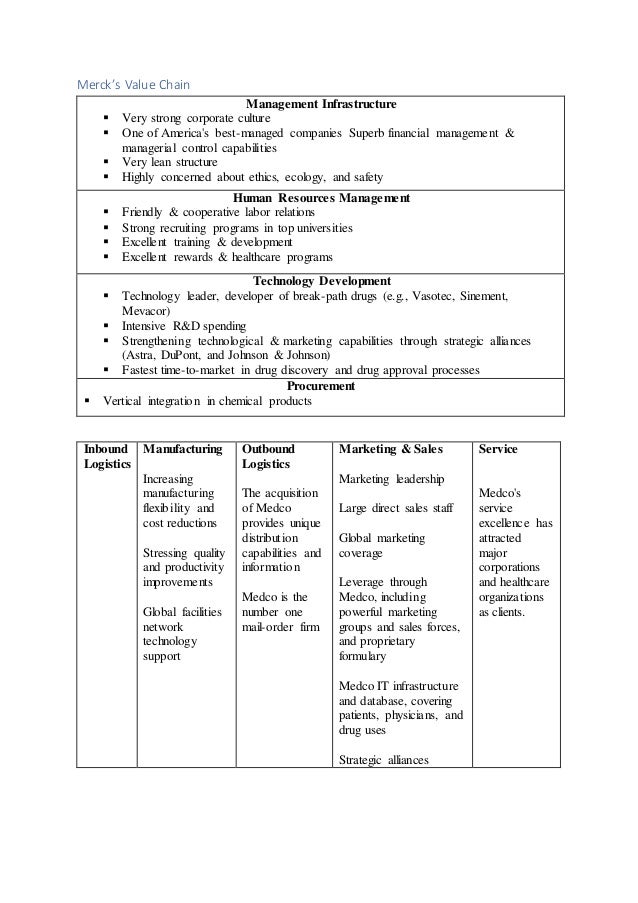
Merck’s Value Chain
Management Infrastructure
ď‚§ Very strong corporate culture
ď‚§ One of America's best-managed companies Superb financial management &
managerial control capabilities
ď‚§ Very lean structure
ď‚§ Highly concerned about ethics, ecology, and safety
Human Resources Management
ď‚§ Friendly & cooperative labor relations
ď‚§ Strong recruiting programs in top universities
ď‚§ Excellent training & development
ď‚§ Excellent rewards & healthcare programs
Technology Development
ď‚§ Technology leader, developer of break-path drugs (e.g., Vasotec, Sinement,
Mevacor)
ď‚§ Intensive R&D spending
ď‚§ Strengthening technological & marketing capabilities through strategic alliances
(Astra, DuPont, and Johnson & Johnson)
ď‚§ Fastest time-to-market in drug discovery and drug approval processes
Procurement
ď‚§ Vertical integration in chemical products
Inbound
Logistics
Manufacturing
Increasing
manufacturing
flexibility and
cost reductions
Stressing quality
and productivity
improvements
Global facilities
network
technology
support
Outbound
Logistics
The acquisition
of Medco
provides unique
distribution
capabilities and
information
Medco is the
number one
mail-order firm
Marketing & Sales
Marketing leadership
Large direct sales staff
Global marketing
coverage
Leverage through
Medco, including
powerful marketing
groups and sales forces,
and proprietary
formulary
Medco IT infrastructure
and database, covering
patients, physicians, and
drug uses
Strategic alliances
Service
Medco's
service
excellence has
attracted
major
corporations
and healthcare
organizations
as clients.
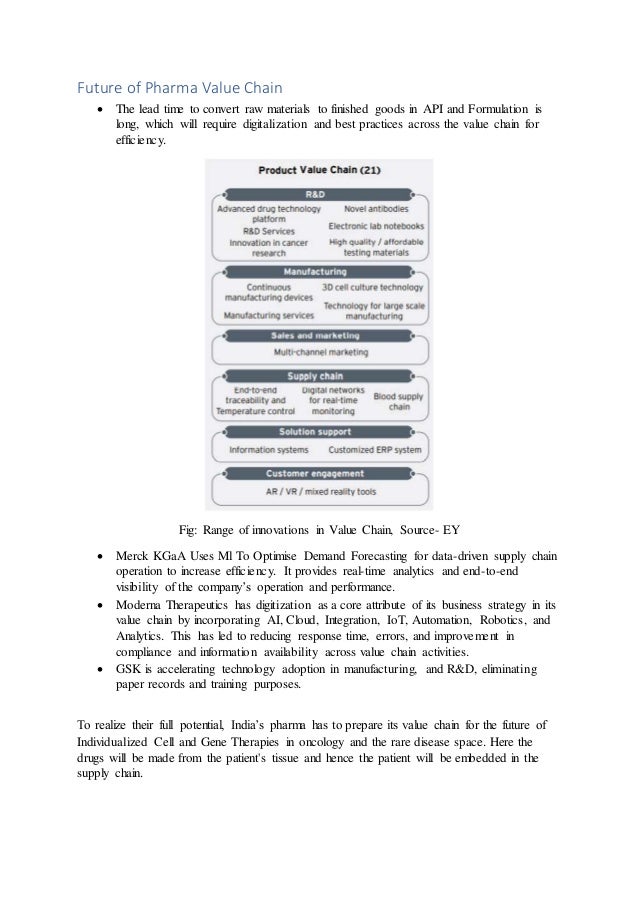
Future of Pharma Value Chain
ď‚· The lead time to convert raw materials to finished goods in API and Formulation is
long, which will require digitalization and best practices across the value chain for
efficiency.
Fig: Range of innovations in Value Chain, Source- EY
ď‚· Merck KGaA Uses Ml To Optimise Demand Forecasting for data-driven supply chain
operation to increase efficiency. It provides real-time analytics and end-to-end
visibility of the company’s operation and performance.
ď‚· Moderna Therapeutics has digitization as a core attribute of its business strategy in its
value chain by incorporating AI, Cloud, Integration, IoT, Automation, Robotics, and
Analytics. This has led to reducing response time, errors, and improvement in
compliance and information availability across value chain activities.
ď‚· GSK is accelerating technology adoption in manufacturing, and R&D, eliminating
paper records and training purposes.
To realize their full potential, India’s pharma has to prepare its value chain for the future of
Individualized Cell and Gene Therapies in oncology and the rare disease space. Here the
drugs will be made from the patient's tissue and hence the patient will be embedded in the
supply chain.
Value Chain Analysis in Pharmaceutical Industry

  • 1.
    Contents The Value Chain............................................................................................................................1 Activities......................................................................................................................................1 Types.......................................................................................................................................2 Primary activities................................................................................................................... 2 Support activities .................................................................................................................. 3 Value ChainAnalysis..................................................................................................................... 3 Steps to perform....................................................................................................................... 3 Competitive Advantage............................................................................................................. 4 Strategy ...................................................................................................................................4 Indian Pharma Industry................................................................................................................. 5 LAZOR......................................................................................................................................5 Merck’s Value Chain.................................................................................................................. 6 Future of PharmaValue Chain...................................................................................................7 The Value Chain  Developed by Michael Porter and used throughout the world  A strategic tool for breaking down a corporation into its strategically important operations in order o To focus on the sources of competitive advantage o Activities based costing o To understand how value is created and see all activities as a step that has to add some increment of value to the finished product  Includes both type of channels- o Upstream (suppliers) o Downstream (distribution)  To have a competitive edge we should give more value at a lower cost to the customers. Activities  The actions involved in delivering value to consumers  All these actions internally combine to form a value chain  The building blocks of competitive advantage  Total Activities: 9 Primary Activities- 5 Support Activities- 4  Profit Margin= Value for the customer- Total cost of production  What companies earn > What value is provided
  • 2.
    Types ď‚· The activitiesthat make up a company's value chain can be divided into two groups that contribute to its profit margin: ď‚· Primary activities- Helps to produce the majority of the value for consumers and go directly into the creation of a product ď‚· Support activities- Help to perform the primary activities to effectively create a competitive advantage Primary activities ď‚· Inbound logistics: Activities related to receiving goods, storage, sampling, warehousing, inventory management of source materials, Identification, Analysis, Purity testing, and components. ď‚· Operations: Activities related to turning raw materials (inputs) into a finished product i.e. API + Excipient, Equipment, Product inspection, testing, Microbial analysis, Finished product, and Randomized analysis. Manufacturing automation, Quality control, and efficient workflow. ď‚· Outbound logistics: Activities related to distribution, including packaging, sorting, and shipping via Central Warehouse, Stockist, Retailer, CFA, Super-Stockist, Material Handling, and Hospitals ď‚· Marketing and sales:Activities related to the marketing and sale of a product or service, including promotion, advertising, pricing strategy, Detailing, LBL, and Clinical Trial evidence - Communicate Product excellence that leads to Sales, distribution channel, and salesforce.
  • 3.
     After-sales services:Activities that take place after a sale has been finalized, including installation, training, quality assurance, repair, customer feedback, and customer service. Add value for the customer Continuing Medical education Samples/Coupons- insulin pens. In medical devices and surgical there is more service element. Support activities  Procurement: Activities related to the sourcing of raw materials, maintaining relations with the suppliers, Buy Vs lease decision, Machinery, vehicles for transport, components, equipment, and services  Technological development: Activities related to research and development, including product design, market research, and process development in Production line, manufacturing time, and knowledge management information systems.  Human resources management: Activities related to the recruitment, hiring, training, development, Dealing with trade unions, retention, motivation via incentive programs, and compensation of employees  Infrastructure: Activities related to the company’s overhead and management, including financing and QA planning. Value Chain Analysis  Value chain analysis is a means of evaluating each of the activities in a company’s value chain to understand where opportunities for improvement lie.  A firm is profitable if the value it receives i.e. revenue exceeds the total costs  Helps to understand the inner workings of a firm, optimize the business model, to be profitable at lower prices, aid in activity-based costing, and build a competitive edge. Steps to perform 1. Identify Value Chain Activities- all of the primary and secondary activities 2. Determine the Cost and Value of Activities- in terms of end user satisfaction and expense involved Fig: Breakdown of the value chain, Source- IFPMA IIHI Report
  • 4.
    3. Identify Opportunitiesfor the Competitive Advantage you’re trying to achieve- service, cost, forecast accuracy, agility in manufacturing or supply. Fig: Opportunities for improving the value chain, Source- PwC Competitive Advantage  The core units of competitive advantage are activities and the whole value chain in which they are integrated.  Every activity is evaluated deeply to realize some form of competitive advantage in terms of cost reduction and Product differentiation  The organization can position itself better than its competitors by giving maximum value at every step of the value chain.  This is done by building expertise in a value chain activity that is critical for market success. Strategy  How the activities in the value chain are designed and connected reflects strategy.  Alignment of capabilities and resources along with the different components of the value chain  Beat rivals by performing activities more proficiently and cheaply to translate company performance of Value Chain Activities into a Competitive Advantage  Benchmarking Costs of Key-Value Chain Activities by comparing with the best practices of other companies.  Integrating best practices into the value chain is essential in crafting strategies
  • 5.
    Indian Pharma Industry Pharma Value Chain can vary based on the segment of the business i.e. API Manufacturing, Pure Generics, Branded Generics, or Proprietary Drug.  Intermediates, Bulk substances, and Commodity generics have less complex value chains than Branded and OTC drugs.  Industry value chain- o Firm’s internal value chain o Value chains of industry suppliers o Value chains of channel intermediaries  To become truly powerful, the Indian pharma industry should move up the value chain to expand beyond generics: exploring biosimilars, NCE, and vaccines, and establish India as the global innovation hub for R&D. Fig: Complex Value Chain of Indian PharmaceuticalIndustry, Source: A.T. Kearney analysis LAZOR  Abbreviation- Lupin, Aurobindo, Zydus, OrchidPharma, and Ranbaxy  Costs and margins of suppliers and channel partners can affect prices to end consumers  Pharma API Buyers come together Pool in requirements for Mutual cost-saving and stronger buyer power over Procuring materials from- China, Korea  Demand from 50 tonnes individually to 700 tonnes together  Effectively lowering the power of suppliers Pressure to lower prices
  • 6.
    Merck’s Value Chain ManagementInfrastructure  Very strong corporate culture  One of America's best-managed companies Superb financial management & managerial control capabilities  Very lean structure  Highly concerned about ethics, ecology, and safety Human Resources Management  Friendly & cooperative labor relations  Strong recruiting programs in top universities  Excellent training & development  Excellent rewards & healthcare programs Technology Development  Technology leader, developer of break-path drugs (e.g., Vasotec, Sinement, Mevacor)  Intensive R&D spending  Strengthening technological & marketing capabilities through strategic alliances (Astra, DuPont, and Johnson & Johnson)  Fastest time-to-market in drug discovery and drug approval processes Procurement  Vertical integration in chemical products Inbound Logistics Manufacturing Increasing manufacturing flexibility and cost reductions Stressing quality and productivity improvements Global facilities network technology support Outbound Logistics The acquisition of Medco provides unique distribution capabilities and information Medco is the number one mail-order firm Marketing & Sales Marketing leadership Large direct sales staff Global marketing coverage Leverage through Medco, including powerful marketing groups and sales forces, and proprietary formulary Medco IT infrastructure and database, covering patients, physicians, and drug uses Strategic alliances Service Medco's service excellence has attracted major corporations and healthcare organizations as clients.
  • 7.
    Future of PharmaValue Chain  The lead time to convert raw materials to finished goods in API and Formulation is long, which will require digitalization and best practices across the value chain for efficiency. Fig: Range of innovations in Value Chain, Source- EY  Merck KGaA Uses Ml To Optimise Demand Forecasting for data-driven supply chain operation to increase efficiency. It provides real-time analytics and end-to-end visibility of the company’s operation and performance.  Moderna Therapeutics has digitization as a core attribute of its business strategy in its value chain by incorporating AI, Cloud, Integration, IoT, Automation, Robotics, and Analytics. This has led to reducing response time, errors, and improvement in compliance and information availability across value chain activities.  GSK is accelerating technology adoption in manufacturing, and R&D, eliminating paper records and training purposes. To realize their full potential, India’s pharma has to prepare its value chain for the future of Individualized Cell and Gene Therapies in oncology and the rare disease space. Here the drugs will be made from the patient's tissue and hence the patient will be embedded in the supply chain.