Performance Management and
Communication
January 2016
material minds
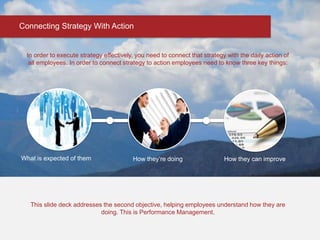
What is expected of them How they’re doing How they can improve
In order to execute strategy effectively, you need to connect that strategy with the daily action of
all employees. In order to connect strategy to action employees need to know three key things:
This slide deck addresses the second objective, helping employees understand how they are
doing. This is Performance Management.
Connecting Strategy With Action
What Performance Management Isn’t
67% of research respondents
thought that performance
management’s objective was
the distribution of rewards.
Many employees think that performance management is annual system for appraisals but it is much
more than this. When research was done to ask people what they thought performance management
was, here is what they said.
54% of respondents thought that
the objective was to improve
accountability.
46% thought talent development
was the objective
What Performance Management Really Is
Performance management is a feedback loop that evaluates progress and helps employees work on
meeting goals.
These goals should be expressed in metrics to ensure that there is no ambiguity in determining
whether or not the goal is met.
Performance management is the mechanism by which employees can come to understand how they
are doing, the second of three things critical for employee success.
Preparation
Getting ready for performance management is accomplished by the two previous steps in this slide deck
series; Metrics and Delegation
Metrics
To do a good job with performance management, each
employee should have a set of metrics that accurately
measures their results and the activities that drive
those results.
Delegation
Secondly, the employee’s manager should
have delegated responsibility for those metrics
and authority over decisions concerning them
so that an employee ‘owns’ their metrics.
Step 2 - What does Success look Like?
Use Metrics to Communicate Results
• Their role in the organization
• How their role connects with the strategy of the firm as a whole
• What they have to do to make the firm successful.
If employees need to know what is expected of them, how they are doing and how they can improve,
the most effective and unambiguous way to communicate those three things is by using metrics. With
metrics they have a clearer understanding of:
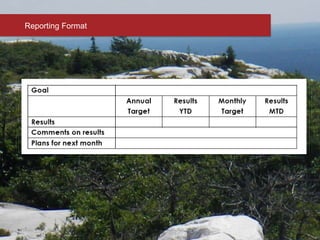
Having developed a set of metrics, a regular report
should be developed to quantify results.
• The report should be prepared by the
employee, not the manager
• This report should be reviewed weekly if
possible or at least monthly.
• It should be produced once metrics are
available.
Reporting
Reporting Format
Once the metrics report is ready, the
manager should meet with the
employee to review and discuss
results.
The meeting can be formal or
informal but should be led by the
employee who, after all, owns the
results.
Through this process, the employee
knows how they are doing and
knows that their manager is aware of
this as well.
Meeting
A Chance for further Communication
A regular performance
management meeting is
a chance for the
manager to
communicate other
things so the employee
knows what is going on.
The manager can use
the meeting to
communicate corporate
results, decisions,
rational for decisions and
other strategic matters.
Fundamentals of Leadership
Leadership is all about
communication.
Metrics add clarity to
communication and are
unambiguous.
Communication is a two
way street and when you
communicate metrics, you
are communicating about
strategy.
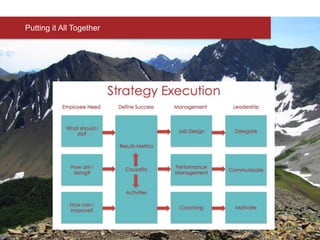
Putting it All Together
material minds
Helping companies execute
strategy better by connecting
strategy with the daily action
of all employees.
Charles Plant
416 458 4850
cplant (at)
materialminds.com
Consulting
Coaching
Workshops
Speaking
Teaching
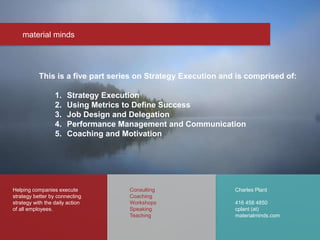
This is a five part series on Strategy Execution and is comprised of:
1. Strategy Execution
2. Using Metrics to Define Success
3. Job Design and Delegation
4. Performance Management and Communication
5. Coaching and Motivation

Performance Management and Communication

  • 1.
  • 2.
    What is expectedof them How they’re doing How they can improve In order to execute strategy effectively, you need to connect that strategy with the daily action of all employees. In order to connect strategy to action employees need to know three key things: This slide deck addresses the second objective, helping employees understand how they are doing. This is Performance Management. Connecting Strategy With Action
  • 3.
    What Performance ManagementIsn’t 67% of research respondents thought that performance management’s objective was the distribution of rewards. Many employees think that performance management is annual system for appraisals but it is much more than this. When research was done to ask people what they thought performance management was, here is what they said. 54% of respondents thought that the objective was to improve accountability. 46% thought talent development was the objective
  • 4.
    What Performance ManagementReally Is Performance management is a feedback loop that evaluates progress and helps employees work on meeting goals. These goals should be expressed in metrics to ensure that there is no ambiguity in determining whether or not the goal is met. Performance management is the mechanism by which employees can come to understand how they are doing, the second of three things critical for employee success.
  • 5.
    Preparation Getting ready forperformance management is accomplished by the two previous steps in this slide deck series; Metrics and Delegation Metrics To do a good job with performance management, each employee should have a set of metrics that accurately measures their results and the activities that drive those results. Delegation Secondly, the employee’s manager should have delegated responsibility for those metrics and authority over decisions concerning them so that an employee ‘owns’ their metrics.
  • 6.
    Step 2 -What does Success look Like? Use Metrics to Communicate Results • Their role in the organization • How their role connects with the strategy of the firm as a whole • What they have to do to make the firm successful. If employees need to know what is expected of them, how they are doing and how they can improve, the most effective and unambiguous way to communicate those three things is by using metrics. With metrics they have a clearer understanding of:
  • 7.
    Having developed aset of metrics, a regular report should be developed to quantify results. • The report should be prepared by the employee, not the manager • This report should be reviewed weekly if possible or at least monthly. • It should be produced once metrics are available. Reporting
  • 8.
  • 9.
    Once the metricsreport is ready, the manager should meet with the employee to review and discuss results. The meeting can be formal or informal but should be led by the employee who, after all, owns the results. Through this process, the employee knows how they are doing and knows that their manager is aware of this as well. Meeting
  • 10.
    A Chance forfurther Communication A regular performance management meeting is a chance for the manager to communicate other things so the employee knows what is going on. The manager can use the meeting to communicate corporate results, decisions, rational for decisions and other strategic matters.
  • 11.
    Fundamentals of Leadership Leadershipis all about communication. Metrics add clarity to communication and are unambiguous. Communication is a two way street and when you communicate metrics, you are communicating about strategy.
  • 12.
  • 13.
    material minds Helping companiesexecute strategy better by connecting strategy with the daily action of all employees. Charles Plant 416 458 4850 cplant (at) materialminds.com Consulting Coaching Workshops Speaking Teaching This is a five part series on Strategy Execution and is comprised of: 1. Strategy Execution 2. Using Metrics to Define Success 3. Job Design and Delegation 4. Performance Management and Communication 5. Coaching and Motivation