Mrs.BALWINDER KAUR
ASSOCIATE PROFESSOR
S.K.S.S.COLLEGE OF NURSING
SARABHA, LUDHIANA
Ohh again…..
PERFORMANCE
APPRAISAL
PERFORMANCE
APPRAISAL
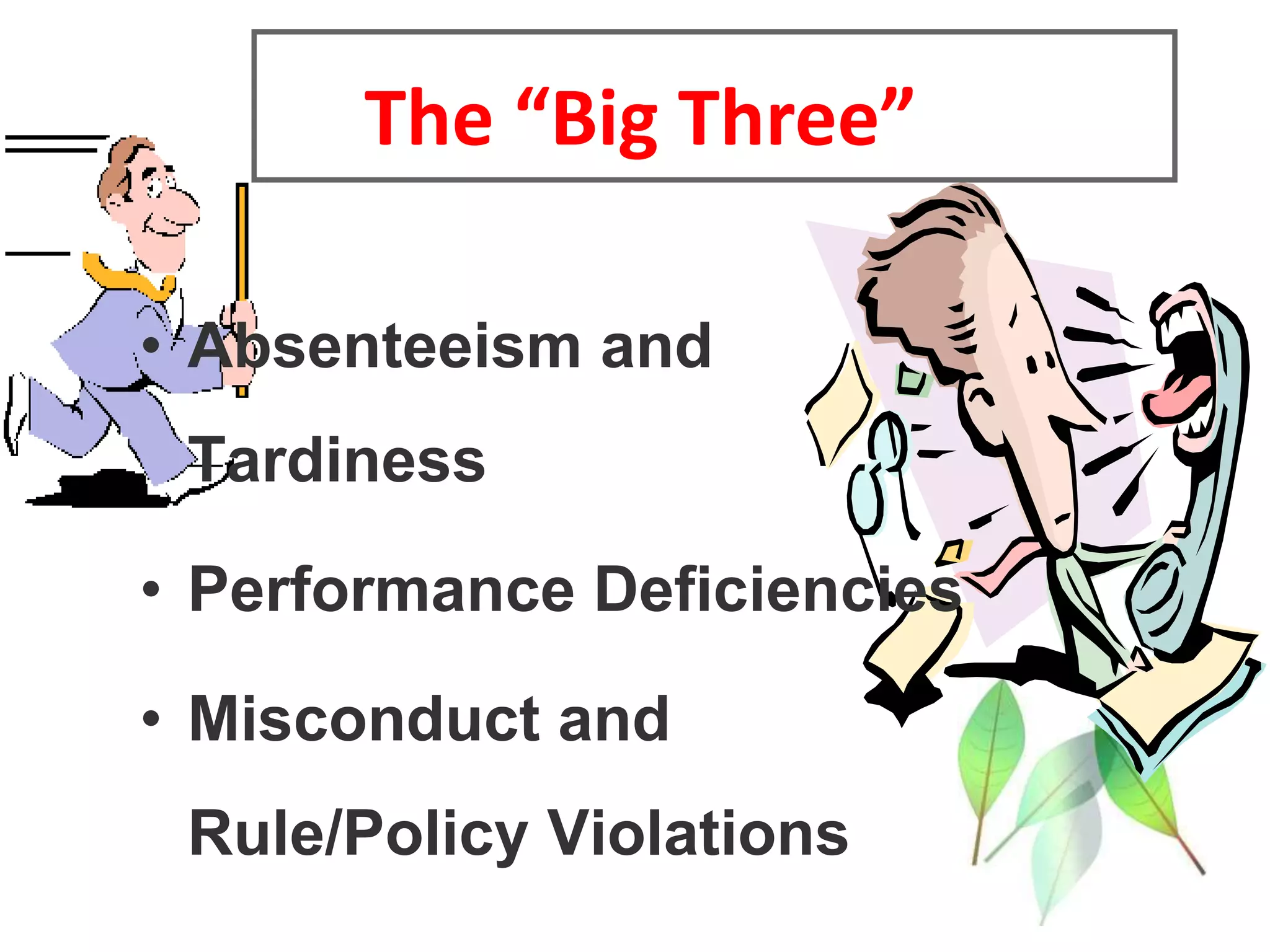
The “Big Three”
• Absenteeism and
Tardiness
• Performance Deficiencies
• Misconduct and
Rule/Policy Violations
WHY SO
IMPORTANT?
???
Performance Appraisals– Why
are they so important?
- Performance reviews are an integral part of
the employee’s on the job experience.
- When fair, accurate and conducted on a
regular basis appraisals can stimulate
employee morale, which can lead to more
efficient business operations and discourage
litigation.
- When performance reviews are not fair
and reasonable, generating inaccurate or
incomplete appraisals, they can have the
opposite effect.
INTRODUCTION
Performance Evaluation
or Performance Appraisal
is the process of
assessing the
performance and
progress of an employee
or a group of employees
on a given job and his
potential for future
development.
As Flippo said:-
Performance appraisal is the
systematic , periodic and an imparting
rating of an employees excellence in
matters pertaining to his present job
and his potential for a better job. It is
the process of obtaining , analyzing
and recording information about the
relative worth of an employee.
Performance Appraisal Is
The Systematic
Evaluation Of The
Individual With Regard
To His Or Her
Performance On The Job
And His Potential For
Development. - By Beach
AIMS OF PERFORMANCE
APPRAISAL
• Give employees feedback on
performance
• To determine job competency
• To enhance staff development
and motivate personnel
towards higher achievement.
contd…..
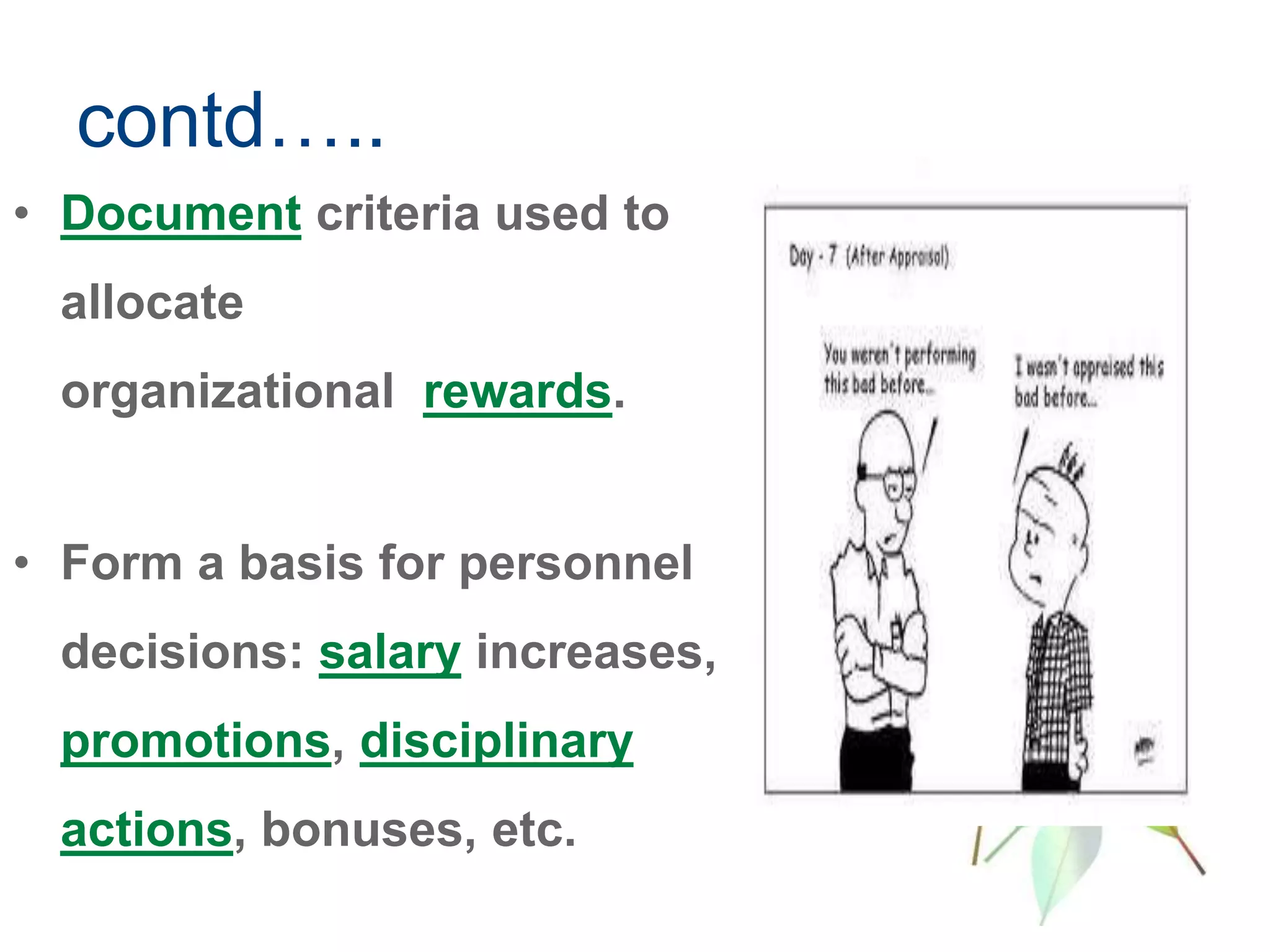
• Document criteria used to
allocate
organizational rewards.
• Form a basis for personnel
decisions: salary increases,
promotions, disciplinary
actions, bonuses, etc.
• Facilitate communication between
employee and administration
• To improve performance through
counseling, coaching and
development.
• To determine training and
developmental needs of nursing.
contd…
OBJECTIVES OF
PERFORMANCE APPRAISAL
• Salary increase.
• Promotion.
• Training and development.
• Feedback.
• Pressure on employees.
• Review the performance of the
employees over a given period of time.
• Judge the gap between the actual and
the desired performance.
• Help the management in exercising
organizational control.
• Helps to strengthen the
relationship and communication
between superior subordinates
• Diagnose the strengths and
weaknesses of the individuals so
as to identify the training and
development needs of the future.
• To know the problem faced by
employees while doing various jobs.
• To provide a basis for comparison to
segregate efficient and inefficient
employees.
• To help management in fixing employees
according to their capacity, interest,
aptitude and qualifications.
• To help supervisors to know their
subordinates more closely.
Qualities most frequently
evaluated are
• Quality of performance
• Mental qualities
• Supervisory qualities
• Personal qualities
• Capacity for further development.
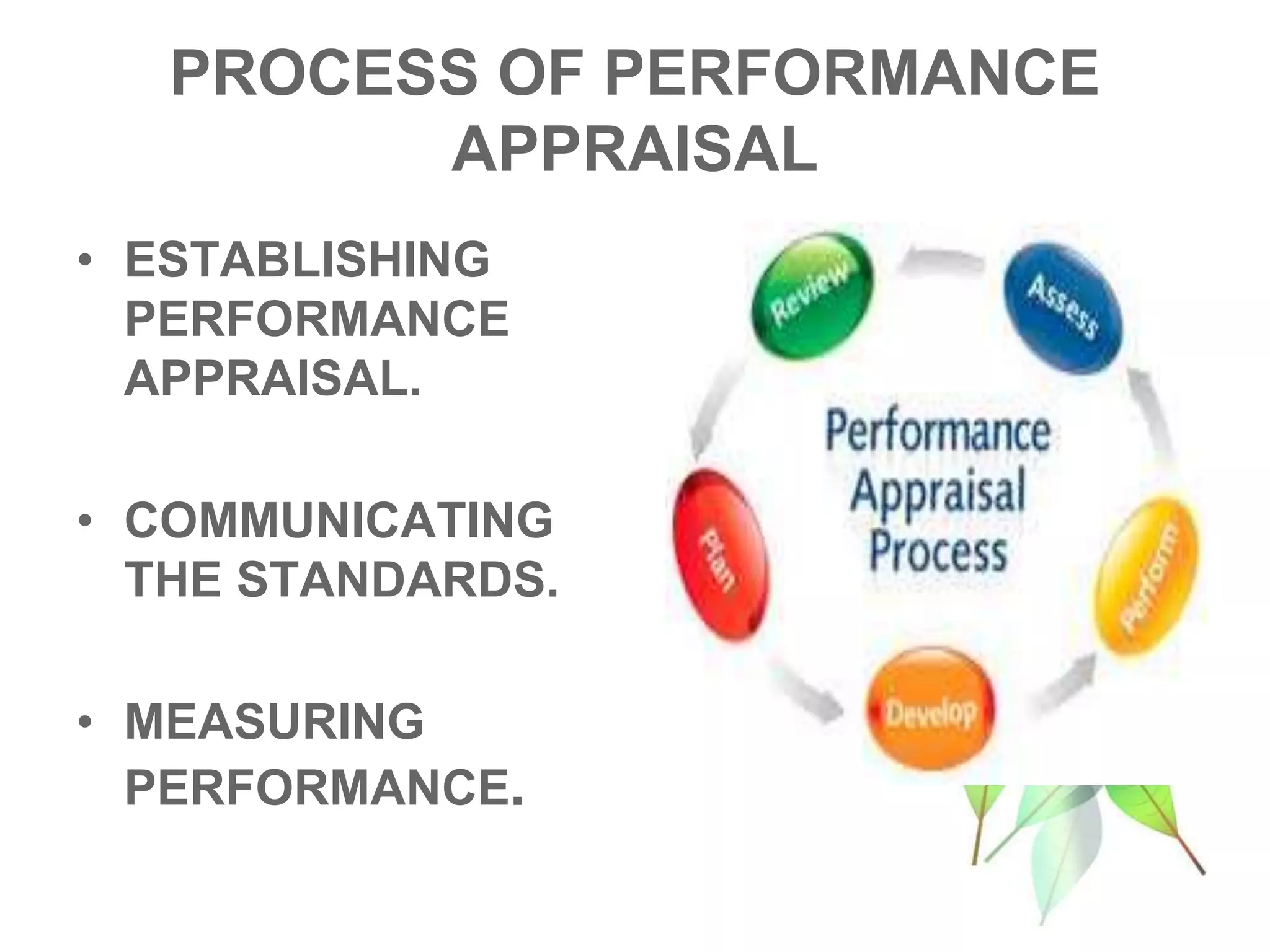
PROCESS OF PERFORMANCE
APPRAISAL
• ESTABLISHING
PERFORMANCE
APPRAISAL.
• COMMUNICATING
THE STANDARDS.
• MEASURING
PERFORMANCE.
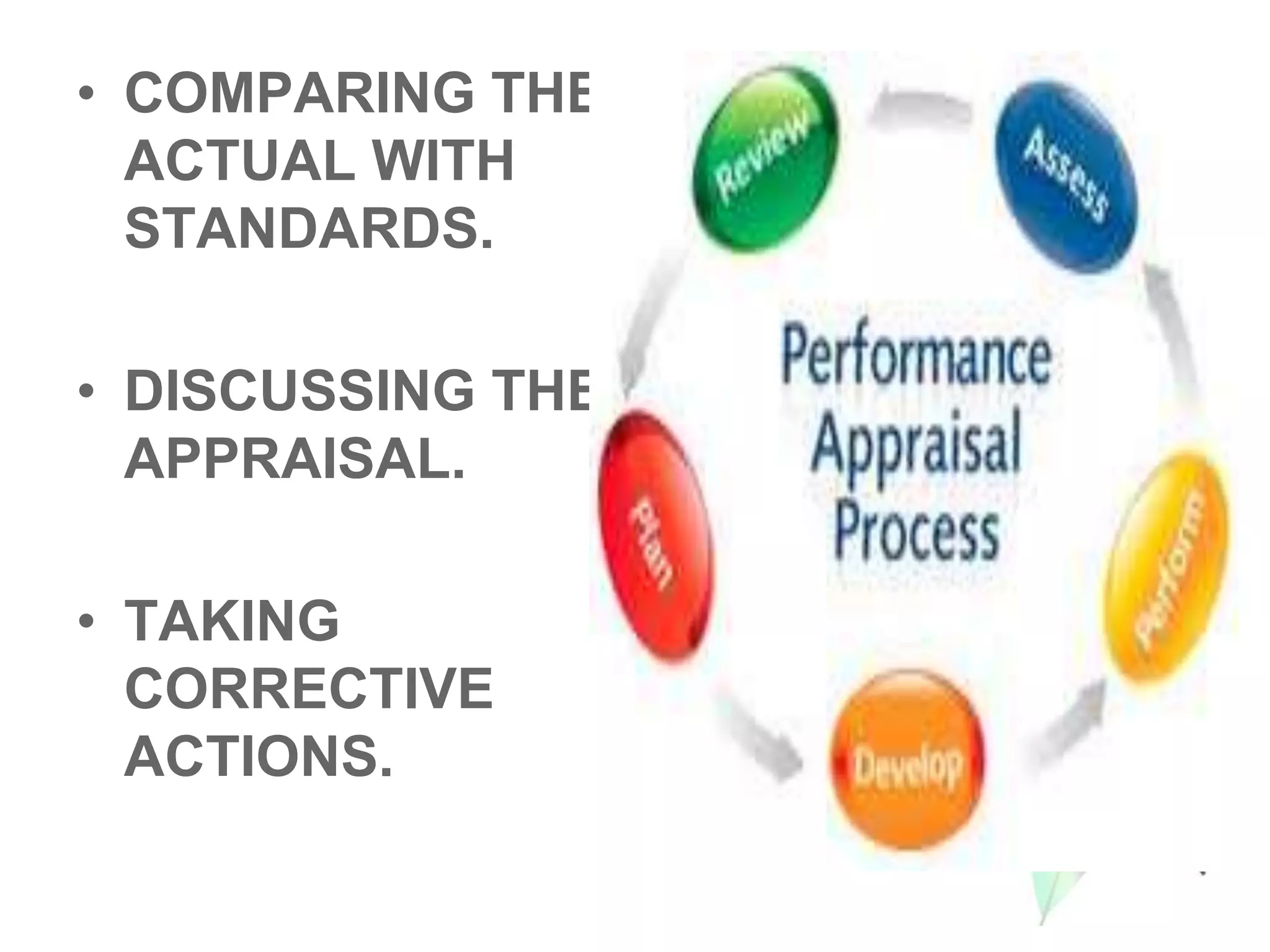
• COMPARING THE
ACTUAL WITH
STANDARDS.
• DISCUSSING THE
APPRAISAL.
• TAKING
CORRECTIVE
ACTIONS.
APPRAISAL INTERVIEW
• PROBATIONARY:- To determine if
the employee has meet the job
requirements
• ANNUAL:- To determine the current
competencies of the employee and
provide feed back and plan for
professional goals for the coming years
• ONGOING-CONTINOUS:- It should
not just occur once a year but
should be ongoing.
• TRANSFER:- Appraisal should take
place before changing the position
and after orientation to new
position.
• EXIT:- If an employee is leaving
an organization a terminal
performance appraisal should
be done. The results should be
documented in the employees
personal file.
PRACTICES OBSERVED FOR
ASSESSMENT OF PERSONNEL
• The assessment of each
employee should be made
by the person to whom the
employee is administratively
responsible and where ever possible,
by one another person.
• The assessment should be made in
relation to the job specification.
• The preparation of the
assessment should
include discussion
with the individual
concerned.
• The assessment
should be considered
confidential.
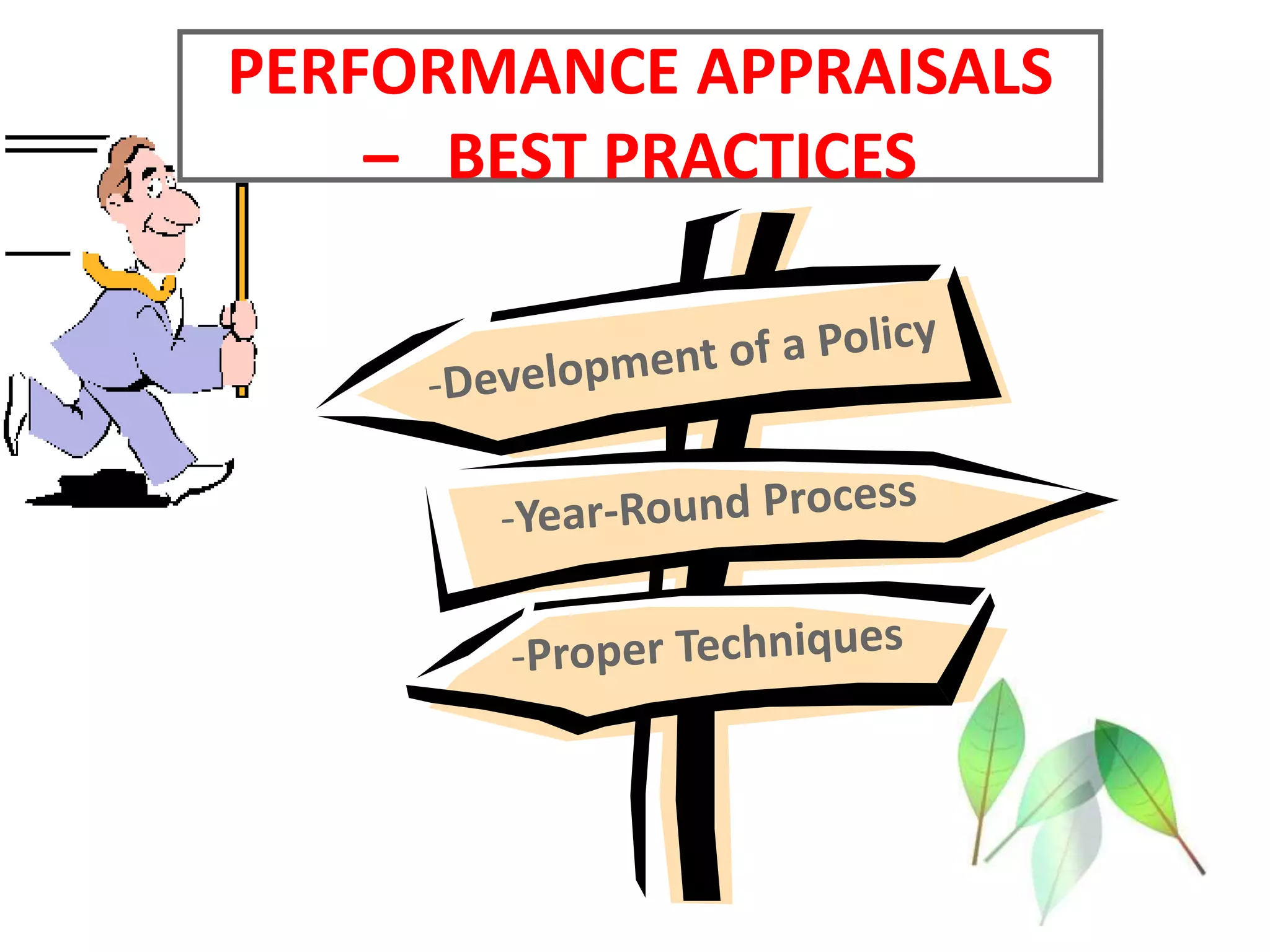
PERFORMANCE APPRAISALS
– BEST PRACTICES
LIMITATIONS OF
PERFORMANCE APPRAISAL
• Bias in conducting appraisal - errors are
introduced in the appraisal because
of a defect or bias in the person
conducting appraisals.
CONTINUED….
• Clarity in standards - unless all raters
agree on what terms such as “good”
or “excellent” mean or on the
numerical evaluation of the different
characteristics, their final rating
cannot be compared.
CONTINUED…..
• Insufficient evidence
• Differing perceptions
• Excessive leniency or strictness
• Influence of man’s job
•ETHICAL BASIS FOR
PERFORMANCE
APPRAISAL
TEN COMMANDMENTS OF
THE SYSTEM ARE
• Know the reason for appraisal before
expressing your opinion or
assessment.
• Appraise on the basis of representative
information.
• Appraise on the basis of sufficient
information.
• Appraise on the basis of relevant
information.
• Make an honest appraisal.
• Keep written and oral appraisals
consistent.
• Present appraisals as opinion.
• Give appraisal information to only
those who have a good reason to
have it.
• Do not imply the existence of an
appraisal that has not been made at all
implying you have information which
is just as misleading
• Do not accept others’ appraisal without
knowing the basis for it.
TECHNIQUES/METHODS OF PERFORMANCE
APPRAISAL
TRADITIONAL METHODS
• Confidential report:- It is a report
prepared by the employees immediate
superiors it covers the strengths and
weaknesses main achievements and
failures personality and behaviour of the
employee. It is used for promotion and
transfers of employees.
ESSAY APPRAISAL: The appraiser is
asked to write an essay on the
employee’s strengths, weaknesses
and potentials
– This technique is more valid and
formal than complicated methods of
appraisal.
– The biggest drawback in this method
is that it is difficult to combine and
compare the essays as it may touch
upon various aspects of one’s
performance and qualifications.
Another drawback is the variability of
length and content in the essays.
RANKING METHODS: This method is
useful when it becomes necessary
to compare people who work for
different supervisors, when there
are several individual ratings an
when appraisal forms are not
particularly useful. This method is
also employed to compare people
in different units of an organization.
–
PAIRED COMPARISON: This is a method of
comparison where each employee is first
compared with the peers, one at a time,
and when all the comparisons are done,
the employees are given the final
rankings.
Critical Incidents Method: In this
traditional method of Performance
appraisal, the evaluator rates the
employee on the basis of critical
events and how the employee reacts
in such events - essentially their
behavioural patterns during those
incidents.
Field review: In this method, a senior
member of the HR department or a training
officer discusses and interviews the
supervisors to evaluate and rate their
respective subordinates. A major
drawback of this method is that it is a very
time consuming method. But this method
helps to reduce the superiors’ personal
bias.
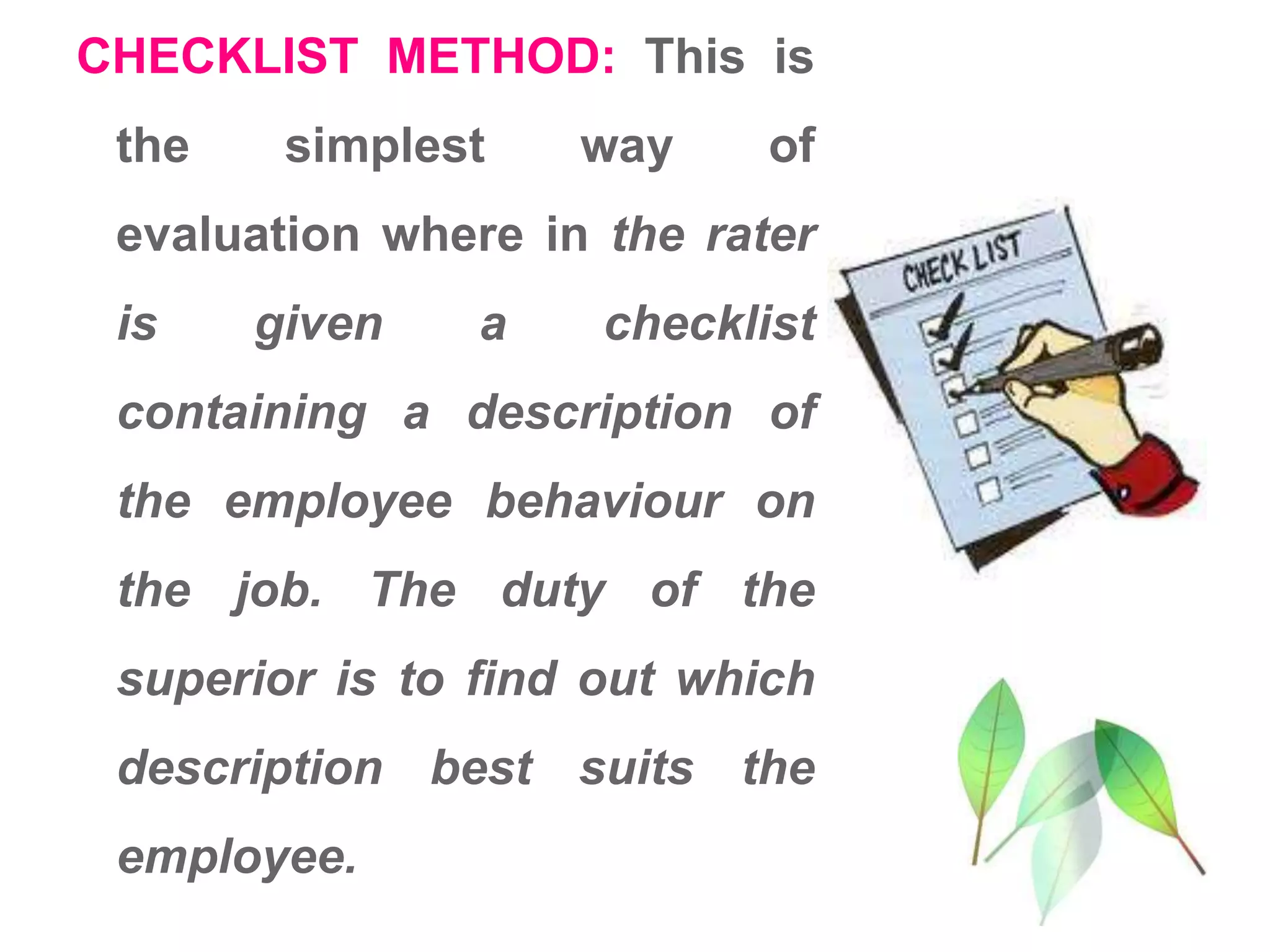
CHECKLIST METHOD: This is
the simplest way of
evaluation where in the rater
is given a checklist
containing a description of
the employee behaviour on
the job. The duty of the
superior is to find out which
description best suits the
employee.
GRAPHIC RATING SCALE: This
is one of the oldest and the
most commonly used methods
for appraisal used alongside
Essay Appraisal Method. In
this method, a printed form is
used for measuring both the
quality and the quantity of
work done by an employee.
FORCED DISTRIBUTION: To eliminate
the element of bias from the rater’s
ratings, the evaluator is asked to
distribute the employees in some fixed
categories of ratings like on a normal
distribution curve. The rater chooses
the appropriate fit for the categories on
his own discretion
MODERN METHODS:
MANAGEMENT BY OBJECTIVES:
It is defined as a process whereby
the employees and the superiors
come together to identify common
goals, the employees set their goals
to be achieved, the standards to be
taken as the criteria for measurement
of their performance and contribution
and deciding the course of action to
be followed.
PERFORMANCE CYCLE
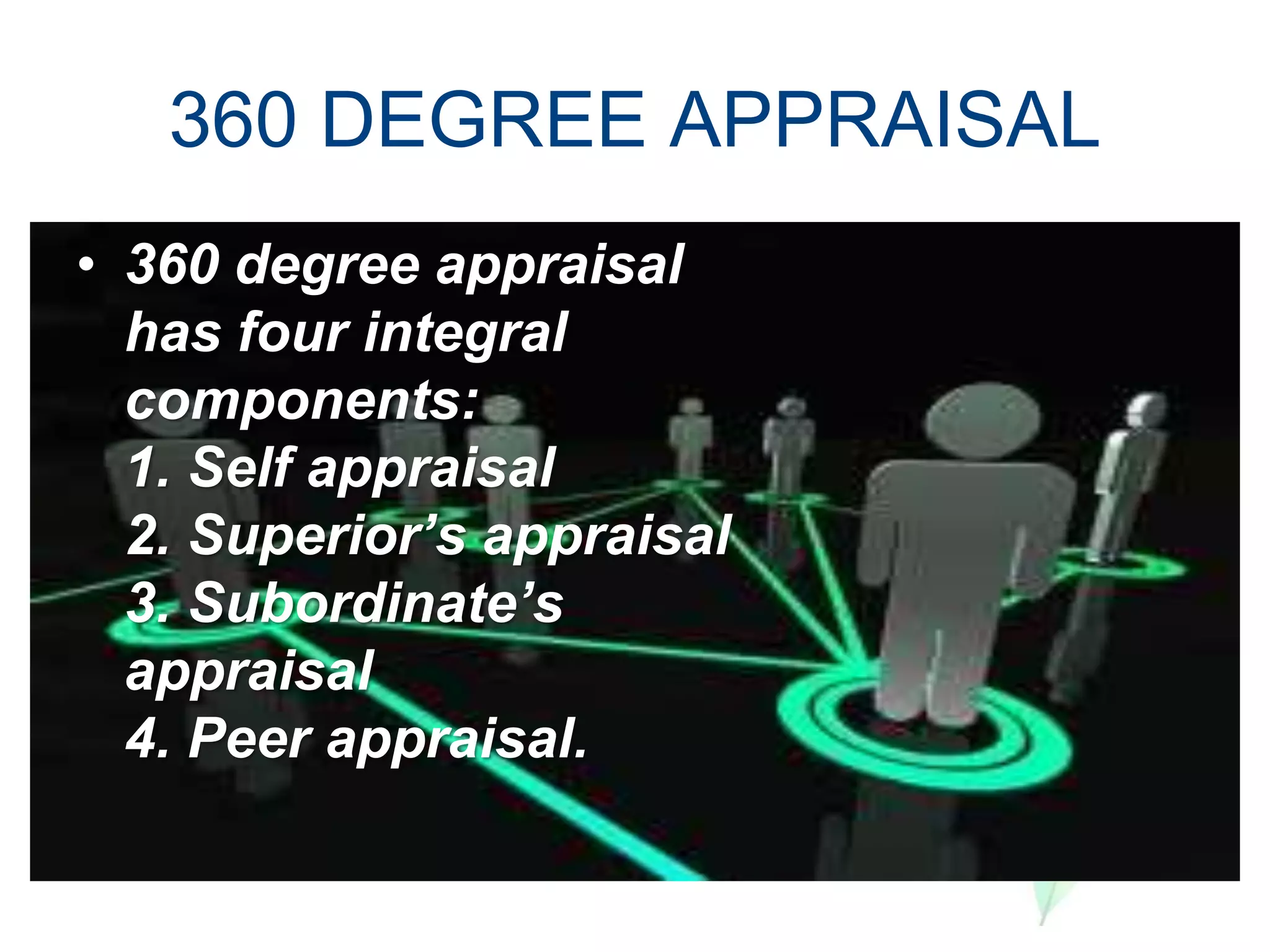
360 DEGREE APPRAISAL
• 360 degree appraisal
has four integral
components:
1. Self appraisal
2. Superior’s appraisal
3. Subordinate’s
appraisal
4. Peer appraisal.
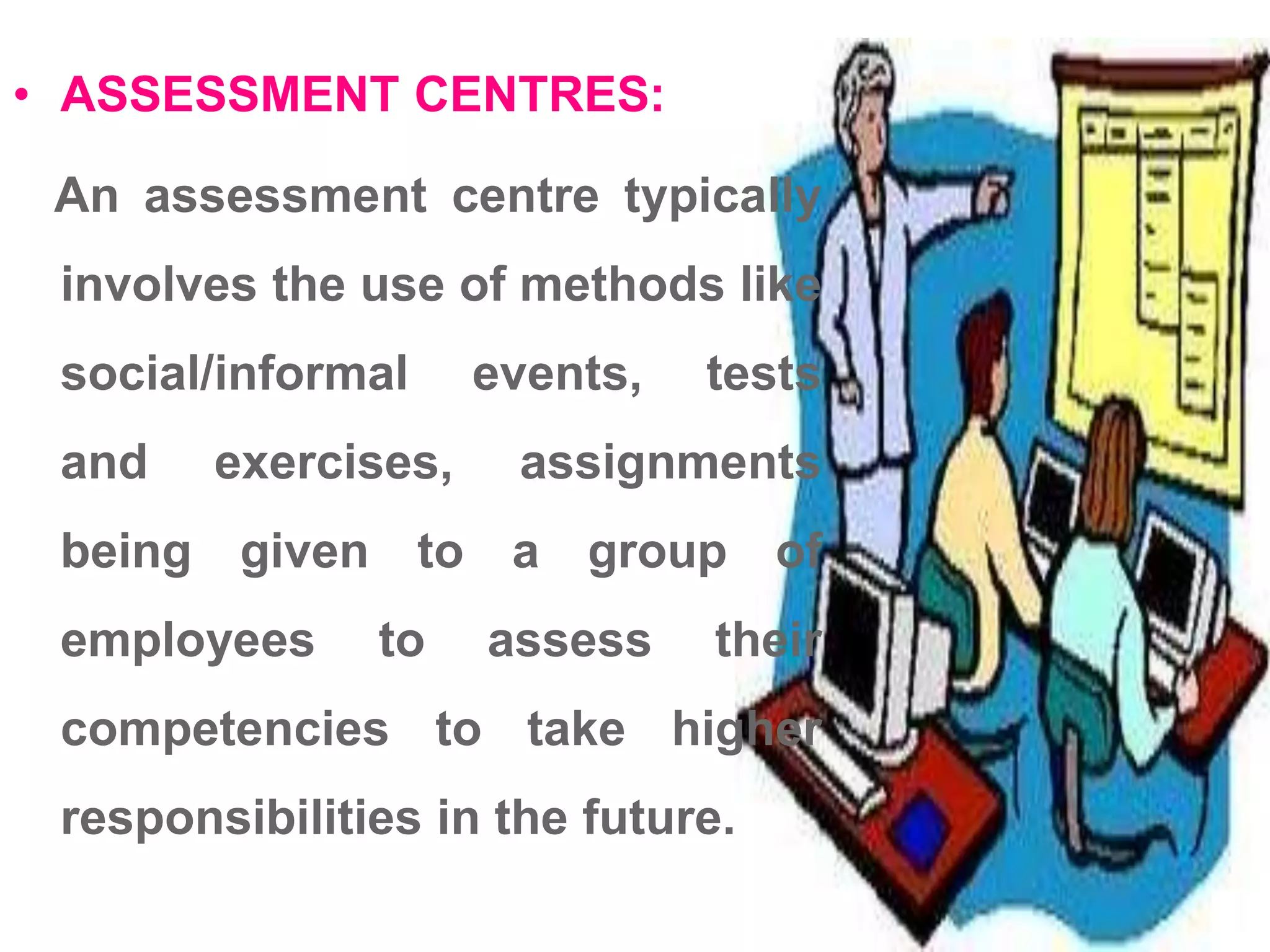
• ASSESSMENT CENTRES:
An assessment centre typically
involves the use of methods like
social/informal events, tests
and exercises, assignments
being given to a group of
employees to assess their
competencies to take higher
responsibilities in the future.
Generally, employees are given an
assignment similar to the job they
would be expected to perform if
promoted. The trained evaluators
observe and evaluate employees as
they perform the assigned jobs and are
evaluated on job related
characteristics.
TIPS FOR PERFORMANCE
APPRAISALS
•Tip #1: Don't
forget about
performance
planning.
•Tip #2: Don't
compare
employees
with each
other.
•Tip #3: Don't
forget that
appraisal is
about
assessment.
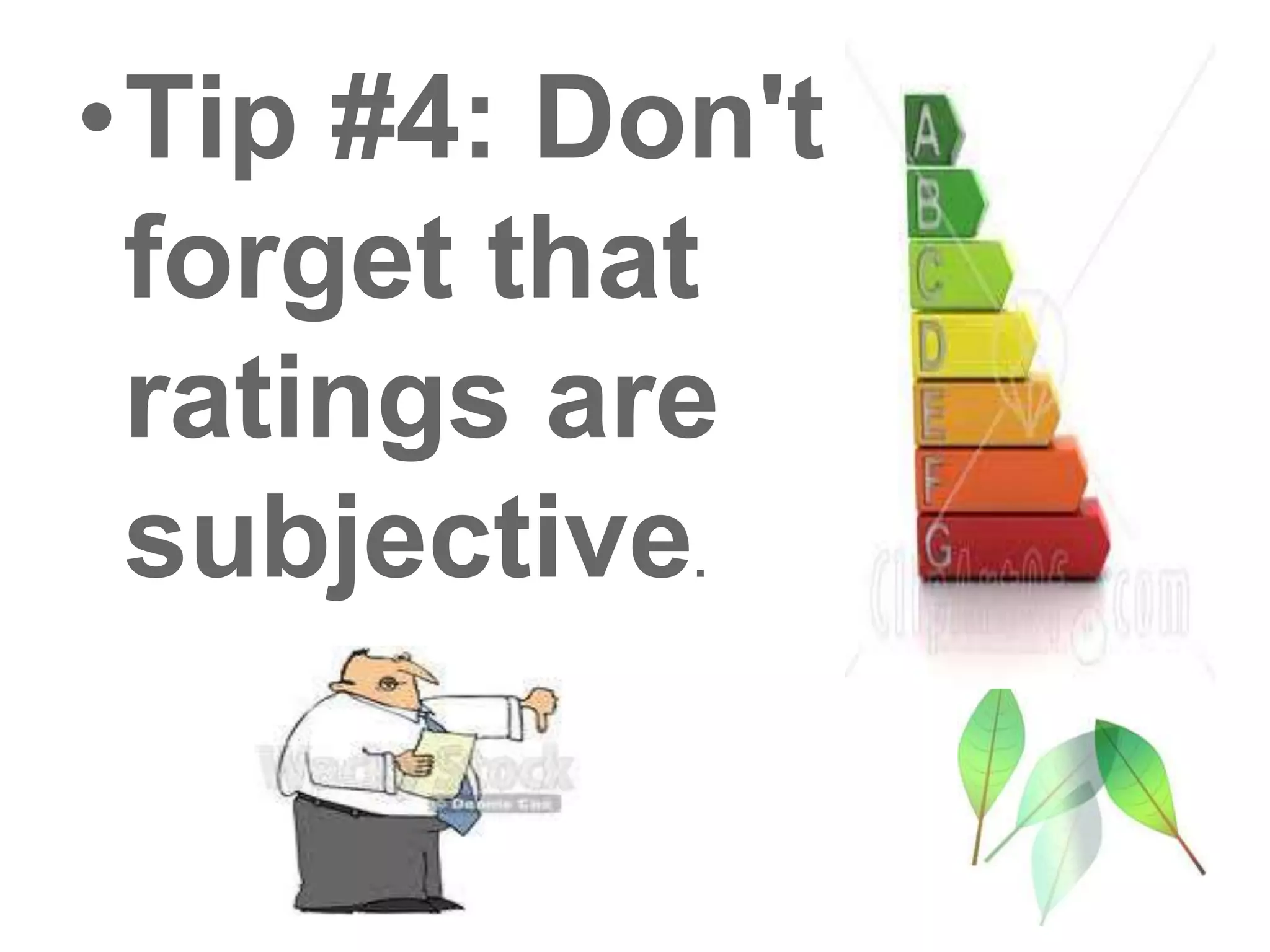
•Tip #4: Don't
forget that
ratings are
subjective.
•Tip #5:
Appraisals are
for
performance
improvement
not salary
administration.
•Tip #6:
Accurately
assessing staff.
•Tip #7:
Don't
postpone
appraisal
meetings.
•Tip #8: No
surprises,
NEVER.
•Tip #9: Don't treat
all employees the
same.
BARRIERS TO EFFECTIVE
APPRAISAL
•Faulty assumptions
•Psychological blocks
•Technical pitfalls.
1.FAULTY ASSUMPTIONS
• Managers take a particular appraisal system as
perfect and feel that once they have launched a
programme that would continue forever.
• Managers sometimes assume that personal opinion
is better than formal appraisal and they find little use
of systematic appraisal and review procedures.
• Managers’ assumptions that employees want to
know frankly where they do stand and what their
superiors think about them are not valid.
2. PSYCHOLOGICAL
BLOCKS
• Managers’ feeling of insecurity
• Appraisal as an extra burden
• Their being excessively modest of sceptical
• Their feeling to treat their subordinates’ failure as
their deficiency
• Disliking of resentment by subordinates
• Disliking of communicating poor performance to
subordinates
3.TECHNICAL PITFALLS
A) THE CRITERION PROBLEM
B) DISTORTIONS
CRITERION PROBLEM –
a criterion is the standard of
performance the manager desires of
his subordinates and against which he
compares their actual
performance. Criteria are
hard to define in
measurable or even objective terms
DISTORTIONS –
Distortions occur in the form of biases
and errors in making the evaluation. An
appraisal system has the following
possible distortions:
• Halo effect
• Central tendency
• Constant errors
• Rater’s liking and disliking
CONCLUSION
• Performance appraisal is
necessary to ensure an
understanding between an
employees and the
supervisor on the goals of
the institution and progress
of the employees in reading
institutional and personal
goals.
performance_appraisal_0.ppt

performance_appraisal_0.ppt

  • 1.
    Mrs.BALWINDER KAUR ASSOCIATE PROFESSOR S.K.S.S.COLLEGEOF NURSING SARABHA, LUDHIANA Ohh again…..
  • 2.
  • 3.
  • 4.
    The “Big Three” •Absenteeism and Tardiness • Performance Deficiencies • Misconduct and Rule/Policy Violations
  • 5.
  • 6.
    Performance Appraisals– Why arethey so important? - Performance reviews are an integral part of the employee’s on the job experience. - When fair, accurate and conducted on a regular basis appraisals can stimulate employee morale, which can lead to more efficient business operations and discourage litigation. - When performance reviews are not fair and reasonable, generating inaccurate or incomplete appraisals, they can have the opposite effect.
  • 7.
    INTRODUCTION Performance Evaluation or PerformanceAppraisal is the process of assessing the performance and progress of an employee or a group of employees on a given job and his potential for future development.
  • 8.
    As Flippo said:- Performanceappraisal is the systematic , periodic and an imparting rating of an employees excellence in matters pertaining to his present job and his potential for a better job. It is the process of obtaining , analyzing and recording information about the relative worth of an employee.
  • 9.
    Performance Appraisal Is TheSystematic Evaluation Of The Individual With Regard To His Or Her Performance On The Job And His Potential For Development. - By Beach
  • 10.
    AIMS OF PERFORMANCE APPRAISAL •Give employees feedback on performance • To determine job competency • To enhance staff development and motivate personnel towards higher achievement.
  • 11.
    contd….. • Document criteriaused to allocate organizational rewards. • Form a basis for personnel decisions: salary increases, promotions, disciplinary actions, bonuses, etc.
  • 12.
    • Facilitate communicationbetween employee and administration • To improve performance through counseling, coaching and development. • To determine training and developmental needs of nursing. contd…
  • 13.
    OBJECTIVES OF PERFORMANCE APPRAISAL •Salary increase. • Promotion. • Training and development. • Feedback. • Pressure on employees.
  • 14.
    • Review theperformance of the employees over a given period of time. • Judge the gap between the actual and the desired performance. • Help the management in exercising organizational control.
  • 15.
    • Helps tostrengthen the relationship and communication between superior subordinates • Diagnose the strengths and weaknesses of the individuals so as to identify the training and development needs of the future.
  • 16.
    • To knowthe problem faced by employees while doing various jobs. • To provide a basis for comparison to segregate efficient and inefficient employees. • To help management in fixing employees according to their capacity, interest, aptitude and qualifications. • To help supervisors to know their subordinates more closely.
  • 17.
    Qualities most frequently evaluatedare • Quality of performance • Mental qualities • Supervisory qualities • Personal qualities • Capacity for further development.
  • 18.
    PROCESS OF PERFORMANCE APPRAISAL •ESTABLISHING PERFORMANCE APPRAISAL. • COMMUNICATING THE STANDARDS. • MEASURING PERFORMANCE.
  • 19.
    • COMPARING THE ACTUALWITH STANDARDS. • DISCUSSING THE APPRAISAL. • TAKING CORRECTIVE ACTIONS.
  • 20.
    APPRAISAL INTERVIEW • PROBATIONARY:-To determine if the employee has meet the job requirements • ANNUAL:- To determine the current competencies of the employee and provide feed back and plan for professional goals for the coming years
  • 21.
    • ONGOING-CONTINOUS:- Itshould not just occur once a year but should be ongoing. • TRANSFER:- Appraisal should take place before changing the position and after orientation to new position.
  • 22.
    • EXIT:- Ifan employee is leaving an organization a terminal performance appraisal should be done. The results should be documented in the employees personal file.
  • 23.
    PRACTICES OBSERVED FOR ASSESSMENTOF PERSONNEL • The assessment of each employee should be made by the person to whom the employee is administratively responsible and where ever possible, by one another person. • The assessment should be made in relation to the job specification.
  • 24.
    • The preparationof the assessment should include discussion with the individual concerned. • The assessment should be considered confidential.
  • 25.
  • 26.
    LIMITATIONS OF PERFORMANCE APPRAISAL •Bias in conducting appraisal - errors are introduced in the appraisal because of a defect or bias in the person conducting appraisals.
  • 27.
    CONTINUED…. • Clarity instandards - unless all raters agree on what terms such as “good” or “excellent” mean or on the numerical evaluation of the different characteristics, their final rating cannot be compared.
  • 28.
    CONTINUED….. • Insufficient evidence •Differing perceptions • Excessive leniency or strictness • Influence of man’s job
  • 29.
  • 30.
    TEN COMMANDMENTS OF THESYSTEM ARE • Know the reason for appraisal before expressing your opinion or assessment. • Appraise on the basis of representative information. • Appraise on the basis of sufficient information. • Appraise on the basis of relevant information.
  • 31.
    • Make anhonest appraisal. • Keep written and oral appraisals consistent. • Present appraisals as opinion. • Give appraisal information to only those who have a good reason to have it.
  • 32.
    • Do notimply the existence of an appraisal that has not been made at all implying you have information which is just as misleading • Do not accept others’ appraisal without knowing the basis for it.
  • 33.
  • 34.
    TRADITIONAL METHODS • Confidentialreport:- It is a report prepared by the employees immediate superiors it covers the strengths and weaknesses main achievements and failures personality and behaviour of the employee. It is used for promotion and transfers of employees.
  • 35.
    ESSAY APPRAISAL: Theappraiser is asked to write an essay on the employee’s strengths, weaknesses and potentials – This technique is more valid and formal than complicated methods of appraisal. – The biggest drawback in this method is that it is difficult to combine and compare the essays as it may touch upon various aspects of one’s performance and qualifications. Another drawback is the variability of length and content in the essays.
  • 36.
    RANKING METHODS: Thismethod is useful when it becomes necessary to compare people who work for different supervisors, when there are several individual ratings an when appraisal forms are not particularly useful. This method is also employed to compare people in different units of an organization. –
  • 37.
    PAIRED COMPARISON: Thisis a method of comparison where each employee is first compared with the peers, one at a time, and when all the comparisons are done, the employees are given the final rankings.
  • 38.
    Critical Incidents Method:In this traditional method of Performance appraisal, the evaluator rates the employee on the basis of critical events and how the employee reacts in such events - essentially their behavioural patterns during those incidents.
  • 39.
    Field review: Inthis method, a senior member of the HR department or a training officer discusses and interviews the supervisors to evaluate and rate their respective subordinates. A major drawback of this method is that it is a very time consuming method. But this method helps to reduce the superiors’ personal bias.
  • 40.
    CHECKLIST METHOD: Thisis the simplest way of evaluation where in the rater is given a checklist containing a description of the employee behaviour on the job. The duty of the superior is to find out which description best suits the employee.
  • 41.
    GRAPHIC RATING SCALE:This is one of the oldest and the most commonly used methods for appraisal used alongside Essay Appraisal Method. In this method, a printed form is used for measuring both the quality and the quantity of work done by an employee.
  • 42.
    FORCED DISTRIBUTION: Toeliminate the element of bias from the rater’s ratings, the evaluator is asked to distribute the employees in some fixed categories of ratings like on a normal distribution curve. The rater chooses the appropriate fit for the categories on his own discretion
  • 43.
    MODERN METHODS: MANAGEMENT BYOBJECTIVES: It is defined as a process whereby the employees and the superiors come together to identify common goals, the employees set their goals to be achieved, the standards to be taken as the criteria for measurement of their performance and contribution and deciding the course of action to be followed.
  • 44.
  • 45.
    360 DEGREE APPRAISAL •360 degree appraisal has four integral components: 1. Self appraisal 2. Superior’s appraisal 3. Subordinate’s appraisal 4. Peer appraisal.
  • 46.
    • ASSESSMENT CENTRES: Anassessment centre typically involves the use of methods like social/informal events, tests and exercises, assignments being given to a group of employees to assess their competencies to take higher responsibilities in the future.
  • 47.
    Generally, employees aregiven an assignment similar to the job they would be expected to perform if promoted. The trained evaluators observe and evaluate employees as they perform the assigned jobs and are evaluated on job related characteristics.
  • 48.
    TIPS FOR PERFORMANCE APPRAISALS •Tip#1: Don't forget about performance planning.
  • 49.
  • 50.
    •Tip #3: Don't forgetthat appraisal is about assessment.
  • 51.
    •Tip #4: Don't forgetthat ratings are subjective.
  • 52.
  • 53.
  • 54.
  • 55.
  • 56.
    •Tip #9: Don'ttreat all employees the same.
  • 57.
    BARRIERS TO EFFECTIVE APPRAISAL •Faultyassumptions •Psychological blocks •Technical pitfalls.
  • 58.
    1.FAULTY ASSUMPTIONS • Managerstake a particular appraisal system as perfect and feel that once they have launched a programme that would continue forever. • Managers sometimes assume that personal opinion is better than formal appraisal and they find little use of systematic appraisal and review procedures. • Managers’ assumptions that employees want to know frankly where they do stand and what their superiors think about them are not valid.
  • 59.
    2. PSYCHOLOGICAL BLOCKS • Managers’feeling of insecurity • Appraisal as an extra burden • Their being excessively modest of sceptical • Their feeling to treat their subordinates’ failure as their deficiency • Disliking of resentment by subordinates • Disliking of communicating poor performance to subordinates
  • 60.
    3.TECHNICAL PITFALLS A) THECRITERION PROBLEM B) DISTORTIONS
  • 61.
    CRITERION PROBLEM – acriterion is the standard of performance the manager desires of his subordinates and against which he compares their actual performance. Criteria are hard to define in measurable or even objective terms
  • 62.
    DISTORTIONS – Distortions occurin the form of biases and errors in making the evaluation. An appraisal system has the following possible distortions: • Halo effect • Central tendency • Constant errors • Rater’s liking and disliking
  • 63.
    CONCLUSION • Performance appraisalis necessary to ensure an understanding between an employees and the supervisor on the goals of the institution and progress of the employees in reading institutional and personal goals.