




Perforated Plate Column
Liquid – Liquid Extraction Equipment
Fawad Akram
12063123-065
B.Sc Chemical Engineering, UoG.
Liquid – Liquid Extraction
Equipment
• LLE involves intimate contact between two
immiscible or partially liquid phases as
compared to a gas or a vapor and a liquid
phase in gas absorption and distillation.
What are differences between these
fluid - fluid contacting phenomena??
•
Liquid – Liquid Extraction is more
difficult than distillation.
Liquid – Liquid Extraction has
higher energy demand than
distillation.
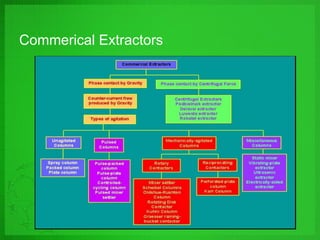
Commerical Extractors
Design of Extractors
Stage-wise Contactors
Differential Contactors
Factors classifying Contactors
• Inducement of countercurrent flow
• Designing
• Effecting Phase Separation
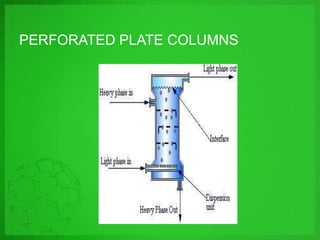
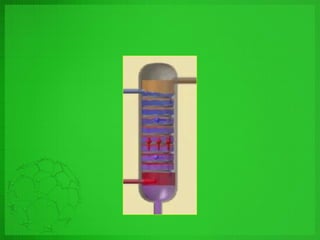
PERFORATED PLATE COLUMNS
• Similar to the sieve tray columns in distillation.
• The column is comprised of several perforated trays
along with either downcomers or upcomers, depending
on which phase, heavy or light, is chosen to be
continuous.
• The original dispersion is performed by a nozzle, as in
spray columns.
• Cross flow contact occurs between each tray.
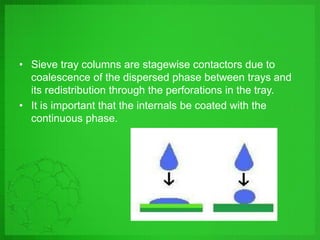
• Sieve tray columns are stagewise contactors due to
coalescence of the dispersed phase between trays and
its redistribution through the perforations in the tray.
• It is important that the internals be coated with the
continuous phase.
Design of Perforated Plate Extraction
Columns
• Procedure developed by Skelland and Chada.
• Procedure involves use of rate equations for mass
transfer during drop formation either at the perforations
or at the end of jets issuing from the perforations, during
free rise or fall of the drops, and during coalescence
beneath each plate, to locate a pseudo-equilibrium
curve.
• When flow rates of the disperse phase are low, drop
formation and detachment occur at the perforations on
each plate.
Design of Perforated Plate Extraction
Columns
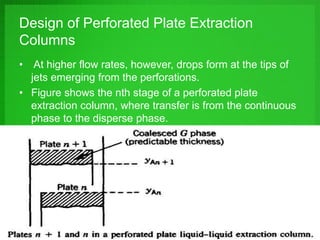
• At higher flow rates, however, drops form at the tips of
jets emerging from the perforations.
• Figure shows the nth stage of a perforated plate
extraction column, where transfer is from the continuous
phase to the disperse phase.
Design of Perforated Plate Extraction
Columns
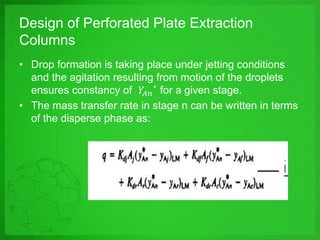
• Drop formation is taking place under jetting conditions
and the agitation resulting from motion of the droplets
ensures constancy of 𝑌𝐴𝑛
∗
for a given stage.
• The mass transfer rate in stage n can be written in terms
of the disperse phase as:
Design of Perforated Plate Extraction
Columns
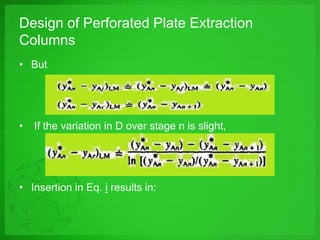
• But
• If the variation in D over stage n is slight,
• Insertion in Eq. i results in:
Design of Perforated Plate Extraction
Columns
• c
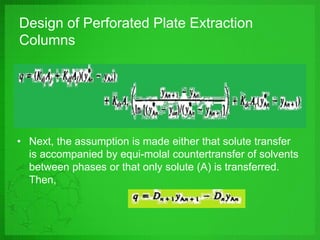
• Next, the assumption is made either that solute transfer
is accompanied by equi-molal countertransfer of solvents
between phases or that only solute (A) is transferred.
Then,
Design of Perforated Plate Extraction
Columns
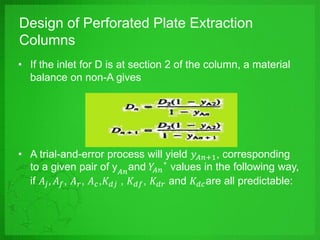
• If the inlet for D is at section 2 of the column, a material
balance on non-A gives
• A trial-and-error process will yield 𝑦 𝐴𝑛+1, corresponding
to a given pair of y 𝐴𝑛and 𝑌𝐴𝑛
∗
values in the following way,
if 𝐴𝑗, 𝐴 𝑓, 𝐴 𝑟, 𝐴 𝑐,𝐾 𝑑𝑗 , 𝐾 𝑑𝑓, 𝐾 𝑑𝑟 and 𝐾 𝑑𝑐are all predictable:
Design of Perforated Plate Extraction
Columns
1. A value of 𝑦 𝐴𝑛+1, is assumed, corresponding to a given
pair of y 𝐴𝑛 and 𝑌𝐴𝑛
∗
, values in Fig.
2. 𝐷 𝑛 and 𝐷 𝑛+1corresponding to y 𝐴𝑛 and the assumed
𝑦 𝐴𝑛+1 are calculated next from Eqs. Given on previous
slide.
3. Values of q are computed from Eqs. On slide 18.
Design of Perforated Plate Extraction
Columns
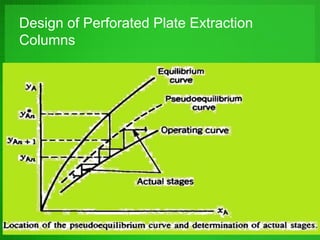
• The value assumed for 𝑦 𝐴𝑛+1, is correct when these two
estimates of q coincide.
• This enables construction of the pseudoequilibrium
curve, which is then used with the operating curve to
step off the number of real plates needed to accomplish
the desired change in D-phase composition from y 𝐴2 to
y 𝐴1
.
Design of Perforated Plate Extraction
Columns
Perforated plate column - LLE Equipment

Perforated plate column - LLE Equipment

  • 1.
    Perforated Plate Column Liquid– Liquid Extraction Equipment Fawad Akram 12063123-065 B.Sc Chemical Engineering, UoG.
  • 2.
    Liquid – LiquidExtraction Equipment • LLE involves intimate contact between two immiscible or partially liquid phases as compared to a gas or a vapor and a liquid phase in gas absorption and distillation.
  • 3.
    What are differencesbetween these fluid - fluid contacting phenomena?? •
  • 4.
    Liquid – LiquidExtraction is more difficult than distillation.
  • 5.
    Liquid – LiquidExtraction has higher energy demand than distillation.
  • 6.
  • 7.
    Design of Extractors Stage-wiseContactors Differential Contactors
  • 8.
    Factors classifying Contactors •Inducement of countercurrent flow • Designing • Effecting Phase Separation
  • 9.
  • 10.
    • Similar tothe sieve tray columns in distillation. • The column is comprised of several perforated trays along with either downcomers or upcomers, depending on which phase, heavy or light, is chosen to be continuous. • The original dispersion is performed by a nozzle, as in spray columns. • Cross flow contact occurs between each tray.
  • 11.
    • Sieve traycolumns are stagewise contactors due to coalescence of the dispersed phase between trays and its redistribution through the perforations in the tray. • It is important that the internals be coated with the continuous phase.
  • 14.
    Design of PerforatedPlate Extraction Columns • Procedure developed by Skelland and Chada. • Procedure involves use of rate equations for mass transfer during drop formation either at the perforations or at the end of jets issuing from the perforations, during free rise or fall of the drops, and during coalescence beneath each plate, to locate a pseudo-equilibrium curve. • When flow rates of the disperse phase are low, drop formation and detachment occur at the perforations on each plate.
  • 15.
    Design of PerforatedPlate Extraction Columns • At higher flow rates, however, drops form at the tips of jets emerging from the perforations. • Figure shows the nth stage of a perforated plate extraction column, where transfer is from the continuous phase to the disperse phase.
  • 16.
    Design of PerforatedPlate Extraction Columns • Drop formation is taking place under jetting conditions and the agitation resulting from motion of the droplets ensures constancy of 𝑌𝐴𝑛 ∗ for a given stage. • The mass transfer rate in stage n can be written in terms of the disperse phase as:
  • 17.
    Design of PerforatedPlate Extraction Columns • But • If the variation in D over stage n is slight, • Insertion in Eq. i results in:
  • 18.
    Design of PerforatedPlate Extraction Columns • c • Next, the assumption is made either that solute transfer is accompanied by equi-molal countertransfer of solvents between phases or that only solute (A) is transferred. Then,
  • 19.
    Design of PerforatedPlate Extraction Columns • If the inlet for D is at section 2 of the column, a material balance on non-A gives • A trial-and-error process will yield 𝑦 𝐴𝑛+1, corresponding to a given pair of y 𝐴𝑛and 𝑌𝐴𝑛 ∗ values in the following way, if 𝐴𝑗, 𝐴 𝑓, 𝐴 𝑟, 𝐴 𝑐,𝐾 𝑑𝑗 , 𝐾 𝑑𝑓, 𝐾 𝑑𝑟 and 𝐾 𝑑𝑐are all predictable:
  • 20.
    Design of PerforatedPlate Extraction Columns 1. A value of 𝑦 𝐴𝑛+1, is assumed, corresponding to a given pair of y 𝐴𝑛 and 𝑌𝐴𝑛 ∗ , values in Fig. 2. 𝐷 𝑛 and 𝐷 𝑛+1corresponding to y 𝐴𝑛 and the assumed 𝑦 𝐴𝑛+1 are calculated next from Eqs. Given on previous slide. 3. Values of q are computed from Eqs. On slide 18.
  • 21.
    Design of PerforatedPlate Extraction Columns • The value assumed for 𝑦 𝐴𝑛+1, is correct when these two estimates of q coincide. • This enables construction of the pseudoequilibrium curve, which is then used with the operating curve to step off the number of real plates needed to accomplish the desired change in D-phase composition from y 𝐴2 to y 𝐴1 .
  • 22.
    Design of PerforatedPlate Extraction Columns