PERDEV LQ
M3-M7
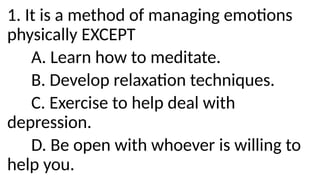
1. It is a method of managing emotions
physically EXCEPT
A. Learn how to meditate.
B. Develop relaxation techniques.
C. Exercise to help deal with
depression.
D. Be open with whoever is willing to
help you.
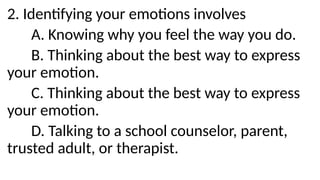
2. Identifying your emotions involves
A. Knowing why you feel the way you do.
B. Thinking about the best way to express
your emotion.
C. Thinking about the best way to express
your emotion.
D. Talking to a school counselor, parent,
trusted adult, or therapist.
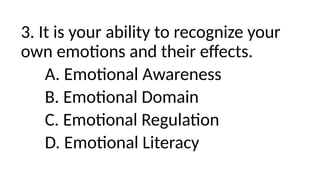
3. It is your ability to recognize your
own emotions and their effects.
A. Emotional Awareness
B. Emotional Domain
C. Emotional Regulation
D. Emotional Literacy
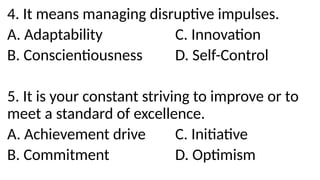
4. It means managing disruptive impulses.
A. Adaptability C. Innovation
B. Conscientiousness D. Self-Control
5. It is your constant striving to improve or to
meet a standard of excellence.
A. Achievement drive C. Initiative
B. Commitment D. Optimism
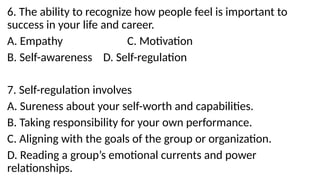
6. The ability to recognize how people feel is important to
success in your life and career.
A. Empathy C. Motivation
B. Self-awareness D. Self-regulation
7. Self-regulation involves
A. Sureness about your self-worth and capabilities.
B. Taking responsibility for your own performance.
C. Aligning with the goals of the group or organization.
D. Reading a group’s emotional currents and power
relationships.
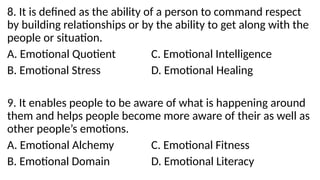
8. It is defined as the ability of a person to command respect
by building relationships or by the ability to get along with the
people or situation.
A. Emotional Quotient C. Emotional Intelligence
B. Emotional Stress D. Emotional Healing
9. It enables people to be aware of what is happening around
them and helps people become more aware of their as well as
other people’s emotions.
A. Emotional Alchemy C. Emotional Fitness
B. Emotional Domain D. Emotional Literacy
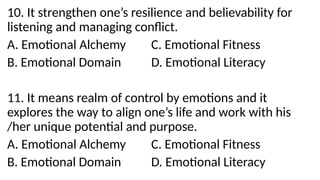
10. It strengthen one’s resilience and believability for
listening and managing conflict.
A. Emotional Alchemy C. Emotional Fitness
B. Emotional Domain D. Emotional Literacy
11. It means realm of control by emotions and it
explores the way to align one’s life and work with his
/her unique potential and purpose.
A. Emotional Alchemy C. Emotional Fitness
B. Emotional Domain D. Emotional Literacy
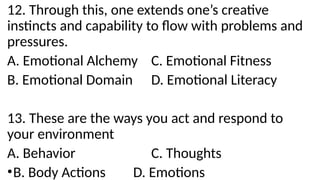
12. Through this, one extends one’s creative
instincts and capability to flow with problems and
pressures.
A. Emotional Alchemy C. Emotional Fitness
B. Emotional Domain D. Emotional Literacy
13. These are the ways you act and respond to
your environment
A. Behavior C. Thoughts
•B. Body Actions D. Emotions
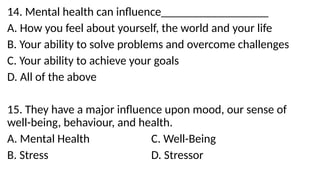
14. Mental health can influence__________________
A. How you feel about yourself, the world and your life
B. Your ability to solve problems and overcome challenges
C. Your ability to achieve your goals
D. All of the above
15. They have a major influence upon mood, our sense of
well-being, behaviour, and health.
A. Mental Health C. Well-Being
B. Stress D. Stressor
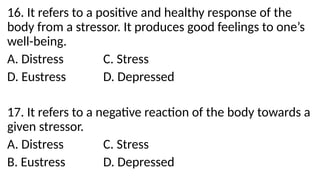
16. It refers to a positive and healthy response of the
body from a stressor. It produces good feelings to one’s
well-being.
A. Distress C. Stress
D. Eustress D. Depressed
17. It refers to a negative reaction of the body towards a
given stressor.
A. Distress C. Stress
B. Eustress D. Depressed
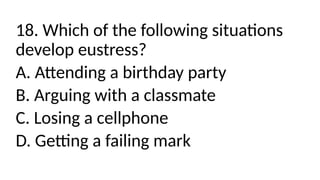
18. Which of the following situations
develop eustress?
A. Attending a birthday party
B. Arguing with a classmate
C. Losing a cellphone
D. Getting a failing mark
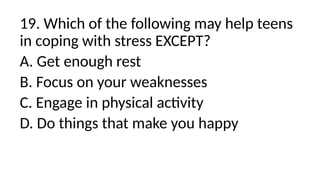
19. Which of the following may help teens
in coping with stress EXCEPT?
A. Get enough rest
B. Focus on your weaknesses
C. Engage in physical activity
D. Do things that make you happy
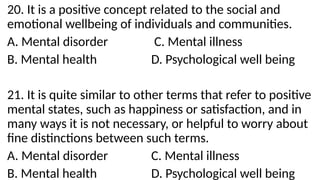
20. It is a positive concept related to the social and
emotional wellbeing of individuals and communities.
A. Mental disorder C. Mental illness
B. Mental health D. Psychological well being
21. It is quite similar to other terms that refer to positive
mental states, such as happiness or satisfaction, and in
many ways it is not necessary, or helpful to worry about
fine distinctions between such terms.
A. Mental disorder C. Mental illness
B. Mental health D. Psychological well being
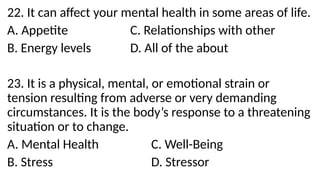
22. It can affect your mental health in some areas of life.
A. Appetite C. Relationships with other
B. Energy levels D. All of the about
23. It is a physical, mental, or emotional strain or
tension resulting from adverse or very demanding
circumstances. It is the body’s response to a threatening
situation or to change.
A. Mental Health C. Well-Being
B. Stress D. Stressor
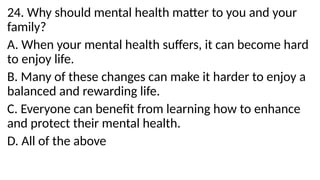
24. Why should mental health matter to you and your
family?
A. When your mental health suffers, it can become hard
to enjoy life.
B. Many of these changes can make it harder to enjoy a
balanced and rewarding life.
C. Everyone can benefit from learning how to enhance
and protect their mental health.
D. All of the above
25. What is true about the cerebrum?
A. It’s named after its bell-like shape.
B. It plays a large role in motor control.
C. Common signs of cerebellum damage are related to
vision.
D. It is the area of the brain stem that controls heart rate
and breathing.
26. Which of the following is not a major layer of the brain
A. Stem brain C. Hindbrain
B. Forebrain D. Midbrain
27. Injury to the frontal lobes may affect
A. Perception of size, color, and shape
B. The ability to locate parts of the body
C. Emotions, impulse control, language,
memory, social and sexual behaviour
D. The ability to recognize a familiar person’s
face and processing sensory information
28. Which part of the brain is responsible for reasoning,
planning, speech and movement, emotions and
problem-solving?
A. Frontal lobe C. Parietal lobe
B. Occipital lobe D. Temporal lobe
29. This part of the brain handles the perception of
stimuli like touch, pressure, temperature and pain.
A. Frontal lobe C. Parietal lobe
B. Occipital lobe D. Temporal lobe
30. The perception and recognition of sounds and
memory are the responsibility of this part of the
brain.
A. Frontal lobe C. Parietal lobe
B. Occipital lobe D. Temporal lobe
31. Which part of the brain oversees vision?
A. Frontal lobe C. Parietal lobe
B. Occipital lobe D. Temporal lobe
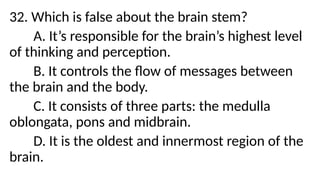
32. Which is false about the brain stem?
A. It’s responsible for the brain’s highest level
of thinking and perception.
B. It controls the flow of messages between
the brain and the body.
C. It consists of three parts: the medulla
oblongata, pons and midbrain.
D. It is the oldest and innermost region of the
brain.
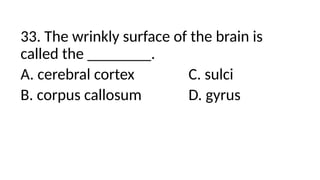
33. The wrinkly surface of the brain is
called the ________.
A. cerebral cortex C. sulci
B. corpus callosum D. gyrus
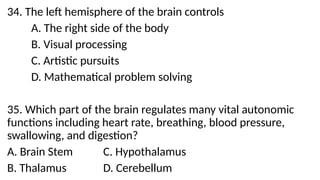
34. The left hemisphere of the brain controls
A. The right side of the body
B. Visual processing
C. Artistic pursuits
D. Mathematical problem solving
35. Which part of the brain regulates many vital autonomic
functions including heart rate, breathing, blood pressure,
swallowing, and digestion?
A. Brain Stem C. Hypothalamus
B. Thalamus D. Cerebellum
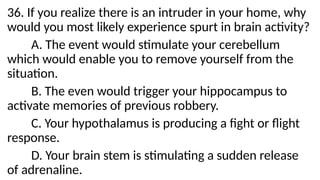
36. If you realize there is an intruder in your home, why
would you most likely experience spurt in brain activity?
A. The event would stimulate your cerebellum
which would enable you to remove yourself from the
situation.
B. The even would trigger your hippocampus to
activate memories of previous robbery.
C. Your hypothalamus is producing a fight or flight
response.
D. Your brain stem is stimulating a sudden release
of adrenaline.
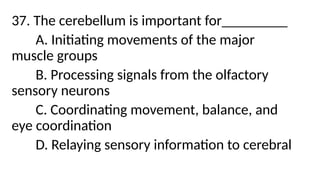
37. The cerebellum is important for_________
A. Initiating movements of the major
muscle groups
B. Processing signals from the olfactory
sensory neurons
C. Coordinating movement, balance, and
eye coordination
D. Relaying sensory information to cerebral
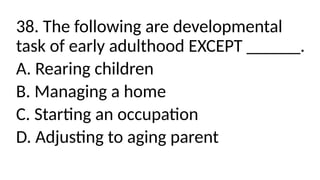
38. The following are developmental
task of early adulthood EXCEPT ______.
A. Rearing children
B. Managing a home
C. Starting an occupation
D. Adjusting to aging parent
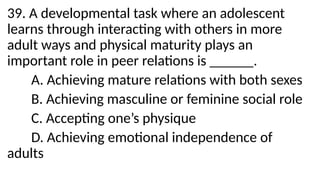
39. A developmental task where an adolescent
learns through interacting with others in more
adult ways and physical maturity plays an
important role in peer relations is ______.
A. Achieving mature relations with both sexes
B. Achieving masculine or feminine social role
C. Accepting one’s physique
D. Achieving emotional independence of
adults
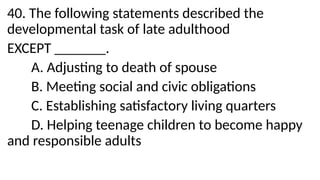
40. The following statements described the
developmental task of late adulthood
EXCEPT _______.
A. Adjusting to death of spouse
B. Meeting social and civic obligations
C. Establishing satisfactory living quarters
D. Helping teenage children to become happy
and responsible adults
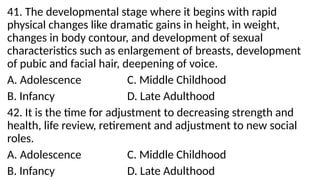
41. The developmental stage where it begins with rapid
physical changes like dramatic gains in height, in weight,
changes in body contour, and development of sexual
characteristics such as enlargement of breasts, development
of pubic and facial hair, deepening of voice.
A. Adolescence C. Middle Childhood
B. Infancy D. Late Adulthood
42. It is the time for adjustment to decreasing strength and
health, life review, retirement and adjustment to new social
roles.
A. Adolescence C. Middle Childhood
B. Infancy D. Late Adulthood
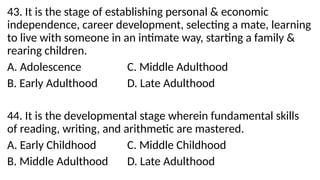
43. It is the stage of establishing personal & economic
independence, career development, selecting a mate, learning
to live with someone in an intimate way, starting a family &
rearing children.
A. Adolescence C. Middle Adulthood
B. Early Adulthood D. Late Adulthood
44. It is the developmental stage wherein fundamental skills
of reading, writing, and arithmetic are mastered.
A. Early Childhood C. Middle Childhood
B. Middle Adulthood D. Late Adulthood
45. He defines developmental tasks as one
that arises at certain period in our life, the
successful achievement of which leads to
happiness and success with later tasks while
failure leads to unhappiness, social
disapproval, and difficulty with later task.
A. Erick Ericson C. John Locke
B. John Santrosk D. Robert Havighurt
46. Which of following statements is NOT true about
adolescence developmental task?
A. Adolescents have one foot in childhood and one foot
in adulthood.
B. Parents and adults have an important role to play with
and can give a positive impact on the lives of adolescents.
C. A developmental task represents our culture's
definition of normal development at different points in the life
span.
D. Adults should not provide adolescents a space to make
their own decisions and be accountable for the consequences
of their actions.
47. The following statements will help you become a
responsible adolescent
EXCEPT________.
A. Take care of your health and hygiene.
B. Give in to temptations.
C. Focus on your studies and do well in all your
endeavors.
D. Establish open and good communication with
parents and guardians.
48. Accepting one’s physique, achieving
emotional independence of adults and
preparing for marriage and family life and
preparing for an economic career are
examples of what developmental stage?
A. Adolescence C. Middle Adulthood
B. Early Adulthood D. Late Adulthood
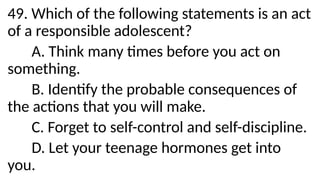
49. Which of the following statements is an act
of a responsible adolescent?
A. Think many times before you act on
something.
B. Identify the probable consequences of
the actions that you will make.
C. Forget to self-control and self-discipline.
D. Let your teenage hormones get into
you.
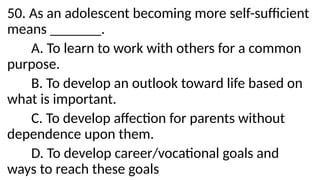
50. As an adolescent becoming more self-sufficient
means _______.
A. To learn to work with others for a common
purpose.
B. To develop an outlook toward life based on
what is important.
C. To develop affection for parents without
dependence upon them.
D. To develop career/vocational goals and
ways to reach these goals

PERDEV Quarter 1-Long Quiz Module 1-Module 7

  • 1.
  • 2.
    1. It isa method of managing emotions physically EXCEPT A. Learn how to meditate. B. Develop relaxation techniques. C. Exercise to help deal with depression. D. Be open with whoever is willing to help you.
  • 3.
    2. Identifying youremotions involves A. Knowing why you feel the way you do. B. Thinking about the best way to express your emotion. C. Thinking about the best way to express your emotion. D. Talking to a school counselor, parent, trusted adult, or therapist.
  • 4.
    3. It isyour ability to recognize your own emotions and their effects. A. Emotional Awareness B. Emotional Domain C. Emotional Regulation D. Emotional Literacy
  • 5.
    4. It meansmanaging disruptive impulses. A. Adaptability C. Innovation B. Conscientiousness D. Self-Control 5. It is your constant striving to improve or to meet a standard of excellence. A. Achievement drive C. Initiative B. Commitment D. Optimism
  • 6.
    6. The abilityto recognize how people feel is important to success in your life and career. A. Empathy C. Motivation B. Self-awareness D. Self-regulation 7. Self-regulation involves A. Sureness about your self-worth and capabilities. B. Taking responsibility for your own performance. C. Aligning with the goals of the group or organization. D. Reading a group’s emotional currents and power relationships.
  • 7.
    8. It isdefined as the ability of a person to command respect by building relationships or by the ability to get along with the people or situation. A. Emotional Quotient C. Emotional Intelligence B. Emotional Stress D. Emotional Healing 9. It enables people to be aware of what is happening around them and helps people become more aware of their as well as other people’s emotions. A. Emotional Alchemy C. Emotional Fitness B. Emotional Domain D. Emotional Literacy
  • 8.
    10. It strengthenone’s resilience and believability for listening and managing conflict. A. Emotional Alchemy C. Emotional Fitness B. Emotional Domain D. Emotional Literacy 11. It means realm of control by emotions and it explores the way to align one’s life and work with his /her unique potential and purpose. A. Emotional Alchemy C. Emotional Fitness B. Emotional Domain D. Emotional Literacy
  • 9.
    12. Through this,one extends one’s creative instincts and capability to flow with problems and pressures. A. Emotional Alchemy C. Emotional Fitness B. Emotional Domain D. Emotional Literacy 13. These are the ways you act and respond to your environment A. Behavior C. Thoughts •B. Body Actions D. Emotions
  • 10.
    14. Mental healthcan influence__________________ A. How you feel about yourself, the world and your life B. Your ability to solve problems and overcome challenges C. Your ability to achieve your goals D. All of the above 15. They have a major influence upon mood, our sense of well-being, behaviour, and health. A. Mental Health C. Well-Being B. Stress D. Stressor
  • 11.
    16. It refersto a positive and healthy response of the body from a stressor. It produces good feelings to one’s well-being. A. Distress C. Stress D. Eustress D. Depressed 17. It refers to a negative reaction of the body towards a given stressor. A. Distress C. Stress B. Eustress D. Depressed
  • 12.
    18. Which ofthe following situations develop eustress? A. Attending a birthday party B. Arguing with a classmate C. Losing a cellphone D. Getting a failing mark
  • 13.
    19. Which ofthe following may help teens in coping with stress EXCEPT? A. Get enough rest B. Focus on your weaknesses C. Engage in physical activity D. Do things that make you happy
  • 14.
    20. It isa positive concept related to the social and emotional wellbeing of individuals and communities. A. Mental disorder C. Mental illness B. Mental health D. Psychological well being 21. It is quite similar to other terms that refer to positive mental states, such as happiness or satisfaction, and in many ways it is not necessary, or helpful to worry about fine distinctions between such terms. A. Mental disorder C. Mental illness B. Mental health D. Psychological well being
  • 15.
    22. It canaffect your mental health in some areas of life. A. Appetite C. Relationships with other B. Energy levels D. All of the about 23. It is a physical, mental, or emotional strain or tension resulting from adverse or very demanding circumstances. It is the body’s response to a threatening situation or to change. A. Mental Health C. Well-Being B. Stress D. Stressor
  • 16.
    24. Why shouldmental health matter to you and your family? A. When your mental health suffers, it can become hard to enjoy life. B. Many of these changes can make it harder to enjoy a balanced and rewarding life. C. Everyone can benefit from learning how to enhance and protect their mental health. D. All of the above
  • 17.
    25. What istrue about the cerebrum? A. It’s named after its bell-like shape. B. It plays a large role in motor control. C. Common signs of cerebellum damage are related to vision. D. It is the area of the brain stem that controls heart rate and breathing. 26. Which of the following is not a major layer of the brain A. Stem brain C. Hindbrain B. Forebrain D. Midbrain
  • 18.
    27. Injury tothe frontal lobes may affect A. Perception of size, color, and shape B. The ability to locate parts of the body C. Emotions, impulse control, language, memory, social and sexual behaviour D. The ability to recognize a familiar person’s face and processing sensory information
  • 19.
    28. Which partof the brain is responsible for reasoning, planning, speech and movement, emotions and problem-solving? A. Frontal lobe C. Parietal lobe B. Occipital lobe D. Temporal lobe 29. This part of the brain handles the perception of stimuli like touch, pressure, temperature and pain. A. Frontal lobe C. Parietal lobe B. Occipital lobe D. Temporal lobe
  • 20.
    30. The perceptionand recognition of sounds and memory are the responsibility of this part of the brain. A. Frontal lobe C. Parietal lobe B. Occipital lobe D. Temporal lobe 31. Which part of the brain oversees vision? A. Frontal lobe C. Parietal lobe B. Occipital lobe D. Temporal lobe
  • 21.
    32. Which isfalse about the brain stem? A. It’s responsible for the brain’s highest level of thinking and perception. B. It controls the flow of messages between the brain and the body. C. It consists of three parts: the medulla oblongata, pons and midbrain. D. It is the oldest and innermost region of the brain.
  • 22.
    33. The wrinklysurface of the brain is called the ________. A. cerebral cortex C. sulci B. corpus callosum D. gyrus
  • 23.
    34. The lefthemisphere of the brain controls A. The right side of the body B. Visual processing C. Artistic pursuits D. Mathematical problem solving 35. Which part of the brain regulates many vital autonomic functions including heart rate, breathing, blood pressure, swallowing, and digestion? A. Brain Stem C. Hypothalamus B. Thalamus D. Cerebellum
  • 24.
    36. If yourealize there is an intruder in your home, why would you most likely experience spurt in brain activity? A. The event would stimulate your cerebellum which would enable you to remove yourself from the situation. B. The even would trigger your hippocampus to activate memories of previous robbery. C. Your hypothalamus is producing a fight or flight response. D. Your brain stem is stimulating a sudden release of adrenaline.
  • 25.
    37. The cerebellumis important for_________ A. Initiating movements of the major muscle groups B. Processing signals from the olfactory sensory neurons C. Coordinating movement, balance, and eye coordination D. Relaying sensory information to cerebral
  • 26.
    38. The followingare developmental task of early adulthood EXCEPT ______. A. Rearing children B. Managing a home C. Starting an occupation D. Adjusting to aging parent
  • 27.
    39. A developmentaltask where an adolescent learns through interacting with others in more adult ways and physical maturity plays an important role in peer relations is ______. A. Achieving mature relations with both sexes B. Achieving masculine or feminine social role C. Accepting one’s physique D. Achieving emotional independence of adults
  • 28.
    40. The followingstatements described the developmental task of late adulthood EXCEPT _______. A. Adjusting to death of spouse B. Meeting social and civic obligations C. Establishing satisfactory living quarters D. Helping teenage children to become happy and responsible adults
  • 29.
    41. The developmentalstage where it begins with rapid physical changes like dramatic gains in height, in weight, changes in body contour, and development of sexual characteristics such as enlargement of breasts, development of pubic and facial hair, deepening of voice. A. Adolescence C. Middle Childhood B. Infancy D. Late Adulthood 42. It is the time for adjustment to decreasing strength and health, life review, retirement and adjustment to new social roles. A. Adolescence C. Middle Childhood B. Infancy D. Late Adulthood
  • 30.
    43. It isthe stage of establishing personal & economic independence, career development, selecting a mate, learning to live with someone in an intimate way, starting a family & rearing children. A. Adolescence C. Middle Adulthood B. Early Adulthood D. Late Adulthood 44. It is the developmental stage wherein fundamental skills of reading, writing, and arithmetic are mastered. A. Early Childhood C. Middle Childhood B. Middle Adulthood D. Late Adulthood
  • 31.
    45. He definesdevelopmental tasks as one that arises at certain period in our life, the successful achievement of which leads to happiness and success with later tasks while failure leads to unhappiness, social disapproval, and difficulty with later task. A. Erick Ericson C. John Locke B. John Santrosk D. Robert Havighurt
  • 32.
    46. Which offollowing statements is NOT true about adolescence developmental task? A. Adolescents have one foot in childhood and one foot in adulthood. B. Parents and adults have an important role to play with and can give a positive impact on the lives of adolescents. C. A developmental task represents our culture's definition of normal development at different points in the life span. D. Adults should not provide adolescents a space to make their own decisions and be accountable for the consequences of their actions.
  • 33.
    47. The followingstatements will help you become a responsible adolescent EXCEPT________. A. Take care of your health and hygiene. B. Give in to temptations. C. Focus on your studies and do well in all your endeavors. D. Establish open and good communication with parents and guardians.
  • 34.
    48. Accepting one’sphysique, achieving emotional independence of adults and preparing for marriage and family life and preparing for an economic career are examples of what developmental stage? A. Adolescence C. Middle Adulthood B. Early Adulthood D. Late Adulthood
  • 35.
    49. Which ofthe following statements is an act of a responsible adolescent? A. Think many times before you act on something. B. Identify the probable consequences of the actions that you will make. C. Forget to self-control and self-discipline. D. Let your teenage hormones get into you.
  • 36.
    50. As anadolescent becoming more self-sufficient means _______. A. To learn to work with others for a common purpose. B. To develop an outlook toward life based on what is important. C. To develop affection for parents without dependence upon them. D. To develop career/vocational goals and ways to reach these goals