It is one of the
leading beverage
companies in the
Philippines.
PepsiCo.
Be the premier food
and beverage
company in the
Philippines.
Vision Statement
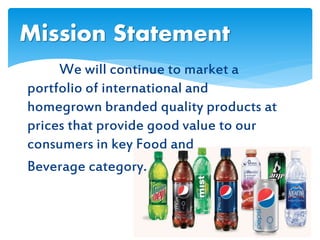
We will continue to market a
portfolio of international and
homegrown branded quality products at
prices that provide good value to our
consumers in key Food and
Beverage category.
Mission Statement
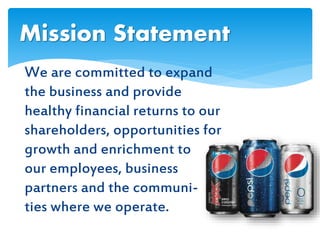
We are committed to expand
the business and provide
healthy financial returns to our
shareholders, opportunities for
growth and enrichment to
our employees, business
partners and the communi-
ties where we operate.
Mission Statement
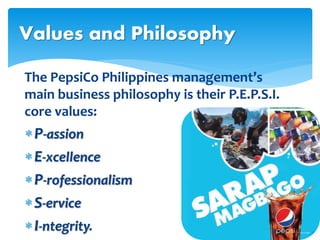
The PepsiCo Philippines management’s
main business philosophy is their P.E.P.S.I.
core values:
P-assion
E-xcellence
P-rofessionalism
S-ervice
I-ntegrity.
Values and Philosophy
PASSION
They stimulate passion
by bringing their new
and creative ideas to
life and also by
overcoming any
obstacle they
experience.
A good leadership
mindset is steeped
into the culture
of PepsiCo. at
all levels.
EXCELLENCE
Management is
called to a form
of servant
leadership, what
PepsiCo calls
“leadership by
service”.
PROFESSIONALISM
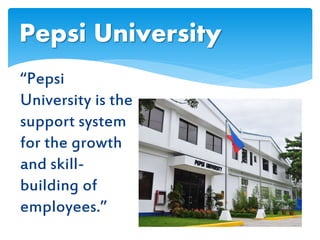
“Pepsi
University is the
support system
for the growth
and skill-
building of
employees.”
Pepsi University
In any sales
business, the sales
people are the
front liners, but in
PepsiCo, everyone
is a front liner.
SERVICE
Pepsi is governed by the
highest standards of integrity,
remaining true to its
commitments whether people
are looking or not and
exacting the highest
standards in its employees
and their corporate conduct.
INTEGRITY
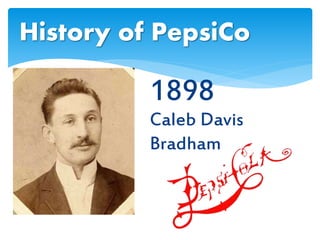
1898
History of PepsiCo
Caleb Davis
Bradham
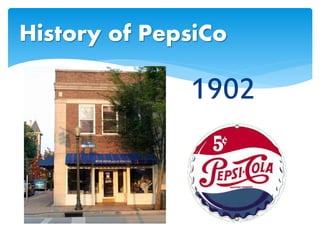
1902
History of PepsiCo
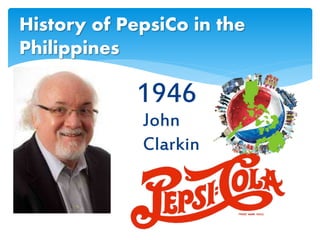
1946
History of PepsiCo in the
Philippines
John
Clarkin
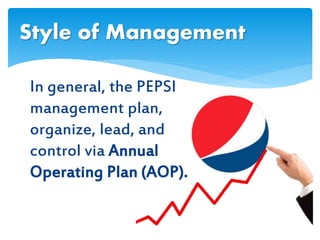
In general, the PEPSI
management plan,
organize, lead, and
control via Annual
Operating Plan (AOP).
Style of Management
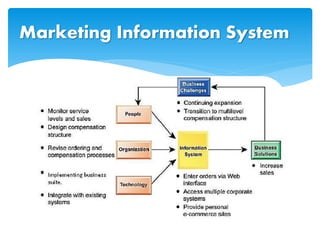
Marketing Information System
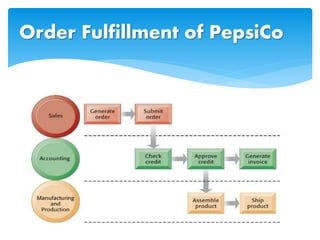
Order Fulfillment of PepsiCo
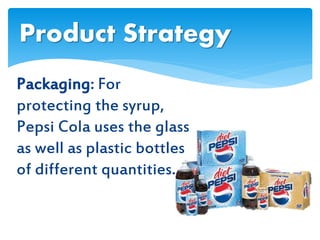
Packaging: For
protecting the syrup,
Pepsi Cola uses the glass
as well as plastic bottles
of different quantities.
Product Strategy
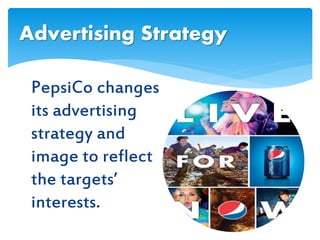
PepsiCo changes
its advertising
strategy and
image to reflect
the targets’
interests.
Advertising Strategy
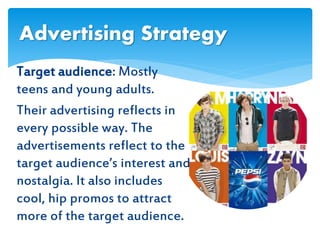
Target audience: Mostly
teens and young adults.
Their advertising reflects in
every possible way. The
advertisements reflect to the
target audience’s interest and
nostalgia. It also includes
cool, hip promos to attract
more of the target audience.
Advertising Strategy
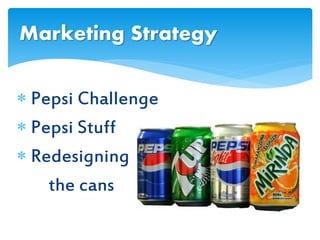
 Pepsi Challenge
 Pepsi Stuff
 Redesigning
the cans
Marketing Strategy
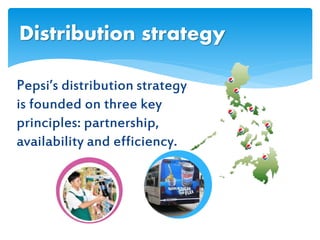
Pepsi’s distribution strategy
is founded on three key
principles: partnership,
availability and efficiency.
Distribution strategy
 Global Advertisement
 Strives to ensure excellence and
specifically for the brands or
products together with the
packaging, advertising and
marketing
 Markets products using the
localization process
PepsiCo International
Strategy
 Promotes products and brand
through supermarkets across the
world
 Partnered with customers
through TV networks
 International expansion
 Brand flexibility
PepsiCo International
Strategy
Product Portfolio
Product Portfolio
Product Portfolio
Product Portfolio
Product Portfolio
Product Portfolio
Product Portfolio
Product Portfolio
Low
PepsiCo is well
established and
has brand equity,
loyal customers
Threat of New Entrance
 Low
 Not a great deal for
PepsiCo
 Consumers preference is
“taste more than the
cost”.
 Other than Coca-Cola,
not many carbonated
drink have the same taste
as Pepsi-Cola.
Threat of Substitute
Not so significant even
though it has low
switching cost.
Consumers preference is
the taste
Convenience of the
vending machine
Bargaining Power of
Buyers
 Low
 There are many raw material
supplier like fruit and other
ingredients.
 Builds partnership with
farmers & community group,
ensuring quality supply.
 Only problem may rely on
bad harvesting season due to
climate change. Another
aspect is on fuel oil crisis.
Bargaining Power of
Supplier
Moderate to
Strong
 Pepsi is not no.1
in Beverage
market.
Pepsi still need to
compete with
Coca-cola.
Competitive Rivalry Within
An Industry
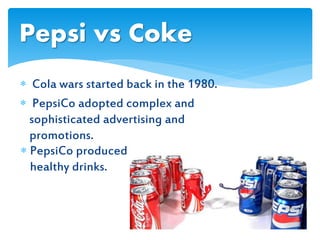
 PepsiCo produced
healthy drinks.
Pepsi vs Coke
 Cola wars started back in the 1980.
 PepsiCo adopted complex and
sophisticated advertising and
promotions.
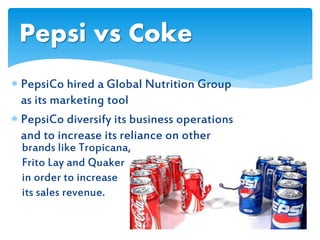
 PepsiCo hired a Global Nutrition Group
as its marketing tool
 PepsiCo diversify its business operations
and to increase its reliance on other
Pepsi vs Coke
brands like Tropicana,
Frito Lay and Quaker
in order to increase
its sales revenue.
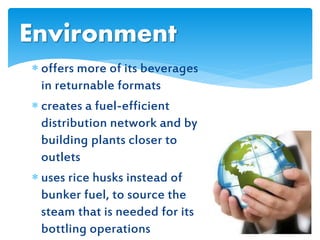
 offers more of its beverages
in returnable formats
 creates a fuel-efficient
distribution network and by
building plants closer to
outlets
 uses rice husks instead of
bunker fuel, to source the
steam that is needed for its
bottling operations
Environment
 Partnered with
Solutions Using
Renewable Energy
(SURE) for a
cogeneration
facility that will use
renewable source
of energy as fuel
input
Environment
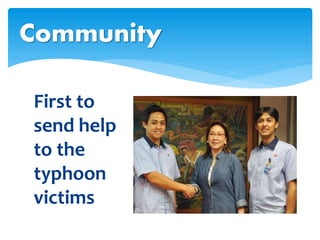
First to
send help
to the
typhoon
victims
Community
Advocate of
health and
wellness
Community
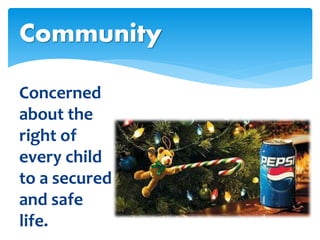
Concerned
about the
right of
every child
to a secured
and safe
life.
Community
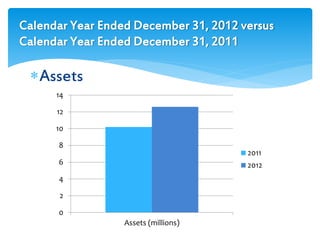
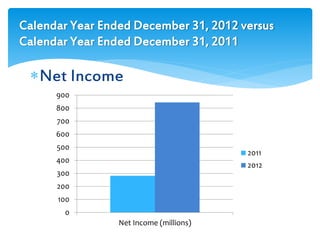
Calendar Year Ended December 31, 2012 versus
Calendar Year Ended December 31, 2011
Assets
0
2
4
6
8
10
12
14
Assets (millions)
2011
2012
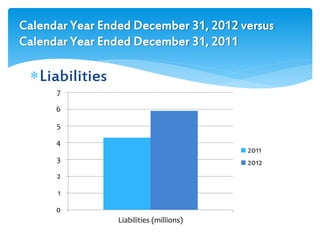
Calendar Year Ended December 31, 2012 versus
Calendar Year Ended December 31, 2011
Liabilities
0
1
2
3
4
5
6
7
Liabilities (millions)
2011
2012
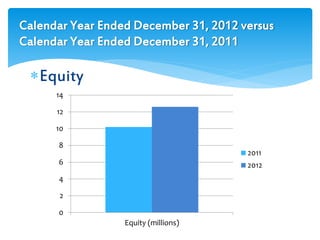
Calendar Year Ended December 31, 2012 versus
Calendar Year Ended December 31, 2011
Equity
0
2
4
6
8
10
12
14
Equity (millions)
2011
2012
Calendar Year Ended December 31, 2012 versus
Calendar Year Ended December 31, 2011
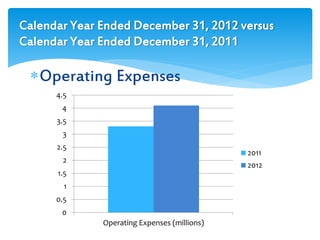
Operating Expenses
0
0.5
1
1.5
2
2.5
3
3.5
4
4.5
Operating Expenses (millions)
2011
2012
Calendar Year Ended December 31, 2012 versus
Calendar Year Ended December 31, 2011
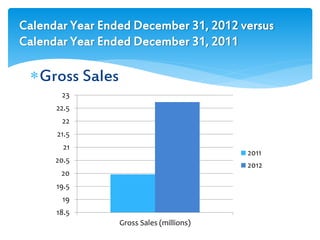
Gross Sales
18.5
19
19.5
20
20.5
21
21.5
22
22.5
23
Gross Sales (millions)
2011
2012
Calendar Year Ended December 31, 2012 versus
Calendar Year Ended December 31, 2011
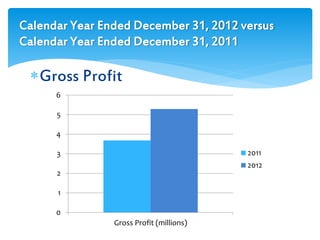
Gross Profit
0
1
2
3
4
5
6
Gross Profit (millions)
2011
2012
Calendar Year Ended December 31, 2012 versus
Calendar Year Ended December 31, 2011
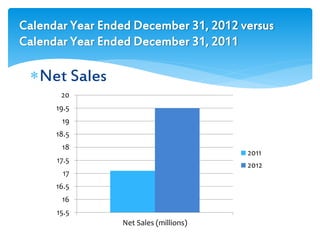
Net Sales
15.5
16
16.5
17
17.5
18
18.5
19
19.5
20
Net Sales (millions)
2011
2012
Calendar Year Ended December 31, 2012 versus
Calendar Year Ended December 31, 2011
Net Income
0
100
200
300
400
500
600
700
800
900
Net Income (millions)
2011
2012
 Established name and a good
reputation
 Has larger market share than its
competitors
 More brand loyal customers
 Satisfying price
 Has a very strong position
internationally
STRENGTHS
 Environment of factory is very
good and attractive
 Spends a lot of budget on its
advertising
 Has a very vast distribution
 Easily accessible
 Offers many discount schemes
 Sponsors sports, musical
concerts, walks
STRENGTHS
 Does not offer any sort of
incentive or discount to its
retailers
 Crown of the disposable
bottle is not good
 Demand of disposal bottle is
declining
 Tin pack is not available in
rural areas
 Does not consider outlets
such as hotels, and fast foods
WEAKNESSES
 May start entering rural areas
also
 May also diversify its business
in some other potential
business
 Increased interest of people in
musical groups, cultural shows
and sports has provided an
opportunity for Pepsi to
increase its sales through
them
OPPORTUNITIES
The main competitor of
the company is the
Coca Cola
Cola drinks are not
good for the health
THREATS
2007
ETHICAL DILEMMAS
Pepsi was faced
with false
advertising
PepsiCo was pressured
by the Corporate
Accountability
International (CAI)
Confidence of the
consumers to the
product was greatly
affected
CONSEQUENCES
 The Corporate Accountability
International (CAI) claimed
that PepsiCo was using tap
water to fill Aquafina bottled
water.
 ”Public Water Source” is now
on the label of the bottled
water and is now branded as
purified drinking water.
SOLUTIONS
1999
FINANCIAL CHALLENGES
 Asian regional crisis added
a record loss of 4billion
 Market share also declined
to record low 14%
 Capital infusion between
Guoco Group and PepsiCo
International had reached
$90M.
The Lorenzo group
invited Guoco Holdings
(Philippines) Inc. which
was based in Hong Kong
to assume majority of
ownership of PepsiCo
and to install a new
management team.
SOLUTIONS
Come up with strategies
that will overcome
weaknesses such as lack
of profile in some
outlets (hotels, fast-food
etc.)
Consistency in their
advertising strategy.
RECOMMENDATIONS
Prepared by:
Almendares, Jessica C.
Dagdag, Joses A.
De Jesus, Angelo Paul N.
Mendoza, Ariane C.
Mercado, Leilani C.
Sapnu, Clarissa T.

Pepsi Management

  • 2.
    It is oneof the leading beverage companies in the Philippines. PepsiCo.
  • 3.
    Be the premierfood and beverage company in the Philippines. Vision Statement
  • 4.
    We will continueto market a portfolio of international and homegrown branded quality products at prices that provide good value to our consumers in key Food and Beverage category. Mission Statement
  • 5.
    We are committedto expand the business and provide healthy financial returns to our shareholders, opportunities for growth and enrichment to our employees, business partners and the communi- ties where we operate. Mission Statement
  • 6.
    The PepsiCo Philippinesmanagement’s main business philosophy is their P.E.P.S.I. core values: P-assion E-xcellence P-rofessionalism S-ervice I-ntegrity. Values and Philosophy
  • 7.
    PASSION They stimulate passion bybringing their new and creative ideas to life and also by overcoming any obstacle they experience.
  • 8.
    A good leadership mindsetis steeped into the culture of PepsiCo. at all levels. EXCELLENCE
  • 9.
    Management is called toa form of servant leadership, what PepsiCo calls “leadership by service”. PROFESSIONALISM
  • 10.
    “Pepsi University is the supportsystem for the growth and skill- building of employees.” Pepsi University
  • 11.
    In any sales business,the sales people are the front liners, but in PepsiCo, everyone is a front liner. SERVICE
  • 12.
    Pepsi is governedby the highest standards of integrity, remaining true to its commitments whether people are looking or not and exacting the highest standards in its employees and their corporate conduct. INTEGRITY
  • 13.
  • 14.
  • 15.
    1946 History of PepsiCoin the Philippines John Clarkin
  • 17.
    In general, thePEPSI management plan, organize, lead, and control via Annual Operating Plan (AOP). Style of Management
  • 18.
  • 19.
  • 21.
    Packaging: For protecting thesyrup, Pepsi Cola uses the glass as well as plastic bottles of different quantities. Product Strategy
  • 22.
    PepsiCo changes its advertising strategyand image to reflect the targets’ interests. Advertising Strategy
  • 23.
    Target audience: Mostly teensand young adults. Their advertising reflects in every possible way. The advertisements reflect to the target audience’s interest and nostalgia. It also includes cool, hip promos to attract more of the target audience. Advertising Strategy
  • 24.
     Pepsi Challenge Pepsi Stuff  Redesigning the cans Marketing Strategy
  • 25.
    Pepsi’s distribution strategy isfounded on three key principles: partnership, availability and efficiency. Distribution strategy
  • 26.
     Global Advertisement Strives to ensure excellence and specifically for the brands or products together with the packaging, advertising and marketing  Markets products using the localization process PepsiCo International Strategy
  • 27.
     Promotes productsand brand through supermarkets across the world  Partnered with customers through TV networks  International expansion  Brand flexibility PepsiCo International Strategy
  • 29.
  • 30.
  • 31.
  • 32.
  • 33.
  • 34.
  • 35.
  • 36.
  • 38.
    Low PepsiCo is well establishedand has brand equity, loyal customers Threat of New Entrance
  • 39.
     Low  Nota great deal for PepsiCo  Consumers preference is “taste more than the cost”.  Other than Coca-Cola, not many carbonated drink have the same taste as Pepsi-Cola. Threat of Substitute
  • 40.
    Not so significanteven though it has low switching cost. Consumers preference is the taste Convenience of the vending machine Bargaining Power of Buyers
  • 41.
     Low  Thereare many raw material supplier like fruit and other ingredients.  Builds partnership with farmers & community group, ensuring quality supply.  Only problem may rely on bad harvesting season due to climate change. Another aspect is on fuel oil crisis. Bargaining Power of Supplier
  • 42.
    Moderate to Strong  Pepsiis not no.1 in Beverage market. Pepsi still need to compete with Coca-cola. Competitive Rivalry Within An Industry
  • 43.
     PepsiCo produced healthydrinks. Pepsi vs Coke  Cola wars started back in the 1980.  PepsiCo adopted complex and sophisticated advertising and promotions.
  • 44.
     PepsiCo hireda Global Nutrition Group as its marketing tool  PepsiCo diversify its business operations and to increase its reliance on other Pepsi vs Coke brands like Tropicana, Frito Lay and Quaker in order to increase its sales revenue.
  • 46.
     offers moreof its beverages in returnable formats  creates a fuel-efficient distribution network and by building plants closer to outlets  uses rice husks instead of bunker fuel, to source the steam that is needed for its bottling operations Environment
  • 47.
     Partnered with SolutionsUsing Renewable Energy (SURE) for a cogeneration facility that will use renewable source of energy as fuel input Environment
  • 48.
    First to send help tothe typhoon victims Community
  • 49.
  • 50.
    Concerned about the right of everychild to a secured and safe life. Community
  • 52.
    Calendar Year EndedDecember 31, 2012 versus Calendar Year Ended December 31, 2011 Assets 0 2 4 6 8 10 12 14 Assets (millions) 2011 2012
  • 53.
    Calendar Year EndedDecember 31, 2012 versus Calendar Year Ended December 31, 2011 Liabilities 0 1 2 3 4 5 6 7 Liabilities (millions) 2011 2012
  • 54.
    Calendar Year EndedDecember 31, 2012 versus Calendar Year Ended December 31, 2011 Equity 0 2 4 6 8 10 12 14 Equity (millions) 2011 2012
  • 55.
    Calendar Year EndedDecember 31, 2012 versus Calendar Year Ended December 31, 2011 Operating Expenses 0 0.5 1 1.5 2 2.5 3 3.5 4 4.5 Operating Expenses (millions) 2011 2012
  • 56.
    Calendar Year EndedDecember 31, 2012 versus Calendar Year Ended December 31, 2011 Gross Sales 18.5 19 19.5 20 20.5 21 21.5 22 22.5 23 Gross Sales (millions) 2011 2012
  • 57.
    Calendar Year EndedDecember 31, 2012 versus Calendar Year Ended December 31, 2011 Gross Profit 0 1 2 3 4 5 6 Gross Profit (millions) 2011 2012
  • 58.
    Calendar Year EndedDecember 31, 2012 versus Calendar Year Ended December 31, 2011 Net Sales 15.5 16 16.5 17 17.5 18 18.5 19 19.5 20 Net Sales (millions) 2011 2012
  • 59.
    Calendar Year EndedDecember 31, 2012 versus Calendar Year Ended December 31, 2011 Net Income 0 100 200 300 400 500 600 700 800 900 Net Income (millions) 2011 2012
  • 61.
     Established nameand a good reputation  Has larger market share than its competitors  More brand loyal customers  Satisfying price  Has a very strong position internationally STRENGTHS
  • 62.
     Environment offactory is very good and attractive  Spends a lot of budget on its advertising  Has a very vast distribution  Easily accessible  Offers many discount schemes  Sponsors sports, musical concerts, walks STRENGTHS
  • 63.
     Does notoffer any sort of incentive or discount to its retailers  Crown of the disposable bottle is not good  Demand of disposal bottle is declining  Tin pack is not available in rural areas  Does not consider outlets such as hotels, and fast foods WEAKNESSES
  • 64.
     May startentering rural areas also  May also diversify its business in some other potential business  Increased interest of people in musical groups, cultural shows and sports has provided an opportunity for Pepsi to increase its sales through them OPPORTUNITIES
  • 65.
    The main competitorof the company is the Coca Cola Cola drinks are not good for the health THREATS
  • 66.
    2007 ETHICAL DILEMMAS Pepsi wasfaced with false advertising
  • 67.
    PepsiCo was pressured bythe Corporate Accountability International (CAI) Confidence of the consumers to the product was greatly affected CONSEQUENCES
  • 68.
     The CorporateAccountability International (CAI) claimed that PepsiCo was using tap water to fill Aquafina bottled water.  ”Public Water Source” is now on the label of the bottled water and is now branded as purified drinking water. SOLUTIONS
  • 69.
    1999 FINANCIAL CHALLENGES  Asianregional crisis added a record loss of 4billion  Market share also declined to record low 14%  Capital infusion between Guoco Group and PepsiCo International had reached $90M.
  • 70.
    The Lorenzo group invitedGuoco Holdings (Philippines) Inc. which was based in Hong Kong to assume majority of ownership of PepsiCo and to install a new management team. SOLUTIONS
  • 71.
    Come up withstrategies that will overcome weaknesses such as lack of profile in some outlets (hotels, fast-food etc.) Consistency in their advertising strategy. RECOMMENDATIONS
  • 72.
    Prepared by: Almendares, JessicaC. Dagdag, Joses A. De Jesus, Angelo Paul N. Mendoza, Ariane C. Mercado, Leilani C. Sapnu, Clarissa T.