PEPFAR Programs
Current Status
Braden Hale, MD MPH
27 Oct 2017
Objectives
• Introduction to PEPFAR
• Basic PEPFAR concepts and issues
• Current problems confronting PEPFAR
• Example of one issue (HTS)
PEPFAR
• President’s Emergency Fund for AIDS Relief
– Largest global health initiative against a single
disease in world history
• As ID physicians, we should know what is
happening in this extremely large program
– Decisions in PEPFAR essentially dictate the global
response to HIV
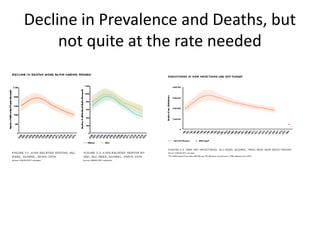
Decline in Prevalence and Deaths, but
not quite at the rate needed
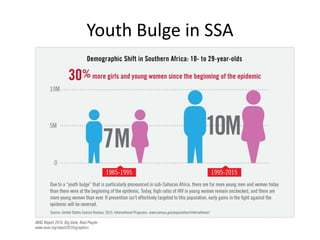
Youth Bulge in SSA
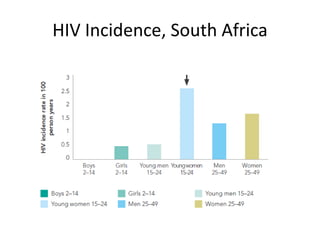
HIV Incidence, South Africa
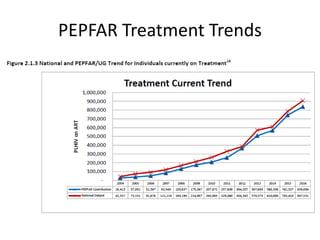
PEPFAR Treatment Trends
PEPFAR Goals
• Based on HPTN 052, most dollars are going
towards test and treat
• Also significant funding for other known
effective interventions, such as PMTCT and
VMMC
Understanding PEPFARese
• Acronyms and DC-speak
• PEPFAR is a conglomeration of USAID (60%),
CDC (30%) and OGAC, DoD, PC, HRSA (the
rest).
• About $5 billion/year
• PEPFAR countries are about where you would
expect – some (shrinking) exceptions
Program Codes
• 01. MTCT – PMTCT
• 02. HVAB – Abstinence/be faithful
• 03. HVOP – Other sexual prevention
• 04. HMBL – Blood safety
• 05. HMIN – Injection safety
• 06. IDUP – Prevention among injecting and non-injecting drug users
• 07. CIRC – Voluntary medical male circumcision (VMMC)
• 08. HTS – HIV testing services
• 09. HBHC – Adult Care and Support
• 10. HTXS – Adult Treatment
• 11. PDCS – Pediatric Care and Support
• 12. PDTX – Pediatric Treatment
• 13. HVTB – TB/HIV
• 14. HKID – Orphans and Vulnerable Children
• 15. HTXD – ARV Drugs
• 16. HLAB – Laboratory infrastructure
• 17. HVSI – Strategic information
• 18. OHSS – Health Systems Strengthening
Current Goals
• “95-95-95”
• The idea is that if
– 95% of all HIV+ people know their status
– AND 95% of those people who know their status are
placed on ART
– AND 95% of those on ART achieve “undetectable” VL
(= <1000)
– We will have epidemic control
• Epidemic control is defined by PEPFAR as deaths
from HIV > new cases
Key PEPFAR Ideas
• Pivot
– Moving resources from where they aren’t needed
to where they are needed. Started after it was
discovered PEPFAR funds were supporting clinics
with few or no HIV patients in them
• Yield
– As in “high yield”.
• Linkage to care
Concentrated vs Generalized
• Concentrated HIV epidemic: HIV has spread rapidly in one or more defined
subpopulation but is not well established in the general population. Numerical
proxy: HIV prevalence is consistently over 5% in at least one defined subpopulation
but is less than 1% among pregnant women in urban areas.
• Generalized HIV epidemic: HIV is firmly established in the general population.
Numerical proxy: HIV prevalence consistently exceeding 1% among pregnant
women. Most generalized HIV epidemics are mixed in nature, in which certain
(key) subpopulations are disproportionately affected.
• Mixed epidemics: people are acquiring HIV infection in one or more
subpopulations and in the general population. Mixed epidemics are therefore one
or more concentrated epidemics within a generalized epidemic.
• Low-level epidemic: epidemics in which the prevalence of HIV infection has not
consistently exceeded 1% in the general population nationally or 5% in any
subpopulation.
WHO, Consolidated ARV guidelines, June 2013
PEPFAR Targets
• Geographic risk areas
• Women under 25
• Men under 35
• KPs
• School-age children
• PMTCT, VMMC
• Hot spots (a new target)
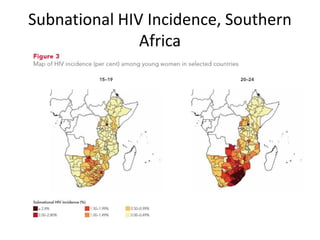
Geographic Data
• We can focus additional resources at spots
where the epidemic is most intense
• Can fluctuate (theoretically) over time, so the
response needs to be able to adjust (hot
spots)
Subnational HIV Incidence, Southern
Africa
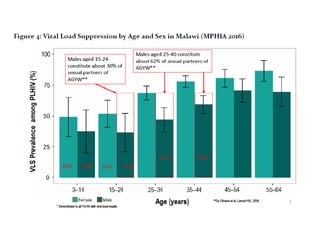
Age Band Focus
• In addition to geographic focus, we are
focused on certain higher incidence age
groups
– 15-24 yo F
– 25-35 yo M
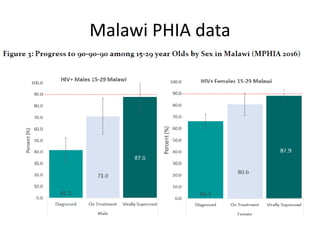
Malawi PHIA data
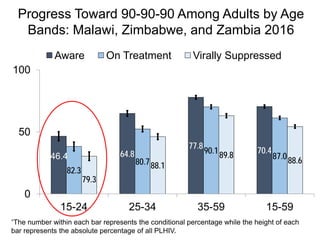
Progress Toward 90-90-90 Among Adults by Age
Bands: Malawi, Zimbabwe, and Zambia 2016
*The number within each bar represents the conditional percentage while the height of each
bar represents the absolute percentage of all PLHIV.
46.4 64.8
77.8
70.4
82.3
80.7
90.1
87.0
79.3
88.1
89.8
88.6
0
50
100
15-24 25-34 35-59 15-59
Aware On Treatment Virally Suppressed
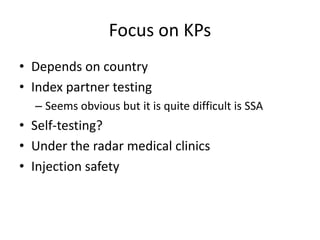
Focus on KPs
• Depends on country
• Index partner testing
– Seems obvious but it is quite difficult is SSA
• Self-testing?
• Under the radar medical clinics
• Injection safety
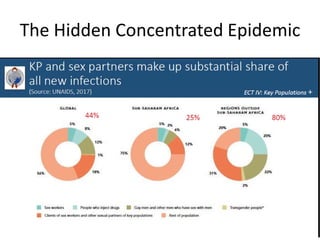
The Hidden Concentrated Epidemic
23
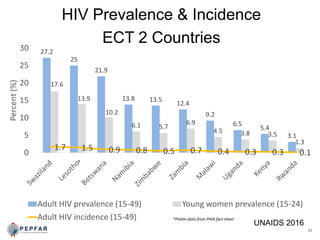
HIV Prevalence & Incidence
ECT 2 Countries
27.2
25
21.9
13.8 13.5
12.4
9.2
6.5
5.4
3.1
17.6
13.9
10.2
6.1 5.7
6.9
4.5 3.8 3.5
1.3
1.7 1.5 0.9 0.8 0.5 0.7 0.4 0.3 0.3 0.10
5
10
15
20
25
30
Percent(%)
Adult HIV prevalence (15-49) Young women prevalence (15-24)
Adult HIV incidence (15-49) *Prelim data from PHIA fact sheet
*
UNAIDS 2016
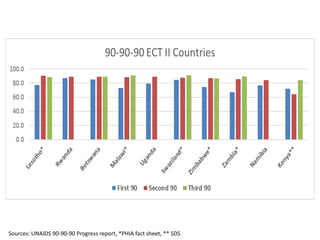
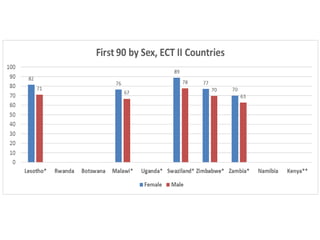
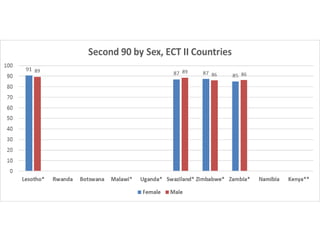
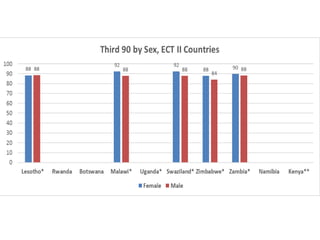
Sources: UNAIDS 90-90-90 Progress report, *PHIA fact sheet, ** SDS
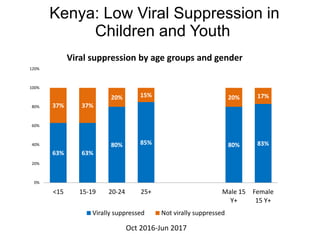
Kenya: Low Viral Suppression in
Children and Youth
63% 63%
80% 85% 80% 83%
37% 37%
20% 15% 20% 17%
0%
20%
40%
60%
80%
100%
120%
<15 15-19 20-24 25+ Male 15
Y+
Female
15 Y+
Viral suppression by age groups and gender
Virally suppressed Not virally suppressed
Oct 2016-Jun 2017
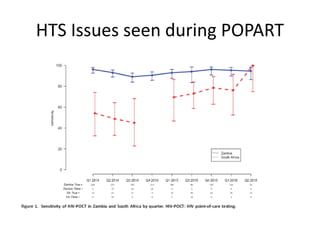
HTS Issues seen during POPART
Realities of HIV Testing under Program
Conditions
Poor training and training often done by lay
counsellor
Testing algorithm and procedures not followed
Disorganized work space
Run-time not followed, no timers
Safety concerns
Poor finger-prick procedure
PT program inconsistent
Little or no supervision
No corrective actions/feedback
32Source: CDC RDTQII presentation
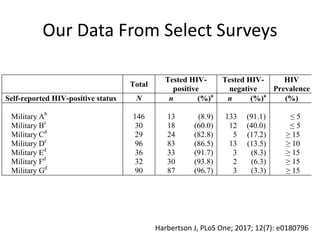
Our Data From Select Surveys
Total
Tested HIV-
positive
Tested HIV-
negative
HIV
Prevalence
Self-reported HIV-positive status N n (%)a
n (%)a
(%)
Military Ab
146 13 (8.9) 133 (91.1) ≤ 5
Military Bc
30 18 (60.0) 12 (40.0) ≤ 5
Military Cd
29 24 (82.8) 5 (17.2) ≥ 15
Military Dc
96 83 (86.5) 13 (13.5) ≥ 10
Military Ed
36 33 (91.7) 3 (8.3) ≥ 15
Military Fd
32 30 (93.8) 2 (6.3) ≥ 15
Military Gd
90 87 (96.7) 3 (3.3) ≥ 15
Harbertson J, PLoS One; 2017; 12(7): e0180796
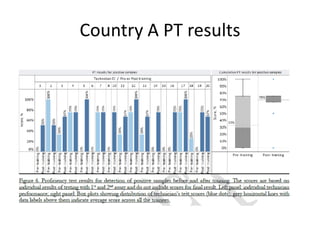
Country A PT results
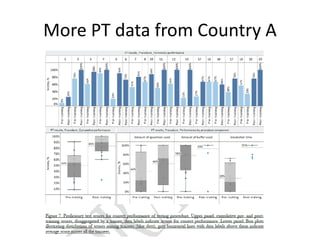
More PT data from Country A
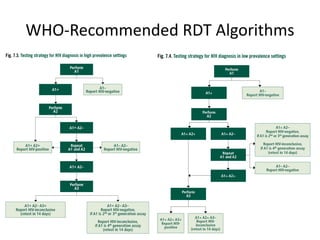
WHO-Recommended RDT Algorithms
Stylized RDT Algorithm
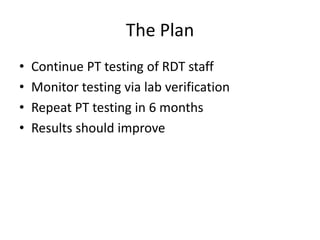
The Plan
• Continue PT testing of RDT staff
• Monitor testing via lab verification
• Repeat PT testing in 6 months
• Results should improve
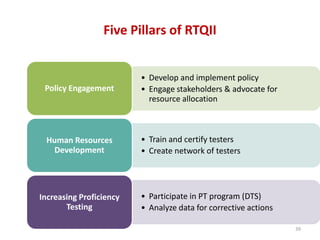
Five Pillars of RTQII
• Develop and implement policy
• Engage stakeholders & advocate for
resource allocation
Policy Engagement
• Train and certify testers
• Create network of testers
Human Resources
Development
• Participate in PT program (DTS)
• Analyze data for corrective actions
Increasing Proficiency
Testing
39
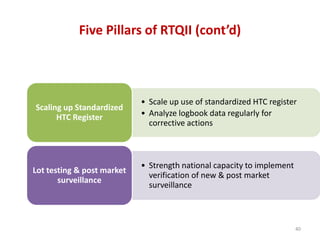
Five Pillars of RTQII (cont’d)
• Scale up use of standardized HTC register
• Analyze logbook data regularly for
corrective actions
Scaling up Standardized
HTC Register
• Strength national capacity to implement
verification of new & post market
surveillance
Lot testing & post market
surveillance
40

PEPFAR Programs

  • 2.
    PEPFAR Programs Current Status BradenHale, MD MPH 27 Oct 2017
  • 3.
    Objectives • Introduction toPEPFAR • Basic PEPFAR concepts and issues • Current problems confronting PEPFAR • Example of one issue (HTS)
  • 4.
    PEPFAR • President’s EmergencyFund for AIDS Relief – Largest global health initiative against a single disease in world history • As ID physicians, we should know what is happening in this extremely large program – Decisions in PEPFAR essentially dictate the global response to HIV
  • 5.
    Decline in Prevalenceand Deaths, but not quite at the rate needed
  • 6.
  • 7.
  • 8.
  • 9.
    PEPFAR Goals • Basedon HPTN 052, most dollars are going towards test and treat • Also significant funding for other known effective interventions, such as PMTCT and VMMC
  • 10.
    Understanding PEPFARese • Acronymsand DC-speak • PEPFAR is a conglomeration of USAID (60%), CDC (30%) and OGAC, DoD, PC, HRSA (the rest). • About $5 billion/year • PEPFAR countries are about where you would expect – some (shrinking) exceptions
  • 11.
    Program Codes • 01.MTCT – PMTCT • 02. HVAB – Abstinence/be faithful • 03. HVOP – Other sexual prevention • 04. HMBL – Blood safety • 05. HMIN – Injection safety • 06. IDUP – Prevention among injecting and non-injecting drug users • 07. CIRC – Voluntary medical male circumcision (VMMC) • 08. HTS – HIV testing services • 09. HBHC – Adult Care and Support • 10. HTXS – Adult Treatment • 11. PDCS – Pediatric Care and Support • 12. PDTX – Pediatric Treatment • 13. HVTB – TB/HIV • 14. HKID – Orphans and Vulnerable Children • 15. HTXD – ARV Drugs • 16. HLAB – Laboratory infrastructure • 17. HVSI – Strategic information • 18. OHSS – Health Systems Strengthening
  • 12.
    Current Goals • “95-95-95” •The idea is that if – 95% of all HIV+ people know their status – AND 95% of those people who know their status are placed on ART – AND 95% of those on ART achieve “undetectable” VL (= <1000) – We will have epidemic control • Epidemic control is defined by PEPFAR as deaths from HIV > new cases
  • 13.
    Key PEPFAR Ideas •Pivot – Moving resources from where they aren’t needed to where they are needed. Started after it was discovered PEPFAR funds were supporting clinics with few or no HIV patients in them • Yield – As in “high yield”. • Linkage to care
  • 14.
    Concentrated vs Generalized •Concentrated HIV epidemic: HIV has spread rapidly in one or more defined subpopulation but is not well established in the general population. Numerical proxy: HIV prevalence is consistently over 5% in at least one defined subpopulation but is less than 1% among pregnant women in urban areas. • Generalized HIV epidemic: HIV is firmly established in the general population. Numerical proxy: HIV prevalence consistently exceeding 1% among pregnant women. Most generalized HIV epidemics are mixed in nature, in which certain (key) subpopulations are disproportionately affected. • Mixed epidemics: people are acquiring HIV infection in one or more subpopulations and in the general population. Mixed epidemics are therefore one or more concentrated epidemics within a generalized epidemic. • Low-level epidemic: epidemics in which the prevalence of HIV infection has not consistently exceeded 1% in the general population nationally or 5% in any subpopulation. WHO, Consolidated ARV guidelines, June 2013
  • 15.
    PEPFAR Targets • Geographicrisk areas • Women under 25 • Men under 35 • KPs • School-age children • PMTCT, VMMC • Hot spots (a new target)
  • 16.
    Geographic Data • Wecan focus additional resources at spots where the epidemic is most intense • Can fluctuate (theoretically) over time, so the response needs to be able to adjust (hot spots)
  • 17.
  • 18.
    Age Band Focus •In addition to geographic focus, we are focused on certain higher incidence age groups – 15-24 yo F – 25-35 yo M
  • 20.
  • 21.
    Progress Toward 90-90-90Among Adults by Age Bands: Malawi, Zimbabwe, and Zambia 2016 *The number within each bar represents the conditional percentage while the height of each bar represents the absolute percentage of all PLHIV. 46.4 64.8 77.8 70.4 82.3 80.7 90.1 87.0 79.3 88.1 89.8 88.6 0 50 100 15-24 25-34 35-59 15-59 Aware On Treatment Virally Suppressed
  • 22.
    Focus on KPs •Depends on country • Index partner testing – Seems obvious but it is quite difficult is SSA • Self-testing? • Under the radar medical clinics • Injection safety
  • 23.
  • 24.
    23 HIV Prevalence &Incidence ECT 2 Countries 27.2 25 21.9 13.8 13.5 12.4 9.2 6.5 5.4 3.1 17.6 13.9 10.2 6.1 5.7 6.9 4.5 3.8 3.5 1.3 1.7 1.5 0.9 0.8 0.5 0.7 0.4 0.3 0.3 0.10 5 10 15 20 25 30 Percent(%) Adult HIV prevalence (15-49) Young women prevalence (15-24) Adult HIV incidence (15-49) *Prelim data from PHIA fact sheet * UNAIDS 2016
  • 25.
    Sources: UNAIDS 90-90-90Progress report, *PHIA fact sheet, ** SDS
  • 30.
    Kenya: Low ViralSuppression in Children and Youth 63% 63% 80% 85% 80% 83% 37% 37% 20% 15% 20% 17% 0% 20% 40% 60% 80% 100% 120% <15 15-19 20-24 25+ Male 15 Y+ Female 15 Y+ Viral suppression by age groups and gender Virally suppressed Not virally suppressed Oct 2016-Jun 2017
  • 32.
    HTS Issues seenduring POPART
  • 33.
    Realities of HIVTesting under Program Conditions Poor training and training often done by lay counsellor Testing algorithm and procedures not followed Disorganized work space Run-time not followed, no timers Safety concerns Poor finger-prick procedure PT program inconsistent Little or no supervision No corrective actions/feedback 32Source: CDC RDTQII presentation
  • 34.
    Our Data FromSelect Surveys Total Tested HIV- positive Tested HIV- negative HIV Prevalence Self-reported HIV-positive status N n (%)a n (%)a (%) Military Ab 146 13 (8.9) 133 (91.1) ≤ 5 Military Bc 30 18 (60.0) 12 (40.0) ≤ 5 Military Cd 29 24 (82.8) 5 (17.2) ≥ 15 Military Dc 96 83 (86.5) 13 (13.5) ≥ 10 Military Ed 36 33 (91.7) 3 (8.3) ≥ 15 Military Fd 32 30 (93.8) 2 (6.3) ≥ 15 Military Gd 90 87 (96.7) 3 (3.3) ≥ 15 Harbertson J, PLoS One; 2017; 12(7): e0180796
  • 35.
    Country A PTresults
  • 36.
    More PT datafrom Country A
  • 37.
  • 38.
  • 39.
    The Plan • ContinuePT testing of RDT staff • Monitor testing via lab verification • Repeat PT testing in 6 months • Results should improve
  • 40.
    Five Pillars ofRTQII • Develop and implement policy • Engage stakeholders & advocate for resource allocation Policy Engagement • Train and certify testers • Create network of testers Human Resources Development • Participate in PT program (DTS) • Analyze data for corrective actions Increasing Proficiency Testing 39
  • 41.
    Five Pillars ofRTQII (cont’d) • Scale up use of standardized HTC register • Analyze logbook data regularly for corrective actions Scaling up Standardized HTC Register • Strength national capacity to implement verification of new & post market surveillance Lot testing & post market surveillance 40