LUPUS & THE KIDNEYS
Sarah Thelen
Dietetic Intern
Benedictine University
The Patient

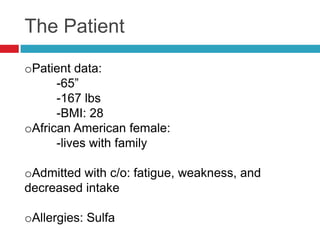
oPatient data:
      -65”
      -167 lbs
      -BMI: 28
oAfrican American female:
      -lives with family

oAdmitted with c/o: fatigue, weakness, and
decreased intake

oAllergies: Sulfa
The Patient

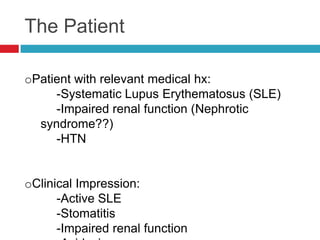
oPatient with relevant medical hx:
     -Systematic Lupus Erythematosus (SLE)
     -Impaired renal function (Nephrotic
  syndrome??)
     -HTN


oClinical Impression:
      -Active SLE
      -Stomatitis
      -Impaired renal function
Food/Nutrition

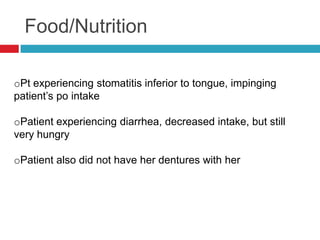
oPt experiencing stomatitis inferior to tongue, impinging
patient’s po intake

oPatient experiencing diarrhea, decreased intake, but still
very hungry

oPatient also did not have her dentures with her
Food/Nutrition

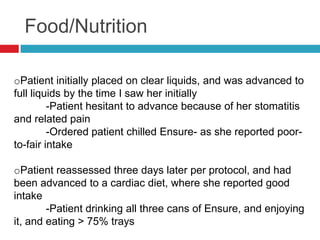
oPatient initially placed on clear liquids, and was advanced to
full liquids by the time I saw her initially
         -Patient hesitant to advance because of her stomatitis
and related pain
         -Ordered patient chilled Ensure- as she reported poor-
to-fair intake

oPatient reassessed three days later per protocol, and had
been advanced to a cardiac diet, where she reported good
intake
        -Patient drinking all three cans of Ensure, and enjoying
it, and eating > 75% trays
Food/Nutrition

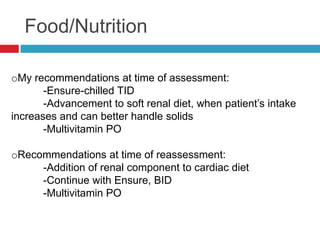
oMy recommendations at time of assessment:
       -Ensure-chilled TID
       -Advancement to soft renal diet, when patient’s intake
increases and can better handle solids
       -Multivitamin PO

oRecommendations at time of reassessment:
     -Addition of renal component to cardiac diet
     -Continue with Ensure, BID
     -Multivitamin PO
Nutrient Needs

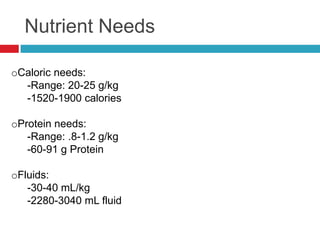
oCaloric needs:
  -Range: 20-25 g/kg
  -1520-1900 calories

oProtein needs:
   -Range: .8-1.2 g/kg
   -60-91 g Protein

oFluids:
   -30-40 mL/kg
   -2280-3040 mL fluid
Lab Data
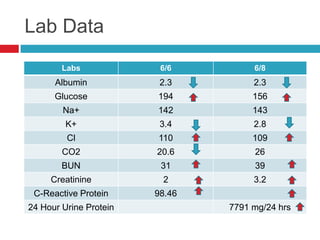
        Labs             6/6         6/8
      Albumin            2.3         2.3
      Glucose           194          156
        Na+             142          143
         K+              3.4         2.8
         Cl             110          109
        CO2             20.6         26
        BUN              31          39
     Creatinine          2           3.2
 C-Reactive Protein     98.46
24 Hour Urine Protein           7791 mg/24 hrs
Lab Value Discussion

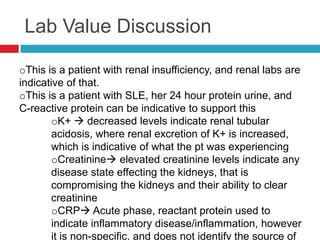
oThis is a patient with renal insufficiency, and renal labs are
indicative of that.
oThis is a patient with SLE, her 24 hour protein urine, and
C-reactive protein can be indicative to support this
        oK+  decreased levels indicate renal tubular
        acidosis, where renal excretion of K+ is increased,
        which is indicative of what the pt was experiencing
        oCreatinine elevated creatinine levels indicate any
        disease state effecting the kidneys, that is
        compromising the kidneys and their ability to clear
        creatinine
        oCRP Acute phase, reactant protein used to
        indicate inflammatory disease/inflammation, however
        it is non-specific, and does not identify the source of
Lab Value Discussion

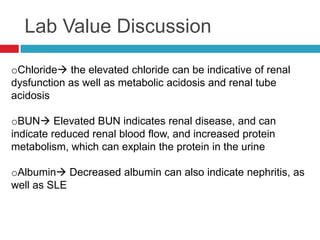
oChloride the elevated chloride can be indicative of renal
dysfunction as well as metabolic acidosis and renal tube
acidosis

oBUN Elevated BUN indicates renal disease, and can
indicate reduced renal blood flow, and increased protein
metabolism, which can explain the protein in the urine

oAlbumin Decreased albumin can also indicate nephritis, as
well as SLE
Medications
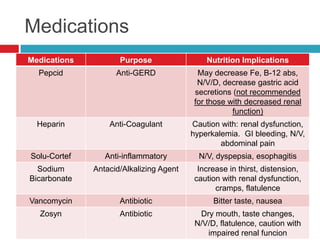
Medications          Purpose                 Nutrition Implications
  Pepcid            Anti-GERD              May decrease Fe, B-12 abs,
                                           N/V/D, decrease gastric acid
                                          secretions (not recommended
                                          for those with decreased renal
                                                     function)
  Heparin         Anti-Coagulant         Caution with: renal dysfunction,
                                         hyperkalemia. GI bleeding, N/V,
                                                 abdominal pain
Solu-Cortef      Anti-inflammatory         N/V, dyspepsia, esophagitis
  Sodium      Antacid/Alkalizing Agent     Increase in thirst, distension,
Bicarbonate                               caution with renal dysfunction,
                                                cramps, flatulence
Vancomycin           Antibiotic                Bitter taste, nausea
  Zosyn              Antibiotic            Dry mouth, taste changes,
                                          N/V/D, flatulence, caution with
                                             impaired renal funcion
Disease State

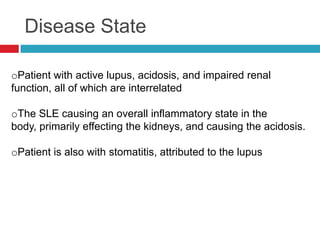
oPatient with active lupus, acidosis, and impaired renal
function, all of which are interrelated

oThe SLE causing an overall inflammatory state in the
body, primarily effecting the kidneys, and causing the acidosis.

oPatient is also with stomatitis, attributed to the lupus
Systematic Lupus
  Erythematosus
oSLE is a chronic, autoimmune, inflammatory condition

oMarked by periods of remissions & exacerbations

oSLE is a “general” inflammatory disease but it does tend to
target organ systems of the body, and in many cases (~40%)
SLE will target the kidneys
Nephrotic Syndrome
  Hypothesis
o40% of all people with SLE, and as many as two-thirds of
all children will develop kidney complications

oNephrotic syndrome can be caused by SLE, and her renal
labs, and proteinuria corroborate that even though it was
medically diagnosed or charted, there is a very good chance
this patient was experiencing Nephrotic symdrome
secondary to SLE

oThe acidosis, I also hypothesize originated with Renal
Tubular Acidosis, that occurred from the impaired renal
function due to the inflammation of the kidneys secondary
from the lupus
Nutrition Diagnosis

oWhen I originally assessed the patient her nutrition
diagnosis I gave her was:

       “Inadequate oral food/beverage intake related to
stomatitis (secondary to SLE) as evidenced by pt
reporting good appetite but more intake because her
mouth hurts her”

oThis nutritional problem was resolved by the time I
followed up with the patient two days later, she was
eating well, and the stomatitis had cleared up for the
most part
Nutrition Intervention

oUpon speaking with the patient, I thought it best for her to
avoid the acidic/sugary juices on her tray

oChilled Ensure, and Protein shakes were ordered TID

oI suggested an MVI for the patient

oI suggested her diet be advanced as tolerated, and as the
stomatitis cleared up, to a renal soft diet, with an ideal
intake of > 75% of her trays
Nutrition Monitoring

oI followed up with the patient two days later, she had
been upgraded to a cardiac diet

oPt was not an MVI, which I suggested again

oI changed the chilled Ensure to BID

oPt was discharged the following day, June 9
Resources

oNutrition Care Manual, American Dietetic Association

o"Nephrotic Syndrome in Adults." National Kidney and Urologic Diseases
Information Clearinghouse. Web. 18 June 2011.
http://kidney.niddk.nih.gov/kudiseases/pubs/nephrotic/

oStaff, Mayo Clinic. "Nephrotic Syndrome: Tests and Diagnosis -
MayoClinic.com." Mayo Clinic. Web. 18 June 2011.
http://www.mayoclinic.com/health/nephrotic-syndrome/DS01047/DSECTION=tests-
and-diagnosis

o"Nephrotic Syndrome - PubMed Health." Pub Med Health. Web. 18 June 2011.
http://www.ncbi.nlm.nih.gov/pubmedhealth/PMH0001520/

o"Nephrotic Syndrome: MedlinePlus Medical Encyclopedia." National Library of
Medicine - National Institutes of Health. Web. 18 June 2011.
http://www.nlm.nih.gov/medlineplus/ency/article/000490.htm
Resources

o"Renal Tubular Acidosis." National Kidney and Urologic Diseases Information
Clearinghouse. Web. 18 June 2011.
http://kidney.niddk.nih.gov/kudiseases/pubs/tubularacidosis/

o"LUPUS FOUNDATION OF AMERICA - Understanding Lupus." Lupus
Foundation of America. Web. 18 June 2011.
http://www.lupus.org/webmodules/webarticlesnet/templates/new_learnunderstandi
ng.aspx?articleid=2231

Lupus & The Kidneys Case Study

  • 1.
    LUPUS & THEKIDNEYS Sarah Thelen Dietetic Intern Benedictine University
  • 2.
    The Patient oPatient data: -65” -167 lbs -BMI: 28 oAfrican American female: -lives with family oAdmitted with c/o: fatigue, weakness, and decreased intake oAllergies: Sulfa
  • 3.
    The Patient oPatient withrelevant medical hx: -Systematic Lupus Erythematosus (SLE) -Impaired renal function (Nephrotic syndrome??) -HTN oClinical Impression: -Active SLE -Stomatitis -Impaired renal function
  • 4.
    Food/Nutrition oPt experiencing stomatitisinferior to tongue, impinging patient’s po intake oPatient experiencing diarrhea, decreased intake, but still very hungry oPatient also did not have her dentures with her
  • 5.
    Food/Nutrition oPatient initially placedon clear liquids, and was advanced to full liquids by the time I saw her initially -Patient hesitant to advance because of her stomatitis and related pain -Ordered patient chilled Ensure- as she reported poor- to-fair intake oPatient reassessed three days later per protocol, and had been advanced to a cardiac diet, where she reported good intake -Patient drinking all three cans of Ensure, and enjoying it, and eating > 75% trays
  • 6.
    Food/Nutrition oMy recommendations attime of assessment: -Ensure-chilled TID -Advancement to soft renal diet, when patient’s intake increases and can better handle solids -Multivitamin PO oRecommendations at time of reassessment: -Addition of renal component to cardiac diet -Continue with Ensure, BID -Multivitamin PO
  • 7.
    Nutrient Needs oCaloric needs: -Range: 20-25 g/kg -1520-1900 calories oProtein needs: -Range: .8-1.2 g/kg -60-91 g Protein oFluids: -30-40 mL/kg -2280-3040 mL fluid
  • 8.
    Lab Data Labs 6/6 6/8 Albumin 2.3 2.3 Glucose 194 156 Na+ 142 143 K+ 3.4 2.8 Cl 110 109 CO2 20.6 26 BUN 31 39 Creatinine 2 3.2 C-Reactive Protein 98.46 24 Hour Urine Protein 7791 mg/24 hrs
  • 9.
    Lab Value Discussion oThisis a patient with renal insufficiency, and renal labs are indicative of that. oThis is a patient with SLE, her 24 hour protein urine, and C-reactive protein can be indicative to support this oK+  decreased levels indicate renal tubular acidosis, where renal excretion of K+ is increased, which is indicative of what the pt was experiencing oCreatinine elevated creatinine levels indicate any disease state effecting the kidneys, that is compromising the kidneys and their ability to clear creatinine oCRP Acute phase, reactant protein used to indicate inflammatory disease/inflammation, however it is non-specific, and does not identify the source of
  • 10.
    Lab Value Discussion oChloridethe elevated chloride can be indicative of renal dysfunction as well as metabolic acidosis and renal tube acidosis oBUN Elevated BUN indicates renal disease, and can indicate reduced renal blood flow, and increased protein metabolism, which can explain the protein in the urine oAlbumin Decreased albumin can also indicate nephritis, as well as SLE
  • 11.
    Medications Medications Purpose Nutrition Implications Pepcid Anti-GERD May decrease Fe, B-12 abs, N/V/D, decrease gastric acid secretions (not recommended for those with decreased renal function) Heparin Anti-Coagulant Caution with: renal dysfunction, hyperkalemia. GI bleeding, N/V, abdominal pain Solu-Cortef Anti-inflammatory N/V, dyspepsia, esophagitis Sodium Antacid/Alkalizing Agent Increase in thirst, distension, Bicarbonate caution with renal dysfunction, cramps, flatulence Vancomycin Antibiotic Bitter taste, nausea Zosyn Antibiotic Dry mouth, taste changes, N/V/D, flatulence, caution with impaired renal funcion
  • 12.
    Disease State oPatient withactive lupus, acidosis, and impaired renal function, all of which are interrelated oThe SLE causing an overall inflammatory state in the body, primarily effecting the kidneys, and causing the acidosis. oPatient is also with stomatitis, attributed to the lupus
  • 13.
    Systematic Lupus Erythematosus oSLE is a chronic, autoimmune, inflammatory condition oMarked by periods of remissions & exacerbations oSLE is a “general” inflammatory disease but it does tend to target organ systems of the body, and in many cases (~40%) SLE will target the kidneys
  • 14.
    Nephrotic Syndrome Hypothesis o40% of all people with SLE, and as many as two-thirds of all children will develop kidney complications oNephrotic syndrome can be caused by SLE, and her renal labs, and proteinuria corroborate that even though it was medically diagnosed or charted, there is a very good chance this patient was experiencing Nephrotic symdrome secondary to SLE oThe acidosis, I also hypothesize originated with Renal Tubular Acidosis, that occurred from the impaired renal function due to the inflammation of the kidneys secondary from the lupus
  • 15.
    Nutrition Diagnosis oWhen Ioriginally assessed the patient her nutrition diagnosis I gave her was: “Inadequate oral food/beverage intake related to stomatitis (secondary to SLE) as evidenced by pt reporting good appetite but more intake because her mouth hurts her” oThis nutritional problem was resolved by the time I followed up with the patient two days later, she was eating well, and the stomatitis had cleared up for the most part
  • 16.
    Nutrition Intervention oUpon speakingwith the patient, I thought it best for her to avoid the acidic/sugary juices on her tray oChilled Ensure, and Protein shakes were ordered TID oI suggested an MVI for the patient oI suggested her diet be advanced as tolerated, and as the stomatitis cleared up, to a renal soft diet, with an ideal intake of > 75% of her trays
  • 17.
    Nutrition Monitoring oI followedup with the patient two days later, she had been upgraded to a cardiac diet oPt was not an MVI, which I suggested again oI changed the chilled Ensure to BID oPt was discharged the following day, June 9
  • 18.
    Resources oNutrition Care Manual,American Dietetic Association o"Nephrotic Syndrome in Adults." National Kidney and Urologic Diseases Information Clearinghouse. Web. 18 June 2011. http://kidney.niddk.nih.gov/kudiseases/pubs/nephrotic/ oStaff, Mayo Clinic. "Nephrotic Syndrome: Tests and Diagnosis - MayoClinic.com." Mayo Clinic. Web. 18 June 2011. http://www.mayoclinic.com/health/nephrotic-syndrome/DS01047/DSECTION=tests- and-diagnosis o"Nephrotic Syndrome - PubMed Health." Pub Med Health. Web. 18 June 2011. http://www.ncbi.nlm.nih.gov/pubmedhealth/PMH0001520/ o"Nephrotic Syndrome: MedlinePlus Medical Encyclopedia." National Library of Medicine - National Institutes of Health. Web. 18 June 2011. http://www.nlm.nih.gov/medlineplus/ency/article/000490.htm
  • 19.
    Resources o"Renal Tubular Acidosis."National Kidney and Urologic Diseases Information Clearinghouse. Web. 18 June 2011. http://kidney.niddk.nih.gov/kudiseases/pubs/tubularacidosis/ o"LUPUS FOUNDATION OF AMERICA - Understanding Lupus." Lupus Foundation of America. Web. 18 June 2011. http://www.lupus.org/webmodules/webarticlesnet/templates/new_learnunderstandi ng.aspx?articleid=2231

Editor's Notes

  • #13 NCM,Mayo ClinicPubMedNIDDKLupus.org