People and empiresDiego Serrat0History 140
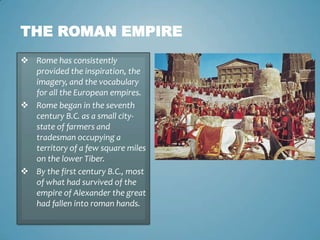
The Roman empireRome has consistently provided the inspiration, the imagery, and the vocabulary for all the European empires.
Rome began in the seventh century B.C. as a small city-state of farmers and tradesman occupying a territory of a few square miles on the lower Tiber.
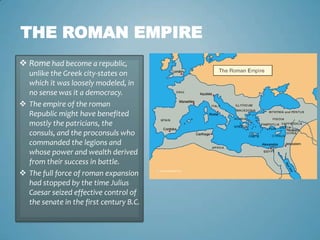
By the first century B.C., most of what had survived of the empire of Alexander the great had fallen into roman hands.The Roman empireRome had become a republic, unlike the Greek city-states on which it was loosely modeled, in no sense was it a democracy.
The empire of the roman Republic might have benefited mostly the patricians, the consuls, and the proconsuls who commanded the legions and whose power and wealth derived from their success in battle.

People and empires

  • 1.
    People and empiresDiegoSerrat0History 140
  • 2.
    The Roman empireRomehas consistently provided the inspiration, the imagery, and the vocabulary for all the European empires.
  • 3.
    Rome began inthe seventh century B.C. as a small city-state of farmers and tradesman occupying a territory of a few square miles on the lower Tiber.
  • 4.
    By the firstcentury B.C., most of what had survived of the empire of Alexander the great had fallen into roman hands.The Roman empireRome had become a republic, unlike the Greek city-states on which it was loosely modeled, in no sense was it a democracy.
  • 5.
    The empire ofthe roman Republic might have benefited mostly the patricians, the consuls, and the proconsuls who commanded the legions and whose power and wealth derived from their success in battle.