
Asia Pacific Network Information Centre 
“A global, open, stable, and 
secure Internet that serves 
the entire Asia Pacific 
Pubudu Jayasinghe 
Colombo, Sri Lanka 
27 October 2014 
community” 
1
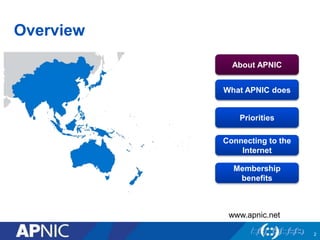
Overview 
2 
About APNIC 
What APNIC does 
Priorities 
Connecting to the 
Internet 
Membership 
benefits 
www.apnic.net
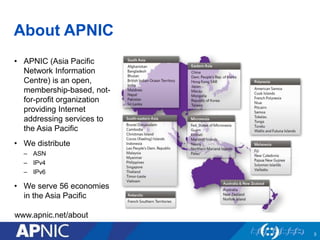
About APNIC 
• APNIC (Asia Pacific 
Network Information 
Centre) is an open, 
membership-based, not-for- 
profit organization 
providing Internet 
addressing services to 
the Asia Pacific 
• We distribute 
– ASN 
– IPv4 
– IPv6 
• We serve 56 economies 
in the Asia Pacific 
3 
www.apnic.net/about
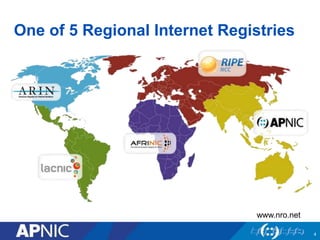
One of 5 Regional Internet Registries 
4 
www.nro.net
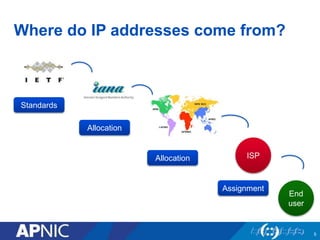
Where do IP addresses come from? 
5 
ISP 
End 
user 
Standards 
Allocation 
Allocation 
Assignment
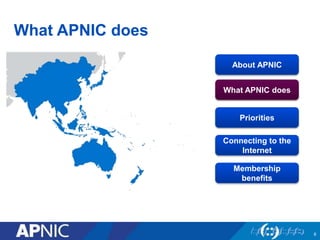
What APNIC does 
6 
About APNIC 
What APNIC does 
Priorities 
Connecting to the 
Internet 
Membership 
benefits
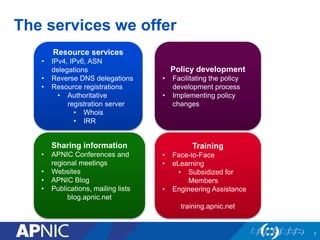
The services we offer 
7 
Resource services 
• IPv4, IPv6, ASN 
delegations 
• Reverse DNS delegations 
• Resource registrations 
• Authoritative 
registration server 
• Whois 
• IRR 
Policy development 
• Facilitating the policy 
development process 
• Implementing policy 
changes 
Sharing information 
• APNIC Conferences and 
regional meetings 
• Websites 
• APNIC Blog 
• Publications, mailing lists 
blog.apnic.net 
Training 
• Face-to-Face 
• eLearning 
• Subsidized for 
Members 
• Engineering Assistance 
training.apnic.net
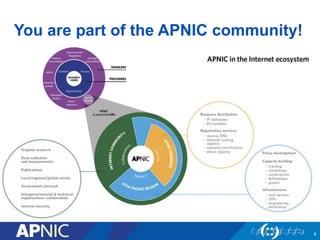
You are part of the APNIC community! 
8
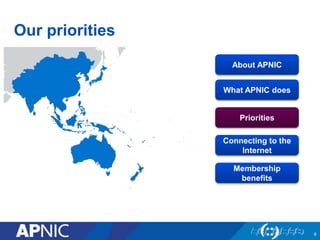
Our priorities 
9 
About APNIC 
What APNIC does 
Priorities 
Connecting to the 
Internet 
Membership 
benefits
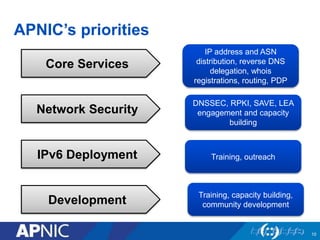
APNIC’s priorities 
10 
Core Services 
IP address and ASN 
distribution, reverse DNS 
delegation, whois 
registrations, routing, PDP 
Network Security 
DNSSEC, RPKI, SAVE, LEA 
engagement and capacity 
building 
IPv6 Deployment Training, outreach 
Development 
Training, capacity building, 
community development
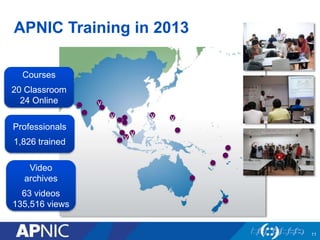
APNIC Training in 2013 
v v 
v 
v 
v 
Courses 
20 Classroom 
24 Online 
Professionals 
1,826 trained 
Video 
archives 
63 videos 
135,516 views 
v 
11
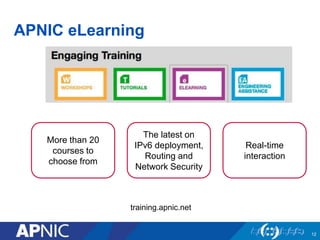
APNIC eLearning 
12 
More than 20 
courses to 
choose from 
The latest on 
IPv6 deployment, 
Routing and 
Network Security 
Real-time 
interaction 
training.apnic.net
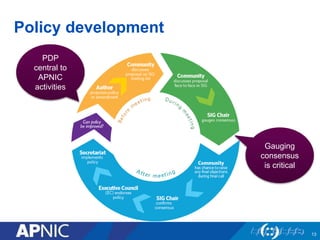
Policy development 
PDP 
central to 
APNIC 
activities 
Gauging 
consensus 
is critical 
13
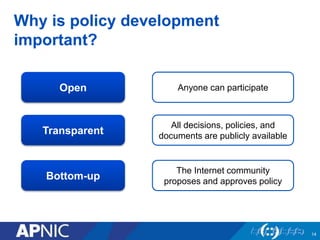
Why is policy development 
important? 
14 
Open Anyone can participate 
Transparent 
Bottom-up 
All decisions, policies, and 
documents are publicly available 
The Internet community 
proposes and approves policy
Connecting to the Internet 
15 
About APNIC 
What APNIC does 
Priorities 
Connecting to the 
Internet 
Membership 
benefits
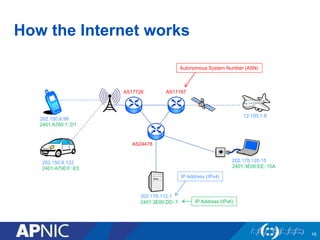
How the Internet works 
16 
202.150.8.99 
202.150.8.132 
AS17726 
202.178.112.1 
Autonomous System Number (ASN) 
202.178.120.15 
AS11167 
12.100.1.8 
AS24478 
2401:A700:1::D1 
2401:A700:F::E3 
2401:3E00:DD::1 
2401:3E00:EE::15A 
IP Address (IPv4) 
IP Address (IPv6)
How the Internet works 
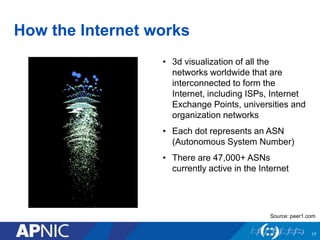
• 3d visualization of all the 
networks worldwide that are 
interconnected to form the 
Internet, including ISPs, Internet 
Exchange Points, universities and 
organization networks 
• Each dot represents an ASN 
(Autonomous System Number) 
• There are 47,000+ ASNs 
currently active in the Internet 
Source: peer1.com 
17
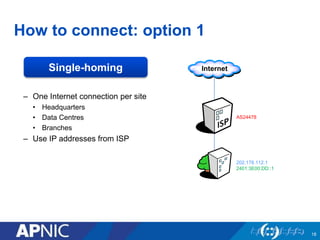
How to connect: option 1 
– One Internet connection per site 
• Headquarters 
• Data Centres 
• Branches 
– Use IP addresses from ISP 
18 
AS24478 
202.178.112.1 
2401:3E00:DD::1 
Single-homing
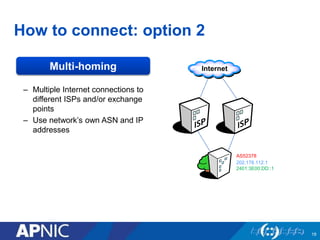
How to connect: option 2 
– Multiple Internet connections to 
different ISPs and/or exchange 
points 
– Use network’s own ASN and IP 
addresses 
19 
AS52378 
202.178.112.1 
2401:3E00:DD::1 
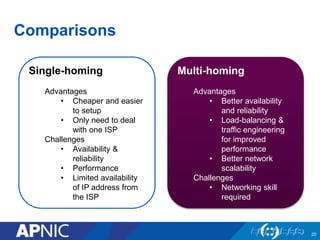
Multi-homing
Comparisons 
20 
Single-homing 
Advantages 
• Cheaper and easier 
to setup 
• Only need to deal 
with one ISP 
Challenges 
• Availability & 
reliability 
• Performance 
• Limited availability 
of IP address from 
the ISP 
Multi-homing 
Advantages 
• Better availability 
and reliability 
• Load-balancing & 
traffic engineering 
for improved 
performance 
• Better network 
scalability 
Challenges 
• Networking skill 
required
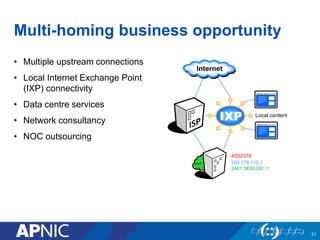
Multi-homing business opportunity 
• Multiple upstream connections 
• Local Internet Exchange Point 
(IXP) connectivity 
• Data centre services 
• Network consultancy 
• NOC outsourcing 
21 
AS52378 
.... .. . 
Local content 
.... .. . 
202.178.112.1 
2401:3E00:DD::1
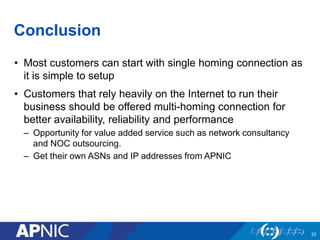
Conclusion 
• Most customers can start with single homing connection as 
it is simple to setup 
• Customers that rely heavily on the Internet to run their 
business should be offered multi-homing connection for 
better availability, reliability and performance 
– Opportunity for value added service such as network consultancy 
and NOC outsourcing. 
– Get their own ASNs and IP addresses from APNIC 
22
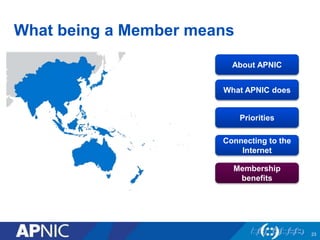
What being a Member means 
23 
About APNIC 
What APNIC does 
Priorities 
Connecting to the 
Internet 
Membership 
benefits
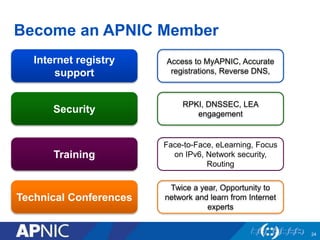
Become an APNIC Member 
24 
Internet registry 
support 
Access to MyAPNIC, Accurate 
registrations, Reverse DNS, 
Security 
RPKI, DNSSEC, LEA 
engagement 
Training 
Face-to-Face, eLearning, Focus 
on IPv6, Network security, 
Routing 
Technical Conferences 
Twice a year, Opportunity to 
network and learn from Internet 
experts
More information 
25 
To find out more about APNIC membership, please contact 
our Member Services team 
EMAIL 
CHAT 
PHONE 
VoIP 
helpdesk@apnic.net 
www.apnic.net/helpdesk 
+61 7 3858 3188 
helpdesk@voip.apnic.net
26

What is APNIC: Infotel 2014

  • 1.
    Asia Pacific NetworkInformation Centre “A global, open, stable, and secure Internet that serves the entire Asia Pacific Pubudu Jayasinghe Colombo, Sri Lanka 27 October 2014 community” 1
  • 2.
    Overview 2 AboutAPNIC What APNIC does Priorities Connecting to the Internet Membership benefits www.apnic.net
  • 3.
    About APNIC •APNIC (Asia Pacific Network Information Centre) is an open, membership-based, not-for- profit organization providing Internet addressing services to the Asia Pacific • We distribute – ASN – IPv4 – IPv6 • We serve 56 economies in the Asia Pacific 3 www.apnic.net/about
  • 4.
    One of 5Regional Internet Registries 4 www.nro.net
  • 5.
    Where do IPaddresses come from? 5 ISP End user Standards Allocation Allocation Assignment
  • 6.
    What APNIC does 6 About APNIC What APNIC does Priorities Connecting to the Internet Membership benefits
  • 7.
    The services weoffer 7 Resource services • IPv4, IPv6, ASN delegations • Reverse DNS delegations • Resource registrations • Authoritative registration server • Whois • IRR Policy development • Facilitating the policy development process • Implementing policy changes Sharing information • APNIC Conferences and regional meetings • Websites • APNIC Blog • Publications, mailing lists blog.apnic.net Training • Face-to-Face • eLearning • Subsidized for Members • Engineering Assistance training.apnic.net
  • 8.
    You are partof the APNIC community! 8
  • 9.
    Our priorities 9 About APNIC What APNIC does Priorities Connecting to the Internet Membership benefits
  • 10.
    APNIC’s priorities 10 Core Services IP address and ASN distribution, reverse DNS delegation, whois registrations, routing, PDP Network Security DNSSEC, RPKI, SAVE, LEA engagement and capacity building IPv6 Deployment Training, outreach Development Training, capacity building, community development
  • 11.
    APNIC Training in2013 v v v v v Courses 20 Classroom 24 Online Professionals 1,826 trained Video archives 63 videos 135,516 views v 11
  • 12.
    APNIC eLearning 12 More than 20 courses to choose from The latest on IPv6 deployment, Routing and Network Security Real-time interaction training.apnic.net
  • 13.
    Policy development PDP central to APNIC activities Gauging consensus is critical 13
  • 14.
    Why is policydevelopment important? 14 Open Anyone can participate Transparent Bottom-up All decisions, policies, and documents are publicly available The Internet community proposes and approves policy
  • 15.
    Connecting to theInternet 15 About APNIC What APNIC does Priorities Connecting to the Internet Membership benefits
  • 16.
    How the Internetworks 16 202.150.8.99 202.150.8.132 AS17726 202.178.112.1 Autonomous System Number (ASN) 202.178.120.15 AS11167 12.100.1.8 AS24478 2401:A700:1::D1 2401:A700:F::E3 2401:3E00:DD::1 2401:3E00:EE::15A IP Address (IPv4) IP Address (IPv6)
  • 17.
    How the Internetworks • 3d visualization of all the networks worldwide that are interconnected to form the Internet, including ISPs, Internet Exchange Points, universities and organization networks • Each dot represents an ASN (Autonomous System Number) • There are 47,000+ ASNs currently active in the Internet Source: peer1.com 17
  • 18.
    How to connect:option 1 – One Internet connection per site • Headquarters • Data Centres • Branches – Use IP addresses from ISP 18 AS24478 202.178.112.1 2401:3E00:DD::1 Single-homing
  • 19.
    How to connect:option 2 – Multiple Internet connections to different ISPs and/or exchange points – Use network’s own ASN and IP addresses 19 AS52378 202.178.112.1 2401:3E00:DD::1 Multi-homing
  • 20.
    Comparisons 20 Single-homing Advantages • Cheaper and easier to setup • Only need to deal with one ISP Challenges • Availability & reliability • Performance • Limited availability of IP address from the ISP Multi-homing Advantages • Better availability and reliability • Load-balancing & traffic engineering for improved performance • Better network scalability Challenges • Networking skill required
  • 21.
    Multi-homing business opportunity • Multiple upstream connections • Local Internet Exchange Point (IXP) connectivity • Data centre services • Network consultancy • NOC outsourcing 21 AS52378 .... .. . Local content .... .. . 202.178.112.1 2401:3E00:DD::1
  • 22.
    Conclusion • Mostcustomers can start with single homing connection as it is simple to setup • Customers that rely heavily on the Internet to run their business should be offered multi-homing connection for better availability, reliability and performance – Opportunity for value added service such as network consultancy and NOC outsourcing. – Get their own ASNs and IP addresses from APNIC 22
  • 23.
    What being aMember means 23 About APNIC What APNIC does Priorities Connecting to the Internet Membership benefits
  • 24.
    Become an APNICMember 24 Internet registry support Access to MyAPNIC, Accurate registrations, Reverse DNS, Security RPKI, DNSSEC, LEA engagement Training Face-to-Face, eLearning, Focus on IPv6, Network security, Routing Technical Conferences Twice a year, Opportunity to network and learn from Internet experts
  • 25.
    More information 25 To find out more about APNIC membership, please contact our Member Services team EMAIL CHAT PHONE VoIP helpdesk@apnic.net www.apnic.net/helpdesk +61 7 3858 3188 helpdesk@voip.apnic.net
  • 26.

Editor's Notes

  • #4 Show RIR system here
  • #5 APNIC is the RIR – Regional Internet Registry for the Asia Pacific. It is one of 5 RIRs operating in the world today. The Number Resource Organization (NRO) is a coordinating body for the five Regional Internet Registries (RIRs). Each RIR consists of the Internet community in its region
  • #6 Internet number resources are distributed in a hierarchical manner. The Internet Assigned Numbers Authority (IANA) delegates large ranges of Internet number resources to the RIRs, which then allocate the resources within their regions to members, Local Internet Registries, National Internet Registries, and end-users.
  • #8 APNIC’s core service is providing IP addresses and AS numbers, which are commonly referred to as Internet Number Resources to our Members and account holders. The RIRs are stewards of these resources and distribute and manage them according to bottom-up community driven policy development processes. APNIC also provides technical training and education on Internet infrastructure development, supports Internet community events including APRICOT and regional NOG meetings, produces leading Internet research results, and assists in the development of critical infrastructure such as DNS root servers and Internet exchange points (IXPs). APNIC actively supports the established and proven multistakeholder approach to Internet governance, both through its own open multistakeholder processes, and through advocacy for and on behalf of the Internet technical community. APNIC's current priorities include supporting IPv6 deployment, while also managing the ongoing depletion of IPv4 address space; promoting Internet security through technical training and Internet resource certification; developing technical consultancy services to provide hands-on technical assistance; and promoting the success of the current multistakeholder model of Internet governance, particularly with governments and with intergovernmental organizations such as the ITU, APEC, OECD, and others.
  • #9 APNIC is part of a broad ecosystem and actively participates in the region and globally, focusing on IPv6 deployment. APNIC is committed to strengthening the open, multistakeholder model of Internet cooperation and represents the region on a global state with it significant contributions to Internet policy.
  • #11 PDP is the APNIC Policy Development Process.
  • #12 Provide both Face-to-Face training in the form of workshops and tutorials and online through our eLearning platform.
  • #14 The PDP is central to APNIC Community activities Supporting the PDP is a core Secretariat function APNIC support for the PDP includes: SIG Chair support Host Mailing list, Remote Participation Provide documentation and editorial support Implementation and implementation reports Support currently provided by Adam Gosling Assigning one (or two) additional staff members Will be trained in all aspects of PDP support Will assist Adam, or provide back-up as required Policy SIG Chairs must consider several inputs Mailing list discussion Comments during the meeting Comments from electronic chat To assist, Chairs usually request a show of hands Remote participation difficult to gauge without counting We don’t count: a show of hands is a ‘temperature of the room’ Internally, a SIG process was launched for secretariat staff to use and understand the bottom up decision making process and procedures. This mechanism is now a formal channel for secretariat decisions about improving the workplace where possible.
  • #15 Fair and consistent distribution of Internet number resources Anyone can participate in how these are managed – how much you can get; how IP addresses are transferred,
  • #17 First, show the internet as cloud, with devices and content hanging around the edges
  • #18 This is one way to visualise the Internet i.e. interconnection between ASNs
  • #19 You can connect to the Internet with your own Internet number resources: 2 types of connection: 1) by IP address 2) by ASN
  • #23 If the bank relies heavily on the Internet, consider becoming an APNIC member. Training is available to help overcome the challenges of running an independent network.
  • #25 Becoming a Member entitles you to your own independent Internet number resources. It’s a quick and easy process. All you have to do is fill out an online application form. Note, you do have to fulfil some criteria to be eligible to receive those resources. MyAPNIC – a member-only portal to manage Internet number resources; backed by experienced support staff