Radiological Imaging
of
Pediatric Hip
Dr Girish G [PG]
Moderator : Dr Madan Mohan [MD radiology]
Objectives
Developmental dysplasia of the hip..(DDH)
Transient synovitis vs Septic artrities arthritis
Developmental dysplasia of the hip
(DDH)
Definition :
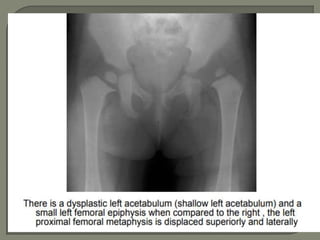
Ball and socket hip joint fails to develop normally,
the socket of the hip joint (acetabulum) is usually shallow
and the ball (femoral head ) can be loose or completely
dislocated
Risk Factors
Female
First born children
Family history Oligohydramnios •
Breech
Left more common (left occiput ant),
Etiology :
•Multifactorial
•Abnormal laxity of ligaments
and hip capsule
•Maternal hormone relaxin
•Causes of oligohydromnios
Clinical features of DDH
Asymmetrical skin fold
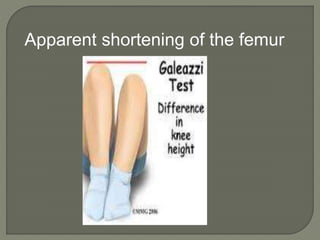
Apparent shortening of the femur
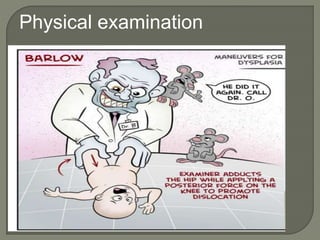
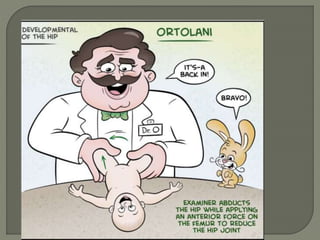
Physical examination
Imaging Findings
Plain radiogram : Gold standerd
Ultrasonography : in first 2week
of life [ beast before 4-6m when
femoral head cartilaginous]
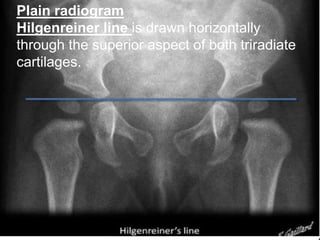
Plain radiogram
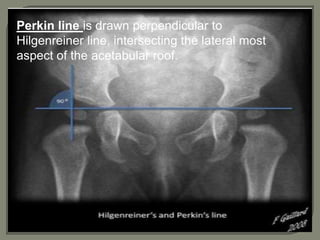
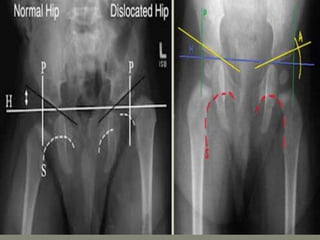
Hilgenreiner line is drawn horizontally
through the superior aspect of both triradiate
cartilages.
Perkin line is drawn perpendicular to
Hilgenreiner line, intersecting the lateral most
aspect of the acetabular roof.
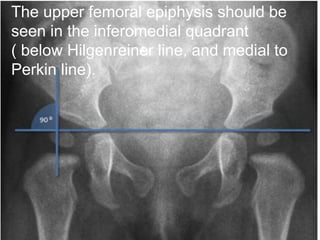
The upper femoral epiphysis should be
seen in the inferomedial quadrant
( below Hilgenreiner line, and medial to
Perkin line).
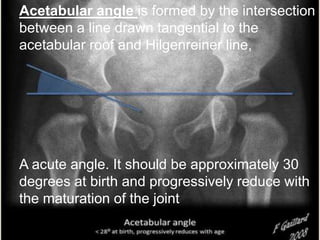
Acetabular angle is formed by the intersection
between a line drawn tangential to the
acetabular roof and Hilgenreiner line,
A acute angle. It should be approximately 30
degrees at birth and progressively reduce with
the maturation of the joint
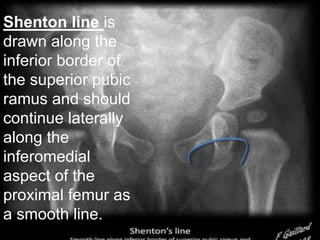
Shenton line is
drawn along the
inferior border of
the superior pubic
ramus and should
continue laterally
along the
inferomedial
aspect of the
proximal femur as
a smooth line.
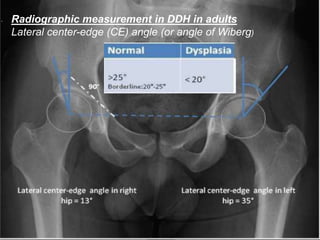
Radiographic measurement in DDH in adults
Lateral center-edge (CE) angle (or angle of Wiberg)
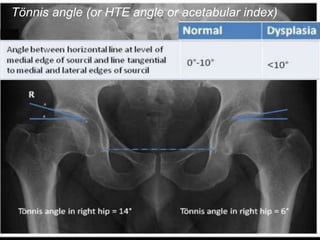
Tönnis angle (or HTE angle or acetabular index)
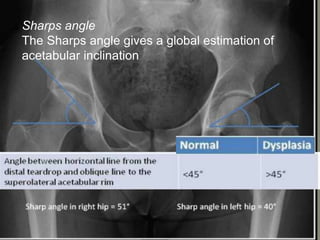
Sharps angle
The Sharps angle gives a global estimation of
acetabular inclination
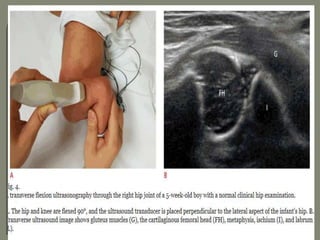
Ultrasonography : in first 2week of life
[ beast before 4-6m when femoral head
cartilaginous]
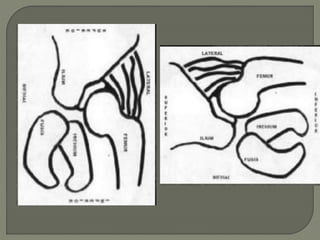
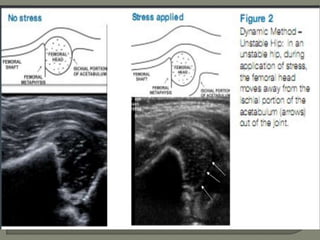
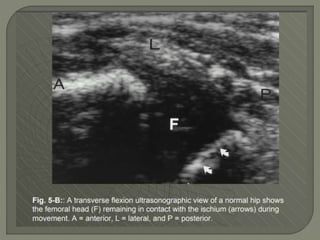
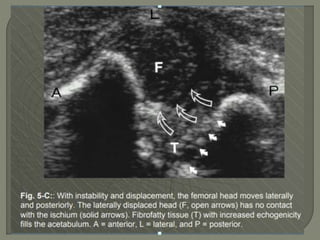
ultrasound examination be performed in
coronal view
Transverse view
7-5 mhz in < 7month
5 mhz in < 7-12 month
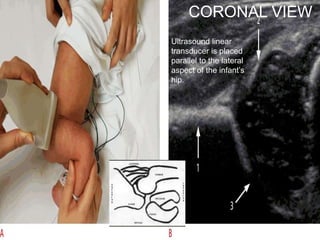
Ultrasound linear
transducer is placed
parallel to the lateral
aspect of the infant’s
hip.
CORONAL VIEW
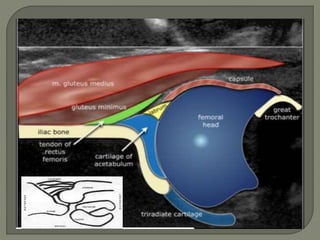
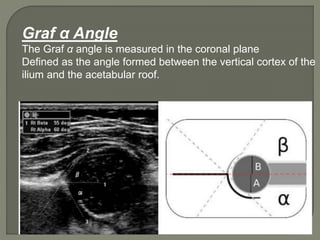
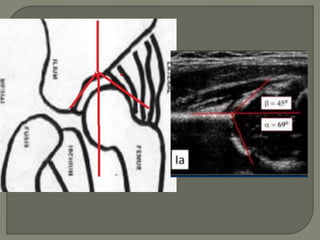
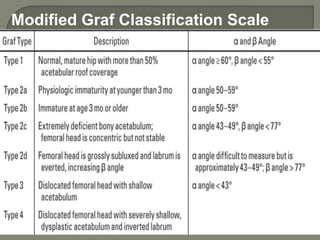
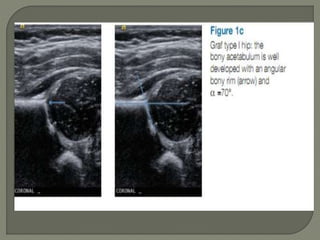
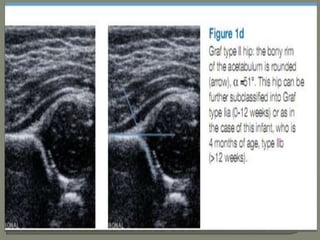
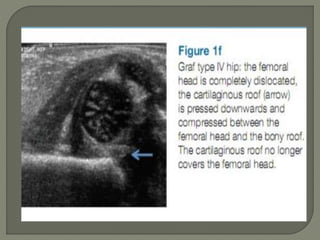
Graf α Angle
The Graf α angle is measured in the coronal plane
Defined as the angle formed between the vertical cortex of the
ilium and the acetabular roof.
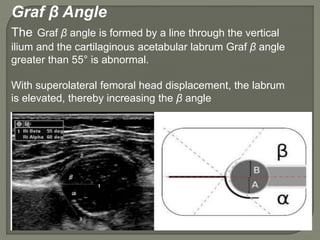
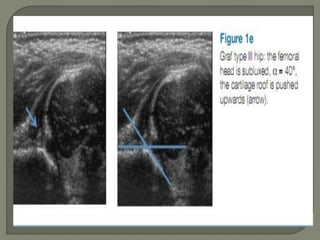
Graf β Angle
The Graf β angle is formed by a line through the vertical
ilium and the cartilaginous acetabular labrum Graf β angle
greater than 55° is abnormal.
With superolateral femoral head displacement, the labrum
is elevated, thereby increasing the β angle
Modified Graf Classification Scale
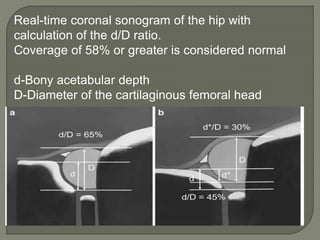
Real-time coronal sonogram of the hip with
calculation of the d/D ratio.
Coverage of 58% or greater is considered normal
d-Bony acetabular depth
D-Diameter of the cartilaginous femoral head
Method depends on Age
1] Birth to 6 months :
Double napkins , Pavlik harness or hip spica cast
2] 6 months – 12 months : Closed reduction and
hip spica casts
3]12 months – 18 months : Possible closed /
possible open reduction
4]Above 18 months : Open reduction and
Acetabuloplasty
5]Above 2 years : Open reduction, acetabulplasty,
and femoral osteotomy
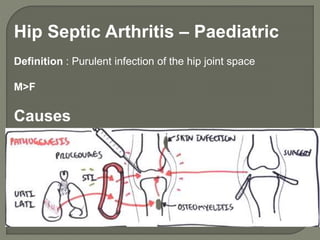
Hip Septic Arthritis – Paediatric
Definition : Purulent infection of the hip joint space
M>F
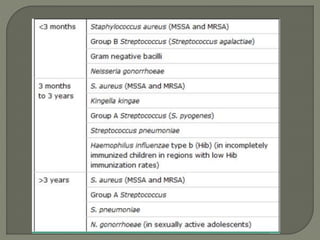
Causes
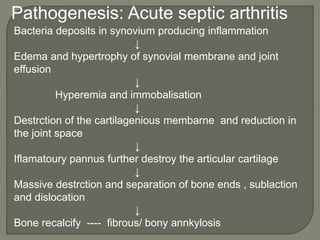
Pathogenesis: Acute septic arthritis
Bacteria deposits in synovium producing inflammation
↓
Edema and hypertrophy of synovial membrane and joint
effusion
↓
Hyperemia and immobalisation
↓
Destrction of the cartilagenious membarne and reduction in
the joint space
↓
Iflamatoury pannus further destroy the articular cartilage
↓
Massive destrction and separation of bone ends , sublaction
and dislocation
↓
Bone recalcify ---- fibrous/ bony annkylosis
A] In the early stage, there is an acute synovitis with a purulent
joint effusion
B] Soon the articular cartilage is attacked by bacterial and
cellular enzyme.
C] If infection is not arrested , the cartilage may be completely
destroyed
D] Sequlae include necrosis, sublaxation, dislocation and
ankylosis
Imaging
Plain x ray
1]Early Stage – Normal
Look for soft tissue swelling, loss of tissue planes,
widening of joint space and slight subluxation due to fluid in
joint.
2] Late stage – Narrowing and irregularity of joint space,
erosion of epiphysis or metaphysis , ostiporosis
3]Plain film findings of superimposed osteomyelitis may
develop (periosteal reaction, bone destruction, sequestrum
formation).
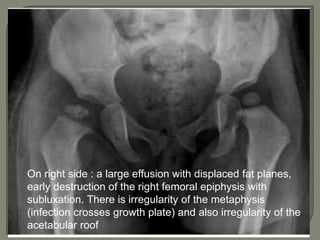
On right side : a large effusion with displaced fat planes,
early destruction of the right femoral epiphysis with
subluxation. There is irregularity of the metaphysis
(infection crosses growth plate) and also irregularity of the
acetabular roof
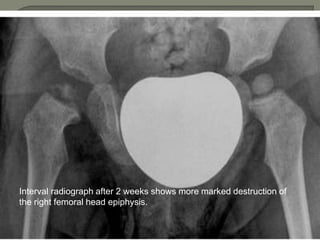
Interval radiograph after 2 weeks shows more marked destruction of
the right femoral head epiphysis.
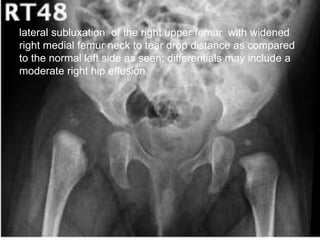
lateral subluxation of the right upper femur with widened
right medial femur neck to tear drop distance as compared
to the normal left side as seen; differentials may include a
moderate right hip effusion.
Radionuleotide scan :
1]Localise the site of infection
2]Positive as early as 2days after onset of symptoms
3]Increased articular activity in blood flow
4] Decreased uptake in the epiphysis as result of
ischemia
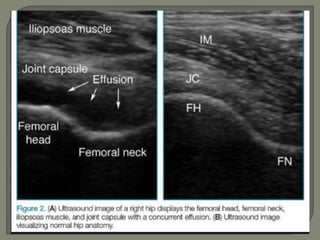
Ultrasound
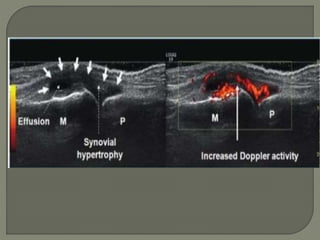
1]More reliable in revealing a joint effusion in early cases.
Widening of space between capsule and bone of > 2mm
indicates effusion.
2]Echo-free - transient synovitis
3]Positively echogenic septic arthritis
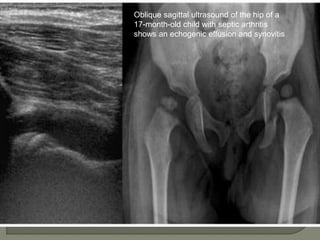
Oblique sagittal ultrasound of the hip of a
17-month-old child with septic arthritis
shows an echogenic effusion and synovitis
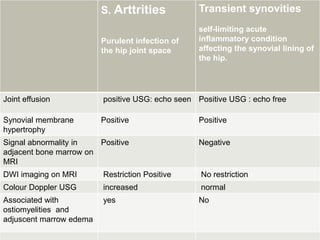
S. Arttrities
Purulent infection of
the hip joint space
Transient synovities
self-limiting acute
inflammatory condition
affecting the synovial lining of
the hip.
Joint effusion positive USG: echo seen Positive USG : echo free
Synovial membrane
hypertrophy
Positive Positive
Signal abnormality in
adjacent bone marrow on
MRI
Positive Negative
DWI imaging on MRI Restriction Positive No restriction
Colour Doppler USG increased normal
Associated with
ostiomyelities and
adjuscent marrow edema
yes No
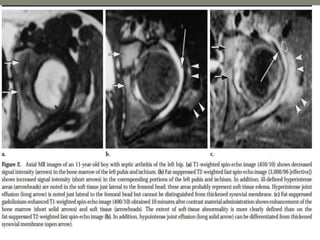
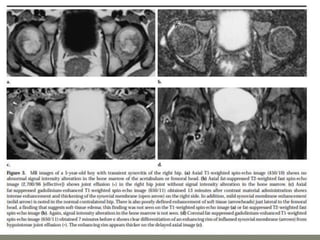
MRI- both tenosynovities and septic arthritis show
T1 hypo T2 /STIR joint effusion
Contrast enhanced image [T1+C]-
Rim of enhancing hypertrophic synovial membrane
differentiated by hypo intense joint effusion
MRI-
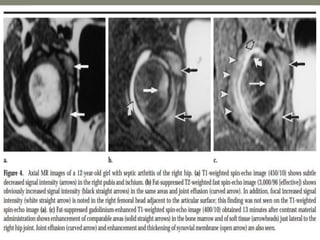
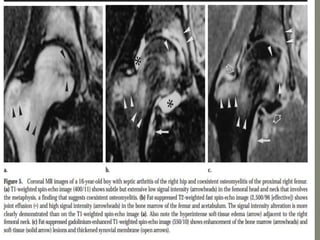
1]septic arthritis show signal intensity alteration in the
bone marrow of affected hip joint
2] In transient synovities cases show no such altered
signal entity in bone marrow
T1- poorly defined low signal intesity
T2-/STIR: hyperintese
Contrast study : show enhancment
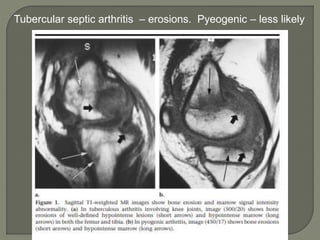
Tubercular septic arthritis – erosions. Pyeogenic – less likely
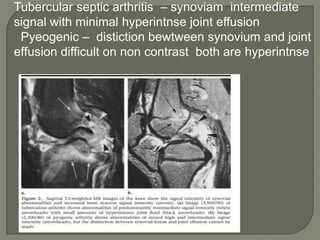
Tubercular septic arthritis – synoviam intermediate
signal with minimal hyperintnse joint effusion
Pyeogenic – distiction bewtween synovium and joint
effusion difficult on non contrast both are hyperintnse
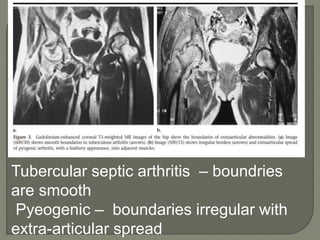
Tubercular septic arthritis – boundries
are smooth
Pyeogenic – boundaries irregular with
extra-articular spread
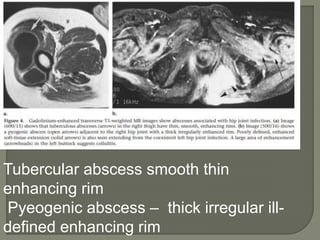
Tubercular abscess smooth thin
enhancing rim
Pyeogenic abscess – thick irregular ill-
defined enhancing rim
THANK YOU

Pediatric hip radiology

  • 1.
    Radiological Imaging of Pediatric Hip DrGirish G [PG] Moderator : Dr Madan Mohan [MD radiology]
  • 2.
    Objectives Developmental dysplasia ofthe hip..(DDH) Transient synovitis vs Septic artrities arthritis
  • 3.
    Developmental dysplasia ofthe hip (DDH) Definition : Ball and socket hip joint fails to develop normally, the socket of the hip joint (acetabulum) is usually shallow and the ball (femoral head ) can be loose or completely dislocated
  • 4.
    Risk Factors Female First bornchildren Family history Oligohydramnios • Breech Left more common (left occiput ant),
  • 5.
    Etiology : •Multifactorial •Abnormal laxityof ligaments and hip capsule •Maternal hormone relaxin •Causes of oligohydromnios
  • 6.
    Clinical features ofDDH Asymmetrical skin fold
  • 7.
  • 8.
  • 10.
    Imaging Findings Plain radiogram: Gold standerd Ultrasonography : in first 2week of life [ beast before 4-6m when femoral head cartilaginous]
  • 11.
    Plain radiogram Hilgenreiner lineis drawn horizontally through the superior aspect of both triradiate cartilages.
  • 12.
    Perkin line isdrawn perpendicular to Hilgenreiner line, intersecting the lateral most aspect of the acetabular roof.
  • 13.
    The upper femoralepiphysis should be seen in the inferomedial quadrant ( below Hilgenreiner line, and medial to Perkin line).
  • 14.
    Acetabular angle isformed by the intersection between a line drawn tangential to the acetabular roof and Hilgenreiner line, A acute angle. It should be approximately 30 degrees at birth and progressively reduce with the maturation of the joint
  • 15.
    Shenton line is drawnalong the inferior border of the superior pubic ramus and should continue laterally along the inferomedial aspect of the proximal femur as a smooth line.
  • 18.
    Radiographic measurement inDDH in adults Lateral center-edge (CE) angle (or angle of Wiberg)
  • 19.
    Tönnis angle (orHTE angle or acetabular index)
  • 20.
    Sharps angle The Sharpsangle gives a global estimation of acetabular inclination
  • 21.
    Ultrasonography : infirst 2week of life [ beast before 4-6m when femoral head cartilaginous] ultrasound examination be performed in coronal view Transverse view 7-5 mhz in < 7month 5 mhz in < 7-12 month
  • 23.
    Ultrasound linear transducer isplaced parallel to the lateral aspect of the infant’s hip. CORONAL VIEW
  • 26.
    Graf α Angle TheGraf α angle is measured in the coronal plane Defined as the angle formed between the vertical cortex of the ilium and the acetabular roof.
  • 27.
    Graf β Angle TheGraf β angle is formed by a line through the vertical ilium and the cartilaginous acetabular labrum Graf β angle greater than 55° is abnormal. With superolateral femoral head displacement, the labrum is elevated, thereby increasing the β angle
  • 29.
  • 37.
    Real-time coronal sonogramof the hip with calculation of the d/D ratio. Coverage of 58% or greater is considered normal d-Bony acetabular depth D-Diameter of the cartilaginous femoral head
  • 38.
    Method depends onAge 1] Birth to 6 months : Double napkins , Pavlik harness or hip spica cast 2] 6 months – 12 months : Closed reduction and hip spica casts 3]12 months – 18 months : Possible closed / possible open reduction 4]Above 18 months : Open reduction and Acetabuloplasty 5]Above 2 years : Open reduction, acetabulplasty, and femoral osteotomy
  • 39.
    Hip Septic Arthritis– Paediatric Definition : Purulent infection of the hip joint space M>F Causes
  • 41.
    Pathogenesis: Acute septicarthritis Bacteria deposits in synovium producing inflammation ↓ Edema and hypertrophy of synovial membrane and joint effusion ↓ Hyperemia and immobalisation ↓ Destrction of the cartilagenious membarne and reduction in the joint space ↓ Iflamatoury pannus further destroy the articular cartilage ↓ Massive destrction and separation of bone ends , sublaction and dislocation ↓ Bone recalcify ---- fibrous/ bony annkylosis
  • 42.
    A] In theearly stage, there is an acute synovitis with a purulent joint effusion B] Soon the articular cartilage is attacked by bacterial and cellular enzyme. C] If infection is not arrested , the cartilage may be completely destroyed D] Sequlae include necrosis, sublaxation, dislocation and ankylosis
  • 43.
    Imaging Plain x ray 1]EarlyStage – Normal Look for soft tissue swelling, loss of tissue planes, widening of joint space and slight subluxation due to fluid in joint. 2] Late stage – Narrowing and irregularity of joint space, erosion of epiphysis or metaphysis , ostiporosis 3]Plain film findings of superimposed osteomyelitis may develop (periosteal reaction, bone destruction, sequestrum formation).
  • 44.
    On right side: a large effusion with displaced fat planes, early destruction of the right femoral epiphysis with subluxation. There is irregularity of the metaphysis (infection crosses growth plate) and also irregularity of the acetabular roof
  • 45.
    Interval radiograph after2 weeks shows more marked destruction of the right femoral head epiphysis.
  • 46.
    lateral subluxation ofthe right upper femur with widened right medial femur neck to tear drop distance as compared to the normal left side as seen; differentials may include a moderate right hip effusion.
  • 47.
    Radionuleotide scan : 1]Localisethe site of infection 2]Positive as early as 2days after onset of symptoms 3]Increased articular activity in blood flow 4] Decreased uptake in the epiphysis as result of ischemia
  • 48.
    Ultrasound 1]More reliable inrevealing a joint effusion in early cases. Widening of space between capsule and bone of > 2mm indicates effusion. 2]Echo-free - transient synovitis 3]Positively echogenic septic arthritis
  • 49.
    Oblique sagittal ultrasoundof the hip of a 17-month-old child with septic arthritis shows an echogenic effusion and synovitis
  • 52.
    S. Arttrities Purulent infectionof the hip joint space Transient synovities self-limiting acute inflammatory condition affecting the synovial lining of the hip. Joint effusion positive USG: echo seen Positive USG : echo free Synovial membrane hypertrophy Positive Positive Signal abnormality in adjacent bone marrow on MRI Positive Negative DWI imaging on MRI Restriction Positive No restriction Colour Doppler USG increased normal Associated with ostiomyelities and adjuscent marrow edema yes No
  • 53.
    MRI- both tenosynovitiesand septic arthritis show T1 hypo T2 /STIR joint effusion Contrast enhanced image [T1+C]- Rim of enhancing hypertrophic synovial membrane differentiated by hypo intense joint effusion
  • 54.
    MRI- 1]septic arthritis showsignal intensity alteration in the bone marrow of affected hip joint 2] In transient synovities cases show no such altered signal entity in bone marrow T1- poorly defined low signal intesity T2-/STIR: hyperintese Contrast study : show enhancment
  • 59.
    Tubercular septic arthritis– erosions. Pyeogenic – less likely
  • 60.
    Tubercular septic arthritis– synoviam intermediate signal with minimal hyperintnse joint effusion Pyeogenic – distiction bewtween synovium and joint effusion difficult on non contrast both are hyperintnse
  • 61.
    Tubercular septic arthritis– boundries are smooth Pyeogenic – boundaries irregular with extra-articular spread
  • 62.
    Tubercular abscess smooththin enhancing rim Pyeogenic abscess – thick irregular ill- defined enhancing rim
  • 63.