


HishamAlrabty
By Dr Hisham Mukhtar Alrabty
Pediatrics consultant and pulmonologist at Tripoli children
hospital.
Senior lecturer at pediatrics department of medicine faculty
Tripoli university.
HishamAlrabty
HishamAlrabty
DEFINITION:
Acute asthma attack or flare up defined
as:
Any known asthmatic child on
prophylactive treatment or no came in
respiratory distress .
Surely with history of cough, wheeze
and breathlessness.
HishamAlrabty
CLINICAL CLASSIFICATION OF ACUTE ASTHMA
Why should we have such classification???
Simply because it is treatment wise.
For each grade there is plan of management.
HishamAlrabty
GRADES OF ACUTE ASTHMA
Mild
Moderate
Severe
HishamAlrabty
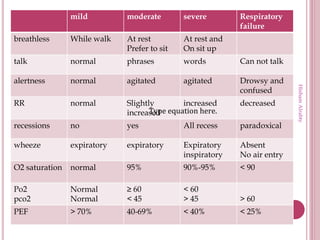
mild moderate severe Respiratory
failure
breathless While walk At rest
Prefer to sit
At rest and
On sit up
talk normal phrases words Can not talk
alertness normal agitated agitated Drowsy and
confused
RR normal Slightly
increased
increased decreased
recessions no yes All recess paradoxical
wheeze expiratory expiratory Expiratory
inspiratory
Absent
No air entry
O2 saturation normal 95% 90%-95% < 90
Po2
pco2
Normal
Normal
≥ 60
< 45
< 60
> 45 > 60
PEF > 70% 40-69% < 40% < 25%
Type equation here.
HishamAlrabty
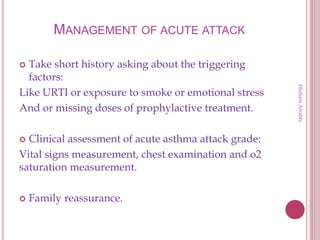
MANAGEMENT OF ACUTE ATTACK
 Take short history asking about the triggering
factors:
Like URTI or exposure to smoke or emotional stress
And or missing doses of prophylactive treatment.
 Clinical assessment of acute asthma attack grade:
Vital signs measurement, chest examination and o2
saturation measurement.
 Family reassurance.
HishamAlrabty
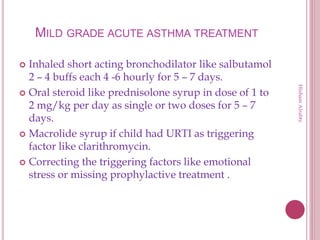
MILD GRADE ACUTE ASTHMA TREATMENT
 Inhaled short acting bronchodilator like salbutamol
2 – 4 buffs each 4 -6 hourly for 5 – 7 days.
 Oral steroid like prednisolone syrup in dose of 1 to
2 mg/kg per day as single or two doses for 5 – 7
days.
 Macrolide syrup if child had URTI as triggering
factor like clarithromycin.
 Correcting the triggering factors like emotional
stress or missing prophylactive treatment .
HishamAlrabty
MODERATE GRADE ACUTE ASTHMA
TREATMENT
 Short acting b2 agonist bronchodilator like
salbutamol either as mdi 2-4 buffs or as nebulized in
dose of 0.075 mg-0.15 mg/kg per dose which both can
be repeated every 20 mins .
 Reassess the patient after each dose and measure o2
saturation .
 Oral steroid like prednisolone syrup 1-2 mg/kg.
 No place for i/m hydrocortisone, never use it
Because of pain and same action like oral steroids.
HishamAlrabty
LEVALBUTEROL
 Nonracemic form of albuterol, levalbuterol (R
isomer) is effective in smaller doses and is reported
to have fewer adverse effects (eg, tachycardia,
hyperglycemia, hypokalemia).
 The dose may be doubled in acute severe episodes
when even a slight increase in the bronchodilator
response may make a big difference in the
management strategy (eg, in avoiding patient
ventilation).
 It is available as an MDI (45 mcg per actuation) or
solution for nebulized inhalation.
HishamAlrabty
After then there will be two possibilities:
Either child will improve and sent home on
short course of oral steroids and inhaled
bronchodilator.
Or child showed little improvement or no
signs of improvement so he will be dealt like
case of severe acute asthma attack.
HishamAlrabty
SEVERE GRADE ACUTE ASTHMA TREATMENT
 Admission.
 Continuous oxygen supplement.
 Bronchodilator nebulization with o2 like salbutamol
which can be repeated every 20 mins and or continuous.
 Add ipratropium bromide nebulization as adjuvant to
salbutamol in 3 successive doses over one hour.
 Nebulized steroids such as budesonide.
 Intravenous steroids methyl prednisolone.
 Keep patient well hydrated.
 Continuous monitoring of vital signs and oxygen
saturation measurement.
HishamAlrabty
after then there will be two possibilities:
 Child started improving so keep on same
treatment and manage accordingly.
 Or child will show NO improvement and
he will get into:
Case of status asthmaticus where you should
admit hem to picu and do the following:
HishamAlrabty
TREATMENT GOALS OF STATUS ASTHMATICUS
 To reverse airway obstruction rapidly
through the aggressive use of beta 2 agonist
and early use of steroids.
 To correct hypoxemia by monitoring and
administering supplemental oxygen.
 To prevent or treat complications such as
pneumothorax and respiratory arrest.
HishamAlrabty
ABG STAGING OF STATUS ASTHMATICUS
1. Stage 1 : normal po2 and hyperventilation.
2. Stage 2 : hypoxia and hypocapnia.
3. Stage 3 : false normal po2 and
hypoventilation indicating respiratory
muscle fatigue and need for picu and
ventilation.
4. Stage 4 : hypoxia and hypercapnia or
respiratory failure type 2 where the need
for ventilation is there.
HishamAlrabty
STATUS ASTHMATICUS MANAGEMENT
 Picu admission.
 Continuous oxygen supplement.
 Intravenous hydration.
 Continuous monitoring of vital signs certainly o2
saturation.
 Ask why the patient not improved ???
Does he have a complication like pneumothorax so do
cxr and or severe pneumonia so do cxr and start
antibacterial accordingly.
And then:
HishamAlrabty
By now the options of other types of treatment and or
medicines are many and differ from place to another
depending on:
 National guidelines and policy of the country in
treating the status asthmaticus.
 Clinical experience and judgment of local doctors.
 Availability of medicines and facilities.
HishamAlrabty
ADRENALINE
Nonspecific powerful bronchodilator working
on both alpha and beta receptors.
It could be given subcutaneously in dose of
0.01 mg/kg and it could be repeated 3 times
20 min apart from each other and or as
nebulization of racemic adrenaline.
HishamAlrabty
IV SALBUTAMOL
The use of IV salbutamol (0.15mg/kg as a
once-off dose) in the early management of
acute severe asthma in children has been
shown to reduce the duration of the
exacerbation and hasten the discharge from
hospital of the children.
Or as infusion in dose of 0.25mg/kg/h.
HishamAlrabty
IV AMINOPHYLLINE
 The positive effect from aminophylline infusion on
acute asthma is well documented.
 May be used in cases of near fatal or life threatening
asthma in the intensive care unit.
 Inhaled drugs may have limited effect in children
with nearly complete airway obstruction and have
practical limitations in ventilated patients.
 A reasonable starting point is 5mg/kg as loading
dose then 0.5mg – 1.2mg/kg/h as infusion.
HishamAlrabty
ANTICHOLINERGICS
 Ipratropium bromide (Atrovent) is the
recommended sympathomimetic agent of choice.
 It comes in premixed vials at 0.2%, is administered
every 4-6 hours, and can be synergistic with
albuterol or other beta2-agonists when treating
severe acute asthma exacerbations.
 Ipratropium may also be used as an alternative
bronchodilator in patients who are unable to
tolerate inhaled beta2-agonists.
 Because children appear to have more cholinergic
receptors, they are more responsive to
parasympathetic stimulation than adults.
HishamAlrabty
STEROIDS
 Nebulized pulmicort, recently and upto
recommendation of Gina can be given in 3
successive doses apart from each other 20
min.
 Continue with intravenous steroids
preferably methylprednisolone.
 it is the essential component of acute asthma
treatment as anti-inflammatory and enhance
response of bronchiolar smooth muscle to
effect of bronchodilator.
HishamAlrabty
MAGNESIUM SULPHATE
 Magnesium cause smooth muscle relaxation
secondary to inhibition of calcium uptake.
 A single dose of IV magnesium sulphate has been
shown to be safe and effective in those patients with
acute severe asthma who have had a poor response
to initial therapy.
 The recent GINA-guidelines suggest that iv
magnesium may be considered in acute moderate
and severe asthma with incomplete response to
initial treatment during the first 1-2 hours.
 The dose is 25 - 50 mg/kg/dose (maximum 2 g) by
slow IV infusion.
HishamAlrabty
HELIOX
It is a mixture of helium and oxygen 30/70.
It should be considered only in patients with deep
breaths because it is dependent on inspiratory flow.
It is inert gas reducing turbulent airflow across
narrowed airways which helps to reduce work of
breathing so in turn results in improved gas
exchange and oxygenation and clinical symptoms.
All this will decrease need for intubation and
ventilation.
HishamAlrabty
KETAMINE
 It is intravenous anesthetic agent.
 Used in patients with high co2 not
responding to mech.ventilation.
 It has bronchodilator effect.
 It improves airway resistance certainly lower
one as well as lung compliance improving the
oxygenation.
 It is also considered as sedative agent.
HishamAlrabty
INHALED ANESTHETIC AGENTS
 Inhaled anesthetic agents, such as halothane,
isoflurane, and enflurane, have been used with
varying degrees of success in refractory, intubated
patients with severe asthma.
 The mechanism of action is unclear but they may
have direct relaxant effects on airway smooth
muscle.
 Sevoflurane has been employed more commonly
than halothane and isoflurane.
 In children, sevoflurane has been shown in some
studies to be safe and effective.
HishamAlrabty
NONINVASIVE VENTILATION
Such as bilevel positive airway pressure could be
considered in cases of impending respiratory failure in
order to avoid intubation.
Ram et al demonstrated that the effectiveness of
noninvasive positive pressure ventilation was affected
by meta-analysis.
Ueda et al reported using noninvasive positive
pressure ventilation to wean a patient with refractory
status asthmaticus who also had developed atelectasis.
One should also consider that noninvasive ventilation
may have a significant role in managing patients with
status asthmaticus.
This has been shown to be mostly effective in the
pediatric population.
HishamAlrabty
MECHANICAL VENTILATION
 Asthma is a disease of increased airway resistance,
resulting in prolongation of the time constant (the time
needed for lung units to fill and empty) so Slow
ventilator rates are needed.
 In the face of high peak airway pressures, the principle
of mechanical ventilation of status asthmaticus is
controlled hypoventilation, tolerating higher levels of
PCO2 in order to minimize tidal volume and peak
inspiratory pressures.
 Permissive hypercapnia can be tolerated as long as the
patient remains adequately oxygenated.
HishamAlrabty
EXTRACORPOREAL LIFE SUPPORT
 The role of extracorporeal life support has been
studied and implemented in several institutions and
should be considered in patients at high risk of
developing refractory status asthmaticus.
 This includes, but is not limited to, patients with a
history of multiple intubations, respiratory failure
requiring intubation within 6 hours of admission,
hemodynamic instability, neurologic impairment at
the time of admission, and duration of respiratory
failure greater than 12 hours despite maximal
medical therapy.
HishamAlrabty
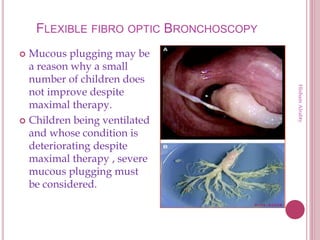
FLEXIBLE FIBRO OPTIC BRONCHOSCOPY
 Mucous plugging may be
a reason why a small
number of children does
not improve despite
maximal therapy.
 Children being ventilated
and whose condition is
deteriorating despite
maximal therapy , severe
mucous plugging must
be considered.
HishamAlrabty
CONCLUSION
 Management of acute asthma certainly severe one
is local doctors experience dependent and it could
differ from country to another.
 Oxygen and good hydration are essential parts of
management.
 Treatment of triggering factors not to be forgotten.
 Here Libya we should have a national guidelines
depending on local doctors experience and
international recommendations to treat acute
asthma in kids.
HishamAlrabty
REFERENCES
1. Emedicine.com/pediatric asthma.
2. Gina 2017 update.
3. Nelson text book for pediatrics 19th edition.
HishamAlrabty
Thank you
For attendance and attention
HishamAlrabty

Pediatric acute asthma management update

  • 1.
  • 2.
    By Dr HishamMukhtar Alrabty Pediatrics consultant and pulmonologist at Tripoli children hospital. Senior lecturer at pediatrics department of medicine faculty Tripoli university. HishamAlrabty
  • 3.
  • 4.
    DEFINITION: Acute asthma attackor flare up defined as: Any known asthmatic child on prophylactive treatment or no came in respiratory distress . Surely with history of cough, wheeze and breathlessness. HishamAlrabty
  • 5.
    CLINICAL CLASSIFICATION OFACUTE ASTHMA Why should we have such classification??? Simply because it is treatment wise. For each grade there is plan of management. HishamAlrabty
  • 6.
    GRADES OF ACUTEASTHMA Mild Moderate Severe HishamAlrabty
  • 7.
    mild moderate severeRespiratory failure breathless While walk At rest Prefer to sit At rest and On sit up talk normal phrases words Can not talk alertness normal agitated agitated Drowsy and confused RR normal Slightly increased increased decreased recessions no yes All recess paradoxical wheeze expiratory expiratory Expiratory inspiratory Absent No air entry O2 saturation normal 95% 90%-95% < 90 Po2 pco2 Normal Normal ≥ 60 < 45 < 60 > 45 > 60 PEF > 70% 40-69% < 40% < 25% Type equation here. HishamAlrabty
  • 8.
    MANAGEMENT OF ACUTEATTACK  Take short history asking about the triggering factors: Like URTI or exposure to smoke or emotional stress And or missing doses of prophylactive treatment.  Clinical assessment of acute asthma attack grade: Vital signs measurement, chest examination and o2 saturation measurement.  Family reassurance. HishamAlrabty
  • 9.
    MILD GRADE ACUTEASTHMA TREATMENT  Inhaled short acting bronchodilator like salbutamol 2 – 4 buffs each 4 -6 hourly for 5 – 7 days.  Oral steroid like prednisolone syrup in dose of 1 to 2 mg/kg per day as single or two doses for 5 – 7 days.  Macrolide syrup if child had URTI as triggering factor like clarithromycin.  Correcting the triggering factors like emotional stress or missing prophylactive treatment . HishamAlrabty
  • 10.
    MODERATE GRADE ACUTEASTHMA TREATMENT  Short acting b2 agonist bronchodilator like salbutamol either as mdi 2-4 buffs or as nebulized in dose of 0.075 mg-0.15 mg/kg per dose which both can be repeated every 20 mins .  Reassess the patient after each dose and measure o2 saturation .  Oral steroid like prednisolone syrup 1-2 mg/kg.  No place for i/m hydrocortisone, never use it Because of pain and same action like oral steroids. HishamAlrabty
  • 11.
    LEVALBUTEROL  Nonracemic formof albuterol, levalbuterol (R isomer) is effective in smaller doses and is reported to have fewer adverse effects (eg, tachycardia, hyperglycemia, hypokalemia).  The dose may be doubled in acute severe episodes when even a slight increase in the bronchodilator response may make a big difference in the management strategy (eg, in avoiding patient ventilation).  It is available as an MDI (45 mcg per actuation) or solution for nebulized inhalation. HishamAlrabty
  • 12.
    After then therewill be two possibilities: Either child will improve and sent home on short course of oral steroids and inhaled bronchodilator. Or child showed little improvement or no signs of improvement so he will be dealt like case of severe acute asthma attack. HishamAlrabty
  • 13.
    SEVERE GRADE ACUTEASTHMA TREATMENT  Admission.  Continuous oxygen supplement.  Bronchodilator nebulization with o2 like salbutamol which can be repeated every 20 mins and or continuous.  Add ipratropium bromide nebulization as adjuvant to salbutamol in 3 successive doses over one hour.  Nebulized steroids such as budesonide.  Intravenous steroids methyl prednisolone.  Keep patient well hydrated.  Continuous monitoring of vital signs and oxygen saturation measurement. HishamAlrabty
  • 14.
    after then therewill be two possibilities:  Child started improving so keep on same treatment and manage accordingly.  Or child will show NO improvement and he will get into: Case of status asthmaticus where you should admit hem to picu and do the following: HishamAlrabty
  • 15.
    TREATMENT GOALS OFSTATUS ASTHMATICUS  To reverse airway obstruction rapidly through the aggressive use of beta 2 agonist and early use of steroids.  To correct hypoxemia by monitoring and administering supplemental oxygen.  To prevent or treat complications such as pneumothorax and respiratory arrest. HishamAlrabty
  • 16.
    ABG STAGING OFSTATUS ASTHMATICUS 1. Stage 1 : normal po2 and hyperventilation. 2. Stage 2 : hypoxia and hypocapnia. 3. Stage 3 : false normal po2 and hypoventilation indicating respiratory muscle fatigue and need for picu and ventilation. 4. Stage 4 : hypoxia and hypercapnia or respiratory failure type 2 where the need for ventilation is there. HishamAlrabty
  • 17.
    STATUS ASTHMATICUS MANAGEMENT Picu admission.  Continuous oxygen supplement.  Intravenous hydration.  Continuous monitoring of vital signs certainly o2 saturation.  Ask why the patient not improved ??? Does he have a complication like pneumothorax so do cxr and or severe pneumonia so do cxr and start antibacterial accordingly. And then: HishamAlrabty
  • 18.
    By now theoptions of other types of treatment and or medicines are many and differ from place to another depending on:  National guidelines and policy of the country in treating the status asthmaticus.  Clinical experience and judgment of local doctors.  Availability of medicines and facilities. HishamAlrabty
  • 19.
    ADRENALINE Nonspecific powerful bronchodilatorworking on both alpha and beta receptors. It could be given subcutaneously in dose of 0.01 mg/kg and it could be repeated 3 times 20 min apart from each other and or as nebulization of racemic adrenaline. HishamAlrabty
  • 20.
    IV SALBUTAMOL The useof IV salbutamol (0.15mg/kg as a once-off dose) in the early management of acute severe asthma in children has been shown to reduce the duration of the exacerbation and hasten the discharge from hospital of the children. Or as infusion in dose of 0.25mg/kg/h. HishamAlrabty
  • 21.
    IV AMINOPHYLLINE  Thepositive effect from aminophylline infusion on acute asthma is well documented.  May be used in cases of near fatal or life threatening asthma in the intensive care unit.  Inhaled drugs may have limited effect in children with nearly complete airway obstruction and have practical limitations in ventilated patients.  A reasonable starting point is 5mg/kg as loading dose then 0.5mg – 1.2mg/kg/h as infusion. HishamAlrabty
  • 22.
    ANTICHOLINERGICS  Ipratropium bromide(Atrovent) is the recommended sympathomimetic agent of choice.  It comes in premixed vials at 0.2%, is administered every 4-6 hours, and can be synergistic with albuterol or other beta2-agonists when treating severe acute asthma exacerbations.  Ipratropium may also be used as an alternative bronchodilator in patients who are unable to tolerate inhaled beta2-agonists.  Because children appear to have more cholinergic receptors, they are more responsive to parasympathetic stimulation than adults. HishamAlrabty
  • 23.
    STEROIDS  Nebulized pulmicort,recently and upto recommendation of Gina can be given in 3 successive doses apart from each other 20 min.  Continue with intravenous steroids preferably methylprednisolone.  it is the essential component of acute asthma treatment as anti-inflammatory and enhance response of bronchiolar smooth muscle to effect of bronchodilator. HishamAlrabty
  • 24.
    MAGNESIUM SULPHATE  Magnesiumcause smooth muscle relaxation secondary to inhibition of calcium uptake.  A single dose of IV magnesium sulphate has been shown to be safe and effective in those patients with acute severe asthma who have had a poor response to initial therapy.  The recent GINA-guidelines suggest that iv magnesium may be considered in acute moderate and severe asthma with incomplete response to initial treatment during the first 1-2 hours.  The dose is 25 - 50 mg/kg/dose (maximum 2 g) by slow IV infusion. HishamAlrabty
  • 25.
    HELIOX It is amixture of helium and oxygen 30/70. It should be considered only in patients with deep breaths because it is dependent on inspiratory flow. It is inert gas reducing turbulent airflow across narrowed airways which helps to reduce work of breathing so in turn results in improved gas exchange and oxygenation and clinical symptoms. All this will decrease need for intubation and ventilation. HishamAlrabty
  • 26.
    KETAMINE  It isintravenous anesthetic agent.  Used in patients with high co2 not responding to mech.ventilation.  It has bronchodilator effect.  It improves airway resistance certainly lower one as well as lung compliance improving the oxygenation.  It is also considered as sedative agent. HishamAlrabty
  • 27.
    INHALED ANESTHETIC AGENTS Inhaled anesthetic agents, such as halothane, isoflurane, and enflurane, have been used with varying degrees of success in refractory, intubated patients with severe asthma.  The mechanism of action is unclear but they may have direct relaxant effects on airway smooth muscle.  Sevoflurane has been employed more commonly than halothane and isoflurane.  In children, sevoflurane has been shown in some studies to be safe and effective. HishamAlrabty
  • 28.
    NONINVASIVE VENTILATION Such asbilevel positive airway pressure could be considered in cases of impending respiratory failure in order to avoid intubation. Ram et al demonstrated that the effectiveness of noninvasive positive pressure ventilation was affected by meta-analysis. Ueda et al reported using noninvasive positive pressure ventilation to wean a patient with refractory status asthmaticus who also had developed atelectasis. One should also consider that noninvasive ventilation may have a significant role in managing patients with status asthmaticus. This has been shown to be mostly effective in the pediatric population. HishamAlrabty
  • 29.
    MECHANICAL VENTILATION  Asthmais a disease of increased airway resistance, resulting in prolongation of the time constant (the time needed for lung units to fill and empty) so Slow ventilator rates are needed.  In the face of high peak airway pressures, the principle of mechanical ventilation of status asthmaticus is controlled hypoventilation, tolerating higher levels of PCO2 in order to minimize tidal volume and peak inspiratory pressures.  Permissive hypercapnia can be tolerated as long as the patient remains adequately oxygenated. HishamAlrabty
  • 30.
    EXTRACORPOREAL LIFE SUPPORT The role of extracorporeal life support has been studied and implemented in several institutions and should be considered in patients at high risk of developing refractory status asthmaticus.  This includes, but is not limited to, patients with a history of multiple intubations, respiratory failure requiring intubation within 6 hours of admission, hemodynamic instability, neurologic impairment at the time of admission, and duration of respiratory failure greater than 12 hours despite maximal medical therapy. HishamAlrabty
  • 31.
    FLEXIBLE FIBRO OPTICBRONCHOSCOPY  Mucous plugging may be a reason why a small number of children does not improve despite maximal therapy.  Children being ventilated and whose condition is deteriorating despite maximal therapy , severe mucous plugging must be considered. HishamAlrabty
  • 32.
    CONCLUSION  Management ofacute asthma certainly severe one is local doctors experience dependent and it could differ from country to another.  Oxygen and good hydration are essential parts of management.  Treatment of triggering factors not to be forgotten.  Here Libya we should have a national guidelines depending on local doctors experience and international recommendations to treat acute asthma in kids. HishamAlrabty
  • 33.
    REFERENCES 1. Emedicine.com/pediatric asthma. 2.Gina 2017 update. 3. Nelson text book for pediatrics 19th edition. HishamAlrabty
  • 34.
    Thank you For attendanceand attention HishamAlrabty