Pedagogy 2.0:  Missing or Broken Link? Dr. Brett J. Millán & Dr. Rebecca O. Mill án South Texas College
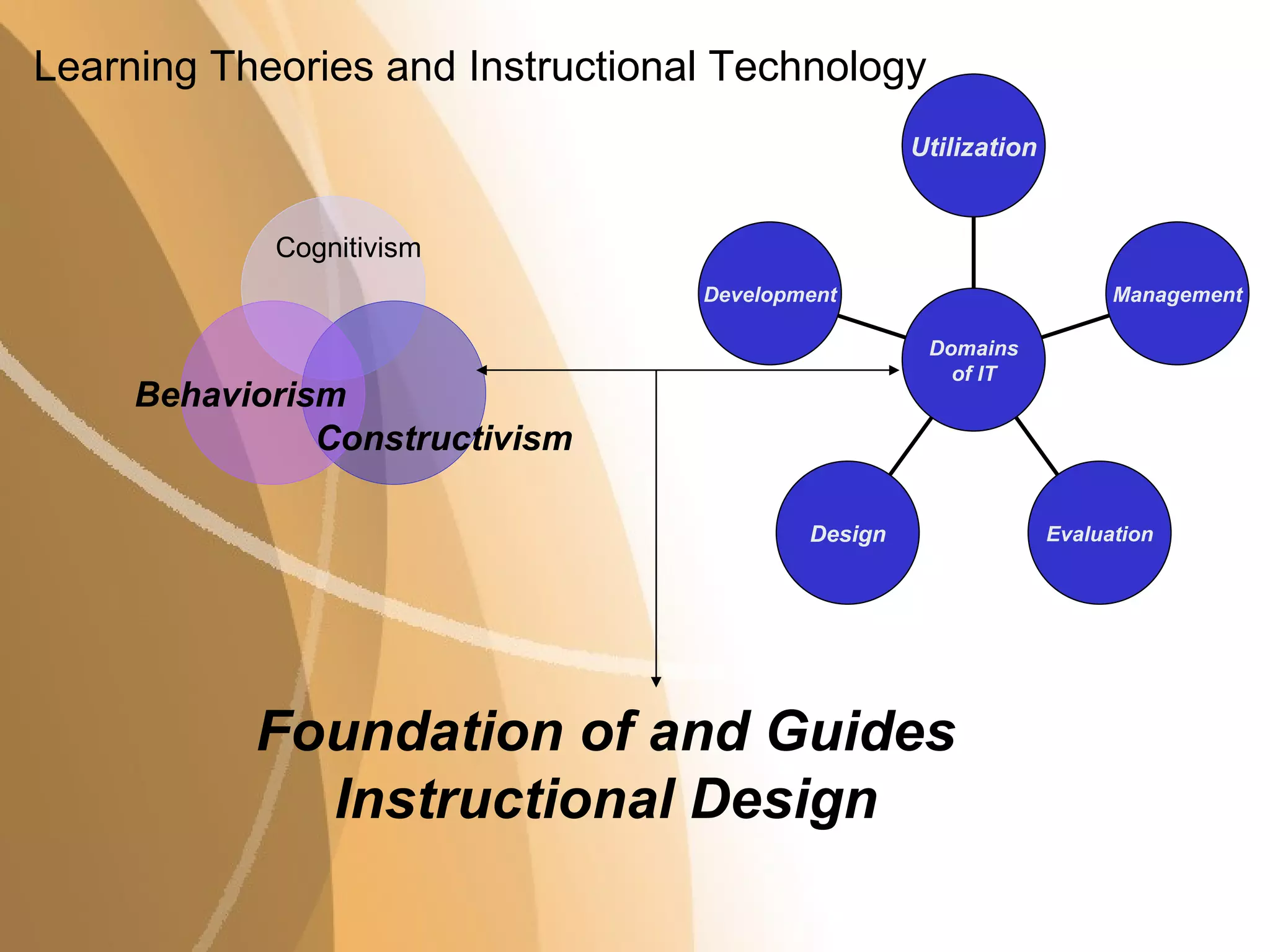
Foundation of and Guides Instructional Design Learning Theories and Instructional Technology Constructivism Behaviorism Cognitivism Development Design Evaluation Management Utilization Domains of IT
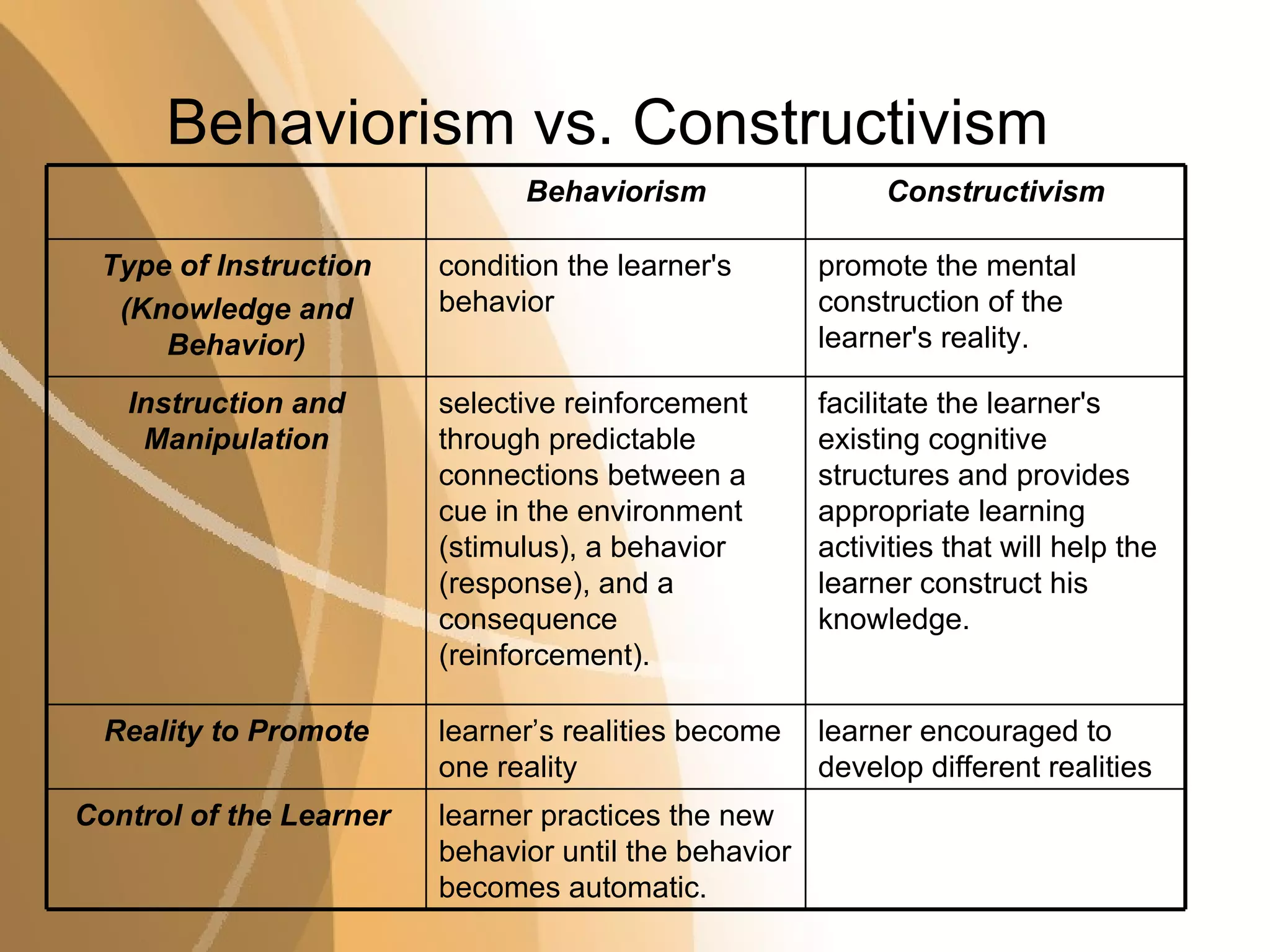
Behaviorism vs. Constructivism learner practices the new behavior until the behavior becomes automatic. Control of the Learner  learner encouraged to develop different realities learner’s realities become one reality Reality to Promote facilitate the learner's existing cognitive structures and provides appropriate learning activities that will help the learner construct his knowledge. selective reinforcement through predictable connections between a cue in the environment (stimulus), a behavior (response), and a consequence (reinforcement).  Instruction and Manipulation promote the mental construction of the learner's reality. condition the learner's behavior Type of Instruction (Knowledge and Behavior) Constructivism Behaviorism
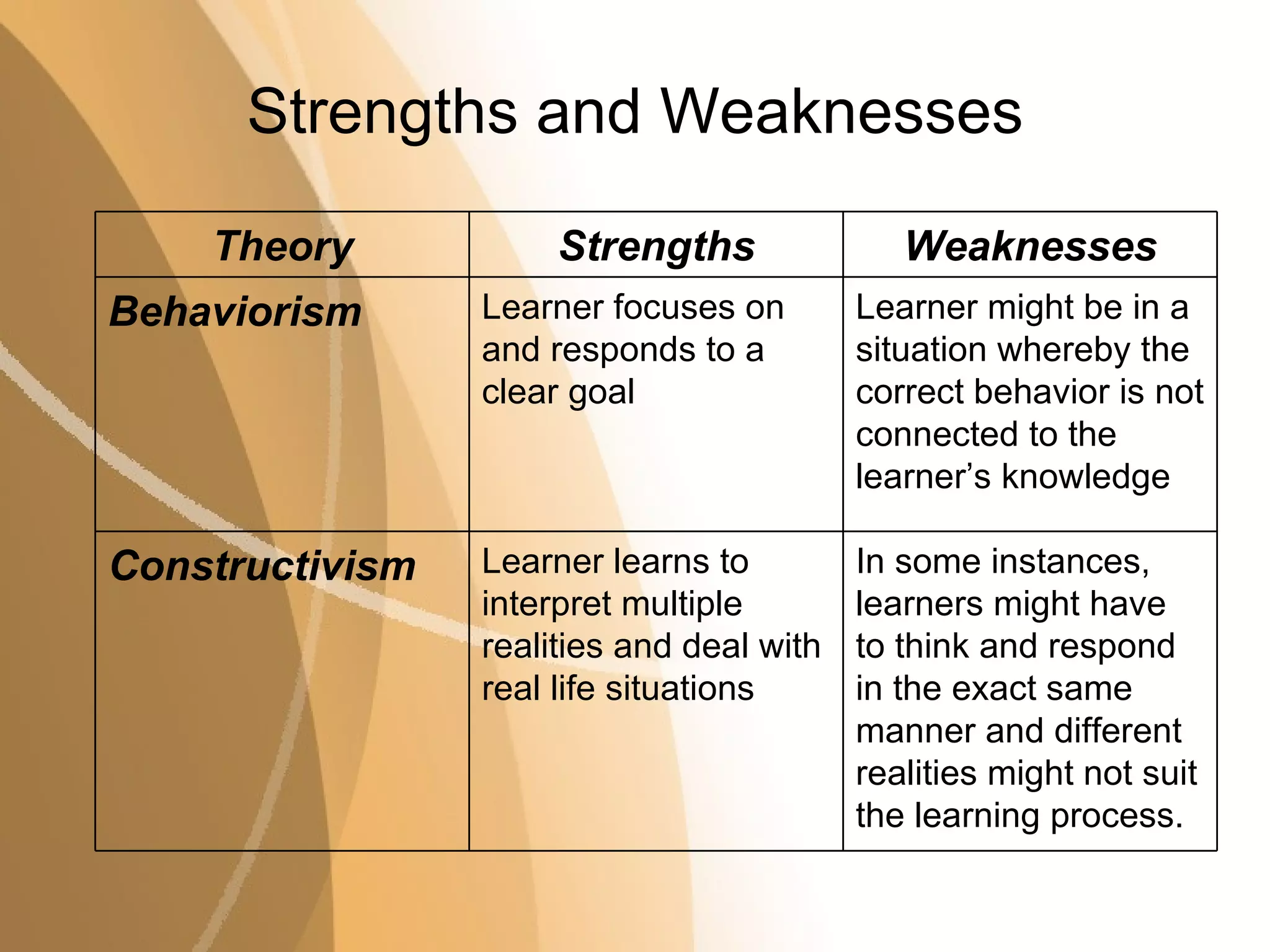
Strengths and Weaknesses In some instances, learners might have to think and respond in the exact same manner and different realities might not suit the learning process. Learner learns to interpret multiple realities and deal with real life situations Constructivism Learner might be in a situation whereby the correct behavior is not connected to the learner’s knowledge Learner focuses on and responds to a clear goal Behaviorism Weaknesses Strengths Theory
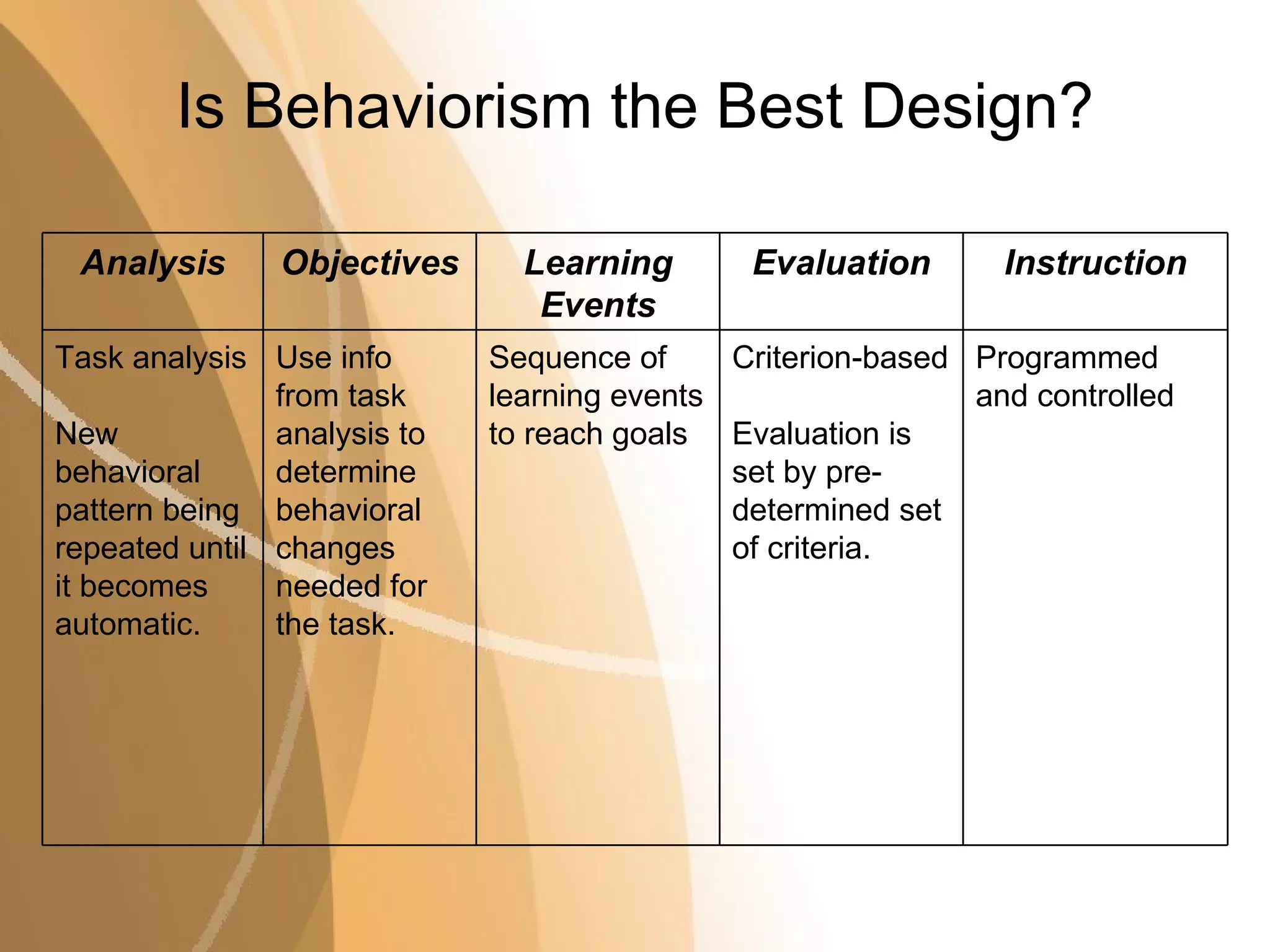
Is Behaviorism the Best Design? Programmed and controlled Criterion-based  Evaluation is set by pre-determined set of criteria. Sequence of learning events to reach goals Use info from task analysis to determine behavioral changes needed for the task. Task analysis New behavioral pattern being repeated until it becomes automatic. Instruction Evaluation Learning Events Objectives Analysis
Is Constructivism the Best Design? Authentic environments embedded (Often includes narrative) Performance based of learner assessment -and self-evaluation What do I need to know? How do I solve it? Objectives are negotiated as student adjusts understanding of reality to make sense of new knowledge Tools and the environment are analyzed Focuses on preparing the learner to problem solve in ambiguous situations Instruction Evaluation Learning Events Objectives Analysis
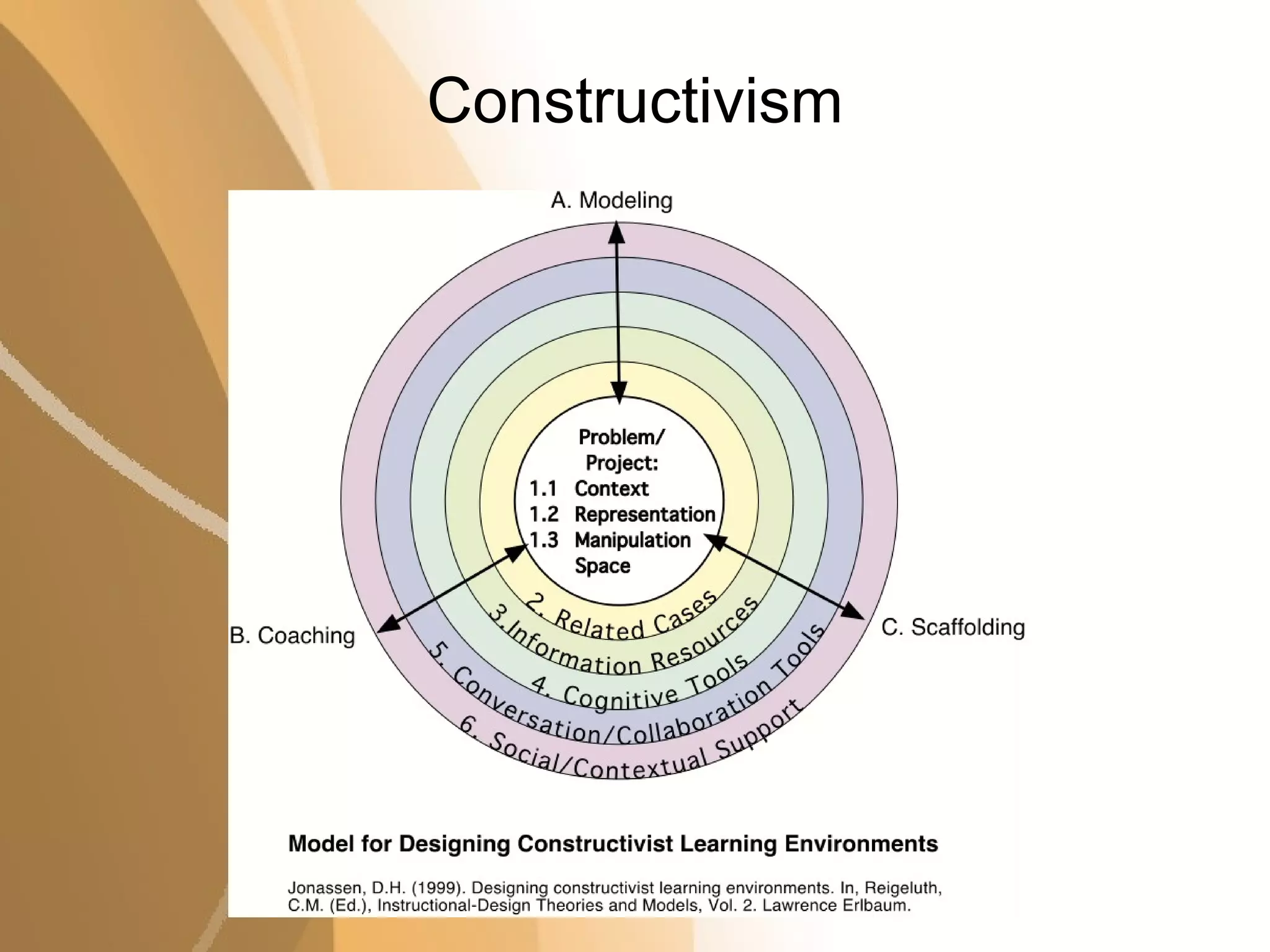
Constructivism
The New Wave
What do we really want to accomplish? Create more student engagement Improve student learning Help the student internalize the information And do this without taking so much time that we can’t get anything else done!
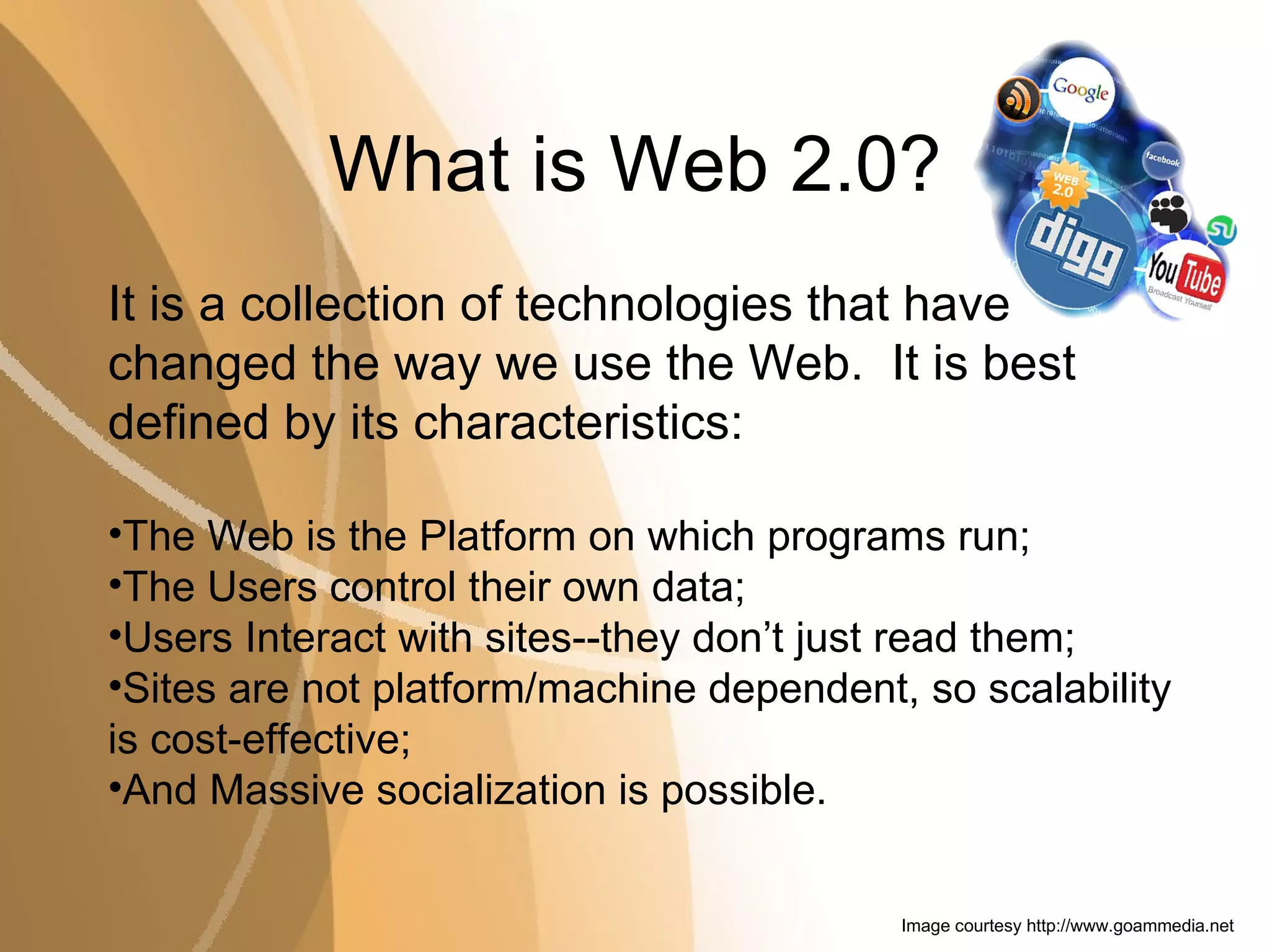
What is Web 2.0? It is a collection of technologies that have changed the way we use the Web.  It is best defined by its characteristics: The Web is the Platform on which programs run; The Users control their own data; Users Interact with sites--they don’t just read them; Sites are not platform/machine dependent, so scalability is cost-effective; And Massive socialization is possible. Image courtesy  http://www.goammedia.net
Flickr
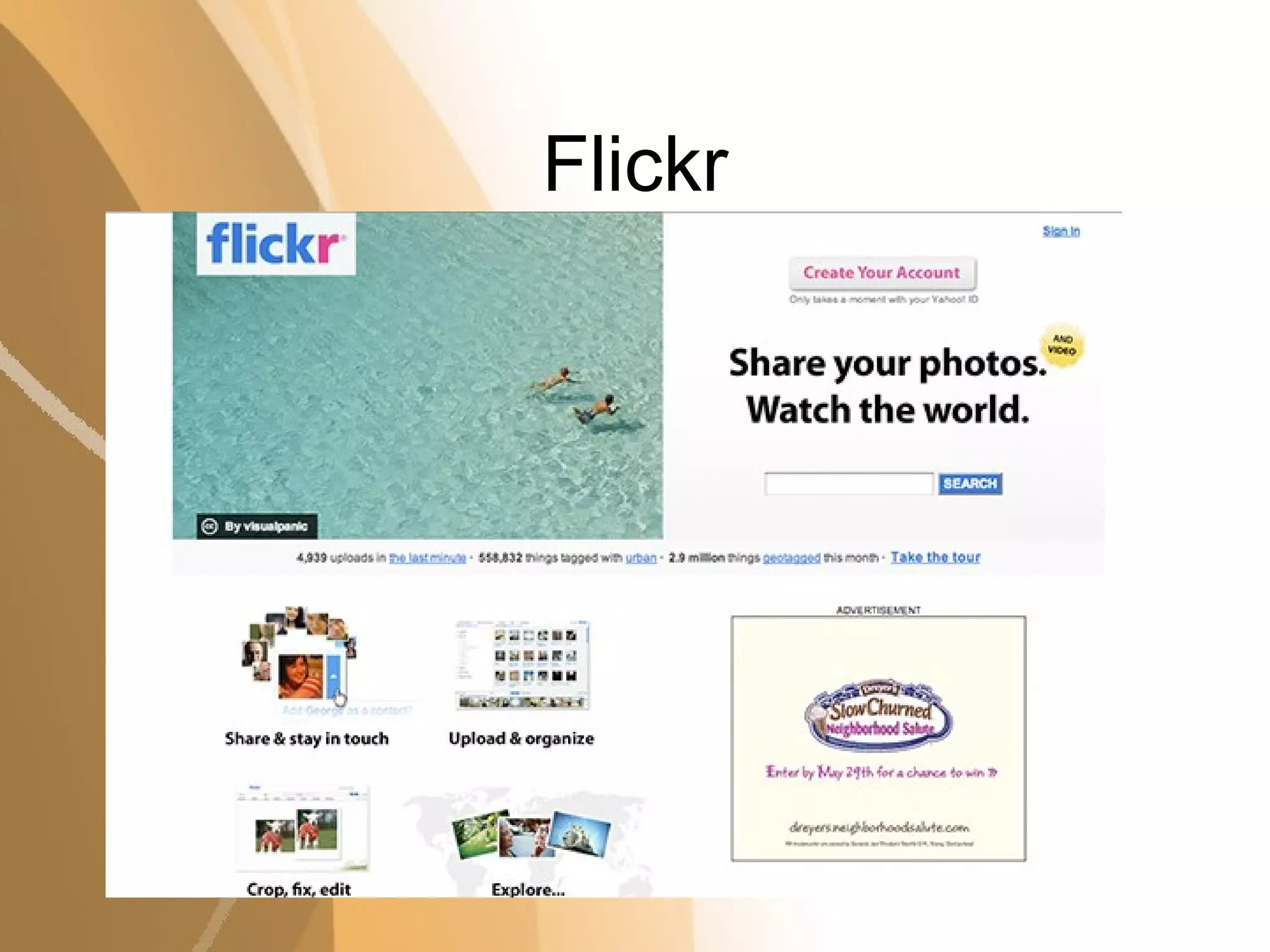
Flickr Flickr, among other things, can be used as a virtual field trip, to explain architectural concepts, photography, tell a story, and explain principles of art. DEProjects Photostream
Big Huge Labs
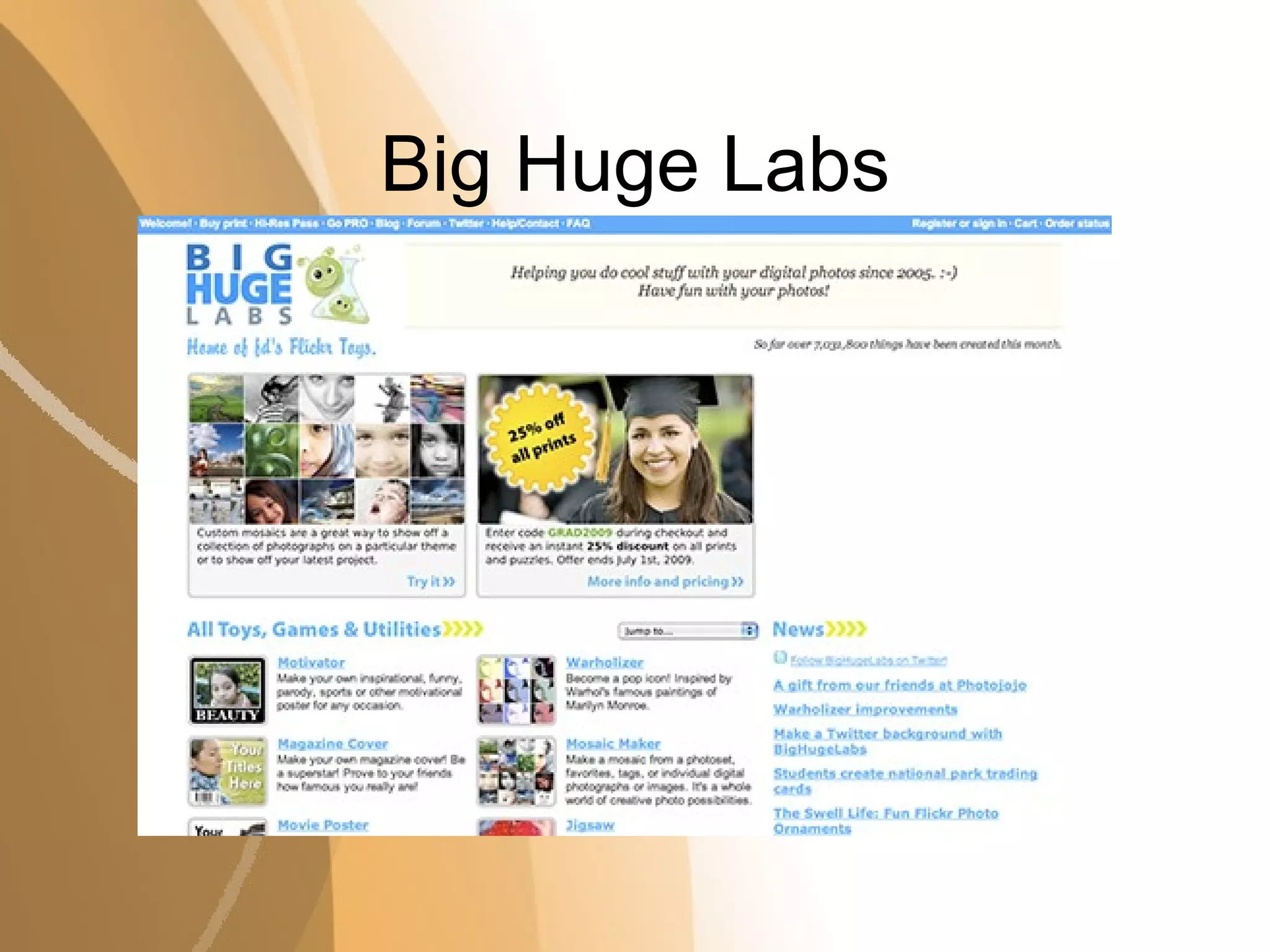
Big Huge Labs Big Huge Labs has created a variety of tools for people to manipulate imagines found on Flickr.  However many of these tools can be used to “spice” up assignment that otherwise would be rote learning. Magazine Cover Creator Trading Card Creator Motivational Poster Creator
Magazine Cover Creator Creating a Magazine Cover forces a student to critically think about the elements that will convey a particular meaning for the audience.  Therefore, students can use it to create summaries, convey aesthetic judgments, learn about the relationship between text and image--these are just some ideas. http://bighugelabs.com/flickr/magazine.php Sample Magazine Cover
Trading Card Creator Like Magazine Covers, creating Trading Cards forces a student to critically think about the elements that will convey a particular meaning for the audience.  Therefore, students can use trading cards to summarize important information while learning about the relationship between text and images. http://bighugelabs.com/flickr/deck.php Sample Card #1 Sample Card #2
Motivational Poster Creator Motivational Posters are seen in many offices, and we tend to ignore them now.  However, this creator can be used to have students understand denotations and connotations of words, or even as a method of reinforcing literary terms. http://bighugelabs.com/flickr/motivator.php Sample Poster
Zoho
Zoho Creator/Google Forms Both Zoho and Google have online office suites, including database handling, so how can these be used in online education? Folklore Collections Student Information
OR as an iFrame page <iframe src=&quot;http://spreadsheets.google.com/embeddedform?key=pOv0j9vlpv8BJt1NM8oU8cA&quot; width=&quot;500&quot; height=&quot;581&quot; frameborder=&quot;0&quot; marginheight=&quot;0&quot; marginwidth=&quot;0&quot;>Loading...</iframe>
ToonDoo
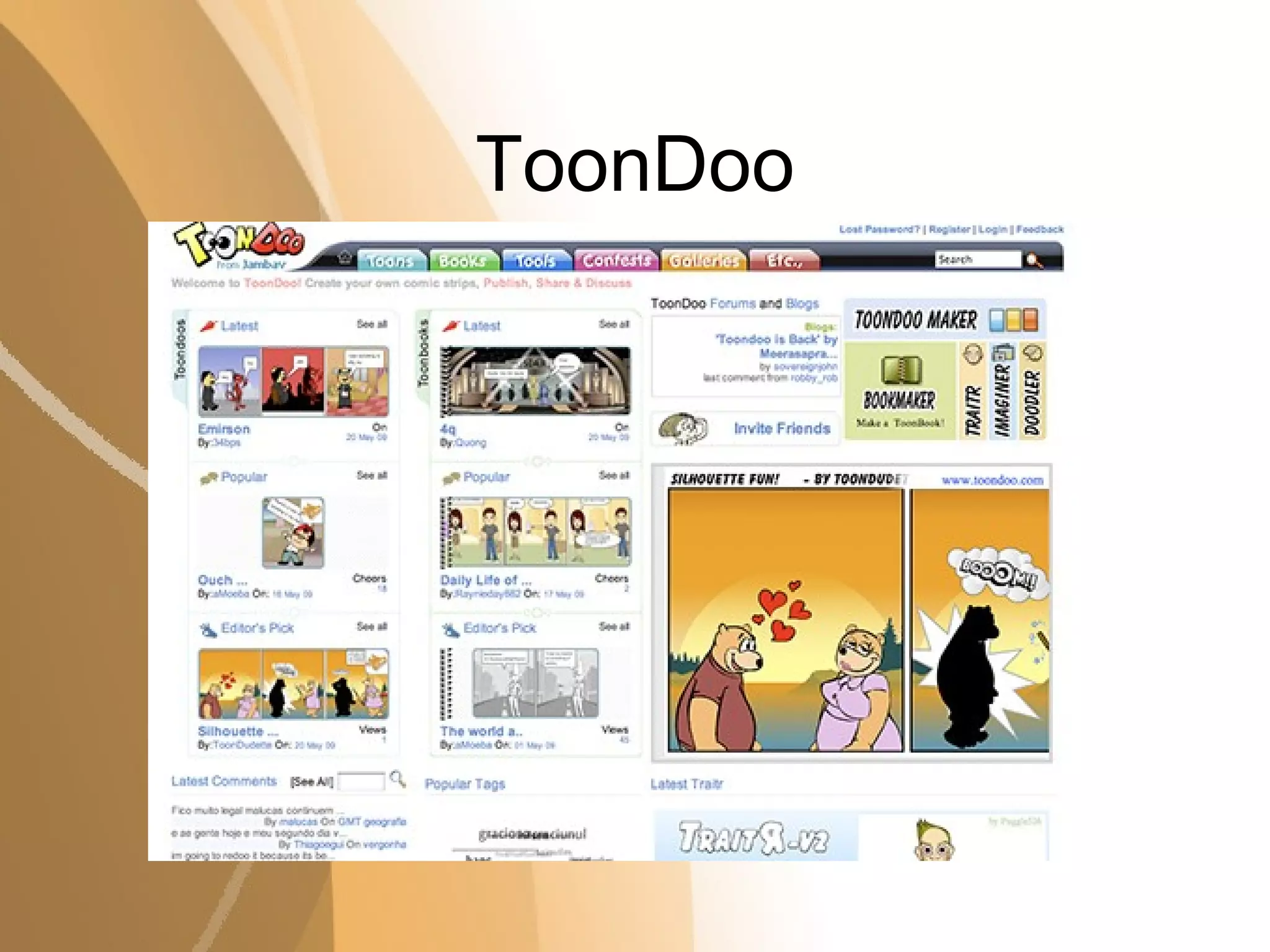
ToonDoo For many years, cartoons have been used to educate (e.g. political cartoons), tell a story (e.g. Egyptian tomb paintings), and to story board (e.g. commercials/ads). Cartoons can now be incorporated for both illustrating a concept or as student assignments. http://www.toondoo.com/ Sample Story Toon
SlideShare
SlideShare Slideshare is a service where people can upload their PowerPoints and share them with the world.  The presentations are converted into a flash-type file with player controls, and the result can be embedded on web pages. http://www.slideshare.com
So how else can we use these technologies for improved pedagogy? Open Discussion
Thank you very much for your time, attention, and participation! To continue the discussion or for any other information, please email us at  [email_address] [email_address] . edu
Any Questions?

Pedagogy2.0: A Missing or Broken Link

  • 1.
    Pedagogy 2.0: Missing or Broken Link? Dr. Brett J. Millán & Dr. Rebecca O. Mill án South Texas College
  • 2.
    Foundation of andGuides Instructional Design Learning Theories and Instructional Technology Constructivism Behaviorism Cognitivism Development Design Evaluation Management Utilization Domains of IT
  • 3.
    Behaviorism vs. Constructivismlearner practices the new behavior until the behavior becomes automatic. Control of the Learner learner encouraged to develop different realities learner’s realities become one reality Reality to Promote facilitate the learner's existing cognitive structures and provides appropriate learning activities that will help the learner construct his knowledge. selective reinforcement through predictable connections between a cue in the environment (stimulus), a behavior (response), and a consequence (reinforcement). Instruction and Manipulation promote the mental construction of the learner's reality. condition the learner's behavior Type of Instruction (Knowledge and Behavior) Constructivism Behaviorism
  • 4.
    Strengths and WeaknessesIn some instances, learners might have to think and respond in the exact same manner and different realities might not suit the learning process. Learner learns to interpret multiple realities and deal with real life situations Constructivism Learner might be in a situation whereby the correct behavior is not connected to the learner’s knowledge Learner focuses on and responds to a clear goal Behaviorism Weaknesses Strengths Theory
  • 5.
    Is Behaviorism theBest Design? Programmed and controlled Criterion-based Evaluation is set by pre-determined set of criteria. Sequence of learning events to reach goals Use info from task analysis to determine behavioral changes needed for the task. Task analysis New behavioral pattern being repeated until it becomes automatic. Instruction Evaluation Learning Events Objectives Analysis
  • 6.
    Is Constructivism theBest Design? Authentic environments embedded (Often includes narrative) Performance based of learner assessment -and self-evaluation What do I need to know? How do I solve it? Objectives are negotiated as student adjusts understanding of reality to make sense of new knowledge Tools and the environment are analyzed Focuses on preparing the learner to problem solve in ambiguous situations Instruction Evaluation Learning Events Objectives Analysis
  • 7.
  • 8.
  • 9.
    What do wereally want to accomplish? Create more student engagement Improve student learning Help the student internalize the information And do this without taking so much time that we can’t get anything else done!
  • 10.
    What is Web2.0? It is a collection of technologies that have changed the way we use the Web. It is best defined by its characteristics: The Web is the Platform on which programs run; The Users control their own data; Users Interact with sites--they don’t just read them; Sites are not platform/machine dependent, so scalability is cost-effective; And Massive socialization is possible. Image courtesy http://www.goammedia.net
  • 11.
  • 12.
    Flickr Flickr, amongother things, can be used as a virtual field trip, to explain architectural concepts, photography, tell a story, and explain principles of art. DEProjects Photostream
  • 13.
  • 14.
    Big Huge LabsBig Huge Labs has created a variety of tools for people to manipulate imagines found on Flickr. However many of these tools can be used to “spice” up assignment that otherwise would be rote learning. Magazine Cover Creator Trading Card Creator Motivational Poster Creator
  • 15.
    Magazine Cover CreatorCreating a Magazine Cover forces a student to critically think about the elements that will convey a particular meaning for the audience. Therefore, students can use it to create summaries, convey aesthetic judgments, learn about the relationship between text and image--these are just some ideas. http://bighugelabs.com/flickr/magazine.php Sample Magazine Cover
  • 16.
    Trading Card CreatorLike Magazine Covers, creating Trading Cards forces a student to critically think about the elements that will convey a particular meaning for the audience. Therefore, students can use trading cards to summarize important information while learning about the relationship between text and images. http://bighugelabs.com/flickr/deck.php Sample Card #1 Sample Card #2
  • 17.
    Motivational Poster CreatorMotivational Posters are seen in many offices, and we tend to ignore them now. However, this creator can be used to have students understand denotations and connotations of words, or even as a method of reinforcing literary terms. http://bighugelabs.com/flickr/motivator.php Sample Poster
  • 18.
  • 19.
    Zoho Creator/Google FormsBoth Zoho and Google have online office suites, including database handling, so how can these be used in online education? Folklore Collections Student Information
  • 20.
    OR as aniFrame page <iframe src=&quot;http://spreadsheets.google.com/embeddedform?key=pOv0j9vlpv8BJt1NM8oU8cA&quot; width=&quot;500&quot; height=&quot;581&quot; frameborder=&quot;0&quot; marginheight=&quot;0&quot; marginwidth=&quot;0&quot;>Loading...</iframe>
  • 21.
  • 22.
    ToonDoo For manyyears, cartoons have been used to educate (e.g. political cartoons), tell a story (e.g. Egyptian tomb paintings), and to story board (e.g. commercials/ads). Cartoons can now be incorporated for both illustrating a concept or as student assignments. http://www.toondoo.com/ Sample Story Toon
  • 23.
  • 24.
    SlideShare Slideshare isa service where people can upload their PowerPoints and share them with the world. The presentations are converted into a flash-type file with player controls, and the result can be embedded on web pages. http://www.slideshare.com
  • 25.
    So how elsecan we use these technologies for improved pedagogy? Open Discussion
  • 26.
    Thank you verymuch for your time, attention, and participation! To continue the discussion or for any other information, please email us at [email_address] [email_address] . edu
  • 27.