e-PORTFOLIO AS
AN ASSESSMENT
TOOL AND AS A
COMMUNICATION
MEDIUM
Learning Objectives
At the end of the Chapter, you are expected to:
• Explain what an e-portfolio is;
• Discuss the learning theory that supports the use of an
e-portfolio;
• Distinguish among the types of an e-portfolio; and
• Discuss how to use e-portfolios effectively.
Meaning of e-Portfolio
• Is a digital collection of course related work.
• An academic e-Portfolio can also capture other
aspects of a student’s life such as experiences,
extracurricular activities and more.
• A good portfolio is both a product (a digital collection
of artifacts) and a process (of reflecting on those
artifacts and what they present.
Meaning of e-Portfolio
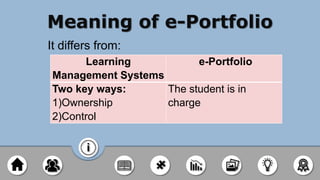
Learning
Management Systems
e-Portfolio
Two key ways:
1)Ownership
2)Control
The student is in
charge
It differs from:
• e-Portfolios, “are a way to generate
learning as well as document
learning.”
— Basken (2008)
• e-Portfolios generate learning
THE LEARNING THEORY BEHIND
e-PORTFOLIOS
1. Constructing Knowledge
• Which states that learning happens
most effectively when students
construct systems of knowledge for
themselves rather that receiving
information presented.
THE LEARNING THEORY BEHIND
e-PORTFOLIOS
2. Making Learning Visible
• Bass and Eynon (2009) describe the
process of critical reflection that is
involved in the creation of e-Portfolios
as one that makes “invisible learning”
visible.
THE LEARNING THEORY BEHIND
e-PORTFOLIOS
2. Making Learning Visible
Invisible learning refers in two things (Bass and
Eynon, 2009).
1. The intermediate step that occur whenever a
student, or any person, is attempting to learn
something or do something.
2. The learning that goes “beyond the cognitive
to include that affective, the personal and social
issues of identity.
THE LEARNING THEORY BEHIND
e-PORTFOLIOS
3. Fostering Student Activity
• e-Portfolios are a student-centered
activity
• e-Portfolios offer this opportunity for
learner control and can support or
promote deep learning.
THE LEARNING THEORY BEHIND
e-PORTFOLIOS
Some educators see e-Portfolios primarily:
• as a tool for generating new or deeper learning; while
others view them
• as a tool for assessment.
TYPES e-PORTFOLIOS
Different perspectives to e-Portfolios (Barret, 2008):
1. Student-centered e-Portfolios
• are driven by “assessment for learning”
• which refers to academic assignments that fulfill the
traditional role of assessing student learning while at the
same time providing an opportunity for students to learn
as they complete the assessment.
TYPES e-PORTFOLIOS
1. Student-centered e-Portfolios
Different kinds:
a. assessment e-Portfolios
• Audience: is internal to the institution
• Goal: to support institutional outcomes assessment
b. learning e-Portfolios
• Audience: is students themselves
• Goal: helping students examine and reflect on their
learning
TYPES e-PORTFOLIOS
1. Student-centered e-Portfolios
Different kinds:
c. Career/Transfer e-Portfolios
• Audience: external
• Goal: provide students with a tool for showcasing their
achievements to employers or transfer institutions.
TYPES e-PORTFOLIOS
Different perspectives to e-Portfolios (Barret, 2008):
2. School-centered e-Portfolios
• are driven by “assessment of learning.”
TYPES e-PORTFOLIOS
• e-Portfolios are most effective when they are established
as an institution- or program-wide initiative, however they
can still be successful at the individual course level.
BEST PRACTICES IN THE USE OF e-
PORTFOLIO
1. Explain the benefits of e-Portfolios to students
E-Portfolios can:
• help learners develop new or deeper learning, which results in
higher grades;
• help learners develop a better sense of themselves as students
and as individuals;
• be shared with friends and family members; and
• showcase learners’ achievements when they are applying for a
job.
BEST PRACTICES IN THE USE OF e-
PORTFOLIO
2. Establish clear expectations
• Explain to your students what you expect them to do in
their e-Portfolios.
3. Provide numerous examples of successful e-
Portfolios created by students
• direct students to examples of effective portfolios
BEST PRACTICES IN THE USE OF e-
PORTFOLIO
4. Scaffold student learning
• Help students start small.
5. Walk the talk
• Create an e-Portfolio for yourself and share it with your
students.
BEST PRACTICES IN THE USE OF e-
PORTFOLIO
6. Tie e-Portfolios to assessment
7. Make it social
• Integrate viewing and commenting on other students’ e-
Portfolios as a part of the assessment
BEST PRACTICES IN THE USE OF e-
PORTFOLIO
ASSESSMENT OF e-PORTFOLIOS
Challenges to assessing e-Portfolios:
1. How does one evaluate the quality of student’s “reflections?”
2. If students come to see their e-Portfolios as “just another
assignment,” then they will not engage with it in an authentic way
and it may become just another “hoop” for them to jump through.
ASSESSMENT OF e-PORTFOLIOS
Genuine benefits by developing an e-Portfolio:
• captures their work and personal reflections
• also acknowledges that assessing e-Portfolios is not
merely “subjective” matter.
ASSESSMENT OF e-PORTFOLIOS
The best way to overcome the assessment challenges:
• Assess e-Portfolios with a rubric while still ensuring that
students benefit from their e-Portfolios.
• Consistent formative feedback helps learners maintain the
motivation to work on their e-Portfolios.
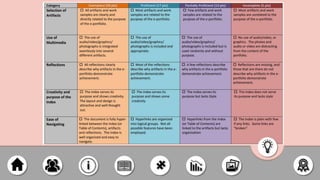
e-Portfolio Assessment Rubric
e-Portfolio Purpose:
• for students to reflect on four years of education.
• The portfolio should include:
a. a statement of the student’s goals;
b. philosophy of education; and
c. files which showcase the student’s best work. The work
selected by the student for the electronic portfolio should
be organized and reflected upon.
e-Portfolio Assessment Rubric
Reflections:
• The electronic portfolio shows examples of different kinds of work.
Each example is accompanied by a reflection composed by the
student.
• The reflection includes:
a. the course for which the file was created;
b. the time it took to create the file;
c. a brief description of why the file has been included in the e-portfolio; and
d. an explanation as to why this file demonstrates achievement.
End of the presentation

PED 18 - CHAPTER 7 (E-PORTFOLIO).pptx xxxxxx

  • 1.
    e-PORTFOLIO AS AN ASSESSMENT TOOLAND AS A COMMUNICATION MEDIUM
  • 2.
    Learning Objectives At theend of the Chapter, you are expected to: • Explain what an e-portfolio is; • Discuss the learning theory that supports the use of an e-portfolio; • Distinguish among the types of an e-portfolio; and • Discuss how to use e-portfolios effectively.
  • 3.
    Meaning of e-Portfolio •Is a digital collection of course related work. • An academic e-Portfolio can also capture other aspects of a student’s life such as experiences, extracurricular activities and more. • A good portfolio is both a product (a digital collection of artifacts) and a process (of reflecting on those artifacts and what they present.
  • 4.
    Meaning of e-Portfolio Learning ManagementSystems e-Portfolio Two key ways: 1)Ownership 2)Control The student is in charge It differs from:
  • 5.
    • e-Portfolios, “area way to generate learning as well as document learning.” — Basken (2008) • e-Portfolios generate learning THE LEARNING THEORY BEHIND e-PORTFOLIOS
  • 6.
    1. Constructing Knowledge •Which states that learning happens most effectively when students construct systems of knowledge for themselves rather that receiving information presented. THE LEARNING THEORY BEHIND e-PORTFOLIOS
  • 7.
    2. Making LearningVisible • Bass and Eynon (2009) describe the process of critical reflection that is involved in the creation of e-Portfolios as one that makes “invisible learning” visible. THE LEARNING THEORY BEHIND e-PORTFOLIOS
  • 8.
    2. Making LearningVisible Invisible learning refers in two things (Bass and Eynon, 2009). 1. The intermediate step that occur whenever a student, or any person, is attempting to learn something or do something. 2. The learning that goes “beyond the cognitive to include that affective, the personal and social issues of identity. THE LEARNING THEORY BEHIND e-PORTFOLIOS
  • 9.
    3. Fostering StudentActivity • e-Portfolios are a student-centered activity • e-Portfolios offer this opportunity for learner control and can support or promote deep learning. THE LEARNING THEORY BEHIND e-PORTFOLIOS
  • 10.
    Some educators seee-Portfolios primarily: • as a tool for generating new or deeper learning; while others view them • as a tool for assessment. TYPES e-PORTFOLIOS
  • 11.
    Different perspectives toe-Portfolios (Barret, 2008): 1. Student-centered e-Portfolios • are driven by “assessment for learning” • which refers to academic assignments that fulfill the traditional role of assessing student learning while at the same time providing an opportunity for students to learn as they complete the assessment. TYPES e-PORTFOLIOS
  • 12.
    1. Student-centered e-Portfolios Differentkinds: a. assessment e-Portfolios • Audience: is internal to the institution • Goal: to support institutional outcomes assessment b. learning e-Portfolios • Audience: is students themselves • Goal: helping students examine and reflect on their learning TYPES e-PORTFOLIOS
  • 13.
    1. Student-centered e-Portfolios Differentkinds: c. Career/Transfer e-Portfolios • Audience: external • Goal: provide students with a tool for showcasing their achievements to employers or transfer institutions. TYPES e-PORTFOLIOS
  • 14.
    Different perspectives toe-Portfolios (Barret, 2008): 2. School-centered e-Portfolios • are driven by “assessment of learning.” TYPES e-PORTFOLIOS
  • 15.
    • e-Portfolios aremost effective when they are established as an institution- or program-wide initiative, however they can still be successful at the individual course level. BEST PRACTICES IN THE USE OF e- PORTFOLIO
  • 16.
    1. Explain thebenefits of e-Portfolios to students E-Portfolios can: • help learners develop new or deeper learning, which results in higher grades; • help learners develop a better sense of themselves as students and as individuals; • be shared with friends and family members; and • showcase learners’ achievements when they are applying for a job. BEST PRACTICES IN THE USE OF e- PORTFOLIO
  • 17.
    2. Establish clearexpectations • Explain to your students what you expect them to do in their e-Portfolios. 3. Provide numerous examples of successful e- Portfolios created by students • direct students to examples of effective portfolios BEST PRACTICES IN THE USE OF e- PORTFOLIO
  • 18.
    4. Scaffold studentlearning • Help students start small. 5. Walk the talk • Create an e-Portfolio for yourself and share it with your students. BEST PRACTICES IN THE USE OF e- PORTFOLIO
  • 19.
    6. Tie e-Portfoliosto assessment 7. Make it social • Integrate viewing and commenting on other students’ e- Portfolios as a part of the assessment BEST PRACTICES IN THE USE OF e- PORTFOLIO
  • 20.
    ASSESSMENT OF e-PORTFOLIOS Challengesto assessing e-Portfolios: 1. How does one evaluate the quality of student’s “reflections?” 2. If students come to see their e-Portfolios as “just another assignment,” then they will not engage with it in an authentic way and it may become just another “hoop” for them to jump through.
  • 21.
    ASSESSMENT OF e-PORTFOLIOS Genuinebenefits by developing an e-Portfolio: • captures their work and personal reflections • also acknowledges that assessing e-Portfolios is not merely “subjective” matter.
  • 22.
    ASSESSMENT OF e-PORTFOLIOS Thebest way to overcome the assessment challenges: • Assess e-Portfolios with a rubric while still ensuring that students benefit from their e-Portfolios. • Consistent formative feedback helps learners maintain the motivation to work on their e-Portfolios.
  • 23.
    e-Portfolio Assessment Rubric e-PortfolioPurpose: • for students to reflect on four years of education. • The portfolio should include: a. a statement of the student’s goals; b. philosophy of education; and c. files which showcase the student’s best work. The work selected by the student for the electronic portfolio should be organized and reflected upon.
  • 24.
    e-Portfolio Assessment Rubric Reflections: •The electronic portfolio shows examples of different kinds of work. Each example is accompanied by a reflection composed by the student. • The reflection includes: a. the course for which the file was created; b. the time it took to create the file; c. a brief description of why the file has been included in the e-portfolio; and d. an explanation as to why this file demonstrates achievement.
  • 26.
    End of thepresentation