.
Disclosures
• The speaker has no disclosures to make.
.
1. Illustrate current cutting edge uses of application technology by consumers
and health care providers to promote optimal health outcomes.
2. Demonstrate critical appraisal of health apps.
3. Analyze benefits and legal pitfalls associate with health application
technology in the healthcare environment.
.
• Web 2.0
/web to͞o point ˈō/
– the second stage of development of the World
Wide Web, characterized especially by the change
from static web pages to dynamic or user-
generated content and the growth of social media.
.
.
Life in 2017
• Facebook- 1.18 billion daily active users
• YouTube- 3.25 billion hours of videos viewed
each month
• Twitter- 317 million daily active users
– 500 million tweets/day
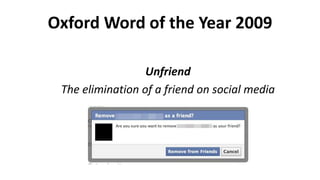
Oxford Word of the Year 2009
Unfriend
The elimination of a friend on social media
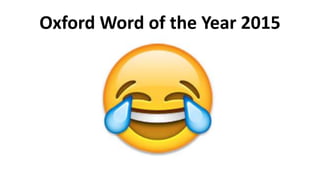
Oxford Word of the Year 2015
.
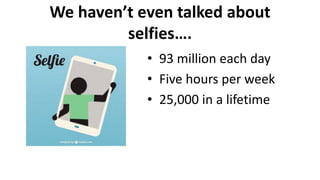
We haven’t even talked about
selfies….
• 93 million each day
• Five hours per week
• 25,000 in a lifetime
Our Feelings Exactly…
.
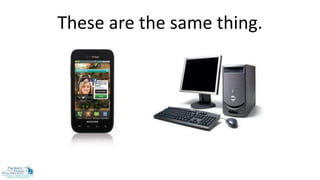
These are the same thing.
. .
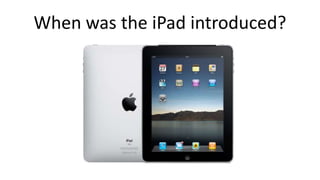
When was the iPad introduced?
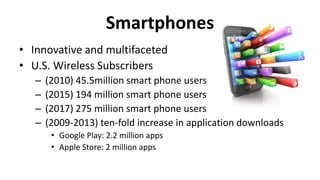
Smartphones
• Innovative and multifaceted
• U.S. Wireless Subscribers
– (2010) 45.5million smart phone users
– (2015) 194 million smart phone users
– (2017) 275 million smart phone users
– (2009-2013) ten-fold increase in application downloads
• Google Play: 2.2 million apps
• Apple Store: 2 million apps
Terms 101
• Smart phone: a high-end mobile phone that includes more advanced computing
ability, functionality and internet connectivity than a traditional phone. Smart
phones typically have the capacity to make phone calls, send text messages, play
videos, communicate via email, take and display photos, and surf the internet.
• Smart phone application: also known as "apps" or "app": a software application
that runs in a smart phone. Applications make the functionality of a mobile phone
literally limitless.
• QR Code: QR stands for "quality response." It is a two dimensional bar code used
to decode and download mobile applications at a high rate of speed.
• Platform: Also known as an operating system, it is an operating system which
permits application software to run on a mobile device. There are many cellular
providers who use platforms. Vendors include iPhone, Android, and Blackberry.
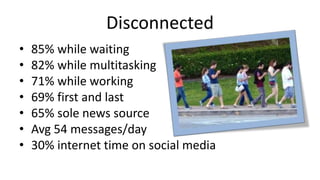
Disconnected
• 85% while waiting
• 82% while multitasking
• 71% while working
• 69% first and last
• 65% sole news source
• Avg 54 messages/day
• 30% internet time on social media
.
.
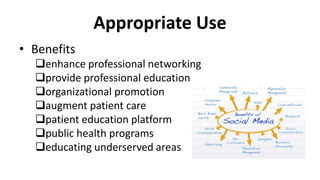
Appropriate Use
• Benefits
enhance professional networking
provide professional education
organizational promotion
augment patient care
patient education platform
public health programs
educating underserved areas
Risks
Distribute inaccurate information
Damage professional image
Violate professional boundaries
Legal issues
Violation of patient privacy
Professional Networking
• Participate in online medical communities
• Listen to experts
• Communicate with colleagues
• Crowdsourcing
• Educating underserved areas
• Getting a job
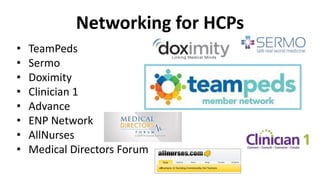
Networking for HCPs
• TeamPeds
• Sermo
• Doximity
• Clinician 1
• Advance
• ENP Network
• AllNurses
• Medical Directors Forum
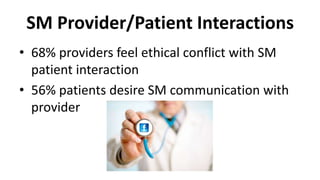
SM Provider/Patient Interactions
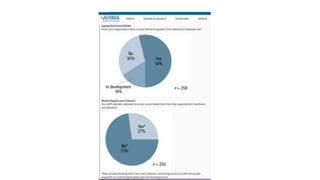
• 68% providers feel ethical conflict with SM
patient interaction
• 56% patients desire SM communication with
provider
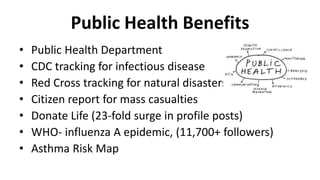
Public Health Benefits
• Public Health Department
• CDC tracking for infectious disease
• Red Cross tracking for natural disasters
• Citizen report for mass casualties
• Donate Life (23-fold surge in profile posts)
• WHO- influenza A epidemic, (11,700+ followers)
• Asthma Risk Map
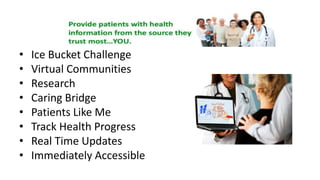
Patient Education
• Ice Bucket Challenge
• Virtual Communities
• Research
• Caring Bridge
• Patients Like Me
• Track Health Progress
• Real Time Updates
• Immediately Accessible
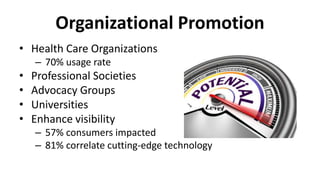
Organizational Promotion
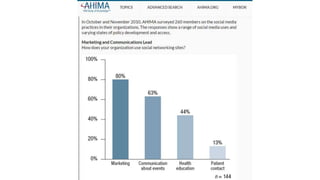
• Health Care Organizations
– 70% usage rate
• Professional Societies
• Advocacy Groups
• Universities
• Enhance visibility
– 57% consumers impacted
– 81% correlate cutting-edge technology
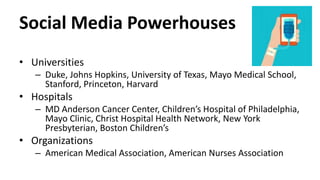
Social Media Powerhouses
• Universities
– Duke, Johns Hopkins, University of Texas, Mayo Medical School,
Stanford, Princeton, Harvard
• Hospitals
– MD Anderson Cancer Center, Children’s Hospital of Philadelphia,
Mayo Clinic, Christ Hospital Health Network, New York
Presbyterian, Boston Children’s
• Organizations
– American Medical Association, American Nurses Association
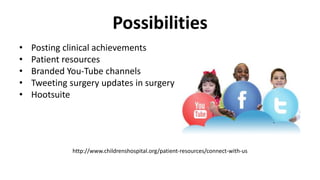
Possibilities
• Posting clinical achievements
• Patient resources
• Branded You-Tube channels
• Tweeting surgery updates in surgery
• Hootsuite
http://www.childrenshospital.org/patient-resources/connect-with-us
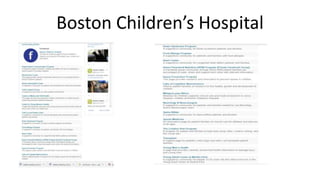
Boston Children’s Hospital
.
• .
.
• .
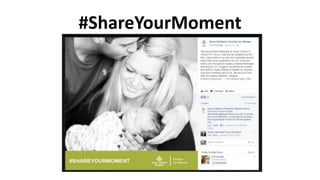
#ShareYourMoment
.
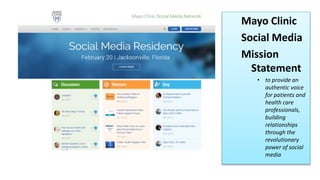
. Mayo Clinic
Social Media
Mission
Statement
• to provide an
authentic voice
for patients and
health care
professionals,
building
relationships
through the
revolutionary
power of social
media
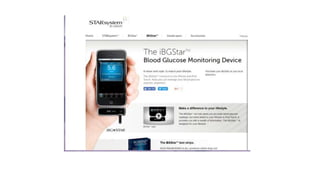
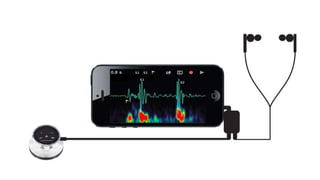
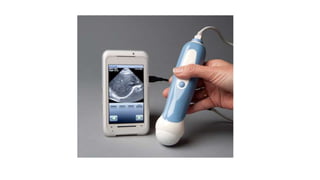
Are people really using health apps?
• 6,000 reported in 2010
– 2million+ in 2016
• Examples
– Poison Control
– American Heart Association
– Center for Disease Control
– New York City Department of Health
• CDC Contest
– $35,000 in prizes
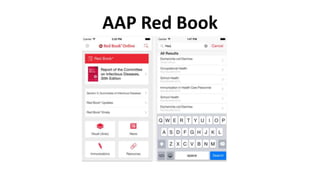
AAP Red Book
.
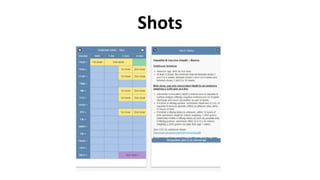
Shots
.
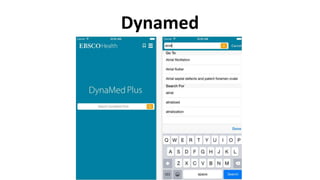
Dynamed
.
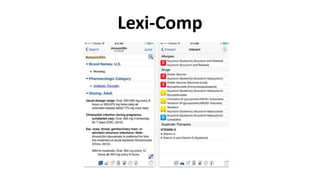
Lexi-Comp
.
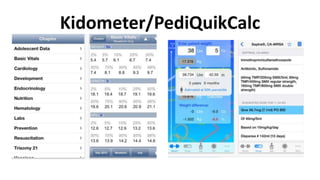
Kidometer/PediQuikCalc
.
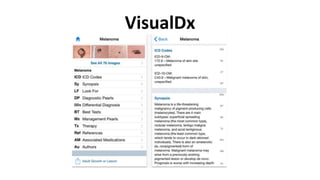
VisualDx
.
.
.
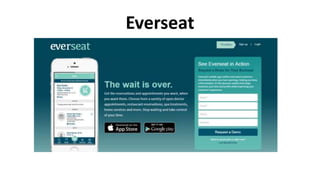
Everseat
.
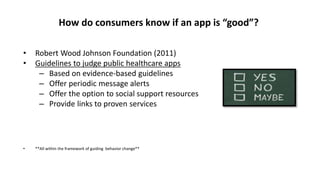
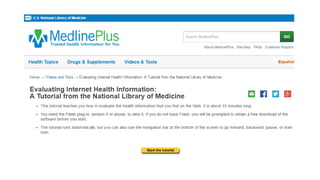
How do consumers know if an app is “good”?
• Robert Wood Johnson Foundation (2011)
• Guidelines to judge public healthcare apps
– Based on evidence-based guidelines
– Offer periodic message alerts
– Offer the option to social support resources
– Provide links to proven services
• **All within the framework of guiding behavior change**
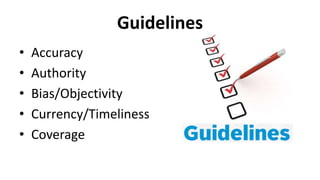
Guidelines
• Accuracy
• Authority
• Bias/Objectivity
• Currency/Timeliness
• Coverage
.
.
• .
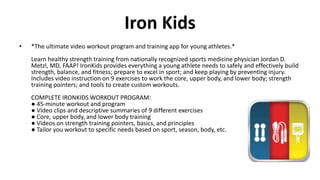
Iron Kids
• *The ultimate video workout program and training app for young athletes.*
Learn healthy strength training from nationally recognized sports medicine physician Jordan D.
Metzl, MD, FAAP! IronKids provides everything a young athlete needs to safely and effectively build
strength, balance, and fitness; prepare to excel in sport; and keep playing by preventing injury.
Includes video instruction on 9 exercises to work the core, upper body, and lower body; strength
training pointers; and tools to create custom workouts.
COMPLETE IRONKIDS WORKOUT PROGRAM:
● 45-minute workout and program
● Video clips and descriptive summaries of 9 different exercises
● Core, upper body, and lower body training
● Videos on strength training pointers, basics, and principles
● Tailor you workout to specific needs based on sport, season, body, etc.
.
.
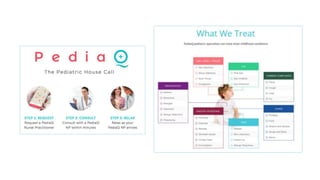
Doctor on Demand
.
Amwell
.
.
.
.
.
Cautionary Tales
• Venting about tough days
• Compassionate intentions
• Boundary issues/live streaming
• Poor reviews
Mitigating Risks
• Do not disclose patient information on SM (HIPAA).
• Do not respond to healthcare questions on SM (unlicensed practice
of medicine).
• Be cognizant of state boundaries and laws.
• Keep separate personal and and professional SM accounts.
• Regularly check your SM accounts.
• Retain strong privacy settings.
• Develop SM policies for your practice.
See AMA Guidelines for Social Media Use
SM Policies
• Restricted access in the workplace
• Inappropriate Use
• Ramifications for abuse
• Responsibility to report
• Clarification of spokesperson role/logo and
trademark use
• Release of civil liability
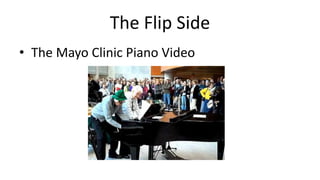
The Flip Side
• The Mayo Clinic Piano Video
A Great Place to Start
• White Paper: A Nurse’s Guide to the Use of
Social Media
– National Council of State Boards of Nursing (2011)
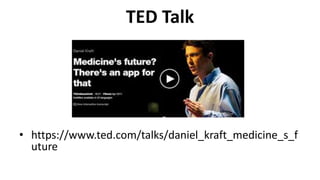
TED Talk
• https://www.ted.com/talks/daniel_kraft_medicine_s_f
uture
.
.

There's an App for That!

  • 1.
  • 2.
    Disclosures • The speakerhas no disclosures to make.
  • 3.
    . 1. Illustrate currentcutting edge uses of application technology by consumers and health care providers to promote optimal health outcomes. 2. Demonstrate critical appraisal of health apps. 3. Analyze benefits and legal pitfalls associate with health application technology in the healthcare environment.
  • 4.
    . • Web 2.0 /webto͞o point ˈō/ – the second stage of development of the World Wide Web, characterized especially by the change from static web pages to dynamic or user- generated content and the growth of social media.
  • 5.
  • 6.
    Life in 2017 •Facebook- 1.18 billion daily active users • YouTube- 3.25 billion hours of videos viewed each month • Twitter- 317 million daily active users – 500 million tweets/day
  • 7.
    Oxford Word ofthe Year 2009 Unfriend The elimination of a friend on social media
  • 8.
    Oxford Word ofthe Year 2015 .
  • 9.
    We haven’t eventalked about selfies…. • 93 million each day • Five hours per week • 25,000 in a lifetime
  • 10.
  • 11.
    These are thesame thing. . .
  • 12.
    When was theiPad introduced?
  • 13.
    Smartphones • Innovative andmultifaceted • U.S. Wireless Subscribers – (2010) 45.5million smart phone users – (2015) 194 million smart phone users – (2017) 275 million smart phone users – (2009-2013) ten-fold increase in application downloads • Google Play: 2.2 million apps • Apple Store: 2 million apps
  • 14.
    Terms 101 • Smartphone: a high-end mobile phone that includes more advanced computing ability, functionality and internet connectivity than a traditional phone. Smart phones typically have the capacity to make phone calls, send text messages, play videos, communicate via email, take and display photos, and surf the internet. • Smart phone application: also known as "apps" or "app": a software application that runs in a smart phone. Applications make the functionality of a mobile phone literally limitless. • QR Code: QR stands for "quality response." It is a two dimensional bar code used to decode and download mobile applications at a high rate of speed. • Platform: Also known as an operating system, it is an operating system which permits application software to run on a mobile device. There are many cellular providers who use platforms. Vendors include iPhone, Android, and Blackberry.
  • 15.
    Disconnected • 85% whilewaiting • 82% while multitasking • 71% while working • 69% first and last • 65% sole news source • Avg 54 messages/day • 30% internet time on social media
  • 16.
  • 17.
    Appropriate Use • Benefits enhanceprofessional networking provide professional education organizational promotion augment patient care patient education platform public health programs educating underserved areas
  • 18.
    Risks Distribute inaccurate information Damageprofessional image Violate professional boundaries Legal issues Violation of patient privacy
  • 19.
    Professional Networking • Participatein online medical communities • Listen to experts • Communicate with colleagues • Crowdsourcing • Educating underserved areas • Getting a job
  • 20.
    Networking for HCPs •TeamPeds • Sermo • Doximity • Clinician 1 • Advance • ENP Network • AllNurses • Medical Directors Forum
  • 21.
    SM Provider/Patient Interactions •68% providers feel ethical conflict with SM patient interaction • 56% patients desire SM communication with provider
  • 22.
    Public Health Benefits •Public Health Department • CDC tracking for infectious disease • Red Cross tracking for natural disasters • Citizen report for mass casualties • Donate Life (23-fold surge in profile posts) • WHO- influenza A epidemic, (11,700+ followers) • Asthma Risk Map
  • 23.
    Patient Education • IceBucket Challenge • Virtual Communities • Research • Caring Bridge • Patients Like Me • Track Health Progress • Real Time Updates • Immediately Accessible
  • 24.
    Organizational Promotion • HealthCare Organizations – 70% usage rate • Professional Societies • Advocacy Groups • Universities • Enhance visibility – 57% consumers impacted – 81% correlate cutting-edge technology
  • 26.
    Social Media Powerhouses •Universities – Duke, Johns Hopkins, University of Texas, Mayo Medical School, Stanford, Princeton, Harvard • Hospitals – MD Anderson Cancer Center, Children’s Hospital of Philadelphia, Mayo Clinic, Christ Hospital Health Network, New York Presbyterian, Boston Children’s • Organizations – American Medical Association, American Nurses Association
  • 27.
    Possibilities • Posting clinicalachievements • Patient resources • Branded You-Tube channels • Tweeting surgery updates in surgery • Hootsuite http://www.childrenshospital.org/patient-resources/connect-with-us
  • 28.
  • 30.
  • 31.
    . Mayo Clinic SocialMedia Mission Statement • to provide an authentic voice for patients and health care professionals, building relationships through the revolutionary power of social media
  • 32.
    Are people reallyusing health apps? • 6,000 reported in 2010 – 2million+ in 2016 • Examples – Poison Control – American Heart Association – Center for Disease Control – New York City Department of Health • CDC Contest – $35,000 in prizes
  • 33.
  • 34.
  • 35.
  • 36.
  • 37.
  • 38.
  • 39.
  • 40.
  • 41.
    How do consumersknow if an app is “good”? • Robert Wood Johnson Foundation (2011) • Guidelines to judge public healthcare apps – Based on evidence-based guidelines – Offer periodic message alerts – Offer the option to social support resources – Provide links to proven services • **All within the framework of guiding behavior change**
  • 42.
    Guidelines • Accuracy • Authority •Bias/Objectivity • Currency/Timeliness • Coverage
  • 43.
  • 44.
  • 51.
    Iron Kids • *Theultimate video workout program and training app for young athletes.* Learn healthy strength training from nationally recognized sports medicine physician Jordan D. Metzl, MD, FAAP! IronKids provides everything a young athlete needs to safely and effectively build strength, balance, and fitness; prepare to excel in sport; and keep playing by preventing injury. Includes video instruction on 9 exercises to work the core, upper body, and lower body; strength training pointers; and tools to create custom workouts. COMPLETE IRONKIDS WORKOUT PROGRAM: ● 45-minute workout and program ● Video clips and descriptive summaries of 9 different exercises ● Core, upper body, and lower body training ● Videos on strength training pointers, basics, and principles ● Tailor you workout to specific needs based on sport, season, body, etc.
  • 52.
  • 53.
  • 54.
  • 55.
  • 56.
  • 58.
    Cautionary Tales • Ventingabout tough days • Compassionate intentions • Boundary issues/live streaming • Poor reviews
  • 59.
    Mitigating Risks • Donot disclose patient information on SM (HIPAA). • Do not respond to healthcare questions on SM (unlicensed practice of medicine). • Be cognizant of state boundaries and laws. • Keep separate personal and and professional SM accounts. • Regularly check your SM accounts. • Retain strong privacy settings. • Develop SM policies for your practice. See AMA Guidelines for Social Media Use
  • 61.
    SM Policies • Restrictedaccess in the workplace • Inappropriate Use • Ramifications for abuse • Responsibility to report • Clarification of spokesperson role/logo and trademark use • Release of civil liability
  • 62.
    The Flip Side •The Mayo Clinic Piano Video
  • 63.
    A Great Placeto Start • White Paper: A Nurse’s Guide to the Use of Social Media – National Council of State Boards of Nursing (2011)
  • 64.
  • 65.

Editor's Notes

  • #33 Consumer Reports has published information regarding available health applications. As of 2010, there were close to 6,000 consumer health applications available and the number is expected to dramatically increase (LA Times, 2010). The Robert Wood Johnson Foundation (2011) has information on their website for consumers, educating them about the use of health applications. There are many applications available from entities such as Poison Control, the New York City Department of Health, the American Heart Association, and the Centers for Disease Control (CDC). The CDC recently gave $35,000 in prizes for the most innovative applications that used the CDC flu data. 75,000 apps in android market 500,000 apps in iphone