Teaching Reading Comprehension:  Cognitive Engagement and Critical Literacy P. David Pearson UC Berkeley Slides at www.scienceandliteracy.org
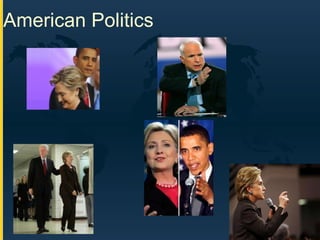
American Politics
American Business
 
Why Critical Literacy Should Become an Everyday Activity in Every Classroom P. David Pearson University of California at Berkeley For presentations and papers, go to www.scienceandliteracy.org
Levels of teaching Elementary Teachers Love Their students High School Teachers Love Their subject matter College Teachers Love Themselves!
Why Critical Literacy?  Why Now? Certainly bucking a curricular trend in Reading/Language Arts Education Sisyphean task:  rock up the hill, swimming upstream, fighting windmills We are at the height of yet another back to the basics swing.  Without a strong emphasis on comprehension, writing, and critical examination of texts, we will never get to where we (our kids, our state, our nation) need to be.
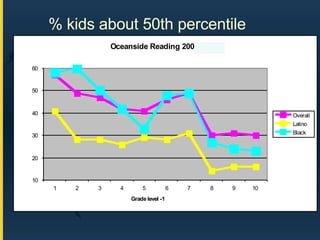
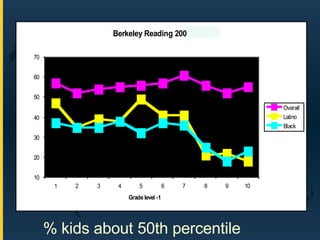
Why Critical Literacy?  Why Now? The performance data on schools demand it At every level, our achievement profiles tell a tale of early promise and later disappointment
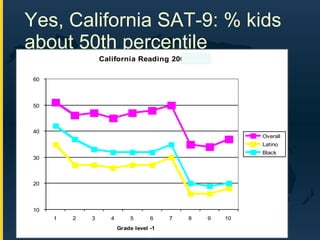
Yes, California SAT-9: % kids about 50th percentile
% kids about 50th percentile
Two ways to interpret these data Well, the reforms that are working so well at the primary grades just have not had a chance to kick in yet. Well, this is the price you pay later on for not paying as much attention to comprehension, writing, and critical analysis of texts as you should. The 7 th  grade cliff has replaced the 4 th  grade slump
Caveat We still have much to do…in the name of everyday comprehension
Three big ideas in comprehension instruction Conceptually based vocabulary instruction Ambitious strategy instruction High quality talk about text
Supportive Classroom Instruction Good word level instruction Community of learners with lots of collaborative activities Solid writing instruction  Lots of opportunity to read things you Can read Want to read Rich content area instruction
This is the message We improve comprehension when we teach reading well Implement a balanced curriculum Engage kids deeply in the reading process
The Cognitive Engagement part
Teaching for Cognitive Engagement Student support  stance (coaching, modeling, scaffolding learning) not a teacher directed stance (telling or recitation) Active  (reading, writing, doing) not passive (listening to others in turn taking situations) student response mode A clear focus on the  higher , not the lower order tasks--for ALL kids. Higher proportion of  engaged time on task
That gets us to the point where we can use reading to live our lives well Reading for  Learning  Enjoyment  Personal insight Personal advantage (job, class, opportunity) Societal responsibility  Being a competent, skeptical, critical reader Good citizenship entails a critical responsibility
What do I mean by critical literacy? Be sure to require this from anyone who talks about critical literacy.  Why? Because each of us has a slightly different take on critical literacy. This is a good, not a bad, thing. In fact, those who advocate for critical literacy would have it no other way Something inherently contradictory about an official or canonical definition of critical literacy
How does it relate to other concepts with which it might be confused? Comprehension Literary Interpretation Critical Thinking My take on the differences: Critical literacy can entail all the others, BUT its distinctive feature is that it asks the fundamental  external  and  political  questions about things, namely: Whose interests are served by the existence of this text? Critical perspectives worry about  consequences  of texts/reading and  motives  of those who create texts
Comprehension and Critical Literacy Comprehension is a necessary but certainly not a sufficient condition for critical literacy Hard to critique a message that you don’t understand: Comprehension: What is the main point of this story? Critical Literacy:  Why would an author write a story that makes that point?  What might (s)he want us to do or believe?
Critical Literacy and Literary Interpretation Lots of overlap, especially on questions about the role of the author What do we know about the author--personal background, education, philosophical grounding--that might help us explain the way he portrays women in novels?
Areas where overlap may or may not occur: Plot Who can summarize the plot? Versus Why would an author write a story with this particular plot?  What is he trying to make us think about the characters in the story? The first assumes a neutral or autonomous text, the second an “interested” text Critical Literacy and Literary Interpretation
Areas where overlap may or may not occur: Theme Let’s see if we can unpack the theme of this story Versus Stories with themes like this one--what are they supposed to make us think about the environment? How does this theme fit into the general pattern of story themes we have discovered this semester? Critical Literacy and Literary Interpretation
Alyssa getting happier Critique entails comparison
Critical Thinking and Critical Literacy This is the contrast for which there is the greatest potential confusion. Critical Thinking comes out of Liberal Humanist Tradition of Rhetoric and Argumentation:  look at assumptions and validity of argument Critical Literacy comes out of one or another of several post-modern traditions,  all of which begin with the assumption that language is inherently political, never neutral, laden with purpose, intention, and action.
Critical Thinking and Critical Literacy Critical thinking tends to look  inside  an utterance at the structure of the argument to determine flaws and fallacies Claim—>Warrant<—Evidence Critical literacy tends to look  outside , at the context in which an utterance occurs to examine how the utterance impacts and is impacted by the context and the players.
Critical Thinking and Critical Literacy Eighth graders reading a political tract: How has the author organized the basic argument in this essay? What is wrong with this argument? How good is the evidence Versus What does the way the author has organized the arguments in this essay tell you about her politics? How would a conservative politician have framed this same argument?
Let’s try an historical approach
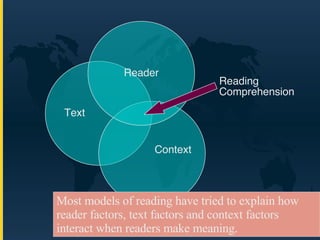
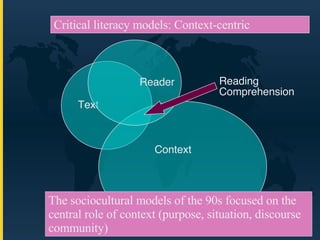
Text Reader Context Reading Comprehension Most models of reading have tried to explain how reader factors, text factors and context factors interact when readers make meaning.
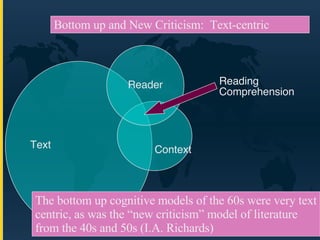
Text Reader Context Reading The bottom up cognitive models of the 60s were very text centric, as was the “new criticism” model of literature from the 40s and 50s (I.A. Richards)  Reading Comprehension Bottom up and New Criticism:  Text-centric
Since the meaning is in the text, we need to go dig it out… Leads to Questions that  Interrogate the facts of the text Get to the “right” interpretation Right there kinds of questions Writerly readings or textual readings Pedagogy for Bottom up and New Criticism:  Text-centric
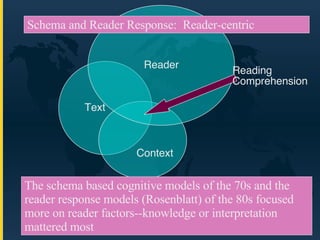
Text Reader Context The schema based cognitive models of the 70s and the reader response models (Rosenblatt) of the 80s focused more on reader factors--knowledge or interpretation mattered most Reading Comprehension Schema and Reader Response:  Reader-centric
Pedagogy for  Reader-centric Since the meaning is largely in the reader, we need to go dig it out… Spend a lot of time on Building background knowledge Inferences needed to build a coherent model of meaning Readers’ impressions, expressions, unbridled response Readerly readings
Text Reader Context Reading The sociocultural models of the 90s focused on the central role of context (purpose, situation, discourse community) Reading Comprehension Critical literacy models: Context-centric
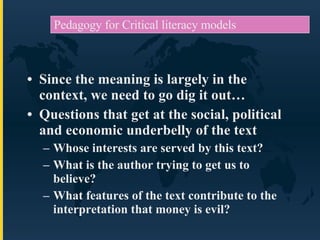
Since the meaning is largely in the context, we need to go dig it out… Questions that get at the social, political and economic underbelly of the text Whose interests are served by this text? What is the author trying to get us to believe? What features of the text contribute to the interpretation that money is evil? Pedagogy for Critical literacy models
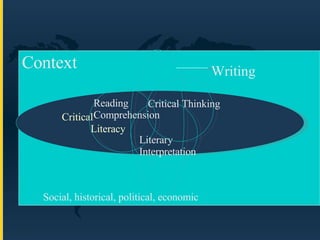
Context Critical  Literacy Social, historical, political, economic Reading  Comprehension Literary Interpretation Critical Thinking Writing
Another way to think about critical literacy Why things are the way they are? What consequences do they have? What functions (for good or ill) do different forms serve? It is all about form-function or structure-purpose relationships. What difference does it make?  Is it trying to make?
Some sure fire activities for critical literacy Questions about author intentions Why would an author write a piece like this?  What could she possibly want us to think? What is the author trying to do here? Questions about author’s craft in relation to intentions What does the author do or say to try to get us to like this character?
Chris van Allsberg
Sure fire, cont Comparing two texts on some dimensions Which version of  The Three Little Pigs  is kindest to the wolf?  Why do you suppose that author tried to get us to like the wolf? Which author uses adjectives to describe characters?  Which one uses verbs?  Which is most effective in creating a vision of characters?
Sure fire… Examining biases and assumptions What solution to the global warming problem does this author favor?  How can you tell? (Comparing two texts…) Which author is most sympathetic to the environmentalists?  To the energy producers?  How can you tell?
From Mass State Standards 10.5  Compare and contrast the presentation of a theme or topic across genres to explain how the selection of genre shapes the message.   For example, students compare and contrast three reactions to Lincoln’s death: Walt Whitman’s poem, “O Captain, My Captain,” Frederick Douglass’s eulogy, and the report in the New York Times on April 12, 1865. They make specific contrasts between the impersonal newspaper report and the personal poem and eulogy and between the two personal genres. Of all places…
Even in California… Moreover, students should become text users in that they should learn to &quot;compare and contrast the ways in which media genres (e.g., televised news, news magazines, documentaries, online information) cover the same event&quot; (Grades Nine and Ten Standard 1.2).
More in California By graduation students should be able to &quot;critique the power, validity, and truthfulness of arguments set forth in public documents; their appeal to both friendly and hostile audiences; and the extent to which the arguments anticipate and address reader concerns and counterclaims (e.g., appeal to reason, to authority, to pathos and emotion)&quot; (Grade Eleven and Twelve, Standard  Later on…the tests don’t reflect the standards…
Sure fire Encouraging kids to compare texts to their lives
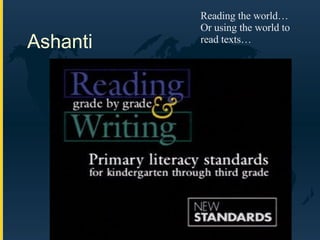
Ashanti Reading the world… Or using the world to read texts…
Even with vocabulary What words does the author use in paragraph 5 to make us feel sympathetic to Henry?  Does it work? How could you change the effect of this paragraph on the reader?  What words would you replace to make readers feel more hostile to Henry?
An example The man walked through the mall. Use words or details to  Make him malevolent… Make him beneficent…
Why is it so hard to get these elements into the curriculum? Simple view of reading RC=LC*Decoding First among equals problem:  Yes, all of that is important, but…first things first.  Once the basics are in place, we can get to these things.  (what I call the basic skills “conspiracy of good intentions”) The tests don’t reflect the standards, and when push comes to shove…
What I hope for Find a way to make all of these other curricular areas a part of the daily routines we use in classrooms. Critical literacy questions can, and should, be a part of every conversation about text. Texts do, after all, have authors, all of whom have intentions.  The sooner kids understand that, the better they can learn to judge authorial intentions and importance for themselves That is the first requirement for a free and democratic society.
To be perfectly honest… In my entire life, I cannot remember a time when I was more concerned about the gullibility of the American citizenry Criticism is suspect if not outright evidence of disloyalty We tend to believe what we read and are told Our voting patterns illustrate internal contradictions in our thinking.  We don’t even vote in our self interest
This is not a curriculum for the privileged few Helping students examine texts and authors critically is as important for a student at the 20 th  percentile as it is for a student at the 90 th  percentile We cannot contribute to a dual curriculum—one for the rich and one for the poor, one for the haves and another for the have nots Even, no especially, the least amongst us deserves this curricular opportunity
At any rate… Those of you privileged to teach reading and writing in our schools… Have a tremendous challenge before you, but also An incredible opportunity to help students demonstrate their patriotism through critique…
 
Develop the healthy skepticism for ideas, arguments, and text that makes for  Good reading, Good writing, and  Good citizens
Vivian Vasquez Barbara Comber Allan Luke and Peter Freebody


Pearson

  • 1.
    Teaching Reading Comprehension: Cognitive Engagement and Critical Literacy P. David Pearson UC Berkeley Slides at www.scienceandliteracy.org
  • 2.
  • 3.
  • 4.
  • 5.
    Why Critical LiteracyShould Become an Everyday Activity in Every Classroom P. David Pearson University of California at Berkeley For presentations and papers, go to www.scienceandliteracy.org
  • 6.
    Levels of teachingElementary Teachers Love Their students High School Teachers Love Their subject matter College Teachers Love Themselves!
  • 7.
    Why Critical Literacy? Why Now? Certainly bucking a curricular trend in Reading/Language Arts Education Sisyphean task: rock up the hill, swimming upstream, fighting windmills We are at the height of yet another back to the basics swing. Without a strong emphasis on comprehension, writing, and critical examination of texts, we will never get to where we (our kids, our state, our nation) need to be.
  • 8.
    Why Critical Literacy? Why Now? The performance data on schools demand it At every level, our achievement profiles tell a tale of early promise and later disappointment
  • 9.
    Yes, California SAT-9:% kids about 50th percentile
  • 10.
    % kids about50th percentile
  • 11.
    % kids about50th percentile
  • 12.
    Two ways tointerpret these data Well, the reforms that are working so well at the primary grades just have not had a chance to kick in yet. Well, this is the price you pay later on for not paying as much attention to comprehension, writing, and critical analysis of texts as you should. The 7 th grade cliff has replaced the 4 th grade slump
  • 13.
    Caveat We stillhave much to do…in the name of everyday comprehension
  • 14.
    Three big ideasin comprehension instruction Conceptually based vocabulary instruction Ambitious strategy instruction High quality talk about text
  • 15.
    Supportive Classroom InstructionGood word level instruction Community of learners with lots of collaborative activities Solid writing instruction Lots of opportunity to read things you Can read Want to read Rich content area instruction
  • 16.
    This is themessage We improve comprehension when we teach reading well Implement a balanced curriculum Engage kids deeply in the reading process
  • 17.
  • 18.
    Teaching for CognitiveEngagement Student support stance (coaching, modeling, scaffolding learning) not a teacher directed stance (telling or recitation) Active (reading, writing, doing) not passive (listening to others in turn taking situations) student response mode A clear focus on the higher , not the lower order tasks--for ALL kids. Higher proportion of engaged time on task
  • 19.
    That gets usto the point where we can use reading to live our lives well Reading for Learning Enjoyment Personal insight Personal advantage (job, class, opportunity) Societal responsibility Being a competent, skeptical, critical reader Good citizenship entails a critical responsibility
  • 20.
    What do Imean by critical literacy? Be sure to require this from anyone who talks about critical literacy. Why? Because each of us has a slightly different take on critical literacy. This is a good, not a bad, thing. In fact, those who advocate for critical literacy would have it no other way Something inherently contradictory about an official or canonical definition of critical literacy
  • 21.
    How does itrelate to other concepts with which it might be confused? Comprehension Literary Interpretation Critical Thinking My take on the differences: Critical literacy can entail all the others, BUT its distinctive feature is that it asks the fundamental external and political questions about things, namely: Whose interests are served by the existence of this text? Critical perspectives worry about consequences of texts/reading and motives of those who create texts
  • 22.
    Comprehension and CriticalLiteracy Comprehension is a necessary but certainly not a sufficient condition for critical literacy Hard to critique a message that you don’t understand: Comprehension: What is the main point of this story? Critical Literacy: Why would an author write a story that makes that point? What might (s)he want us to do or believe?
  • 23.
    Critical Literacy andLiterary Interpretation Lots of overlap, especially on questions about the role of the author What do we know about the author--personal background, education, philosophical grounding--that might help us explain the way he portrays women in novels?
  • 24.
    Areas where overlapmay or may not occur: Plot Who can summarize the plot? Versus Why would an author write a story with this particular plot? What is he trying to make us think about the characters in the story? The first assumes a neutral or autonomous text, the second an “interested” text Critical Literacy and Literary Interpretation
  • 25.
    Areas where overlapmay or may not occur: Theme Let’s see if we can unpack the theme of this story Versus Stories with themes like this one--what are they supposed to make us think about the environment? How does this theme fit into the general pattern of story themes we have discovered this semester? Critical Literacy and Literary Interpretation
  • 26.
    Alyssa getting happierCritique entails comparison
  • 27.
    Critical Thinking andCritical Literacy This is the contrast for which there is the greatest potential confusion. Critical Thinking comes out of Liberal Humanist Tradition of Rhetoric and Argumentation: look at assumptions and validity of argument Critical Literacy comes out of one or another of several post-modern traditions, all of which begin with the assumption that language is inherently political, never neutral, laden with purpose, intention, and action.
  • 28.
    Critical Thinking andCritical Literacy Critical thinking tends to look inside an utterance at the structure of the argument to determine flaws and fallacies Claim—>Warrant<—Evidence Critical literacy tends to look outside , at the context in which an utterance occurs to examine how the utterance impacts and is impacted by the context and the players.
  • 29.
    Critical Thinking andCritical Literacy Eighth graders reading a political tract: How has the author organized the basic argument in this essay? What is wrong with this argument? How good is the evidence Versus What does the way the author has organized the arguments in this essay tell you about her politics? How would a conservative politician have framed this same argument?
  • 30.
    Let’s try anhistorical approach
  • 31.
    Text Reader ContextReading Comprehension Most models of reading have tried to explain how reader factors, text factors and context factors interact when readers make meaning.
  • 32.
    Text Reader ContextReading The bottom up cognitive models of the 60s were very text centric, as was the “new criticism” model of literature from the 40s and 50s (I.A. Richards) Reading Comprehension Bottom up and New Criticism: Text-centric
  • 33.
    Since the meaningis in the text, we need to go dig it out… Leads to Questions that Interrogate the facts of the text Get to the “right” interpretation Right there kinds of questions Writerly readings or textual readings Pedagogy for Bottom up and New Criticism: Text-centric
  • 34.
    Text Reader ContextThe schema based cognitive models of the 70s and the reader response models (Rosenblatt) of the 80s focused more on reader factors--knowledge or interpretation mattered most Reading Comprehension Schema and Reader Response: Reader-centric
  • 35.
    Pedagogy for Reader-centric Since the meaning is largely in the reader, we need to go dig it out… Spend a lot of time on Building background knowledge Inferences needed to build a coherent model of meaning Readers’ impressions, expressions, unbridled response Readerly readings
  • 36.
    Text Reader ContextReading The sociocultural models of the 90s focused on the central role of context (purpose, situation, discourse community) Reading Comprehension Critical literacy models: Context-centric
  • 37.
    Since the meaningis largely in the context, we need to go dig it out… Questions that get at the social, political and economic underbelly of the text Whose interests are served by this text? What is the author trying to get us to believe? What features of the text contribute to the interpretation that money is evil? Pedagogy for Critical literacy models
  • 38.
    Context Critical Literacy Social, historical, political, economic Reading Comprehension Literary Interpretation Critical Thinking Writing
  • 39.
    Another way tothink about critical literacy Why things are the way they are? What consequences do they have? What functions (for good or ill) do different forms serve? It is all about form-function or structure-purpose relationships. What difference does it make? Is it trying to make?
  • 40.
    Some sure fireactivities for critical literacy Questions about author intentions Why would an author write a piece like this? What could she possibly want us to think? What is the author trying to do here? Questions about author’s craft in relation to intentions What does the author do or say to try to get us to like this character?
  • 41.
  • 42.
    Sure fire, contComparing two texts on some dimensions Which version of The Three Little Pigs is kindest to the wolf? Why do you suppose that author tried to get us to like the wolf? Which author uses adjectives to describe characters? Which one uses verbs? Which is most effective in creating a vision of characters?
  • 43.
    Sure fire… Examiningbiases and assumptions What solution to the global warming problem does this author favor? How can you tell? (Comparing two texts…) Which author is most sympathetic to the environmentalists? To the energy producers? How can you tell?
  • 44.
    From Mass StateStandards 10.5 Compare and contrast the presentation of a theme or topic across genres to explain how the selection of genre shapes the message. For example, students compare and contrast three reactions to Lincoln’s death: Walt Whitman’s poem, “O Captain, My Captain,” Frederick Douglass’s eulogy, and the report in the New York Times on April 12, 1865. They make specific contrasts between the impersonal newspaper report and the personal poem and eulogy and between the two personal genres. Of all places…
  • 45.
    Even in California…Moreover, students should become text users in that they should learn to &quot;compare and contrast the ways in which media genres (e.g., televised news, news magazines, documentaries, online information) cover the same event&quot; (Grades Nine and Ten Standard 1.2).
  • 46.
    More in CaliforniaBy graduation students should be able to &quot;critique the power, validity, and truthfulness of arguments set forth in public documents; their appeal to both friendly and hostile audiences; and the extent to which the arguments anticipate and address reader concerns and counterclaims (e.g., appeal to reason, to authority, to pathos and emotion)&quot; (Grade Eleven and Twelve, Standard Later on…the tests don’t reflect the standards…
  • 47.
    Sure fire Encouragingkids to compare texts to their lives
  • 48.
    Ashanti Reading theworld… Or using the world to read texts…
  • 49.
    Even with vocabularyWhat words does the author use in paragraph 5 to make us feel sympathetic to Henry? Does it work? How could you change the effect of this paragraph on the reader? What words would you replace to make readers feel more hostile to Henry?
  • 50.
    An example Theman walked through the mall. Use words or details to Make him malevolent… Make him beneficent…
  • 51.
    Why is itso hard to get these elements into the curriculum? Simple view of reading RC=LC*Decoding First among equals problem: Yes, all of that is important, but…first things first. Once the basics are in place, we can get to these things. (what I call the basic skills “conspiracy of good intentions”) The tests don’t reflect the standards, and when push comes to shove…
  • 52.
    What I hopefor Find a way to make all of these other curricular areas a part of the daily routines we use in classrooms. Critical literacy questions can, and should, be a part of every conversation about text. Texts do, after all, have authors, all of whom have intentions. The sooner kids understand that, the better they can learn to judge authorial intentions and importance for themselves That is the first requirement for a free and democratic society.
  • 53.
    To be perfectlyhonest… In my entire life, I cannot remember a time when I was more concerned about the gullibility of the American citizenry Criticism is suspect if not outright evidence of disloyalty We tend to believe what we read and are told Our voting patterns illustrate internal contradictions in our thinking. We don’t even vote in our self interest
  • 54.
    This is nota curriculum for the privileged few Helping students examine texts and authors critically is as important for a student at the 20 th percentile as it is for a student at the 90 th percentile We cannot contribute to a dual curriculum—one for the rich and one for the poor, one for the haves and another for the have nots Even, no especially, the least amongst us deserves this curricular opportunity
  • 55.
    At any rate…Those of you privileged to teach reading and writing in our schools… Have a tremendous challenge before you, but also An incredible opportunity to help students demonstrate their patriotism through critique…
  • 56.
  • 57.
    Develop the healthyskepticism for ideas, arguments, and text that makes for Good reading, Good writing, and Good citizens
  • 58.
    Vivian Vasquez BarbaraComber Allan Luke and Peter Freebody
  • 59.
  • 60.

Editor's Notes

  • #2 I have been following American politics for the past several months, and I have concluded that we have a problem in this country that is equally as serious as, if not more serious than, our comprehension problem. We have an engagement problem critical reading and critical thinking problem.