Collective Action to Promote Non-Violent and
Protective Society for Children
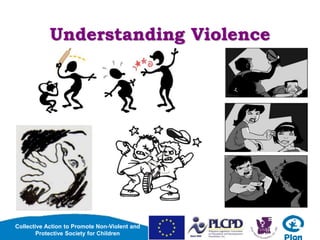
Understanding Violence
Collective Action to Promote Non-Violent and
Protective Society for Children
What is Violence?
 It is generally defined as an act committed with
the deliberate or perceived intention of hurting
another person
 An act or state whereby pain, fear or
degradation is inflicted on a person by another
 Action/state of omission/commission
 Feelings: hurt, pained, low/down, afraid,
shamed, terrified, anger.
Collective Action to Promote Non-Violent and
Protective Society for Children
Different forms of abuse/violence:
 Physical
 Verbal
 Emotional/Psychological
 Sexual (incestuous, marital rape)
 Economic
Collective Action to Promote Non-Violent and
Protective Society for Children
Perpetrators of violence/abuse
 Person to person
 Group to group
 Person to group
 Group to person
 State to person/group
 Person to environment
Collective Action to Promote Non-Violent and
Protective Society for Children
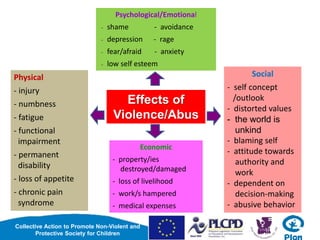
Effects of
Violence/Abus
e
Psychological/Emotional
- shame - avoidance
- depression - rage
- fear/afraid - anxiety
- low self esteem
Economic
- property/ies
destroyed/damaged
- loss of livelihood
- work/s hampered
- medical expenses
Physical
- injury
- numbness
- fatigue
- functional
impairment
- permanent
disability
- loss of appetite
- chronic pain
syndrome
Social
- self concept
/outlook
- distorted values
- the world is
unkind
- blaming self
- attitude towards
authority and
work
- dependent on
decision-making
- abusive behavior
Collective Action to Promote Non-Violent and
Protective Society for Children
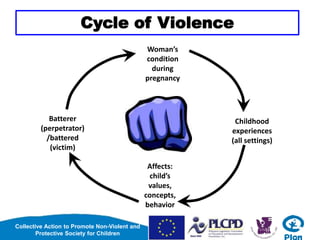
Cycle of Violence
Woman’s
condition
during
pregnancy
Childhood
experiences
(all settings)
Affects:
child’s
values,
concepts,
behavior
Batterer
(perpetrator)
/battered
(victim)
Collective Action to Promote Non-Violent and
Protective Society for Children
Inter-generational transmission of patterns of violence
 Patterns of violence are perpetuated from one generation to
the next through role modeling and social learning (cultural)
– it is not and never be transmitted through gens.
 Children learn the distorted view that violence is a way to
resolve conflict and a natural part of intimate relationships.
 Exposure to violence in early stage of childhood is “a
significant factor in the development of violent behavior,
and it is associated with other problems in childhood and in
later life.” (World Report on Violence and Health 2002)
 Women who grew up in violent homes are 50% more likely
to expect or accept violence in their own relationship.
Collective Action to Promote Non-Violent and
Protective Society for Children
End the cycle of violence.
Practice non-violent approach
in child discipline

Understanding Violence

  • 1.
    Collective Action toPromote Non-Violent and Protective Society for Children Understanding Violence
  • 2.
    Collective Action toPromote Non-Violent and Protective Society for Children What is Violence?  It is generally defined as an act committed with the deliberate or perceived intention of hurting another person  An act or state whereby pain, fear or degradation is inflicted on a person by another  Action/state of omission/commission  Feelings: hurt, pained, low/down, afraid, shamed, terrified, anger.
  • 3.
    Collective Action toPromote Non-Violent and Protective Society for Children Different forms of abuse/violence:  Physical  Verbal  Emotional/Psychological  Sexual (incestuous, marital rape)  Economic
  • 4.
    Collective Action toPromote Non-Violent and Protective Society for Children Perpetrators of violence/abuse  Person to person  Group to group  Person to group  Group to person  State to person/group  Person to environment
  • 5.
    Collective Action toPromote Non-Violent and Protective Society for Children Effects of Violence/Abus e Psychological/Emotional - shame - avoidance - depression - rage - fear/afraid - anxiety - low self esteem Economic - property/ies destroyed/damaged - loss of livelihood - work/s hampered - medical expenses Physical - injury - numbness - fatigue - functional impairment - permanent disability - loss of appetite - chronic pain syndrome Social - self concept /outlook - distorted values - the world is unkind - blaming self - attitude towards authority and work - dependent on decision-making - abusive behavior
  • 6.
    Collective Action toPromote Non-Violent and Protective Society for Children Cycle of Violence Woman’s condition during pregnancy Childhood experiences (all settings) Affects: child’s values, concepts, behavior Batterer (perpetrator) /battered (victim)
  • 7.
    Collective Action toPromote Non-Violent and Protective Society for Children Inter-generational transmission of patterns of violence  Patterns of violence are perpetuated from one generation to the next through role modeling and social learning (cultural) – it is not and never be transmitted through gens.  Children learn the distorted view that violence is a way to resolve conflict and a natural part of intimate relationships.  Exposure to violence in early stage of childhood is “a significant factor in the development of violent behavior, and it is associated with other problems in childhood and in later life.” (World Report on Violence and Health 2002)  Women who grew up in violent homes are 50% more likely to expect or accept violence in their own relationship.
  • 8.
    Collective Action toPromote Non-Violent and Protective Society for Children End the cycle of violence. Practice non-violent approach in child discipline