+
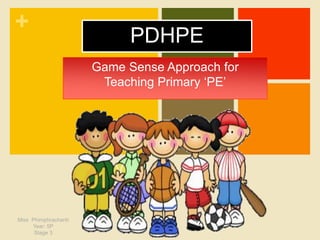
PDHPE
Game Sense Approach for
Teaching Primary ‘PE’
Miss Phimphrachanh
Year: 5P
Stage 3
+ What is Game Sense?
Miss Phimphrachanh
Year: 5P
Stage 3
Come and join 5P to
discover more about
‘Game Sense’ and
see how it is
implemented in our
PE lessons
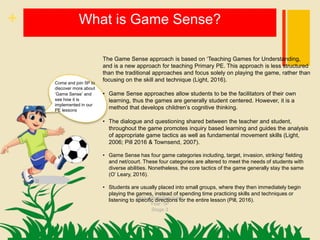
The Game Sense approach is based on ‘Teaching Games for Understanding,
and is a new approach for teaching Primary PE. This approach is less structured
than the traditional approaches and focus solely on playing the game, rather than
focusing on the skill and technique (Light, 2016).
• Game Sense approaches allow students to be the facilitators of their own
learning, thus the games are generally student centered. However, it is a
method that develops children’s cognitive thinking.
• The dialogue and questioning shared between the teacher and student,
throughout the game promotes inquiry based learning and guides the analysis
of appropriate game tactics as well as fundamental movement skills (Light,
2006; Pill 2016 & Townsend, 2007).
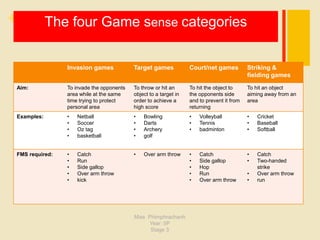
• Game Sense has four game categories including, target, invasion, striking/ fielding
and net/court. These four categories are altered to meet the needs of students with
diverse abilities. Nonetheless, the core tactics of the game generally stay the same
(O’ Leary, 2016).
• Students are usually placed into small groups, where they then immediately begin
playing the games, instead of spending time practicing skills and techniques or
listening to specific directions for the entire lesson (Pill, 2016).
+ The four Game sense categories
Miss Phimphrachanh
Year: 5P
Stage 3
Invasion games Target games Court/net games Striking &
fielding games
Aim: To invade the opponents
area while at the same
time trying to protect
personal area
To throw or hit an
object to a target in
order to achieve a
high score
To hit the object to
the opponents side
and to prevent it from
returning
To hit an object
aiming away from an
area
Examples: • Netball
• Soccer
• Oz tag
• basketball
• Bowling
• Darts
• Archery
• golf
• Volleyball
• Tennis
• badminton
• Cricket
• Baseball
• Softball
FMS required: • Catch
• Run
• Side gallop
• Over arm throw
• kick
• Over arm throw • Catch
• Side gallop
• Hop
• Run
• Over arm throw
• Catch
• Two-handed
strike
• Over arm throw
• run
+
Why ‘Game Sense?’
 The Game Sense approach should be implemented into PDHPE lessons in primary schools, as it
provides students with the opportunity to learn different skills and techniques in modified games. This
builds on prior knowledge and skills, in order to eventually play a full game.
 Pill (2016) states that by using a Game Sense approach in PDHPE lessons, students are able to
enjoy themselves more than being in a traditional classroom approach. They allow for the movement
skills to be taught in a natural and authentic way of learning, which further improves the interpersonal
relationships between students.
 Game sense allows teachers to take a traditional game and modify it using a conventional concept.
This also helps students adapt to new rules and come up with different game tactics, to align with the
altered fragments. For example, changing the size of the balls.
 It teaches students the key principles of a game before allowing students to play the game. This
encourages student participation, as they enter the game with a better understanding as well as
having the required skills. For example, introducing students to a simple game of tag and then
changing the game environment to challenge their cognitive responses. This enhances their
intellectual, physical and social learning (Breed & Spittle, 2011).
Miss Phimphrachanh
Year: 5P
Stage 3
+ Fundamental Movement Skills
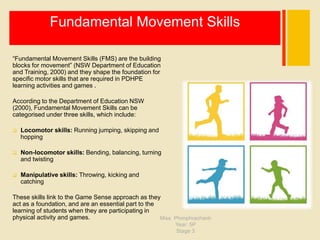
“Fundamental Movement Skills (FMS) are the building
blocks for movement” (NSW Department of Education
and Training, 2000) and they shape the foundation for
specific motor skills that are required in PDHPE
learning activities and games .
According to the Department of Education NSW
(2000), Fundamental Movement Skills can be
categorised under three skills, which include:
 Locomotor skills: Running jumping, skipping and
hopping
 Non-locomotor skills: Bending, balancing, turning
and twisting
 Manipulative skills: Throwing, kicking and
catching
These skills link to the Game Sense approach as they
act as a foundation, and are an essential part to the
learning of students when they are participating in
physical activity and games. Miss Phimphrachanh
Year: 5P
Stage 3
+ Game Sense- Strengths/ Rationale
Using Game Sense as an approach to teaching PE in Primary schools is beneficial as it develops
students skills and encourages positive attitudes towards physical education. Some of the strengths that
Game Sense provides includes:
 Game sense illustrates the objectives and skills of a game in order to increase student participation,
motivation and appreciation for the activity.
 It encourages student engagement as it uses a student-centered approach, when focusing on skill
development. This allows students to be the facilitators of their own learning (Light, 2006).
 It caters for students who are diverse learners and have different capabilities, as the games can be
modified to suit the appropriate skill level of these students. This will therefore, maximise student
participation.
 Game Sense approach promotes ‘Inquiry Based learning’. Students are able to engage in their
learning whilst also enjoying themselves through the interaction of games. Through this, they are able
to build on their team working skills, spatial awareness and a range of body movement skills.
Miss Phimphrachanh
Year: 5P
Stage 3
Game Sense Promotes:
• An enjoyable learning environment
• Communication
• Thinking skills
• Inclusive learning
• Challenges
+Game Sense –Strengths/ Syllabus Links
The Game Sense approach is highly supported by the K-6 NSW PDHPE Syllabus (NESA, 2018).
 The PDHPE Syllabus highlights the importance of fundamental movement skills through a Game Sense approach,
as it provides opportunities for these skills to be developed and enhanced when students are participating in
physical activity.
 A key focus in the PDHPE syllabus is building positive, interpersonal relationships amongst students. This is
conveyed through Game Sense, as students foster these positive relationships through the way in which they
interact with one another when participating in these games and other activities.
 The Game Sense approach links with the PDHPE syllabus as it states that Stage 3 students are “required to
communicate and cooperate together to make a decision and achieve a goal” when participating in a variety of
games and physical activity.
Miss Phimphrachanh
Year: 5P
Stage 3
Stage 3 teaching outcomes include: (NESA, 2018)
GSS3.8. Applies movement skills in games and sports that require communication,
cooperation, decision making and observation of rules.
COS3.3-Communicating, DMS3.2- Decision Making, INS3.3- Interacting, MOS3.4-
Moving & PSS3.5- Problem Solving
+
References
 Breed, R. & Spittle, M. (2011). Developing game sense through tactical learning. Victoria: Cambridge University
Press.
 Light, R. (2006). Game Sense: Innovation or just good coaching? Journal of Physical Education New Zealand, 39 (1), pp.
8-19
 NSW Department of Education and Training. (2000). Get skilled: Get active. Retrieved from
https://www.healthykids.nsw.gov.au/downloads/file/teacherschildcare/Get_skilled_get_active_booklet.pdf
 NSW Education Standards Authority. (2018). Personal Development, Health and Physical Education K-6 Syllabus.
Sydney : NESA
 O’Leary, N. (2016). Learning informally to use the ‘full version’ of teaching games of understanding. European Physical
Education Review , 22 (1), 3-22. doi: 10.1177/1356336XI5586177
 Pill, S. (2016). An appreciative inquiry exploring game sense teaching in physical education. Sport. Education and
Society, 21(2). 279-297. doi: 10.1080/13573322.2014.912624
 Townsend, G. (2007). Game Sense. RFU Technical Journal. Retrieved from:
http://www.agard.rugby.hu/letolt/EDZOI/070417ErezdAJatekot.pdf
Miss Phimphrachanh
Year: 5P
Stage 3

PDHPE

  • 1.
    + PDHPE Game Sense Approachfor Teaching Primary ‘PE’ Miss Phimphrachanh Year: 5P Stage 3
  • 2.
    + What isGame Sense? Miss Phimphrachanh Year: 5P Stage 3 Come and join 5P to discover more about ‘Game Sense’ and see how it is implemented in our PE lessons The Game Sense approach is based on ‘Teaching Games for Understanding, and is a new approach for teaching Primary PE. This approach is less structured than the traditional approaches and focus solely on playing the game, rather than focusing on the skill and technique (Light, 2016). • Game Sense approaches allow students to be the facilitators of their own learning, thus the games are generally student centered. However, it is a method that develops children’s cognitive thinking. • The dialogue and questioning shared between the teacher and student, throughout the game promotes inquiry based learning and guides the analysis of appropriate game tactics as well as fundamental movement skills (Light, 2006; Pill 2016 & Townsend, 2007). • Game Sense has four game categories including, target, invasion, striking/ fielding and net/court. These four categories are altered to meet the needs of students with diverse abilities. Nonetheless, the core tactics of the game generally stay the same (O’ Leary, 2016). • Students are usually placed into small groups, where they then immediately begin playing the games, instead of spending time practicing skills and techniques or listening to specific directions for the entire lesson (Pill, 2016).
  • 3.
    + The fourGame sense categories Miss Phimphrachanh Year: 5P Stage 3 Invasion games Target games Court/net games Striking & fielding games Aim: To invade the opponents area while at the same time trying to protect personal area To throw or hit an object to a target in order to achieve a high score To hit the object to the opponents side and to prevent it from returning To hit an object aiming away from an area Examples: • Netball • Soccer • Oz tag • basketball • Bowling • Darts • Archery • golf • Volleyball • Tennis • badminton • Cricket • Baseball • Softball FMS required: • Catch • Run • Side gallop • Over arm throw • kick • Over arm throw • Catch • Side gallop • Hop • Run • Over arm throw • Catch • Two-handed strike • Over arm throw • run
  • 4.
    + Why ‘Game Sense?’ The Game Sense approach should be implemented into PDHPE lessons in primary schools, as it provides students with the opportunity to learn different skills and techniques in modified games. This builds on prior knowledge and skills, in order to eventually play a full game.  Pill (2016) states that by using a Game Sense approach in PDHPE lessons, students are able to enjoy themselves more than being in a traditional classroom approach. They allow for the movement skills to be taught in a natural and authentic way of learning, which further improves the interpersonal relationships between students.  Game sense allows teachers to take a traditional game and modify it using a conventional concept. This also helps students adapt to new rules and come up with different game tactics, to align with the altered fragments. For example, changing the size of the balls.  It teaches students the key principles of a game before allowing students to play the game. This encourages student participation, as they enter the game with a better understanding as well as having the required skills. For example, introducing students to a simple game of tag and then changing the game environment to challenge their cognitive responses. This enhances their intellectual, physical and social learning (Breed & Spittle, 2011). Miss Phimphrachanh Year: 5P Stage 3
  • 5.
    + Fundamental MovementSkills “Fundamental Movement Skills (FMS) are the building blocks for movement” (NSW Department of Education and Training, 2000) and they shape the foundation for specific motor skills that are required in PDHPE learning activities and games . According to the Department of Education NSW (2000), Fundamental Movement Skills can be categorised under three skills, which include:  Locomotor skills: Running jumping, skipping and hopping  Non-locomotor skills: Bending, balancing, turning and twisting  Manipulative skills: Throwing, kicking and catching These skills link to the Game Sense approach as they act as a foundation, and are an essential part to the learning of students when they are participating in physical activity and games. Miss Phimphrachanh Year: 5P Stage 3
  • 6.
    + Game Sense-Strengths/ Rationale Using Game Sense as an approach to teaching PE in Primary schools is beneficial as it develops students skills and encourages positive attitudes towards physical education. Some of the strengths that Game Sense provides includes:  Game sense illustrates the objectives and skills of a game in order to increase student participation, motivation and appreciation for the activity.  It encourages student engagement as it uses a student-centered approach, when focusing on skill development. This allows students to be the facilitators of their own learning (Light, 2006).  It caters for students who are diverse learners and have different capabilities, as the games can be modified to suit the appropriate skill level of these students. This will therefore, maximise student participation.  Game Sense approach promotes ‘Inquiry Based learning’. Students are able to engage in their learning whilst also enjoying themselves through the interaction of games. Through this, they are able to build on their team working skills, spatial awareness and a range of body movement skills. Miss Phimphrachanh Year: 5P Stage 3 Game Sense Promotes: • An enjoyable learning environment • Communication • Thinking skills • Inclusive learning • Challenges
  • 7.
    +Game Sense –Strengths/Syllabus Links The Game Sense approach is highly supported by the K-6 NSW PDHPE Syllabus (NESA, 2018).  The PDHPE Syllabus highlights the importance of fundamental movement skills through a Game Sense approach, as it provides opportunities for these skills to be developed and enhanced when students are participating in physical activity.  A key focus in the PDHPE syllabus is building positive, interpersonal relationships amongst students. This is conveyed through Game Sense, as students foster these positive relationships through the way in which they interact with one another when participating in these games and other activities.  The Game Sense approach links with the PDHPE syllabus as it states that Stage 3 students are “required to communicate and cooperate together to make a decision and achieve a goal” when participating in a variety of games and physical activity. Miss Phimphrachanh Year: 5P Stage 3 Stage 3 teaching outcomes include: (NESA, 2018) GSS3.8. Applies movement skills in games and sports that require communication, cooperation, decision making and observation of rules. COS3.3-Communicating, DMS3.2- Decision Making, INS3.3- Interacting, MOS3.4- Moving & PSS3.5- Problem Solving
  • 8.
    + References  Breed, R.& Spittle, M. (2011). Developing game sense through tactical learning. Victoria: Cambridge University Press.  Light, R. (2006). Game Sense: Innovation or just good coaching? Journal of Physical Education New Zealand, 39 (1), pp. 8-19  NSW Department of Education and Training. (2000). Get skilled: Get active. Retrieved from https://www.healthykids.nsw.gov.au/downloads/file/teacherschildcare/Get_skilled_get_active_booklet.pdf  NSW Education Standards Authority. (2018). Personal Development, Health and Physical Education K-6 Syllabus. Sydney : NESA  O’Leary, N. (2016). Learning informally to use the ‘full version’ of teaching games of understanding. European Physical Education Review , 22 (1), 3-22. doi: 10.1177/1356336XI5586177  Pill, S. (2016). An appreciative inquiry exploring game sense teaching in physical education. Sport. Education and Society, 21(2). 279-297. doi: 10.1080/13573322.2014.912624  Townsend, G. (2007). Game Sense. RFU Technical Journal. Retrieved from: http://www.agard.rugby.hu/letolt/EDZOI/070417ErezdAJatekot.pdf Miss Phimphrachanh Year: 5P Stage 3