Miss. Gatt
Year 6G
What is Game Sense?
Game Sense is a teaching approach that is based on Light’s
(2006) the ‘Teaching Games for Understanding Model’ (model
can be found on next slide)
It entails an individuals ability in developing sport and their
physical ability skills through game and student centred
activities and games which are designed to improve the
decision making, thinking and problem-solving skills and
physical performance of an individual whilst in an interactive
environment (Mandigo, Butler & Hopper, 2007).
It focuses on four game categories:
Invasion
Basketball
Football
Soccer
Hockey
Net/Wall
Tennis
Volleyball
Handball
Squash
Target
Archery
Bowling
Golf
Darts
Strike/Field
Baseball
Cricket
Softball
T-ball
Why Game Sense? Continued…
Game Sense is inquiry-based and allows students to think,
communicate and perform about the tactics and techniques of
certain skills and games that are modified rather than being
taught in a direct, authoritarian manner. Students are able to
“develop their own skills and understandings while being
actively involved in a game” (Curry, 2011).
The four main features of a game sense approach are that
according to Light (2014) providing an appropriate (physical)
learning environment, using questions to stimulate dialogue,
interaction and reflection, collaboration to formulate test and
evaluate solutions to problems, providing a supportive socio-
moral environment (pp.4).
There is a dire need for Game Sense as students need to be
learning from a high quality pedagogy that highlights the
possibilities for learning through movement (Curry, 2011).
Through teaching using a Game Sense approach, students
will be receiving the highest quality learning experiences that
will potentially allow them towards being optimally engaged in
PDHPE, motivate them to love sport and health and also have
it be a truly valuable education experience.
Realistic Approach to Game Sense
Below is a URL embedded that
displays a PDHPE primary teacher
explaining to his class what Game
Sense is and how it can be taught.
https://www.youtube.com/watch?v=XBgu5
jhPTsg
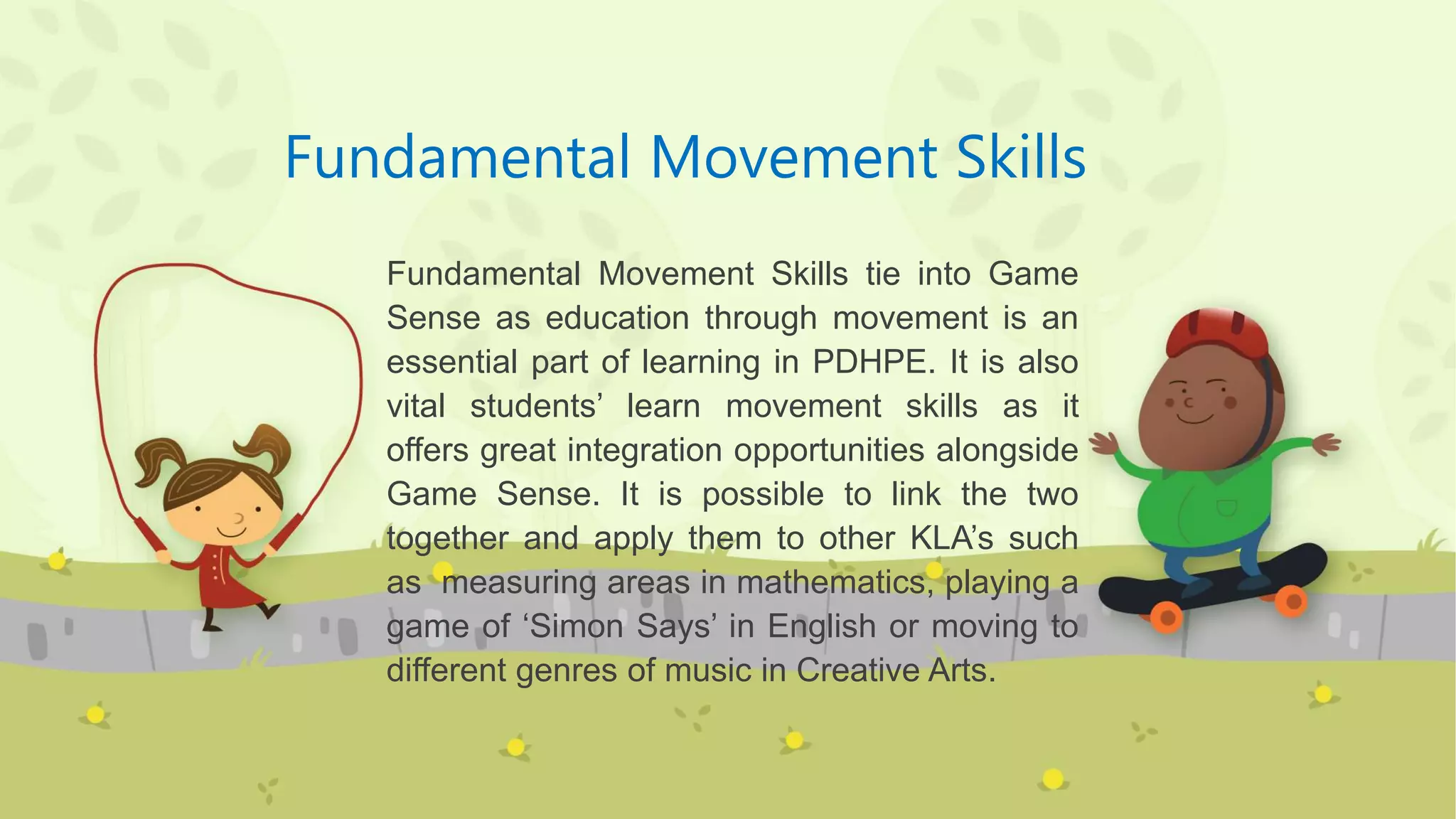
Fundamental Movement Skills
Fundamental Movement Skills tie into Game
Sense as education through movement is an
essential part of learning in PDHPE. It is also
vital students’ learn movement skills as it
offers great integration opportunities alongside
Game Sense. It is possible to link the two
together and apply them to other KLA’s such
as measuring areas in mathematics, playing a
game of ‘Simon Says’ in English or moving to
different genres of music in Creative Arts.
Rationale
Game Sense has many strengths and benefits that link
to guiding students to develop their own abilities to
express themselves (COES1.1) interact with peers
(INS3.3) and help them to consider and select
appropriate alternatives when resolving conflicts or
problems (PSS3.5).
Game Sense also caters to all students of all abilities,
ages, sizes and interests.
It also offers teachers and coaches more flexibility with
the option to modify games based on the needs of all
students. Games sense offers valuable ways of
developing enhancing students skills whilst making
sport more enjoyable, increasing participation and
contributing to the development of responsible and
active futures for themselves (Light, 2013).
Students learn a game best by physically playing it.
Discussion
As a future teacher that will teach PDHPE I will have to
know my students and how they learn which aligns with
the AITSL Standards (2016) of 1.1, 1.2 and 1.4.
My aim is to create a warm, opening, trusting, inclusive,
and positive environment for my students and to
promote health, fitness and nutrition through safe and
positive practices.
Furthermore, as a teacher I will use Game Sense in all
of my PDHPE pedagogies and games and will
incorporate the syllabus in my teachings.
I will also use Game Sense to enable my students to
comprehensively understand the game in its entirety, to
be more engaging, fun and for my students to be able
to develop confidence, appreciation of the game and be
more actively involved learners, regardless of their skill,
ability or developmental level.
Outcomes Achieved from
Game Sense
Interacting INS3.3–
 Makes informed decisions and accepts
responsibility for consequences.
Communicating COS3.3 –
 Communicates confidently in a variety of
situations.
Games and Sports GSS3.8-
 Applies movement skills in games and sports
that require communication, cooperation,
decision making and observation of rules.
- BOS, 2007
Reference List
Australian Institute of Teaching and School Leadership. (2016). Australian Professional
Standards for Teachers. Retrieved 1 October, 2016, from:
http://www.aitsl.edu.au/australian-professional-standards-for-teachers/standards/list
Board of Studies, NSW. (2007). Personal development, health and physical education K-6:
Syllabus. Sydney, Australia: Author.
Bunker, B., & Thorpe, R. (1986). The curriculum model. In R. Thorpe, Bunker, D., & Almond, L
(Ed.), Rethinking games teaching. Loughborough: University of Technology,
Loughborough, 7-10.
Curry, C. (2011). Using the game sense approach to deliver quality teaching in physical
education. University of Western Sydney. Retrieved from
http://learning21c.wordpress.com/2011/11/27/using-the-game-sense-approach- to-
deliver-quality-teaching-in-physical-education/
Game Sense - Video One – Explanation [Video file]. Retrieved from
https://www.youtube.com/watch?v=XBgu5jhPTsg (4.10.16)
Horne, N. (2012). Physical Education With Purpose. iPhys-Ed.com. Retrieved 28 September
2016, from http://www.iphys-ed.com/
Light, R. (2013). Game sense for physical education and sport coaching. In Game sense:
Pedagogy for performance, participation and enjoyment. London, UK:
Routledge, 37-47.
Light, R. (2006). Game Sense: Innovation or just good coaching? Journal of Physical
Education New Zealand, 39 (1), 8-19.
Mandigo, J., Buttler, J., & Hopper, T. (2007). What is Teaching Games for Understanding? A
Canadian perspective. Physical and Health Education, 73(2), 14-20.

Game Sense PP

  • 1.
  • 2.
    What is GameSense? Game Sense is a teaching approach that is based on Light’s (2006) the ‘Teaching Games for Understanding Model’ (model can be found on next slide) It entails an individuals ability in developing sport and their physical ability skills through game and student centred activities and games which are designed to improve the decision making, thinking and problem-solving skills and physical performance of an individual whilst in an interactive environment (Mandigo, Butler & Hopper, 2007). It focuses on four game categories: Invasion Basketball Football Soccer Hockey Net/Wall Tennis Volleyball Handball Squash Target Archery Bowling Golf Darts Strike/Field Baseball Cricket Softball T-ball
  • 4.
    Why Game Sense?Continued… Game Sense is inquiry-based and allows students to think, communicate and perform about the tactics and techniques of certain skills and games that are modified rather than being taught in a direct, authoritarian manner. Students are able to “develop their own skills and understandings while being actively involved in a game” (Curry, 2011). The four main features of a game sense approach are that according to Light (2014) providing an appropriate (physical) learning environment, using questions to stimulate dialogue, interaction and reflection, collaboration to formulate test and evaluate solutions to problems, providing a supportive socio- moral environment (pp.4). There is a dire need for Game Sense as students need to be learning from a high quality pedagogy that highlights the possibilities for learning through movement (Curry, 2011). Through teaching using a Game Sense approach, students will be receiving the highest quality learning experiences that will potentially allow them towards being optimally engaged in PDHPE, motivate them to love sport and health and also have it be a truly valuable education experience.
  • 5.
    Realistic Approach toGame Sense Below is a URL embedded that displays a PDHPE primary teacher explaining to his class what Game Sense is and how it can be taught. https://www.youtube.com/watch?v=XBgu5 jhPTsg
  • 6.
    Fundamental Movement Skills FundamentalMovement Skills tie into Game Sense as education through movement is an essential part of learning in PDHPE. It is also vital students’ learn movement skills as it offers great integration opportunities alongside Game Sense. It is possible to link the two together and apply them to other KLA’s such as measuring areas in mathematics, playing a game of ‘Simon Says’ in English or moving to different genres of music in Creative Arts.
  • 7.
    Rationale Game Sense hasmany strengths and benefits that link to guiding students to develop their own abilities to express themselves (COES1.1) interact with peers (INS3.3) and help them to consider and select appropriate alternatives when resolving conflicts or problems (PSS3.5). Game Sense also caters to all students of all abilities, ages, sizes and interests. It also offers teachers and coaches more flexibility with the option to modify games based on the needs of all students. Games sense offers valuable ways of developing enhancing students skills whilst making sport more enjoyable, increasing participation and contributing to the development of responsible and active futures for themselves (Light, 2013). Students learn a game best by physically playing it.
  • 8.
    Discussion As a futureteacher that will teach PDHPE I will have to know my students and how they learn which aligns with the AITSL Standards (2016) of 1.1, 1.2 and 1.4. My aim is to create a warm, opening, trusting, inclusive, and positive environment for my students and to promote health, fitness and nutrition through safe and positive practices. Furthermore, as a teacher I will use Game Sense in all of my PDHPE pedagogies and games and will incorporate the syllabus in my teachings. I will also use Game Sense to enable my students to comprehensively understand the game in its entirety, to be more engaging, fun and for my students to be able to develop confidence, appreciation of the game and be more actively involved learners, regardless of their skill, ability or developmental level.
  • 9.
    Outcomes Achieved from GameSense Interacting INS3.3–  Makes informed decisions and accepts responsibility for consequences. Communicating COS3.3 –  Communicates confidently in a variety of situations. Games and Sports GSS3.8-  Applies movement skills in games and sports that require communication, cooperation, decision making and observation of rules. - BOS, 2007
  • 10.
    Reference List Australian Instituteof Teaching and School Leadership. (2016). Australian Professional Standards for Teachers. Retrieved 1 October, 2016, from: http://www.aitsl.edu.au/australian-professional-standards-for-teachers/standards/list Board of Studies, NSW. (2007). Personal development, health and physical education K-6: Syllabus. Sydney, Australia: Author. Bunker, B., & Thorpe, R. (1986). The curriculum model. In R. Thorpe, Bunker, D., & Almond, L (Ed.), Rethinking games teaching. Loughborough: University of Technology, Loughborough, 7-10. Curry, C. (2011). Using the game sense approach to deliver quality teaching in physical education. University of Western Sydney. Retrieved from http://learning21c.wordpress.com/2011/11/27/using-the-game-sense-approach- to- deliver-quality-teaching-in-physical-education/ Game Sense - Video One – Explanation [Video file]. Retrieved from https://www.youtube.com/watch?v=XBgu5jhPTsg (4.10.16) Horne, N. (2012). Physical Education With Purpose. iPhys-Ed.com. Retrieved 28 September 2016, from http://www.iphys-ed.com/ Light, R. (2013). Game sense for physical education and sport coaching. In Game sense: Pedagogy for performance, participation and enjoyment. London, UK: Routledge, 37-47. Light, R. (2006). Game Sense: Innovation or just good coaching? Journal of Physical Education New Zealand, 39 (1), 8-19. Mandigo, J., Buttler, J., & Hopper, T. (2007). What is Teaching Games for Understanding? A Canadian perspective. Physical and Health Education, 73(2), 14-20.