GAME SENSE
Why use this approach?
What is Game Sense?
The game sense is a approach to modified sport that encourages all students to
engage with minor modified game strategies. Sports Australia (n.d.) states the
game sense ‘modified game rules, the playing equipment for the purpose of
highlight aspects of the game’, this could include attack and defense play.
Students from all sporting backgrounds are able to succeed in the lesson when
the game sense approach has been applied. The game sense approach allows
both the teacher to ‘implement flexible learning in and through’ (Zuccolo, Spittle
& Pill, pg.22, 2014). Students develop skills including the fundamental movement
skills and communication strategies that are used during the lessons.
FUNDAMENTAL
MOVEMENTS SKILLS
1. Catch
2. Hop
3. Gallop
4. Skip
5. Over arm throw
6. Leap
7. Two handed strike
8. Dodging
9. Balancing
10. Running
Fundamental movement skills (FMS) are a key priority of the PDHPE Syllabus. Through the game sense
approach the students can actively participate in lesson that are made to develop their FMS while not
feeling the pressures of getting it ‘right’ or ‘wrong’.
Skill Development
through Game Sense.
While students are participating in
the game sense learning approach
they are still developing their skills in
PE. This could be using their
fundamental movement skills or
learning new techniques to play a
sport. The students skill developed is
being developed at the same time a
understanding with modified games
however, students are not under the
same pressure to learning the
technical skills.
Not only are students developing their skills throughout
the sport they are also meeting the general capabilities
of the PDHPE Syllabus (2018). The two general
capabilities that can been seen as examples are critical
and creative thinking and personal and social capability.
Critical and Creative Thinking:
● Students build qualities that
build resilience and maintain
respectful relationships with
fellow peers.
● Critically and creatively think
which therefore, propose
actions and strategies that
build inclusivity and create
connectedness with other
students.
(NESA, 2018)
Personal and Social
Capabilities:
● Students will recognise
their own personal
strengths.
● Become independent
learners that can apply the
skills and knowledge
learnt.
● Improve performance and
solve movement challenges
using movement concepts.
(NESA, 2018)
Strengths of Game
Sense in the
Lessons
“In game sense the teacher sets
a learning environment with
which the students engage and
encourages students to explore”
(Curry & Light, pg,11 2007)
The main strength the derives
from game sense approach is the
level of the teacher and student
engagement. Students and the
teacher are open to engage actively
‘in a dialogue during the lesson”
(Curry & Light, 2007). Studenta re
also engcouraged to engage with
each other this could include team
talks and the communication that
is non-verbal during the game.
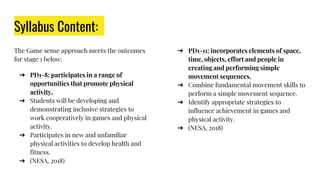
Syllabus Content:
The Game sense approach meets the outcomes
for stage 1 below:
➔ PD1-8: participates in a range of
opportunities that promote physical
activity.
➔ Students will be developing and
demonstrating inclusive strategies to
work cooperatively in games and physical
activity.
➔ Participates in new and unfamiliar
physical activities to develop health and
fitness.
➔ (NESA, 2018)
➔ PD1-11: incorporates elements of space,
time, objects, effort and people in
creating and performing simple
movement sequences.
➔ Combine fundamental movement skills to
perform a simple movement sequence.
➔ Identify appropriate strategies to
influence achievement in games and
physical activity.
➔ (NESA, 2018)
References
Curry, C., & Light, R. (2007). Addressing the NSW quality teaching framework in physical education: Is game sense the answer?. In Proceedings of
the Asia Pacific Conference on Teaching Sport and Physical Education for Understanding.
NESA (2018). Personal Development, Health and Physical Education K-10 Syllabus. NESA.
https://educationstandards.nsw.edu.au/wps/portal/nesa/k-10/learning-areas/pdhpe/pdhpe-k-10-2018
Sports Australia. (2019). Playing For Life: Game Sense Approach. https://www.sportaus.gov.au/p4l/game_sense_approach
Zuccolo, A. S. H. L. E. I. G. H., Spittle, M., & Pill, S. H. A. N. E. (2014). Game sense research in coaching: Findings and reflections. University of
Sydney Papers in Human Movement. Health and Coach Education-Game Sense Special Edition, 15-30.

Game sense

  • 1.
    GAME SENSE Why usethis approach?
  • 2.
    What is GameSense? The game sense is a approach to modified sport that encourages all students to engage with minor modified game strategies. Sports Australia (n.d.) states the game sense ‘modified game rules, the playing equipment for the purpose of highlight aspects of the game’, this could include attack and defense play. Students from all sporting backgrounds are able to succeed in the lesson when the game sense approach has been applied. The game sense approach allows both the teacher to ‘implement flexible learning in and through’ (Zuccolo, Spittle & Pill, pg.22, 2014). Students develop skills including the fundamental movement skills and communication strategies that are used during the lessons.
  • 3.
    FUNDAMENTAL MOVEMENTS SKILLS 1. Catch 2.Hop 3. Gallop 4. Skip 5. Over arm throw 6. Leap 7. Two handed strike 8. Dodging 9. Balancing 10. Running Fundamental movement skills (FMS) are a key priority of the PDHPE Syllabus. Through the game sense approach the students can actively participate in lesson that are made to develop their FMS while not feeling the pressures of getting it ‘right’ or ‘wrong’.
  • 4.
    Skill Development through GameSense. While students are participating in the game sense learning approach they are still developing their skills in PE. This could be using their fundamental movement skills or learning new techniques to play a sport. The students skill developed is being developed at the same time a understanding with modified games however, students are not under the same pressure to learning the technical skills. Not only are students developing their skills throughout the sport they are also meeting the general capabilities of the PDHPE Syllabus (2018). The two general capabilities that can been seen as examples are critical and creative thinking and personal and social capability. Critical and Creative Thinking: ● Students build qualities that build resilience and maintain respectful relationships with fellow peers. ● Critically and creatively think which therefore, propose actions and strategies that build inclusivity and create connectedness with other students. (NESA, 2018) Personal and Social Capabilities: ● Students will recognise their own personal strengths. ● Become independent learners that can apply the skills and knowledge learnt. ● Improve performance and solve movement challenges using movement concepts. (NESA, 2018)
  • 5.
    Strengths of Game Sensein the Lessons “In game sense the teacher sets a learning environment with which the students engage and encourages students to explore” (Curry & Light, pg,11 2007) The main strength the derives from game sense approach is the level of the teacher and student engagement. Students and the teacher are open to engage actively ‘in a dialogue during the lesson” (Curry & Light, 2007). Studenta re also engcouraged to engage with each other this could include team talks and the communication that is non-verbal during the game.
  • 6.
    Syllabus Content: The Gamesense approach meets the outcomes for stage 1 below: ➔ PD1-8: participates in a range of opportunities that promote physical activity. ➔ Students will be developing and demonstrating inclusive strategies to work cooperatively in games and physical activity. ➔ Participates in new and unfamiliar physical activities to develop health and fitness. ➔ (NESA, 2018) ➔ PD1-11: incorporates elements of space, time, objects, effort and people in creating and performing simple movement sequences. ➔ Combine fundamental movement skills to perform a simple movement sequence. ➔ Identify appropriate strategies to influence achievement in games and physical activity. ➔ (NESA, 2018)
  • 7.
    References Curry, C., &Light, R. (2007). Addressing the NSW quality teaching framework in physical education: Is game sense the answer?. In Proceedings of the Asia Pacific Conference on Teaching Sport and Physical Education for Understanding. NESA (2018). Personal Development, Health and Physical Education K-10 Syllabus. NESA. https://educationstandards.nsw.edu.au/wps/portal/nesa/k-10/learning-areas/pdhpe/pdhpe-k-10-2018 Sports Australia. (2019). Playing For Life: Game Sense Approach. https://www.sportaus.gov.au/p4l/game_sense_approach Zuccolo, A. S. H. L. E. I. G. H., Spittle, M., & Pill, S. H. A. N. E. (2014). Game sense research in coaching: Findings and reflections. University of Sydney Papers in Human Movement. Health and Coach Education-Game Sense Special Edition, 15-30.