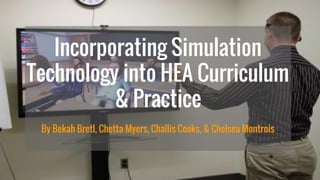
Incorporating Simulation
Technology into HEA Curriculum
& Practice
By Bekah Bretl, Chetta Myers, Challis Cooks, & Chelsea Montrois
HEA Mission Statement
The Higher Education Administration Department (HEA) and the
Higher Education and Student Affairs Administration (HESAA)
program at Buffalo State is committed to promoting access and to
preparing exceptional scholars and practitioners with knowledge,
skills, competencies and an ethic of care needed for sound
professional practice in the twenty-first century.
HEA Learning and Professional Outcomes
1. Social Justice and Inclusion
2. Assessment, Evaluation, and Research
3. Leadership and Administration
4. Integrative Learning
5. Personal and Ethical Foundations
6. Values, Philosophy, and History
7. Student Development and Learning
8. Advising and Supporting
9. Technology
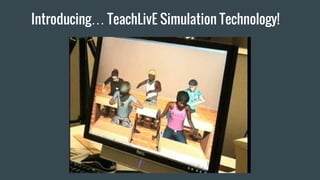
Introducing… TeachLivE Simulation Technology!
About TeachLivE
● Different from artificial intelligence
○ Avatars’ behavior and words are controlled by people in real time
● Customizable scenarios
○ Faculty arranges sessions ahead of time.
○ Informs controller of preferred teaching content, student
behavior, and specific classroom occurrences that shape the
session based on the learning objectives for the teaching student.
TeachLivE Adult Avatar
2014 National TeachLivE Research Project
● At 10 sites across the nation, 157 middle school mathematics teachers received four
levels of innovative professional development, including computer simulation,
synchronous online instruction, and lesson resources based on the Common Core State
Standards (CCSS).
● Teachers were observed in the TeachLivE classroom simulator and in their regular
classrooms to determine the effects of treatment.
“Teachers who took part in a series of sessions in TeachLivE increased their instances of
teaching practices in the simulator, similar to studies conducted earlier (e.g., Dawson &
Lignugaris/Kraft, 2103; Elford et al., 2013; Vince Garland et al.; 2012).”
TeachLivE Implementation at California State University
● “First and foremost, we appreciate the fact that the TeachLivE experience allows our
candidates opportunities to not only practice new skills, but to get immediate feedback
and try again. This kind of immediate reflection and practice is not easy in a real
classroom, and by “taking a redo” candidates can instantly see the effects of changes in
their teaching practices.”
● “In addition, we feel the experience of watching their peers, who are at the same
developmental level, practice the same skills with the same class of students, is
invaluable. During the debrief at the end of every session the candidates report on what
they’ve learned from watching their peers; the insights and confidence they gain from
watching the strengths and challenges of their peers is a unique component that is only
available through TeachLivE.”
HEA 694 tests TeachLivE
● Students experimented facilitating college information sessions with high school students
Challis discusses “making the most out of your
college experience” with the students.
Bekah answers questions concerns about
financial aid and admissions.
TeachLivE at SUNY College at Buffalo
● Currently in use by the School of Education
● TeachLivE lab located in Ketchum Hall
● TeachLivE unit is portable and can be used in any classroom.
● TeachLivE hourly fees paid for through student technology fee
● Grants from the Bill and Melinda Gates Foundation and SUNY
Innovative Instruction Technology Grant help to offset associated
costs
● Lab is underutilized at Buffalo State
Benefits of TeachLivE to Education Students
● Increased comfort in the classroom setting
● Low risk environment for experimentation
● Opportunity for practice and reflection
● Ability to critically review teaching sessions through analytic reports
● Hands-on group behavioral management experience
● Retain learners who had a difficult first experience in the classroom
Applying TeachLivE to the HEA Curriculum
● Counseling
● Student Development
● Mock Interviews and Professional Development
● Assessment/Focus Interview Groups
● Conflict Resolution Simulation
● Supervision Scenarios
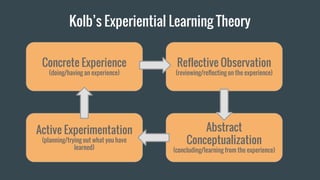
Kolb’s Experiential Learning Theory
Concrete Experience
(doing/having an experience)
Reflective Observation
(reviewing/reflecting on the experience)
Active Experimentation
(planning/trying out what you have
learned)
Abstract
Conceptualization
(concluding/learning from the experience)
Benefits for HEA Department
Market and promote as the only Student Affairs program in the country using TeachLivE
Benefits for HEA Department
● Opportunity for faculty to observe graduate student development in
practice
● Measurable learning outcomes through pre- and post-session reports.
● Produce a more prepared population of alumni
● Student success in the field
● Opportunity to participate in research and conference presentations on
technology in higher education
● Engage with alumni by offering access to mock interview sessions
Perceived Challenges
● Limitations of avatars
● Faculty adoption
● Support and training
● Hefty front loading and planning
● Challenges with computer technology
● Only one student can use it per room at a time
● Session costs
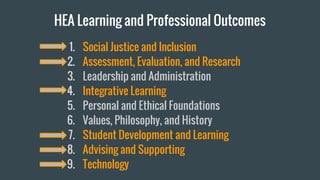
HEA Learning and Professional Outcomes
1. Social Justice and Inclusion
2. Assessment, Evaluation, and Research
3. Leadership and Administration
4. Integrative Learning
5. Personal and Ethical Foundations
6. Values, Philosophy, and History
7. Student Development and Learning
8. Advising and Supporting
9. Technology
Proposal
● HEA to introduce a pilot program for TeachLivE
● Implement this technology into one course during the coming
semester
● Pre and post surveys on students’ experience and learning
outcomes
● Utilize TeachLivE’s analytics to assess student improvement over
the semester
● Determine impact and success and potentially integrate into other
course curricula

PDFTeachLive Presentation

  • 1.
    Incorporating Simulation Technology intoHEA Curriculum & Practice By Bekah Bretl, Chetta Myers, Challis Cooks, & Chelsea Montrois
  • 2.
    HEA Mission Statement TheHigher Education Administration Department (HEA) and the Higher Education and Student Affairs Administration (HESAA) program at Buffalo State is committed to promoting access and to preparing exceptional scholars and practitioners with knowledge, skills, competencies and an ethic of care needed for sound professional practice in the twenty-first century.
  • 3.
    HEA Learning andProfessional Outcomes 1. Social Justice and Inclusion 2. Assessment, Evaluation, and Research 3. Leadership and Administration 4. Integrative Learning 5. Personal and Ethical Foundations 6. Values, Philosophy, and History 7. Student Development and Learning 8. Advising and Supporting 9. Technology
  • 4.
  • 5.
    About TeachLivE ● Differentfrom artificial intelligence ○ Avatars’ behavior and words are controlled by people in real time ● Customizable scenarios ○ Faculty arranges sessions ahead of time. ○ Informs controller of preferred teaching content, student behavior, and specific classroom occurrences that shape the session based on the learning objectives for the teaching student.
  • 6.
  • 7.
    2014 National TeachLivEResearch Project ● At 10 sites across the nation, 157 middle school mathematics teachers received four levels of innovative professional development, including computer simulation, synchronous online instruction, and lesson resources based on the Common Core State Standards (CCSS). ● Teachers were observed in the TeachLivE classroom simulator and in their regular classrooms to determine the effects of treatment. “Teachers who took part in a series of sessions in TeachLivE increased their instances of teaching practices in the simulator, similar to studies conducted earlier (e.g., Dawson & Lignugaris/Kraft, 2103; Elford et al., 2013; Vince Garland et al.; 2012).”
  • 8.
    TeachLivE Implementation atCalifornia State University ● “First and foremost, we appreciate the fact that the TeachLivE experience allows our candidates opportunities to not only practice new skills, but to get immediate feedback and try again. This kind of immediate reflection and practice is not easy in a real classroom, and by “taking a redo” candidates can instantly see the effects of changes in their teaching practices.” ● “In addition, we feel the experience of watching their peers, who are at the same developmental level, practice the same skills with the same class of students, is invaluable. During the debrief at the end of every session the candidates report on what they’ve learned from watching their peers; the insights and confidence they gain from watching the strengths and challenges of their peers is a unique component that is only available through TeachLivE.”
  • 9.
    HEA 694 testsTeachLivE ● Students experimented facilitating college information sessions with high school students Challis discusses “making the most out of your college experience” with the students. Bekah answers questions concerns about financial aid and admissions.
  • 10.
    TeachLivE at SUNYCollege at Buffalo ● Currently in use by the School of Education ● TeachLivE lab located in Ketchum Hall ● TeachLivE unit is portable and can be used in any classroom. ● TeachLivE hourly fees paid for through student technology fee ● Grants from the Bill and Melinda Gates Foundation and SUNY Innovative Instruction Technology Grant help to offset associated costs ● Lab is underutilized at Buffalo State
  • 11.
    Benefits of TeachLivEto Education Students ● Increased comfort in the classroom setting ● Low risk environment for experimentation ● Opportunity for practice and reflection ● Ability to critically review teaching sessions through analytic reports ● Hands-on group behavioral management experience ● Retain learners who had a difficult first experience in the classroom
  • 12.
    Applying TeachLivE tothe HEA Curriculum ● Counseling ● Student Development ● Mock Interviews and Professional Development ● Assessment/Focus Interview Groups ● Conflict Resolution Simulation ● Supervision Scenarios
  • 13.
    Kolb’s Experiential LearningTheory Concrete Experience (doing/having an experience) Reflective Observation (reviewing/reflecting on the experience) Active Experimentation (planning/trying out what you have learned) Abstract Conceptualization (concluding/learning from the experience)
  • 14.
    Benefits for HEADepartment Market and promote as the only Student Affairs program in the country using TeachLivE
  • 15.
    Benefits for HEADepartment ● Opportunity for faculty to observe graduate student development in practice ● Measurable learning outcomes through pre- and post-session reports. ● Produce a more prepared population of alumni ● Student success in the field ● Opportunity to participate in research and conference presentations on technology in higher education ● Engage with alumni by offering access to mock interview sessions
  • 16.
    Perceived Challenges ● Limitationsof avatars ● Faculty adoption ● Support and training ● Hefty front loading and planning ● Challenges with computer technology ● Only one student can use it per room at a time ● Session costs
  • 17.
    HEA Learning andProfessional Outcomes 1. Social Justice and Inclusion 2. Assessment, Evaluation, and Research 3. Leadership and Administration 4. Integrative Learning 5. Personal and Ethical Foundations 6. Values, Philosophy, and History 7. Student Development and Learning 8. Advising and Supporting 9. Technology
  • 18.
    Proposal ● HEA tointroduce a pilot program for TeachLivE ● Implement this technology into one course during the coming semester ● Pre and post surveys on students’ experience and learning outcomes ● Utilize TeachLivE’s analytics to assess student improvement over the semester ● Determine impact and success and potentially integrate into other course curricula