Test Taking Tips and Strategies
Smart Tips to Help You On Your PRAXIS EXAM
Practical Tips
 To help you navigate the Praxis Exam and..
 To make the most effective use of your time
 Based on the ETS Study Guide – Tips to Success with additional resources and handouts
 Let’s See how the ETS people have responded to some frequently asked
questions.
Should I
Guess?
 The ETS people say, YES!!
 Your score is based on the number of
questions you answer correctly, with no
penalty or subtraction for an incorrect answer.
 When you don’t know the answer to a
question, try to eliminate any obviously
WRONG answers and then guess at the
correct one.
 Try to pace yourself so that you have enough
time to carefully consider every question.
 Remember, you can mark the ones you do not
know and come back.
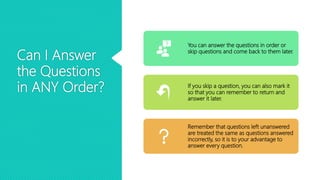
Can I Answer
the Questions
in ANY Order?
You can answer the questions in order or
skip questions and come back to them later.
If you skip a question, you can also mark it
so that you can remember to return and
answer it later.
Remember that questions left unanswered
are treated the same as questions answered
incorrectly, so it is to your advantage to
answer every question.
Are There Trick Questions on the Test?
NO! There are NO hidden meanings or trick
questions.
All of the questions on the test ask about subject
matter knowledge in a straightforward manner.
Are There
Answer
Patterns on the
Test?
 NO!
 ETS states that there are many myths out
there regarding tests and answering test
questions
 Myth 1 – Tests Follow Patterns
 There are NO patterns written into the
Praxis Exam.
 Myth 2 – There will never be more than 2
questions in a row with the correct answer
in the same position among the choices.
 NOT!!
 Select the answer you think is correct
based on your knowledge of the subject –
NOT on the myths above.
What’s The Scratch Paper For?
 You are given scratch paper when entering the test site.
 You can write notes on it
 Work out Problems on it
 Or Anything you want – But, You will not be able to take it with you and it will be destroyed when
you are finished.
 Remember to select and enter your answers on the computer !!
Computer
Delivered
Questions
Answer the questions by
clicking on an option or
entering text on the
If you see something you
are not familiar with –
read the directions
carefully. It will tell you
how to best respond
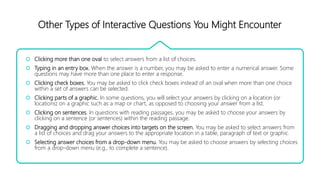
Other Types of Interactive Questions You Might Encounter
 Clicking more than one oval to select answers from a list of choices.
 Typing in an entry box. When the answer is a number, you may be asked to enter a numerical answer. Some
questions may have more than one place to enter a response.
 Clicking check boxes. You may be asked to click check boxes instead of an oval when more than one choice
within a set of answers can be selected.
 Clicking parts of a graphic. In some questions, you will select your answers by clicking on a location (or
locations) on a graphic such as a map or chart, as opposed to choosing your answer from a list.
 Clicking on sentences. In questions with reading passages, you may be asked to choose your answers by
clicking on a sentence (or sentences) within the reading passage.
 Dragging and dropping answer choices into targets on the screen. You may be asked to select answers from
a list of choices and drag your answers to the appropriate location in a table, paragraph of text or graphic.
 Selecting answer choices from a drop-down menu. You may be asked to choose answers by selecting choices
from a drop-down menu (e.g., to complete a sentence).
Tips for Taking the Test
Read the Questions TWICE – Don’t OVERTHINK!
 ETS might state they do not have trick questions – but they ARE
knowledgeable as to how the brain works!!
 Read the questions and answers carefully to avoid being misled by key
terms.
 Be CAREFUL though – Don’t read TOO MUCH into the question!!
 Some people over analyze answers, debating the correctness of each
one.
 In the end, they sometimes make a case to themselves for the wrong
answer. Instead, remember that if the answer seems wrong, it probably is.
Don’t overthink it until the answer seems right to you.
Keep Track of the Time
 Keep an even pace. You should try to maintain a pace that will
allow you to devote enough time to each question.
 Do not spend too much time on any one question. If you find
yourself re-reading or having difficulty with one question, skip it
and come back to it later. You can return to any question in a test if
you have time.
 The on-screen clock will tell you how much time you have left.
 You will probably have plenty of time left – Students have shared
that they were finished way before the time limit was up.
 If you do find yourself getting bogged down, consider moving on
and coming back to any unanswered questions later.
Read Each Question Carefully
 Your ability to read carefully and thoughtfully is as important as your ability to recall and reason.
 Read the answers carefully too! For questions that require more than one answer, or to make
another kind of selection, consider the most likely answers - given what the question is asking.
Then reread the question to be sure the answer(s) you have given really answer the question.
 Sometimes it is helpful to read the answer choices before you read the passages or questions!
 Watch or Key Words
 Remember, a question that contains a phrase such as “Which of the following does NOT ...” is
asking for the one answer that is NOT a correct statement or conclusion.
Key Words
 Make a note of Key Words
 Sometimes there are key words that
will help you pick the correct answer.
Pay close attention to these words.
 If you overlook one of these key
words, you could miss a question
that you really know.
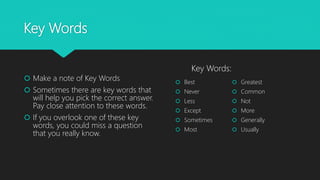
 Best
 Never
 Less
 Except
 Sometimes
 Most
 Greatest
 Common
 Not
 More
 Generally
 Usually
Key Words:
Confusing Math Terms
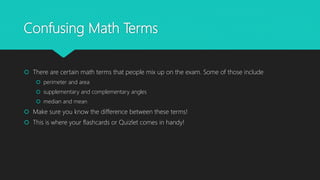
 There are certain math terms that people mix up on the exam. Some of those include
 perimeter and area
 supplementary and complementary angles
 median and mean
 Make sure you know the difference between these terms!
 This is where your flashcards or Quizlet comes in handy!
When In Doubt
 Re-word difficult questions into your own words. Rephrasing can often help
make it clear to you but be sure you don't change the meaning of the
question.
 Don't waste time grappling over troublesome questions at the start.
 If you are struggling with the answer – Skip it and Go Back To It. Make sure
you ‘mark’ it so you can find it easily later.
 Keep track of the time so you’re able to go back over the questions that you
left blank. Even if you don’t know the answer the second time you read the
questions, see if you can narrow down the possible answers,
 Your score is based on the number of right answers, so it is to your advantage
to answer every question.
 Try to answer Multiple Choice questions before reading the answer
choices. Often, you can rule out two of the four answers immediately
and you then have at least a 50-50 chance.
 Frequently when a question says all of the above" or "none of the
above," these are not the correct answer.
 Don't be misled by jargon or familiar phrases used in an incorrect
statement.
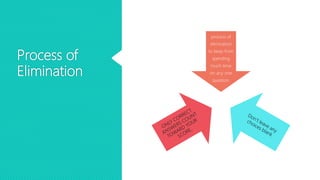
Process of
Elimination
Use the
process of
elimination
to keep from
spending
much time
on any one
question.
Further
Understanding
Selected-
Response
Questions
Download the Handout –
It provides some great
examples and ideas.
In selected response items,
students choose a response rather than
construct one in their own
words. Selected response items do not
require that students recall information,
but only that they recognize the
correct answer.
Finishing Up the Test
 Go back and answer the questions that you skipped/marked and make sure that you didn’t skip
any or leave any answers blank!
 Review your answers but don’t try to second guess yourself! Check the questions you were
unsure of but make sure you have a good reason for changing the answer.
 After you submit your test – It will provide you with a preliminary score. You will need to
remember it because you can not write it down and take it out with you.
And Then ……… YOU’RE
DONE!
Before you know it YOU are done.
The Day of the Test!
We will cover this later, along with a discussion on Test Anxiety

Test Taking Tips for Praxis Study

  • 1.
    Test Taking Tipsand Strategies Smart Tips to Help You On Your PRAXIS EXAM
  • 2.
    Practical Tips  Tohelp you navigate the Praxis Exam and..  To make the most effective use of your time  Based on the ETS Study Guide – Tips to Success with additional resources and handouts  Let’s See how the ETS people have responded to some frequently asked questions.
  • 3.
    Should I Guess?  TheETS people say, YES!!  Your score is based on the number of questions you answer correctly, with no penalty or subtraction for an incorrect answer.  When you don’t know the answer to a question, try to eliminate any obviously WRONG answers and then guess at the correct one.  Try to pace yourself so that you have enough time to carefully consider every question.  Remember, you can mark the ones you do not know and come back.
  • 4.
    Can I Answer theQuestions in ANY Order? You can answer the questions in order or skip questions and come back to them later. If you skip a question, you can also mark it so that you can remember to return and answer it later. Remember that questions left unanswered are treated the same as questions answered incorrectly, so it is to your advantage to answer every question.
  • 5.
    Are There TrickQuestions on the Test? NO! There are NO hidden meanings or trick questions. All of the questions on the test ask about subject matter knowledge in a straightforward manner.
  • 6.
    Are There Answer Patterns onthe Test?  NO!  ETS states that there are many myths out there regarding tests and answering test questions  Myth 1 – Tests Follow Patterns  There are NO patterns written into the Praxis Exam.  Myth 2 – There will never be more than 2 questions in a row with the correct answer in the same position among the choices.  NOT!!  Select the answer you think is correct based on your knowledge of the subject – NOT on the myths above.
  • 7.
    What’s The ScratchPaper For?  You are given scratch paper when entering the test site.  You can write notes on it  Work out Problems on it  Or Anything you want – But, You will not be able to take it with you and it will be destroyed when you are finished.  Remember to select and enter your answers on the computer !!
  • 8.
    Computer Delivered Questions Answer the questionsby clicking on an option or entering text on the If you see something you are not familiar with – read the directions carefully. It will tell you how to best respond
  • 9.
    Other Types ofInteractive Questions You Might Encounter  Clicking more than one oval to select answers from a list of choices.  Typing in an entry box. When the answer is a number, you may be asked to enter a numerical answer. Some questions may have more than one place to enter a response.  Clicking check boxes. You may be asked to click check boxes instead of an oval when more than one choice within a set of answers can be selected.  Clicking parts of a graphic. In some questions, you will select your answers by clicking on a location (or locations) on a graphic such as a map or chart, as opposed to choosing your answer from a list.  Clicking on sentences. In questions with reading passages, you may be asked to choose your answers by clicking on a sentence (or sentences) within the reading passage.  Dragging and dropping answer choices into targets on the screen. You may be asked to select answers from a list of choices and drag your answers to the appropriate location in a table, paragraph of text or graphic.  Selecting answer choices from a drop-down menu. You may be asked to choose answers by selecting choices from a drop-down menu (e.g., to complete a sentence).
  • 10.
  • 11.
    Read the QuestionsTWICE – Don’t OVERTHINK!  ETS might state they do not have trick questions – but they ARE knowledgeable as to how the brain works!!  Read the questions and answers carefully to avoid being misled by key terms.  Be CAREFUL though – Don’t read TOO MUCH into the question!!  Some people over analyze answers, debating the correctness of each one.  In the end, they sometimes make a case to themselves for the wrong answer. Instead, remember that if the answer seems wrong, it probably is. Don’t overthink it until the answer seems right to you.
  • 12.
    Keep Track ofthe Time  Keep an even pace. You should try to maintain a pace that will allow you to devote enough time to each question.  Do not spend too much time on any one question. If you find yourself re-reading or having difficulty with one question, skip it and come back to it later. You can return to any question in a test if you have time.  The on-screen clock will tell you how much time you have left.  You will probably have plenty of time left – Students have shared that they were finished way before the time limit was up.  If you do find yourself getting bogged down, consider moving on and coming back to any unanswered questions later.
  • 13.
    Read Each QuestionCarefully  Your ability to read carefully and thoughtfully is as important as your ability to recall and reason.  Read the answers carefully too! For questions that require more than one answer, or to make another kind of selection, consider the most likely answers - given what the question is asking. Then reread the question to be sure the answer(s) you have given really answer the question.  Sometimes it is helpful to read the answer choices before you read the passages or questions!  Watch or Key Words  Remember, a question that contains a phrase such as “Which of the following does NOT ...” is asking for the one answer that is NOT a correct statement or conclusion.
  • 14.
    Key Words  Makea note of Key Words  Sometimes there are key words that will help you pick the correct answer. Pay close attention to these words.  If you overlook one of these key words, you could miss a question that you really know.  Best  Never  Less  Except  Sometimes  Most  Greatest  Common  Not  More  Generally  Usually Key Words:
  • 15.
    Confusing Math Terms There are certain math terms that people mix up on the exam. Some of those include  perimeter and area  supplementary and complementary angles  median and mean  Make sure you know the difference between these terms!  This is where your flashcards or Quizlet comes in handy!
  • 16.
    When In Doubt Re-word difficult questions into your own words. Rephrasing can often help make it clear to you but be sure you don't change the meaning of the question.  Don't waste time grappling over troublesome questions at the start.  If you are struggling with the answer – Skip it and Go Back To It. Make sure you ‘mark’ it so you can find it easily later.  Keep track of the time so you’re able to go back over the questions that you left blank. Even if you don’t know the answer the second time you read the questions, see if you can narrow down the possible answers,  Your score is based on the number of right answers, so it is to your advantage to answer every question.
  • 17.
     Try toanswer Multiple Choice questions before reading the answer choices. Often, you can rule out two of the four answers immediately and you then have at least a 50-50 chance.  Frequently when a question says all of the above" or "none of the above," these are not the correct answer.  Don't be misled by jargon or familiar phrases used in an incorrect statement.
  • 18.
    Process of Elimination Use the processof elimination to keep from spending much time on any one question.
  • 19.
    Further Understanding Selected- Response Questions Download the Handout– It provides some great examples and ideas. In selected response items, students choose a response rather than construct one in their own words. Selected response items do not require that students recall information, but only that they recognize the correct answer.
  • 20.
    Finishing Up theTest  Go back and answer the questions that you skipped/marked and make sure that you didn’t skip any or leave any answers blank!  Review your answers but don’t try to second guess yourself! Check the questions you were unsure of but make sure you have a good reason for changing the answer.  After you submit your test – It will provide you with a preliminary score. You will need to remember it because you can not write it down and take it out with you.
  • 21.
    And Then ………YOU’RE DONE! Before you know it YOU are done.
  • 22.
    The Day ofthe Test! We will cover this later, along with a discussion on Test Anxiety