Chapter 1 Preparing for Success in College Copyright © 2009 by Tapestry Press, Ltd.
The purpose of this chapter is to perk your thoughts on how to take charge right away and get a strong start in college. Copyright © 2009 by Tapestry Press, Ltd.
Are you ready? Copyright © 2009 by Tapestry Press, Ltd.
Learning Outcomes Clarify your reasons for going to college. Appreciate the advantages of a college education. Become socially and academically involved in your school community. Use your school’s resources and services. Understand your school’s policies. Develop an efficient transportation plan. Make the most of financial management strategies and student financial aid options. Balance the demands of work, school, family, and friends. Copyright © 2009 by Tapestry Press, Ltd.
You won’t regret doing  your best in college! Genius without education  is like silver in the mine.  — Benjamin Franklin What did Benjamin mean? Copyright © 2009 by Tapestry Press, Ltd.
Review text Exercise 1-1:  The reasons I’m going to college Let’s conduct a quick class survey on the top 2 reasons you are going to college. Based on our class survey, what seems to be the top 2–3 most compelling reasons to go to college? How can your reasons for going to college motivate you to succeed in college? Copyright © 2009 by Tapestry Press, Ltd.
-Small Group Discussion- Think about it! 1. What do you like most about college? 2. What do you like least about college? 3. What do you fear most about college? 4. How would the above relate to a new job? Copyright © 2009 by Tapestry Press, Ltd.
Financial Advantages of  a College Education College graduates : earn higher wages.  are more likely to receive employer-provided health insurance & pension benefits. receive a broad education.  gain expertise in their field.  Any other advantages? Copyright © 2009 by Tapestry Press, Ltd.
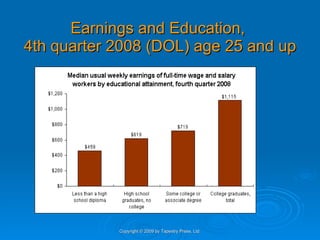
U.S. Department of Labor (DOL) 2007 Reports: “ Generally speaking, jobs that require high levels of education and skill pay higher wages than jobs that require few skills and little education.”  Copyright © 2009 by Tapestry Press, Ltd.
Earnings and Education,  4th quarter 2008 (DOL) age 25 and up Copyright © 2009 by Tapestry Press, Ltd.
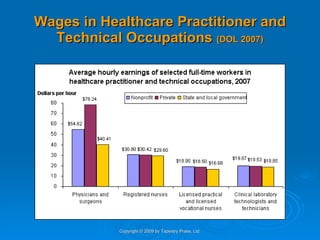
Wages in Healthcare Practitioner and Technical Occupations  (DOL 2007) Copyright © 2009 by Tapestry Press, Ltd.                                                                                                                                                                                
National Compensation Survey Occupational Wages—U.S.  (June 2006)    Link to hourly earnings listed by occupation http://www.bls.gov/ncs/ocs/sp/ncbl0910.pdf Copyright © 2009 by Tapestry Press, Ltd.
Taking Control    Balancing  School, Work, Family, Friends, and More 1. Control your schedule—time management skills are one of the most valuable skills for college, career, and personal success.  The “Making Time Work for You” chapter will help you adopt time management strategies. 2. Keep a firm grasp on your priorities. Understanding what your PRIORITIES are each and every day is one of the biggest keys to college success.  Copyright © 2009 by Tapestry Press, Ltd.
  -Small Group Discussion- Think about it! 1. What obstacles and/or distractions could keep you from doing your best in college? 2. How can you overcome the obstacles and distractions to succeed in college? Copyright © 2009 by Tapestry Press, Ltd.
Get Connected: Social and Academic Involvement at Your College is a Good Investment National student engagement research has shown : When students invest themselves in school-related activities for socializing or learning, they become more attached to their school  and  achieve their educational goals. Copyright © 2009 by Tapestry Press, Ltd.
Be Academically Involved at School 1. Actively participate in class activities. 2. Study in the library or campus study areas. 3. Meet with your instructors and advisor. 4. Join a student organization or student chapter of your professional organization. 5. Get tutoring as soon as you encounter difficulties—even if you just need a little help.  6. Attend special school lectures and events. 7. Start or join a study group. Copyright © 2009 by Tapestry Press, Ltd.
Anything holding you back  from being academically  involved in school? Copyright © 2009 by Tapestry Press, Ltd.
Get Socially Involved at School What types of social events and activities are provided at our college? What? Where? When? Cost? Can you bring family or friends? Copyright © 2009 by Tapestry Press, Ltd.
Using Your School’s Resources and Services Our college offers student services to help you succeed both academically and personally.  In small groups, list as many services as you can think of that our college makes available to you. Copyright © 2009 by Tapestry Press, Ltd.
Understand Your School’s Policies Knowing the college’s rules, policies, and procedures can help you succeed and avoid costly mistakes. Review your responses to  Exercise 1-6: Getting acquainted with your college’s academic requirements and procedures What questions or concerns do you have concerning any of our college’s rules, policies, or procedures? Copyright © 2009 by Tapestry Press, Ltd.
Got Transportation?  What about a backup plan? Situation     You have graduated from your college program.  You are employed full-time by XYZ Company in  ( location ) . Think about what your transportation backup plan would look like while you are working for XYZ. Explain your backup plan to a classmate next to you. Copyright © 2009 by Tapestry Press, Ltd.
Managing Your Money  -Think Fast    Small Group Competition- (1 point for each correct item) 1. Recall and list the textbook credit card tips. 2. Recall and list textbook tips for maximizing your risk for identity theft. 3. Based on the textbook Budgeting Plan Worksheet, write a concise list of guidelines for creating a budget plan. Copyright © 2009 by Tapestry Press, Ltd.
Financial Aid 1. College is expensive. Costs may include food and lodging, tuition, fees, and books.  2. Your college’s Financial Aid Office can inform you about many sources of financial aid.  3. Also consider other possible sources of financial aid. 4. Meet all deadlines for submitting applications and documentation and  be accurate . 5. Respond quickly and completely to all requests for additional information. 6. Be persistent in following up your application. 7. If you do receive financial aid, meet all requirements to keep and continue your aid. Copyright © 2009 by Tapestry Press, Ltd.
Need-Based Aid Funding Sources Financial aid packages generally include two forms of assistance:  grant  and  scholarship funds   and  self-help funds. The first portion of each student's demonstrated need is generally met with self-help funds.  Need in excess of self-help funds is met with grant and scholarship funds. Copyright © 2009 by Tapestry Press, Ltd.
Grant and Scholarship Funds Do not need to be repaid. Are available from a variety of sources (institutional, federal, state, and local).  When packaging student aid awards, colleges generally include those federal and state resources for which the student is eligible. Scholarship funds are derived from a variety of sources including contributions to your school. Copyright © 2009 by Tapestry Press, Ltd.
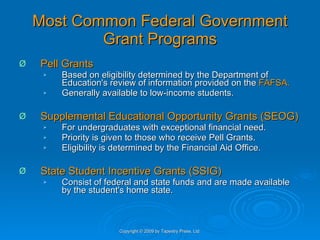
Most Common Federal Government Grant Programs Pell Grants   Based on eligibility determined by the Department of Education's review of information provided on the  FAFSA. Generally available to low-income students.  Supplemental Educational Opportunity Grants (SEOG)   For undergraduates with exceptional financial need. Priority is given to those who receive Pell Grants. Eligibility is determined by the Financial Aid Office.  State Student Incentive Grants (SSIG)   Consist of federal and state funds and are made available by the student's home state.  Copyright © 2009 by Tapestry Press, Ltd.
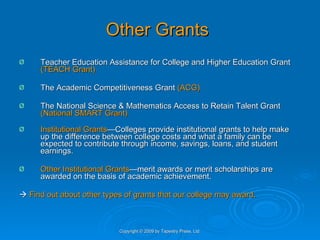
Other Grants Teacher Education Assistance for College and Higher Education Grant  (TEACH Grant)  The Academic Competitiveness Grant  (ACG) The National Science & Mathematics Access to Retain Talent Grant  (National SMART Grant) Institutional Grants —Colleges provide institutional grants to help make up the difference between college costs and what a family can be expected to contribute through income, savings, loans, and student earnings. Other Institutional Grants —merit awards or merit scholarships are awarded on the basis of academic achievement.     Find out about other types of grants that our college may award. Copyright © 2009 by Tapestry Press, Ltd.
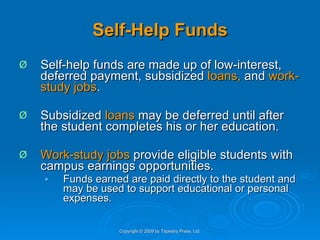
Self-Help Funds Self-help funds are made up of low-interest, deferred payment, subsidized  loans,  and  work-study jobs .  Subsidized  loans  may be deferred until after the student completes his or her education.  Work-study jobs  provide eligible students with campus earnings opportunities.  Funds earned are paid directly to the student and may be used to support educational or personal expenses.  Copyright © 2009 by Tapestry Press, Ltd.
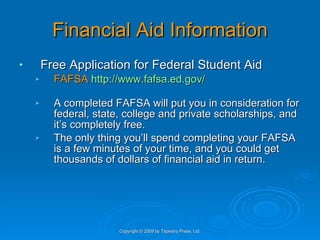
Financial Aid Information Free Application for Federal Student Aid FAFSA   http://www.fafsa.ed.gov/ A completed FAFSA will put you in consideration for federal, state, college and private scholarships, and it’s completely free.  The only thing you’ll spend completing your FAFSA is a few minutes of your time, and you could get thousands of dollars of financial aid in return.  Copyright © 2009 by Tapestry Press, Ltd.
Student Aid on the Web   For information about federal student aid from the U.S. Department of Education, visit  www.studentaid.ed.gov .  Copyright © 2009 by Tapestry Press, Ltd.
Key Chapter Points 1. Use your reasons for going to college to keep you  motivated to succeed  in college. 2. A college education will provide you many employment benefits now and in the future. 3. When you invest yourself in school-related activities for socializing or learning, you become more attached to your school and achieve your educational goals. 4. Our college offers services to help you succeed both academically and personally. Copyright © 2009 by Tapestry Press, Ltd.
Key Chapter Points  continued 5. Knowing the college’s rules, policies, and procedures can help you succeed and avoid costly mistakes. 6. Determine a backup transportation plan for school, just as you would for your job. 7. Make the most of financial management strategies and student financial aid options. 8. Time management skills are one of the most valuable skills for college, career, and personal success. Copyright © 2009 by Tapestry Press, Ltd.
Quick Assessment     Write a response to the following and turn it in to your instructor. What is/are your biggest challenge(s) that you are concerned may interfere with your college success? What is/are your greatest strength(s) that you believe will help you be successful in college? What are the top skills and/or habits you want to improve to be successful in college? Copyright © 2009 by Tapestry Press, Ltd.
See the light? Copyright © 2009 by Tapestry Press, Ltd.

Chap 1 preparing_for_success_in_college

  • 1.
    Chapter 1 Preparingfor Success in College Copyright © 2009 by Tapestry Press, Ltd.
  • 2.
    The purpose ofthis chapter is to perk your thoughts on how to take charge right away and get a strong start in college. Copyright © 2009 by Tapestry Press, Ltd.
  • 3.
    Are you ready?Copyright © 2009 by Tapestry Press, Ltd.
  • 4.
    Learning Outcomes Clarifyyour reasons for going to college. Appreciate the advantages of a college education. Become socially and academically involved in your school community. Use your school’s resources and services. Understand your school’s policies. Develop an efficient transportation plan. Make the most of financial management strategies and student financial aid options. Balance the demands of work, school, family, and friends. Copyright © 2009 by Tapestry Press, Ltd.
  • 5.
    You won’t regretdoing your best in college! Genius without education is like silver in the mine. — Benjamin Franklin What did Benjamin mean? Copyright © 2009 by Tapestry Press, Ltd.
  • 6.
    Review text Exercise1-1: The reasons I’m going to college Let’s conduct a quick class survey on the top 2 reasons you are going to college. Based on our class survey, what seems to be the top 2–3 most compelling reasons to go to college? How can your reasons for going to college motivate you to succeed in college? Copyright © 2009 by Tapestry Press, Ltd.
  • 7.
    -Small Group Discussion-Think about it! 1. What do you like most about college? 2. What do you like least about college? 3. What do you fear most about college? 4. How would the above relate to a new job? Copyright © 2009 by Tapestry Press, Ltd.
  • 8.
    Financial Advantages of a College Education College graduates : earn higher wages. are more likely to receive employer-provided health insurance & pension benefits. receive a broad education. gain expertise in their field. Any other advantages? Copyright © 2009 by Tapestry Press, Ltd.
  • 9.
    U.S. Department ofLabor (DOL) 2007 Reports: “ Generally speaking, jobs that require high levels of education and skill pay higher wages than jobs that require few skills and little education.” Copyright © 2009 by Tapestry Press, Ltd.
  • 10.
    Earnings and Education, 4th quarter 2008 (DOL) age 25 and up Copyright © 2009 by Tapestry Press, Ltd.
  • 11.
    Wages in HealthcarePractitioner and Technical Occupations (DOL 2007) Copyright © 2009 by Tapestry Press, Ltd.                                                                                                                                                                                
  • 12.
    National Compensation SurveyOccupational Wages—U.S. (June 2006)  Link to hourly earnings listed by occupation http://www.bls.gov/ncs/ocs/sp/ncbl0910.pdf Copyright © 2009 by Tapestry Press, Ltd.
  • 13.
    Taking Control  Balancing School, Work, Family, Friends, and More 1. Control your schedule—time management skills are one of the most valuable skills for college, career, and personal success. The “Making Time Work for You” chapter will help you adopt time management strategies. 2. Keep a firm grasp on your priorities. Understanding what your PRIORITIES are each and every day is one of the biggest keys to college success. Copyright © 2009 by Tapestry Press, Ltd.
  • 14.
    -SmallGroup Discussion- Think about it! 1. What obstacles and/or distractions could keep you from doing your best in college? 2. How can you overcome the obstacles and distractions to succeed in college? Copyright © 2009 by Tapestry Press, Ltd.
  • 15.
    Get Connected: Socialand Academic Involvement at Your College is a Good Investment National student engagement research has shown : When students invest themselves in school-related activities for socializing or learning, they become more attached to their school and achieve their educational goals. Copyright © 2009 by Tapestry Press, Ltd.
  • 16.
    Be Academically Involvedat School 1. Actively participate in class activities. 2. Study in the library or campus study areas. 3. Meet with your instructors and advisor. 4. Join a student organization or student chapter of your professional organization. 5. Get tutoring as soon as you encounter difficulties—even if you just need a little help. 6. Attend special school lectures and events. 7. Start or join a study group. Copyright © 2009 by Tapestry Press, Ltd.
  • 17.
    Anything holding youback from being academically involved in school? Copyright © 2009 by Tapestry Press, Ltd.
  • 18.
    Get Socially Involvedat School What types of social events and activities are provided at our college? What? Where? When? Cost? Can you bring family or friends? Copyright © 2009 by Tapestry Press, Ltd.
  • 19.
    Using Your School’sResources and Services Our college offers student services to help you succeed both academically and personally.  In small groups, list as many services as you can think of that our college makes available to you. Copyright © 2009 by Tapestry Press, Ltd.
  • 20.
    Understand Your School’sPolicies Knowing the college’s rules, policies, and procedures can help you succeed and avoid costly mistakes. Review your responses to Exercise 1-6: Getting acquainted with your college’s academic requirements and procedures What questions or concerns do you have concerning any of our college’s rules, policies, or procedures? Copyright © 2009 by Tapestry Press, Ltd.
  • 21.
    Got Transportation? What about a backup plan? Situation  You have graduated from your college program. You are employed full-time by XYZ Company in ( location ) . Think about what your transportation backup plan would look like while you are working for XYZ. Explain your backup plan to a classmate next to you. Copyright © 2009 by Tapestry Press, Ltd.
  • 22.
    Managing Your Money -Think Fast  Small Group Competition- (1 point for each correct item) 1. Recall and list the textbook credit card tips. 2. Recall and list textbook tips for maximizing your risk for identity theft. 3. Based on the textbook Budgeting Plan Worksheet, write a concise list of guidelines for creating a budget plan. Copyright © 2009 by Tapestry Press, Ltd.
  • 23.
    Financial Aid 1.College is expensive. Costs may include food and lodging, tuition, fees, and books. 2. Your college’s Financial Aid Office can inform you about many sources of financial aid. 3. Also consider other possible sources of financial aid. 4. Meet all deadlines for submitting applications and documentation and be accurate . 5. Respond quickly and completely to all requests for additional information. 6. Be persistent in following up your application. 7. If you do receive financial aid, meet all requirements to keep and continue your aid. Copyright © 2009 by Tapestry Press, Ltd.
  • 24.
    Need-Based Aid FundingSources Financial aid packages generally include two forms of assistance: grant and scholarship funds and self-help funds. The first portion of each student's demonstrated need is generally met with self-help funds. Need in excess of self-help funds is met with grant and scholarship funds. Copyright © 2009 by Tapestry Press, Ltd.
  • 25.
    Grant and ScholarshipFunds Do not need to be repaid. Are available from a variety of sources (institutional, federal, state, and local). When packaging student aid awards, colleges generally include those federal and state resources for which the student is eligible. Scholarship funds are derived from a variety of sources including contributions to your school. Copyright © 2009 by Tapestry Press, Ltd.
  • 26.
    Most Common FederalGovernment Grant Programs Pell Grants Based on eligibility determined by the Department of Education's review of information provided on the FAFSA. Generally available to low-income students. Supplemental Educational Opportunity Grants (SEOG) For undergraduates with exceptional financial need. Priority is given to those who receive Pell Grants. Eligibility is determined by the Financial Aid Office. State Student Incentive Grants (SSIG) Consist of federal and state funds and are made available by the student's home state. Copyright © 2009 by Tapestry Press, Ltd.
  • 27.
    Other Grants TeacherEducation Assistance for College and Higher Education Grant (TEACH Grant) The Academic Competitiveness Grant (ACG) The National Science & Mathematics Access to Retain Talent Grant (National SMART Grant) Institutional Grants —Colleges provide institutional grants to help make up the difference between college costs and what a family can be expected to contribute through income, savings, loans, and student earnings. Other Institutional Grants —merit awards or merit scholarships are awarded on the basis of academic achievement.  Find out about other types of grants that our college may award. Copyright © 2009 by Tapestry Press, Ltd.
  • 28.
    Self-Help Funds Self-helpfunds are made up of low-interest, deferred payment, subsidized loans, and work-study jobs . Subsidized loans may be deferred until after the student completes his or her education. Work-study jobs provide eligible students with campus earnings opportunities. Funds earned are paid directly to the student and may be used to support educational or personal expenses. Copyright © 2009 by Tapestry Press, Ltd.
  • 29.
    Financial Aid InformationFree Application for Federal Student Aid FAFSA http://www.fafsa.ed.gov/ A completed FAFSA will put you in consideration for federal, state, college and private scholarships, and it’s completely free. The only thing you’ll spend completing your FAFSA is a few minutes of your time, and you could get thousands of dollars of financial aid in return. Copyright © 2009 by Tapestry Press, Ltd.
  • 30.
    Student Aid onthe Web For information about federal student aid from the U.S. Department of Education, visit  www.studentaid.ed.gov . Copyright © 2009 by Tapestry Press, Ltd.
  • 31.
    Key Chapter Points1. Use your reasons for going to college to keep you motivated to succeed in college. 2. A college education will provide you many employment benefits now and in the future. 3. When you invest yourself in school-related activities for socializing or learning, you become more attached to your school and achieve your educational goals. 4. Our college offers services to help you succeed both academically and personally. Copyright © 2009 by Tapestry Press, Ltd.
  • 32.
    Key Chapter Points continued 5. Knowing the college’s rules, policies, and procedures can help you succeed and avoid costly mistakes. 6. Determine a backup transportation plan for school, just as you would for your job. 7. Make the most of financial management strategies and student financial aid options. 8. Time management skills are one of the most valuable skills for college, career, and personal success. Copyright © 2009 by Tapestry Press, Ltd.
  • 33.
    Quick Assessment  Write a response to the following and turn it in to your instructor. What is/are your biggest challenge(s) that you are concerned may interfere with your college success? What is/are your greatest strength(s) that you believe will help you be successful in college? What are the top skills and/or habits you want to improve to be successful in college? Copyright © 2009 by Tapestry Press, Ltd.
  • 34.
    See the light?Copyright © 2009 by Tapestry Press, Ltd.