PCI-DSS Security Awareness
What you need to know
to protect our customers’ data
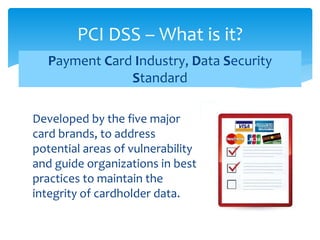
Developed by the five major
card brands, to address
potential areas of vulnerability
and guide organizations in best
practices to maintain the
integrity of cardholder data.
PCI DSS – What is it?
Payment Card Industry, Data Security
Standard
 Failure to comply could result in:
 Significant fines from the card brands
 Inability to accept credit cards for payment
 Damage to Kent State University
brand/reputation
PCI DSS – What is it?
PCI Data Security Standard
What does this
mean for you?
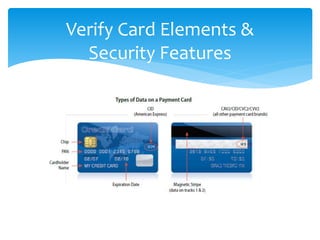
Verify Card Elements &
Security Features
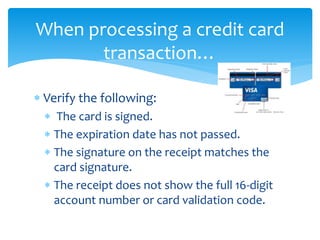
When processing a credit card
transaction…
 Verify the following:
 The card is signed.
 The expiration date has not passed.
 The signature on the receipt matches the
card signature.
 The receipt does not show the full 16-digit
account number or card validation code.
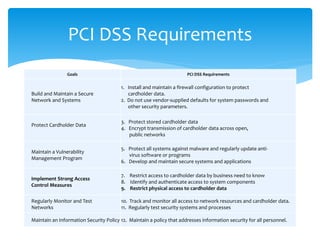
PCI DSS Requirements
Goals PCI DSS Requirements
Build and Maintain a Secure
Network and Systems
1. Install and maintain a firewall configuration to protect
cardholder data.
2. Do not use vendor-supplied defaults for system passwords and
other security parameters.
Protect Cardholder Data
3. Protect stored cardholder data
4. Encrypt transmission of cardholder data across open,
public networks
Maintain a Vulnerability
Management Program
5. Protect all systems against malware and regularly update anti-
virus software or programs
6. Develop and maintain secure systems and applications
Implement Strong Access
Control Measures
7. Restrict access to cardholder data by business need to know
8. Identify and authenticate access to system components
9. Restrict physical access to cardholder data
Regularly Monitor and Test
Networks
10. Track and monitor all access to network resources and cardholder data.
11. Regularly test security systems and processes
Maintain an Information Security Policy 12. Maintain a policy that addresses information security for all personnel.
Implementing Strong Access
Control Measures which
Include:
Restricting physical access to
cardholder data.
Focus on:
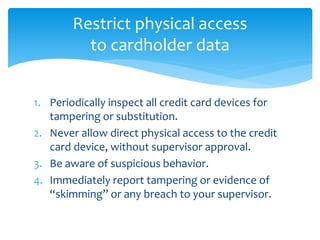
1. Periodically inspect all credit card devices for
tampering or substitution.
2. Never allow direct physical access to the credit
card device, without supervisor approval.
3. Be aware of suspicious behavior.
4. Immediately report tampering or evidence of
“skimming” or any breach to your supervisor.
Restrict physical access
to cardholder data
Periodically inspect all credit card devices
for tampering or substitution.
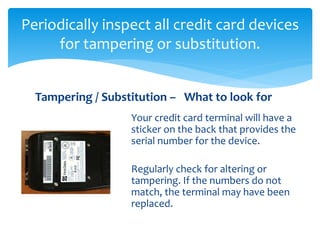
Your credit card terminal will have a
sticker on the back that provides the
serial number for the device.
Regularly check for altering or
tampering. If the numbers do not
match, the terminal may have been
replaced.
Tampering / Substitution – What to look for
Periodically inspect all credit card devices
for tampering or substitution.
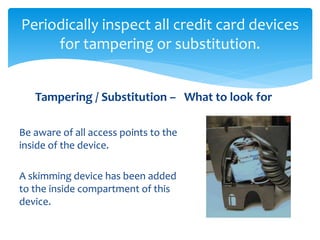
Be aware of all access points to the
inside of the device.
A skimming device has been added
to the inside compartment of this
device.
Tampering / Substitution – What to look for
Periodically inspect all credit card devices
for tampering or substitution.
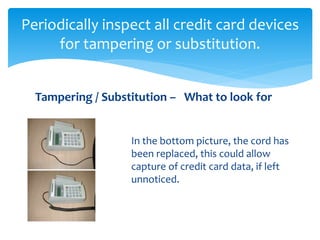
In the bottom picture, the cord has
been replaced, this could allow
capture of credit card data, if left
unnoticed.
Tampering / Substitution – What to look for
Periodically inspect all credit card devices
for tampering or substitution.
Tampering / Substitution – What to look for
More information on skimming prevention may be found at:
https://www.pcisecuritystandards.org/security_standards/docume
nts.php
Download: “Skimming Prevention Best Practices for Merchants”
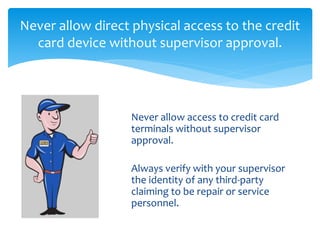
Never allow direct physical access to the credit
card device without supervisor approval.
Never allow access to credit card
terminals without supervisor
approval.
Always verify with your supervisor
the identity of any third-party
claiming to be repair or service
personnel.
Be aware of suspicious behavior.
Be aware of suspicious behavior around
devices (for example, attempts by
unknown persons to unplug or open
devices).
Immediately report tampering or evidence of
skimming or any breach to your supervisor.
If you become aware of evidence of
tampering, replacement, or any
other breach of credit card data,
contact your supervisor
immediately.
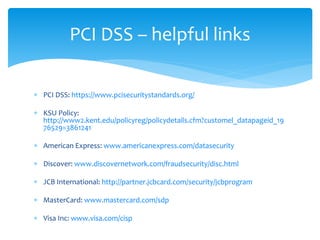
 PCI DSS: https://www.pcisecuritystandards.org/
 KSU Policy:
http://www2.kent.edu/policyreg/policydetails.cfm?customel_datapageid_19
76529=3861241
 American Express: www.americanexpress.com/datasecurity
 Discover: www.discovernetwork.com/fraudsecurity/disc.html
 JCB International: http://partner.jcbcard.com/security/jcbprogram
 MasterCard: www.mastercard.com/sdp
 Visa Inc: www.visa.com/cisp
PCI DSS – helpful links
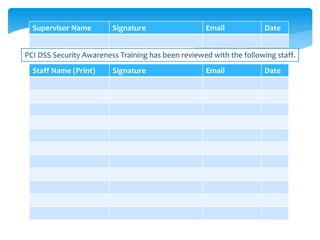
Staff Name (Print) Signature Email Date
Supervisor Name Signature Email Date
PCI DSS Security Awareness Training has been reviewed with the following staff.

PCI_Security_Awareness12345678904321.ppt

  • 1.
    PCI-DSS Security Awareness Whatyou need to know to protect our customers’ data
  • 2.
    Developed by thefive major card brands, to address potential areas of vulnerability and guide organizations in best practices to maintain the integrity of cardholder data. PCI DSS – What is it? Payment Card Industry, Data Security Standard
  • 3.
     Failure tocomply could result in:  Significant fines from the card brands  Inability to accept credit cards for payment  Damage to Kent State University brand/reputation PCI DSS – What is it?
  • 4.
    PCI Data SecurityStandard What does this mean for you?
  • 5.
    Verify Card Elements& Security Features
  • 6.
    When processing acredit card transaction…  Verify the following:  The card is signed.  The expiration date has not passed.  The signature on the receipt matches the card signature.  The receipt does not show the full 16-digit account number or card validation code.
  • 7.
    PCI DSS Requirements GoalsPCI DSS Requirements Build and Maintain a Secure Network and Systems 1. Install and maintain a firewall configuration to protect cardholder data. 2. Do not use vendor-supplied defaults for system passwords and other security parameters. Protect Cardholder Data 3. Protect stored cardholder data 4. Encrypt transmission of cardholder data across open, public networks Maintain a Vulnerability Management Program 5. Protect all systems against malware and regularly update anti- virus software or programs 6. Develop and maintain secure systems and applications Implement Strong Access Control Measures 7. Restrict access to cardholder data by business need to know 8. Identify and authenticate access to system components 9. Restrict physical access to cardholder data Regularly Monitor and Test Networks 10. Track and monitor all access to network resources and cardholder data. 11. Regularly test security systems and processes Maintain an Information Security Policy 12. Maintain a policy that addresses information security for all personnel.
  • 8.
    Implementing Strong Access ControlMeasures which Include: Restricting physical access to cardholder data. Focus on:
  • 9.
    1. Periodically inspectall credit card devices for tampering or substitution. 2. Never allow direct physical access to the credit card device, without supervisor approval. 3. Be aware of suspicious behavior. 4. Immediately report tampering or evidence of “skimming” or any breach to your supervisor. Restrict physical access to cardholder data
  • 10.
    Periodically inspect allcredit card devices for tampering or substitution. Your credit card terminal will have a sticker on the back that provides the serial number for the device. Regularly check for altering or tampering. If the numbers do not match, the terminal may have been replaced. Tampering / Substitution – What to look for
  • 11.
    Periodically inspect allcredit card devices for tampering or substitution. Be aware of all access points to the inside of the device. A skimming device has been added to the inside compartment of this device. Tampering / Substitution – What to look for
  • 12.
    Periodically inspect allcredit card devices for tampering or substitution. In the bottom picture, the cord has been replaced, this could allow capture of credit card data, if left unnoticed. Tampering / Substitution – What to look for
  • 13.
    Periodically inspect allcredit card devices for tampering or substitution. Tampering / Substitution – What to look for More information on skimming prevention may be found at: https://www.pcisecuritystandards.org/security_standards/docume nts.php Download: “Skimming Prevention Best Practices for Merchants”
  • 14.
    Never allow directphysical access to the credit card device without supervisor approval. Never allow access to credit card terminals without supervisor approval. Always verify with your supervisor the identity of any third-party claiming to be repair or service personnel.
  • 15.
    Be aware ofsuspicious behavior. Be aware of suspicious behavior around devices (for example, attempts by unknown persons to unplug or open devices).
  • 16.
    Immediately report tamperingor evidence of skimming or any breach to your supervisor. If you become aware of evidence of tampering, replacement, or any other breach of credit card data, contact your supervisor immediately.
  • 17.
     PCI DSS:https://www.pcisecuritystandards.org/  KSU Policy: http://www2.kent.edu/policyreg/policydetails.cfm?customel_datapageid_19 76529=3861241  American Express: www.americanexpress.com/datasecurity  Discover: www.discovernetwork.com/fraudsecurity/disc.html  JCB International: http://partner.jcbcard.com/security/jcbprogram  MasterCard: www.mastercard.com/sdp  Visa Inc: www.visa.com/cisp PCI DSS – helpful links
  • 18.
    Staff Name (Print)Signature Email Date Supervisor Name Signature Email Date PCI DSS Security Awareness Training has been reviewed with the following staff.