PCB Manufacturing Process
PAGE 1
What is a PCB?
1. A PCB is a flat board made of non-conductive material, usually fiber glass or composite glass epoxy, on
which electronic components are mounted.
2. A PCB can have conductors on one side or two sides and can be multi-layered sandwich with many
layers of conductors, each separated by insulating layers.
3. They provide a compact and organized platform for connecting and mounting components,
simplifying the assembly process.
Types of PCB
 Single Side
 Double Side
 Multilayer
 Rigid-flex
Layers of a PCB
 Substrate
o FR-4
 FR4 is a class of printed circuit board base material made from a flame retardant epoxy
resin and glass fabric composite. FR stands for flame retardant and meets the
requirements of UL94V-0. FR4 has good adhesion to copper foil and has minimal water
absorption, making it very suitable for standard applications. FR4 is either used as a
copper-coated material for 1 and 2-layer PCBs or is used for multilayer PCBs
PAGE 2
o Teflon
 PTFE Teflon PCB to meet the demand for faster communications. Teflon materials are
valued for their suitability in high-frequency electronic applications. The most common
of these Teflon PCB materials were developed by Rogers.
PAGE 3
 The military-grade Teflon PCBs (such as Rogers RT5000 and RT600 series) are mainly
used in
 Antenna Systems
 Communication Systems
 Copper Layer
o Copper layers can be referred to as a printed circuit board (PCB) having copper present on it
once etching is completed. This is usually pads and tracks or ground and power layers.
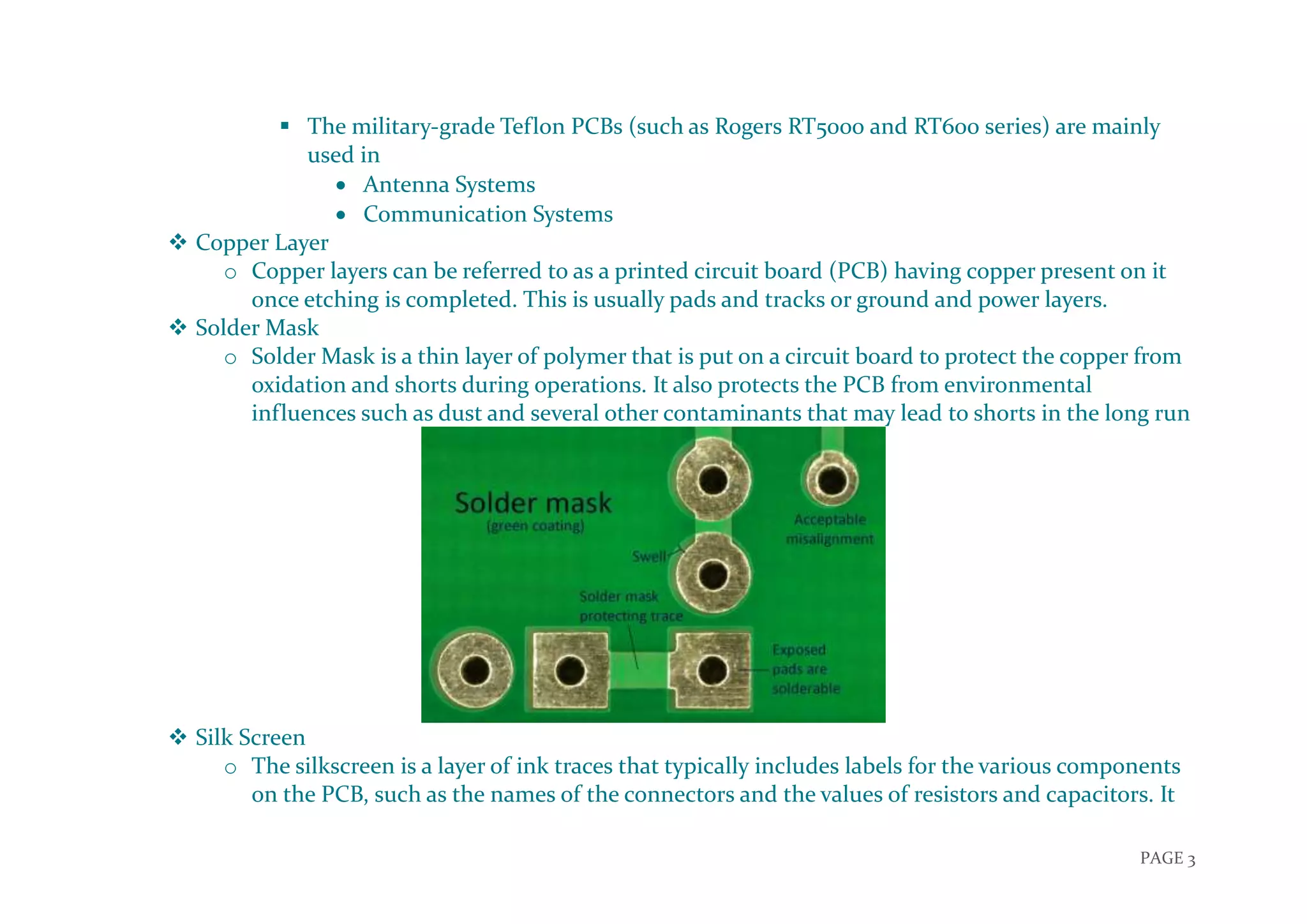
 Solder Mask
o Solder Mask is a thin layer of polymer that is put on a circuit board to protect the copper from
oxidation and shorts during operations. It also protects the PCB from environmental
influences such as dust and several other contaminants that may lead to shorts in the long run
 Silk Screen
o The silkscreen is a layer of ink traces that typically includes labels for the various components
on the PCB, such as the names of the connectors and the values of resistors and capacitors. It
PAGE 4
may also include other information, such as the PCB's title, the polarity of parts, and the test
point locations. The silkscreen is applied to the component part of the printed circuit board.
LEGEND
PAGE 5
MANUAL SCREEN PRINTING
PAGE 6
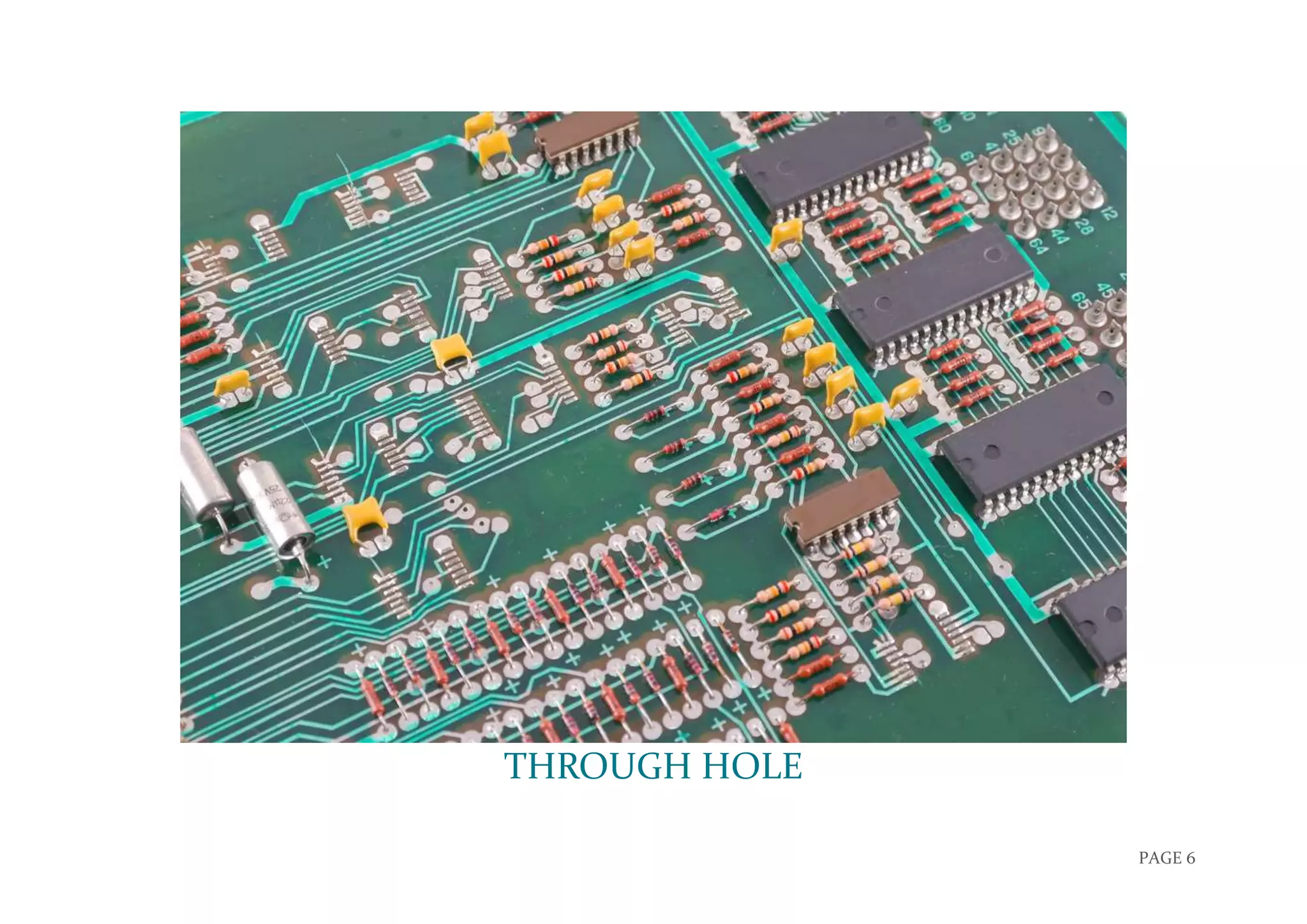
THROUGH HOLE
PAGE 7
SURFACE MOUNT
PAGE 8
PCB DRILLING
 PCB drilling (which is also known as printed circuit board drilling), is the process of creating holes,
slots and other cavities in an electronic circuit board.
 Drilling is the most expensive and time-consuming part of the circuit board manufacturing process.
This is because the process must be carried out exactly to ensure the highest possible levels of quality.
 After the substrate has been prepared for drilling, tooling pins are inserted and are used to hold the
board while it’s in the pre-programmed computer numerically controlled (CNC) machine. Then, the
component mounting holes are drilled in the PCB before the boards are split and measured for
accuracy.
 Finally, a polisher scrubs the surface of the copper clean to remove any small burrs or rough edges.
PAGE 9
FILM DEVELOPMENT
DRY FILM WET FILM
The most common production process is to put the dry film-attached CCL under the film with the
circuit pattern and expose/develop it in the UV machine. The dry film uncovered by circuit pattern
gets hardened, meanwhile, the covered dry film can be removed. Next, the bare copper wire is tinned
and then coated with etch resist, and the hardened dry film and the underlying copper are removed in
the etching process, finally, you get the desired circuit traces.
PAGE 10
ETCHING PROCESS
Etching machine is used to spray chemical solution to copper clad laminator, aluminum substrate or
stainless steel plate, the exposed copper, aluminum, stainless steel are etched away, retain the pattern
or circuit covered by the corrosion-proof film, so as to achieve the purpose of making pattern or circuit.
The etching machine is divided into acid etching machine, alkaline etching machine and hydrofluoric
acid glass etching machine (the three kinds of etching machines can be provided by our company).
The acid etching machine is mostly used for etching the inner layer of the circuit board, and the
production of small batches of various types of sample boards. Acid copper chloride is generally used
(copper chloride is added with hydrochloric acid), which is characterized by easy control, small side
corrosion, large amount of dissolved copper, easy regeneration and recovery, and the etching solution
can achieve high quality etching under stable conditions.
The alkaline etching machine is used for the outer layer of circuit boards, large-scale double-sided
board production, and the production of aluminum substrates. Its alkaline etching process has the
advantages of cost saving and easy control.
PAGE 11
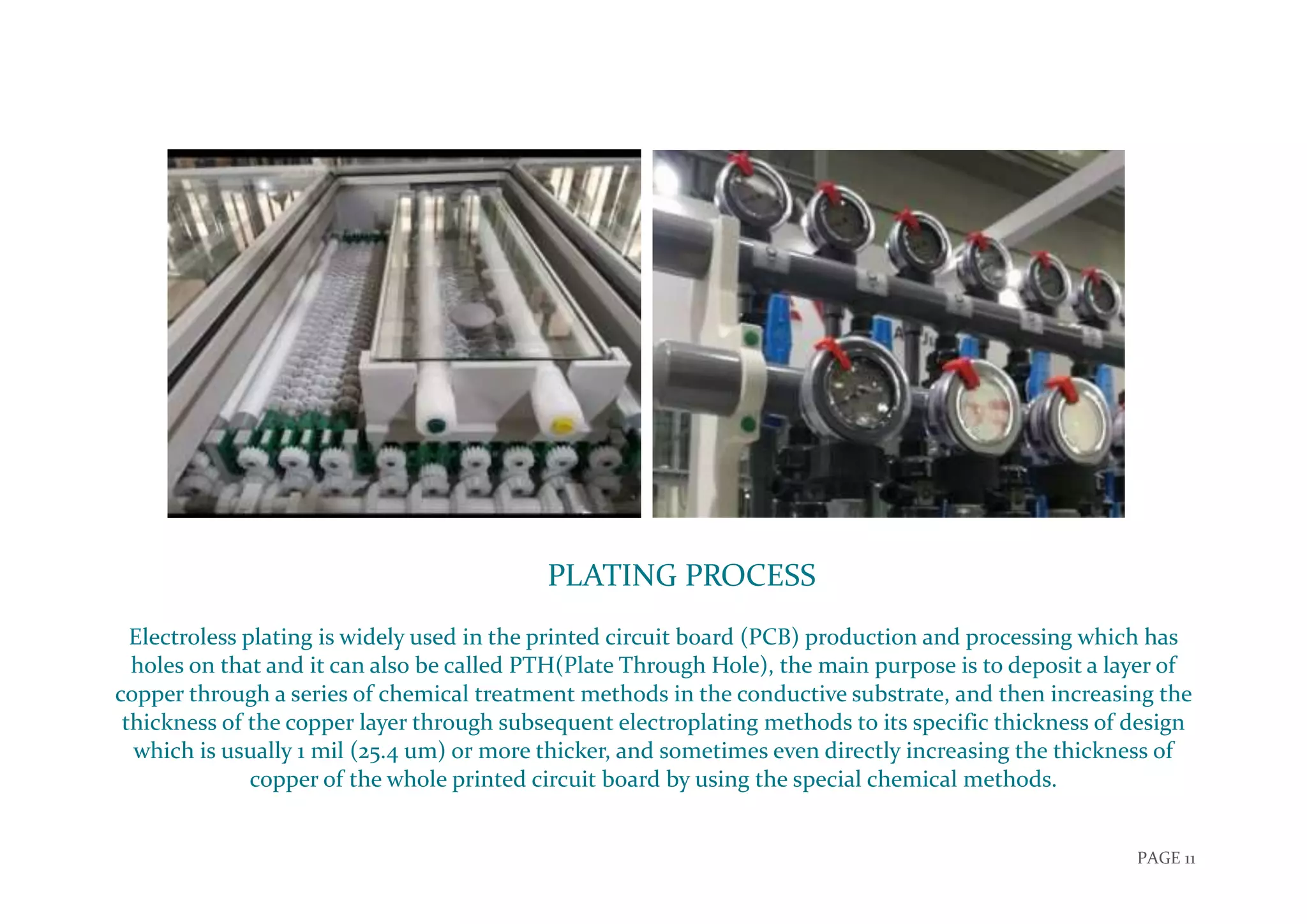
PLATING PROCESS
Electroless plating is widely used in the printed circuit board (PCB) production and processing which has
holes on that and it can also be called PTH(Plate Through Hole), the main purpose is to deposit a layer of
copper through a series of chemical treatment methods in the conductive substrate, and then increasing the
thickness of the copper layer through subsequent electroplating methods to its specific thickness of design
which is usually 1 mil (25.4 um) or more thicker, and sometimes even directly increasing the thickness of
copper of the whole printed circuit board by using the special chemical methods.
PAGE 12
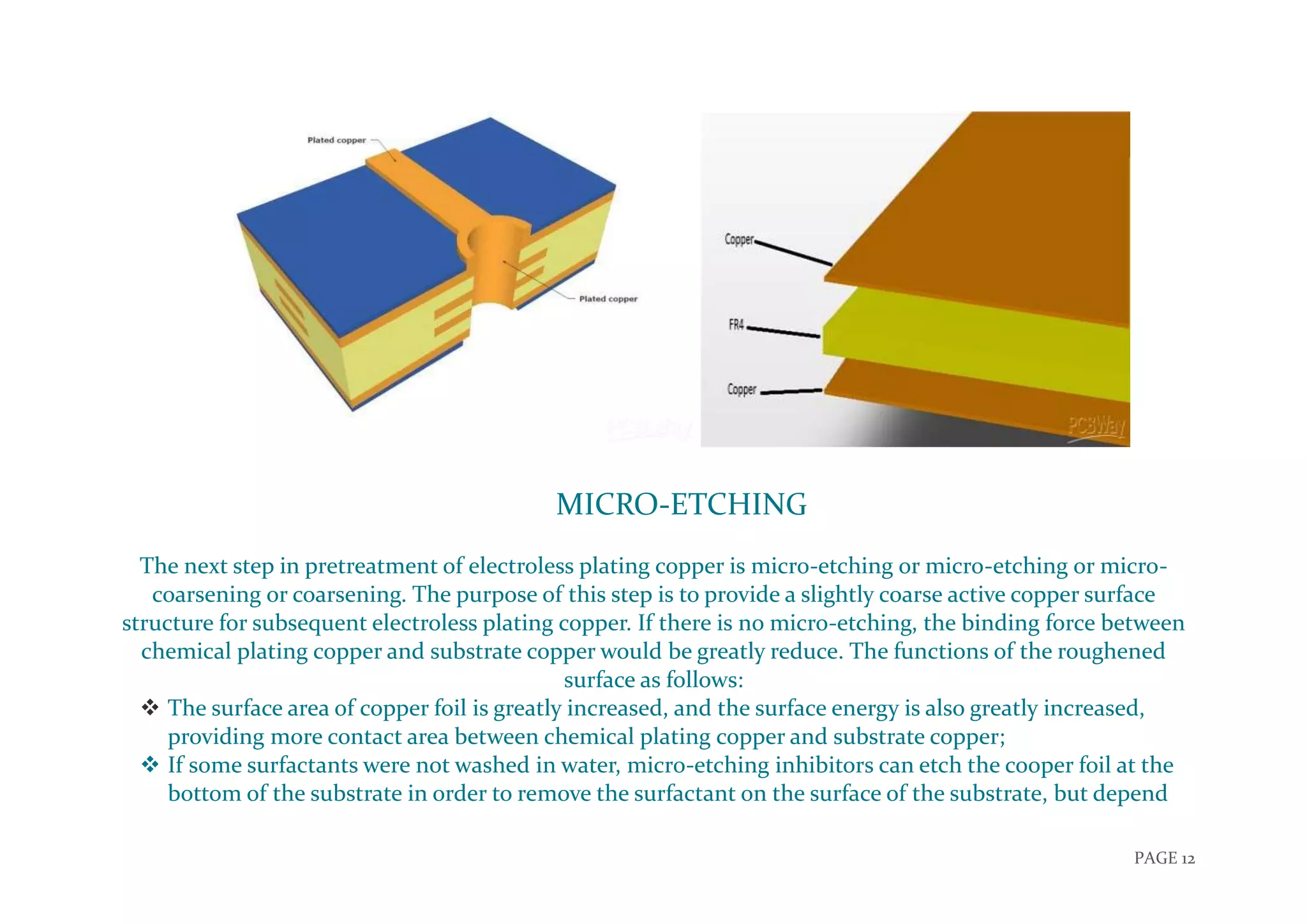
MICRO-ETCHING
The next step in pretreatment of electroless plating copper is micro-etching or micro-etching or micro-
coarsening or coarsening. The purpose of this step is to provide a slightly coarse active copper surface
structure for subsequent electroless plating copper. If there is no micro-etching, the binding force between
chemical plating copper and substrate copper would be greatly reduce. The functions of the roughened
surface as follows:
 The surface area of copper foil is greatly increased, and the surface energy is also greatly increased,
providing more contact area between chemical plating copper and substrate copper;
 If some surfactants were not washed in water, micro-etching inhibitors can etch the cooper foil at the
bottom of the substrate in order to remove the surfactant on the surface of the substrate, but depend
PAGE 13
entirely on micro etching agent to take out the surfactant is not too realistic and effective. For example,
when the area of the surfactant left on the copper layer is larger, the function of micro-etching
inhibitors is very small, and it even cannot exposure the surfactant on the copper layer.
PAGE 14

PCB Manufacturing Process.docx

  • 1.
  • 2.
    PAGE 1 What isa PCB? 1. A PCB is a flat board made of non-conductive material, usually fiber glass or composite glass epoxy, on which electronic components are mounted. 2. A PCB can have conductors on one side or two sides and can be multi-layered sandwich with many layers of conductors, each separated by insulating layers. 3. They provide a compact and organized platform for connecting and mounting components, simplifying the assembly process. Types of PCB  Single Side  Double Side  Multilayer  Rigid-flex Layers of a PCB  Substrate o FR-4  FR4 is a class of printed circuit board base material made from a flame retardant epoxy resin and glass fabric composite. FR stands for flame retardant and meets the requirements of UL94V-0. FR4 has good adhesion to copper foil and has minimal water absorption, making it very suitable for standard applications. FR4 is either used as a copper-coated material for 1 and 2-layer PCBs or is used for multilayer PCBs
  • 3.
    PAGE 2 o Teflon PTFE Teflon PCB to meet the demand for faster communications. Teflon materials are valued for their suitability in high-frequency electronic applications. The most common of these Teflon PCB materials were developed by Rogers.
  • 4.
    PAGE 3  Themilitary-grade Teflon PCBs (such as Rogers RT5000 and RT600 series) are mainly used in  Antenna Systems  Communication Systems  Copper Layer o Copper layers can be referred to as a printed circuit board (PCB) having copper present on it once etching is completed. This is usually pads and tracks or ground and power layers.  Solder Mask o Solder Mask is a thin layer of polymer that is put on a circuit board to protect the copper from oxidation and shorts during operations. It also protects the PCB from environmental influences such as dust and several other contaminants that may lead to shorts in the long run  Silk Screen o The silkscreen is a layer of ink traces that typically includes labels for the various components on the PCB, such as the names of the connectors and the values of resistors and capacitors. It
  • 5.
    PAGE 4 may alsoinclude other information, such as the PCB's title, the polarity of parts, and the test point locations. The silkscreen is applied to the component part of the printed circuit board. LEGEND
  • 6.
  • 7.
  • 8.
  • 9.
    PAGE 8 PCB DRILLING PCB drilling (which is also known as printed circuit board drilling), is the process of creating holes, slots and other cavities in an electronic circuit board.  Drilling is the most expensive and time-consuming part of the circuit board manufacturing process. This is because the process must be carried out exactly to ensure the highest possible levels of quality.  After the substrate has been prepared for drilling, tooling pins are inserted and are used to hold the board while it’s in the pre-programmed computer numerically controlled (CNC) machine. Then, the component mounting holes are drilled in the PCB before the boards are split and measured for accuracy.  Finally, a polisher scrubs the surface of the copper clean to remove any small burrs or rough edges.
  • 10.
    PAGE 9 FILM DEVELOPMENT DRYFILM WET FILM The most common production process is to put the dry film-attached CCL under the film with the circuit pattern and expose/develop it in the UV machine. The dry film uncovered by circuit pattern gets hardened, meanwhile, the covered dry film can be removed. Next, the bare copper wire is tinned and then coated with etch resist, and the hardened dry film and the underlying copper are removed in the etching process, finally, you get the desired circuit traces.
  • 11.
    PAGE 10 ETCHING PROCESS Etchingmachine is used to spray chemical solution to copper clad laminator, aluminum substrate or stainless steel plate, the exposed copper, aluminum, stainless steel are etched away, retain the pattern or circuit covered by the corrosion-proof film, so as to achieve the purpose of making pattern or circuit. The etching machine is divided into acid etching machine, alkaline etching machine and hydrofluoric acid glass etching machine (the three kinds of etching machines can be provided by our company). The acid etching machine is mostly used for etching the inner layer of the circuit board, and the production of small batches of various types of sample boards. Acid copper chloride is generally used (copper chloride is added with hydrochloric acid), which is characterized by easy control, small side corrosion, large amount of dissolved copper, easy regeneration and recovery, and the etching solution can achieve high quality etching under stable conditions. The alkaline etching machine is used for the outer layer of circuit boards, large-scale double-sided board production, and the production of aluminum substrates. Its alkaline etching process has the advantages of cost saving and easy control.
  • 12.
    PAGE 11 PLATING PROCESS Electrolessplating is widely used in the printed circuit board (PCB) production and processing which has holes on that and it can also be called PTH(Plate Through Hole), the main purpose is to deposit a layer of copper through a series of chemical treatment methods in the conductive substrate, and then increasing the thickness of the copper layer through subsequent electroplating methods to its specific thickness of design which is usually 1 mil (25.4 um) or more thicker, and sometimes even directly increasing the thickness of copper of the whole printed circuit board by using the special chemical methods.
  • 13.
    PAGE 12 MICRO-ETCHING The nextstep in pretreatment of electroless plating copper is micro-etching or micro-etching or micro- coarsening or coarsening. The purpose of this step is to provide a slightly coarse active copper surface structure for subsequent electroless plating copper. If there is no micro-etching, the binding force between chemical plating copper and substrate copper would be greatly reduce. The functions of the roughened surface as follows:  The surface area of copper foil is greatly increased, and the surface energy is also greatly increased, providing more contact area between chemical plating copper and substrate copper;  If some surfactants were not washed in water, micro-etching inhibitors can etch the cooper foil at the bottom of the substrate in order to remove the surfactant on the surface of the substrate, but depend
  • 14.
    PAGE 13 entirely onmicro etching agent to take out the surfactant is not too realistic and effective. For example, when the area of the surfactant left on the copper layer is larger, the function of micro-etching inhibitors is very small, and it even cannot exposure the surfactant on the copper layer.
  • 15.