Performance Review Guidelines for Managers
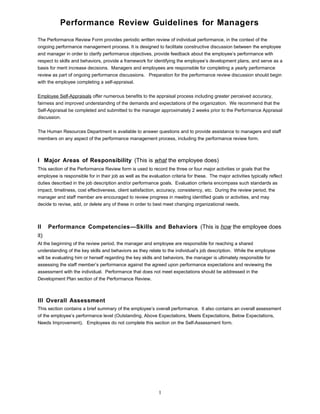
The Performance Review Form provides periodic written review of individual performance, in the context of the
ongoing performance management process. It is designed to facilitate constructive discussion between the employee
and manager in order to clarify performance objectives, provide feedback about the employee’s performance with
respect to skills and behaviors, provide a framework for identifying the employee’s development plans, and serve as a
basis for merit increase decisions. Managers and employees are responsible for completing a yearly performance
review as part of ongoing performance discussions. Preparation for the performance review discussion should begin
with the employee completing a self-appraisal.
Employee Self-Appraisals offer numerous benefits to the appraisal process including greater perceived accuracy,
fairness and improved understanding of the demands and expectations of the organization. We recommend that the
Self-Appraisal be completed and submitted to the manager approximately 2 weeks prior to the Performance Appraisal
discussion.
The Human Resources Department is available to answer questions and to provide assistance to managers and staff
members on any aspect of the performance management process, including the performance review form.
I Major Areas of Responsibility (This is what the employee does)
This section of the Performance Review form is used to record the three or four major activities or goals that the
employee is responsible for in their job as well as the evaluation criteria for these. The major activities typically reflect
duties described in the job description and/or performance goals. Evaluation criteria encompass such standards as
impact, timeliness, cost effectiveness, client satisfaction, accuracy, consistency, etc. During the review period, the
manager and staff member are encouraged to review progress in meeting identified goals or activities, and may
decide to revise, add, or delete any of these in order to best meet changing organizational needs.
II Performance Competencies—Skills and Behaviors (This is how the employee does
it)
At the beginning of the review period, the manager and employee are responsible for reaching a shared
understanding of the key skills and behaviors as they relate to the individual’s job description. While the employee
will be evaluating him or herself regarding the key skills and behaviors, the manager is ultimately responsible for
assessing the staff member’s performance against the agreed upon performance expectations and reviewing the
assessment with the individual. Performance that does not meet expectations should be addressed in the
Development Plan section of the Performance Review.
III Overall Assessment
This section contains a brief summary of the employee’s overall performance. It also contains an overall assessment
of the employee’s performance level (Outstanding, Above Expectations, Meets Expectations, Below Expectations,
Needs Improvement). Employees do not complete this section on the Self-Assessment form.
1
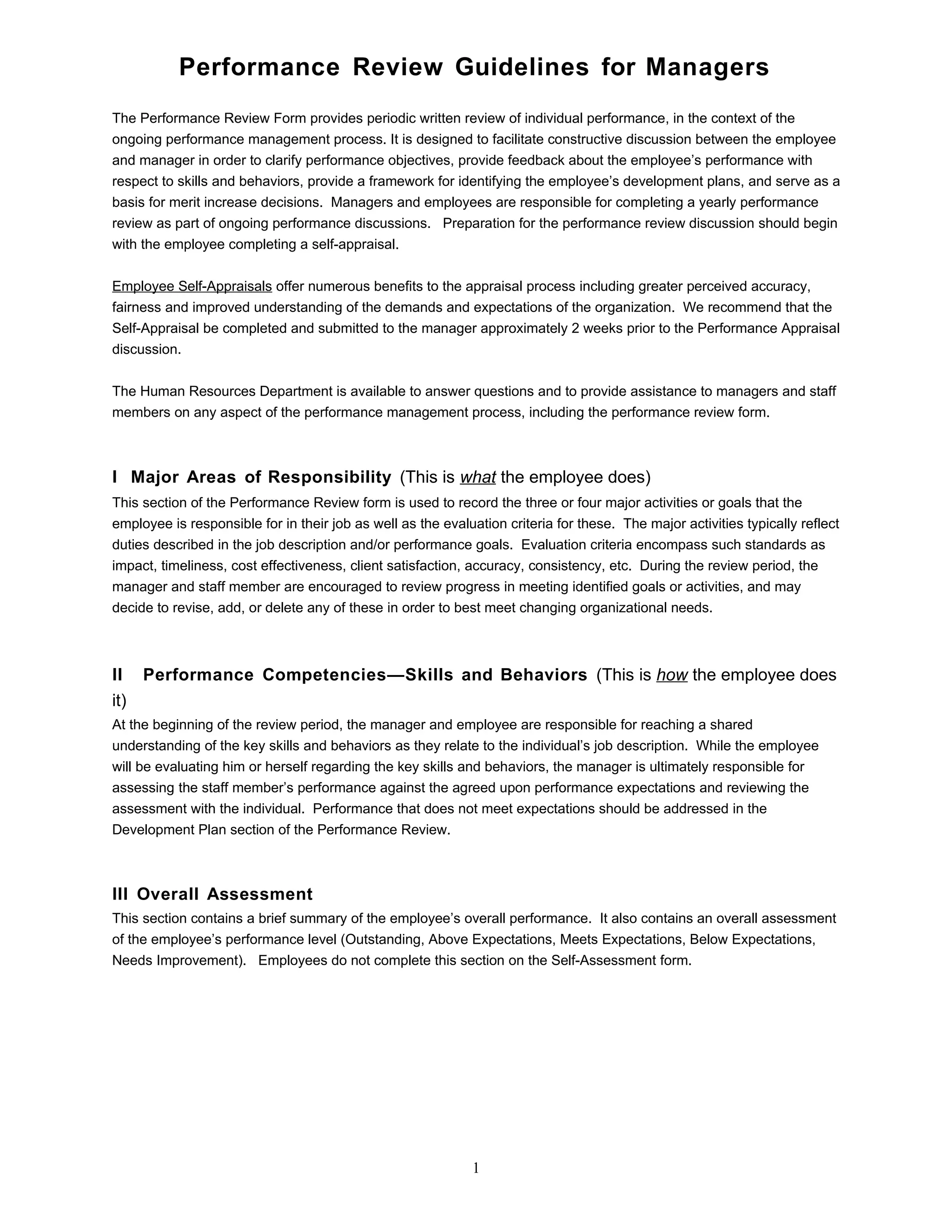
IV Development Plan
There are four kinds of Development Plans:
1) Development to close performance gaps: the manager, in conjunction with the staff member, should identify
development plans for any goals, skills or behaviors which are assessed at the “Needs Improvement” performance
level.
Development plans which address performance at the “Needs Improvement” performance level should be reviewed
and discussed through ongoing performance discussions.
2) Development to enhance job skills and performance: plans identified by a manager with the individual to provide
opportunities for a staff member to enhance job-related skills and performance.
3) Development for career advancement: plans identified by the manager and individual to enhance the promotability
of a staff member.
4) Development for career exploration: staff members may initiate a development plan to provide opportunities for
career exploration through cross-training or mentoring activities.
V Performance Goals and Expectations
This section is used to begin the performance management process for the next review period. Goals typically
reflect major job activities and may be modified throughout the year based upon changing organizational needs.
2
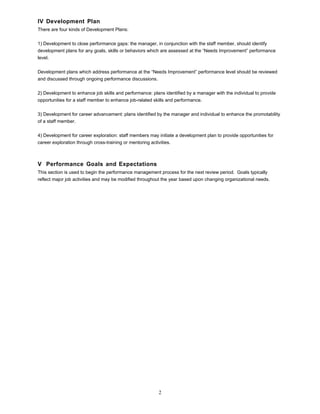
Performance Review
Name ___________ Date of Review
Job Title Department___________________________
Date Appointed to this Position___ Review Period________________
Manager’s Name and Title_______________________________________________________________
Section I—Major Areas of Responsibility
Performance Ratings:
Outstanding – Consistently far exceeds expectations.
Above Expectations - Consistently meets and frequently exceeds expectations.
Meets Expectations - Consistently meets and occasionally exceeds expectations.
Below Expectations - Occasionally fails to meet expectations.
Needs Improvement - Frequently fails to meet expectations.
Major Areas of Responsibility/Goals— These typically relate to the major activities that the employee
performs on the job and/or the goals that have been discussed and established by the manager. This is also an
opportunity to describe noteworthy accomplishments. (Note: the job description should be reviewed and updated, if
necessary, as part of the Performance Review process.)
Primary Performance
Expectations:
Responsibilities/Goals
Notes/Comments on Achievements &
Areas for Improvement
Outstanding Above
Expectations
Meets Expectations
Below Expectations
Needs Improvement
3
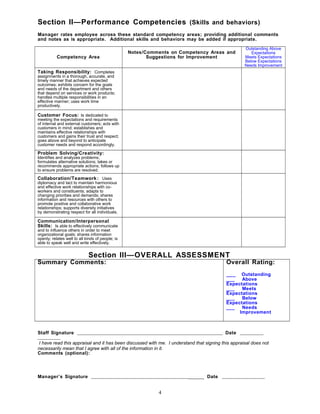
Section II—Performance Competencies (Skills and behaviors)
Manager rates employee across these standard competency areas; providing additional comments
and notes as is appropriate. Additional skills and behaviors may be added if appropriate.
Competency Area
Notes/Comments on Competency Areas and
Suggestions for Improvement
Outstanding Above
Expectations
Meets Expectations
Below Expectations
Needs Improvement
Taking Responsibility: Completes
assignments in a thorough, accurate, and
timely manner that achieves expected
outcomes; exhibits concern for the goals
and needs of the department and others
that depend on services or work products;
handles multiple responsibilities in an
effective manner; uses work time
productively.
Customer Focus: Is dedicated to
meeting the expectations and requirements
of internal and external customers; acts with
customers in mind; establishes and
maintains effective relationships with
customers and gains their trust and respect;
goes above and beyond to anticipate
customer needs and respond accordingly.
Problem Solving/Creativity:
Identifies and analyzes problems;
formulates alternative solutions; takes or
recommends appropriate actions; follows up
to ensure problems are resolved.
Collaboration/Teamwork: Uses
diplomacy and tact to maintain harmonious
and effective work relationships with co-
workers and constituents; adapts to
changing priorities and demands; shares
information and resources with others to
promote positive and collaborative work
relationships; supports diversity initiatives
by demonstrating respect for all individuals.
Communication/Interpersonal
Skills: Is able to effectively communicate
and to influence others in order to meet
organizational goals; shares information
openly; relates well to all kinds of people; is
able to speak well and write effectively.
Section III—OVERALL ASSESSMENT
Summary Comments: Overall Rating:
___ Outstanding
___ Above
Expectations
___ Meets
Expectations
___ Below
Expectations
___ Needs
Improvement
Staff Signature Date
I have read this appraisal and it has been discussed with me. I understand that signing this appraisal does not
necessarily mean that I agree with all of the information in it.
Comments (optional):
Manager’s Signature ______ Date
4
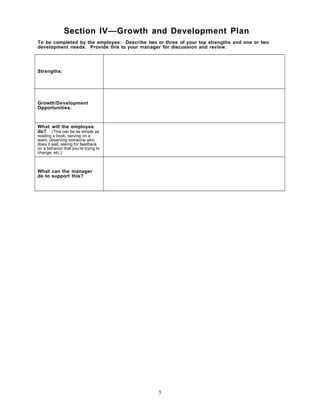
Section IV—Growth and Development Plan
To be completed by the employee: Describe two or three of your top strengths and one or two
development needs. Provide this to your manager for discussion and review.
Strengths:
Growth/Development
Opportunities:
What will the employee
do? (This can be as simple as
reading a book, serving on a
team, observing someone who
does it well, asking for feedback
on a behavior that you’re trying to
change, etc.)
What can the manager
do to support this?
5
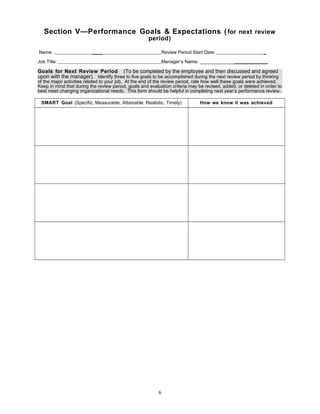
Section V—Performance Goals & Expectations (for next review
period)
Name: ____ Review Period Start Date: _
Job Title: Manager’s Name: __________________________
Goals for Next Review Period (To be completed by the employee and then discussed and agreed
upon with the manager). Identify three to five goals to be accomplished during the next review period by thinking
of the major activities related to your job. At the end of the review period, rate how well these goals were achieved.
Keep in mind that during the review period, goals and evaluation criteria may be revised, added, or deleted in order to
best meet changing organizational needs. This form should be helpful in completing next year’s performance review.
SMART Goal (Specific, Measurable, Attainable, Realistic, Timely) How we know it was achieved
6
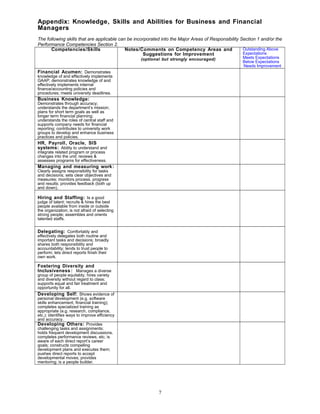
Appendix: Knowledge, Skills and Abilities for Business and Financial
Managers
The following skills that are applicable can be incorporated into the Major Areas of Responsibility Section 1 and/or the
Performance Competencies Section 2.
Competencies/Skills Notes/Comments on Competency Areas and
Suggestions for Improvement
(optional but strongly encouraged)
Outstanding Above
Expectations
Meets Expectations
Below Expectations
Needs Improvement
Financial Acumen: Demonstrates
knowledge of and effectively implements
GAAP; demonstrates knowledge of and
effectively implements internal
finance/accounting policies and
procedures; meets university deadlines.
Business Knowledge:
Demonstrates through accuracy;
understands the department’s mission;
plans for short term goals as well as
longer term financial planning;
understands the roles of central staff and
supports company needs for financial
reporting; contributes to university work
groups to develop and enhance business
practices and policies.
HR, Payroll, Oracle, SIS
systems: Ability to understand and
integrate related program or process
changes into the unit; reviews &
assesses programs for effectiveness.
Managing and measuring work:
Clearly assigns responsibility for tasks
and decisions; sets clear objectives and
measures; monitors process, progress
and results; provides feedback (both up
and down).
Hiring and Staffing: Is a good
judge of talent; recruits & hires the best
people available from inside or outside
the organization; is not afraid of selecting
strong people; assembles and orients
talented staffs.
Delegating: Comfortably and
effectively delegates both routine and
important tasks and decisions; broadly
shares both responsibility and
accountability; tends to trust people to
perform; lets direct reports finish their
own work.
Fostering Diversity and
Inclusiveness: Manages a diverse
group of people equitably; hires variety
and diversity without regard to class;
supports equal and fair treatment and
opportunity for all.
Developing Self: Shows evidence of
personal development (e.g. software
skills enhancement, financial training);
completes specialized training as
appropriate (e.g. research, compliance,
etc.); identifies ways to improve efficiency
and accuracy.
Developing Others: Provides
challenging tasks and assignments;
holds frequent development discussions,
completes performance reviews, etc; is
aware of each direct report’s career
goals; constructs compelling
development plans and executes them;
pushes direct reports to accept
developmental moves; provides
mentoring; is a people builder.
7

Performance review Appraisal

  • 1.
    Performance Review Guidelinesfor Managers The Performance Review Form provides periodic written review of individual performance, in the context of the ongoing performance management process. It is designed to facilitate constructive discussion between the employee and manager in order to clarify performance objectives, provide feedback about the employee’s performance with respect to skills and behaviors, provide a framework for identifying the employee’s development plans, and serve as a basis for merit increase decisions. Managers and employees are responsible for completing a yearly performance review as part of ongoing performance discussions. Preparation for the performance review discussion should begin with the employee completing a self-appraisal. Employee Self-Appraisals offer numerous benefits to the appraisal process including greater perceived accuracy, fairness and improved understanding of the demands and expectations of the organization. We recommend that the Self-Appraisal be completed and submitted to the manager approximately 2 weeks prior to the Performance Appraisal discussion. The Human Resources Department is available to answer questions and to provide assistance to managers and staff members on any aspect of the performance management process, including the performance review form. I Major Areas of Responsibility (This is what the employee does) This section of the Performance Review form is used to record the three or four major activities or goals that the employee is responsible for in their job as well as the evaluation criteria for these. The major activities typically reflect duties described in the job description and/or performance goals. Evaluation criteria encompass such standards as impact, timeliness, cost effectiveness, client satisfaction, accuracy, consistency, etc. During the review period, the manager and staff member are encouraged to review progress in meeting identified goals or activities, and may decide to revise, add, or delete any of these in order to best meet changing organizational needs. II Performance Competencies—Skills and Behaviors (This is how the employee does it) At the beginning of the review period, the manager and employee are responsible for reaching a shared understanding of the key skills and behaviors as they relate to the individual’s job description. While the employee will be evaluating him or herself regarding the key skills and behaviors, the manager is ultimately responsible for assessing the staff member’s performance against the agreed upon performance expectations and reviewing the assessment with the individual. Performance that does not meet expectations should be addressed in the Development Plan section of the Performance Review. III Overall Assessment This section contains a brief summary of the employee’s overall performance. It also contains an overall assessment of the employee’s performance level (Outstanding, Above Expectations, Meets Expectations, Below Expectations, Needs Improvement). Employees do not complete this section on the Self-Assessment form. 1
  • 2.
    IV Development Plan Thereare four kinds of Development Plans: 1) Development to close performance gaps: the manager, in conjunction with the staff member, should identify development plans for any goals, skills or behaviors which are assessed at the “Needs Improvement” performance level. Development plans which address performance at the “Needs Improvement” performance level should be reviewed and discussed through ongoing performance discussions. 2) Development to enhance job skills and performance: plans identified by a manager with the individual to provide opportunities for a staff member to enhance job-related skills and performance. 3) Development for career advancement: plans identified by the manager and individual to enhance the promotability of a staff member. 4) Development for career exploration: staff members may initiate a development plan to provide opportunities for career exploration through cross-training or mentoring activities. V Performance Goals and Expectations This section is used to begin the performance management process for the next review period. Goals typically reflect major job activities and may be modified throughout the year based upon changing organizational needs. 2
  • 3.
    Performance Review Name ___________Date of Review Job Title Department___________________________ Date Appointed to this Position___ Review Period________________ Manager’s Name and Title_______________________________________________________________ Section I—Major Areas of Responsibility Performance Ratings: Outstanding – Consistently far exceeds expectations. Above Expectations - Consistently meets and frequently exceeds expectations. Meets Expectations - Consistently meets and occasionally exceeds expectations. Below Expectations - Occasionally fails to meet expectations. Needs Improvement - Frequently fails to meet expectations. Major Areas of Responsibility/Goals— These typically relate to the major activities that the employee performs on the job and/or the goals that have been discussed and established by the manager. This is also an opportunity to describe noteworthy accomplishments. (Note: the job description should be reviewed and updated, if necessary, as part of the Performance Review process.) Primary Performance Expectations: Responsibilities/Goals Notes/Comments on Achievements & Areas for Improvement Outstanding Above Expectations Meets Expectations Below Expectations Needs Improvement 3
  • 4.
    Section II—Performance Competencies(Skills and behaviors) Manager rates employee across these standard competency areas; providing additional comments and notes as is appropriate. Additional skills and behaviors may be added if appropriate. Competency Area Notes/Comments on Competency Areas and Suggestions for Improvement Outstanding Above Expectations Meets Expectations Below Expectations Needs Improvement Taking Responsibility: Completes assignments in a thorough, accurate, and timely manner that achieves expected outcomes; exhibits concern for the goals and needs of the department and others that depend on services or work products; handles multiple responsibilities in an effective manner; uses work time productively. Customer Focus: Is dedicated to meeting the expectations and requirements of internal and external customers; acts with customers in mind; establishes and maintains effective relationships with customers and gains their trust and respect; goes above and beyond to anticipate customer needs and respond accordingly. Problem Solving/Creativity: Identifies and analyzes problems; formulates alternative solutions; takes or recommends appropriate actions; follows up to ensure problems are resolved. Collaboration/Teamwork: Uses diplomacy and tact to maintain harmonious and effective work relationships with co- workers and constituents; adapts to changing priorities and demands; shares information and resources with others to promote positive and collaborative work relationships; supports diversity initiatives by demonstrating respect for all individuals. Communication/Interpersonal Skills: Is able to effectively communicate and to influence others in order to meet organizational goals; shares information openly; relates well to all kinds of people; is able to speak well and write effectively. Section III—OVERALL ASSESSMENT Summary Comments: Overall Rating: ___ Outstanding ___ Above Expectations ___ Meets Expectations ___ Below Expectations ___ Needs Improvement Staff Signature Date I have read this appraisal and it has been discussed with me. I understand that signing this appraisal does not necessarily mean that I agree with all of the information in it. Comments (optional): Manager’s Signature ______ Date 4
  • 5.
    Section IV—Growth andDevelopment Plan To be completed by the employee: Describe two or three of your top strengths and one or two development needs. Provide this to your manager for discussion and review. Strengths: Growth/Development Opportunities: What will the employee do? (This can be as simple as reading a book, serving on a team, observing someone who does it well, asking for feedback on a behavior that you’re trying to change, etc.) What can the manager do to support this? 5
  • 6.
    Section V—Performance Goals& Expectations (for next review period) Name: ____ Review Period Start Date: _ Job Title: Manager’s Name: __________________________ Goals for Next Review Period (To be completed by the employee and then discussed and agreed upon with the manager). Identify three to five goals to be accomplished during the next review period by thinking of the major activities related to your job. At the end of the review period, rate how well these goals were achieved. Keep in mind that during the review period, goals and evaluation criteria may be revised, added, or deleted in order to best meet changing organizational needs. This form should be helpful in completing next year’s performance review. SMART Goal (Specific, Measurable, Attainable, Realistic, Timely) How we know it was achieved 6
  • 7.
    Appendix: Knowledge, Skillsand Abilities for Business and Financial Managers The following skills that are applicable can be incorporated into the Major Areas of Responsibility Section 1 and/or the Performance Competencies Section 2. Competencies/Skills Notes/Comments on Competency Areas and Suggestions for Improvement (optional but strongly encouraged) Outstanding Above Expectations Meets Expectations Below Expectations Needs Improvement Financial Acumen: Demonstrates knowledge of and effectively implements GAAP; demonstrates knowledge of and effectively implements internal finance/accounting policies and procedures; meets university deadlines. Business Knowledge: Demonstrates through accuracy; understands the department’s mission; plans for short term goals as well as longer term financial planning; understands the roles of central staff and supports company needs for financial reporting; contributes to university work groups to develop and enhance business practices and policies. HR, Payroll, Oracle, SIS systems: Ability to understand and integrate related program or process changes into the unit; reviews & assesses programs for effectiveness. Managing and measuring work: Clearly assigns responsibility for tasks and decisions; sets clear objectives and measures; monitors process, progress and results; provides feedback (both up and down). Hiring and Staffing: Is a good judge of talent; recruits & hires the best people available from inside or outside the organization; is not afraid of selecting strong people; assembles and orients talented staffs. Delegating: Comfortably and effectively delegates both routine and important tasks and decisions; broadly shares both responsibility and accountability; tends to trust people to perform; lets direct reports finish their own work. Fostering Diversity and Inclusiveness: Manages a diverse group of people equitably; hires variety and diversity without regard to class; supports equal and fair treatment and opportunity for all. Developing Self: Shows evidence of personal development (e.g. software skills enhancement, financial training); completes specialized training as appropriate (e.g. research, compliance, etc.); identifies ways to improve efficiency and accuracy. Developing Others: Provides challenging tasks and assignments; holds frequent development discussions, completes performance reviews, etc; is aware of each direct report’s career goals; constructs compelling development plans and executes them; pushes direct reports to accept developmental moves; provides mentoring; is a people builder. 7