J. Paul Taylor, MD, PhD
St. Jude Children’s Research Hospital
Howard Hughes Medical Institute
Dynamic RNA-protein assemblies in
neurological disease
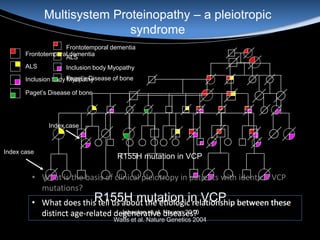
Multisystem Proteinopathy – a pleiotropic
syndrome
Frontotemporal dementia
ALS
Inclusion body Myopathy
Paget’s Disease of bone
Index case
Johnston et al. Neuron 2010
Watts et al. Nature Genetics 2004
R155H mutation in VCP
Frontotemporal dementia
ALS
Inclusion body Myopathy
Paget’s Disease of bone
Index case
R155H mutation in VCP
• What is the basis of clinical pleiotropy in patients with identical VCP
mutations?
• What does this tell us about the etiologic relationship between these
distinct age-related degenerative diseases?
• What is the basis of clinical pleiotropy in patients with identical VCP
mutations?
• What does this tell us about the etiologic relationship between these
distinct age-related degenerative diseases?
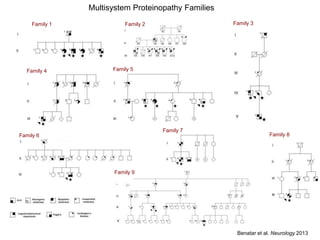
Family 1 Family 3Family 2
Family 4 Family 5
Family 6
Family 7
Family 8
Family 9
Multisystem Proteinopathy Families
Benatar et al. Neurology 2013
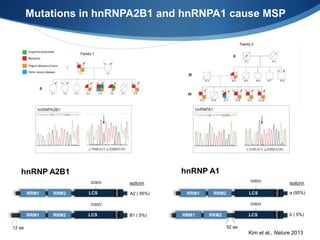
Mutations in hnRNPA2B1 and hnRNPA1 cause MSP
hnRNP A2B1
12 aa
D290V
D302V
A2 ( 95%)
B1 ( 5%)
isoform
LCS
LCS
MS9MS9
D262V
hnRNP A1
52 aa
a (95%)
b ( 5%)
isoform
LCS
LCS
MS9MS9
D262V
Kim et al., Nature 2013
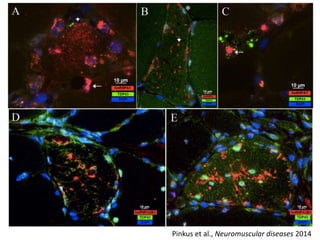
Pinkus et al., Neuromuscular diseases 2014
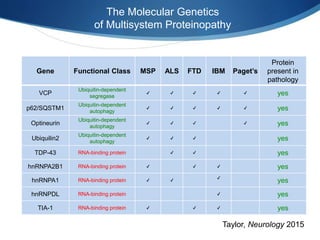
Gene Functional Class MSP ALS FTD IBM Paget’s
Protein
present in
pathology
VCP
Ubiquitin-dependent
segregase
✔ ✔ ✔ ✔ ✔ yes
p62/SQSTM1
Ubiquitin-dependent
autophagy
✔ ✔ ✔ ✔ ✔ yes
Optineurin
Ubiquitin-dependent
autophagy
✔ ✔ ✔ ✔ yes
Ubiquilin2
Ubiquitin-dependent
autophagy
✔ ✔ ✔ yes
TDP-43 RNA-binding protein ✔ ✔ yes
hnRNPA2B1 RNA-binding protein ✔ ✔ ✔ yes
hnRNPA1 RNA-binding protein ✔ ✔
✔
yes
hnRNPDL RNA-binding protein ✔ yes
TIA-1 RNA-binding protein ✔ ✔ ✔ yes
The Molecular Genetics
of Multisystem Proteinopathy
Taylor, Neurology 2015
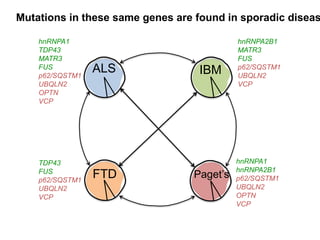
Mutations in these same genes are found in sporadic diseas
ALS
hnRNPA1
TDP43
MATR3
FUS
p62/SQSTM1
UBQLN2
OPTN
VCP
IBM
hnRNPA2B1
MATR3
FUS
p62/SQSTM1
UBQLN2
VCP
Paget’s
hnRNPA1
hnRNPA2B1
p62/SQSTM1
UBQLN2
OPTN
VCP
FTD
TDP43
FUS
p62/SQSTM1
UBQLN2
VCP
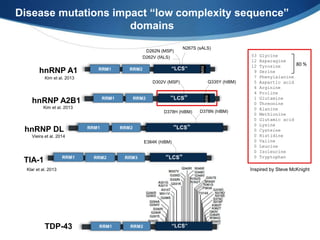
Disease mutations impact “low complexity sequence”
domains
80 %
53 Glycine
12 Asparagine
12 Tyrosine
9 Serine
7 Phenylalanine
5 Aspartic acid
4 Arginine
4 Proline
1 Glutamine
0 Threonine
0 Alanine
0 Methionine
0 Glutamic acid
0 Lysine
0 Cysteine
0 Histidine
0 Valine
0 Leucine
0 Isoleucine
0 Tryptophan
Inspired by Steve McKnight
TDP-43
hnRNP A1
D262V (fALS)
D262N (MSP)
N267S (sALS)
MS9
hnRNP A2B1
D302V (MSP)
MS9
Q335Y (hIBM)
hnRNP DL
D378N (hIBM)D378H (hIBM)
Vieira et al. 2014
TIA-1
E384K (hIBM)
Kim et al. 2013
Kim et al. 2013
Klar et al. 2013
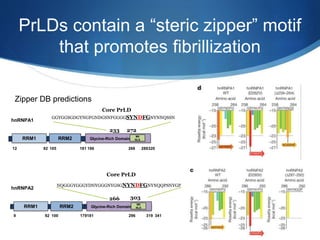
PrLDs contain a “steric zipper” motif
that promotes fibrillization
Core PrLD
hnRNPA1
RRM1 RRM2 Glycine-Rich Domain
M9
NLS
12 92 105 181 186 289268 320
GGYGGSGDGYNGFGNDGSNFGGGGSYNDFGNYNNQSSN
233 272
hnRNPA2
RRM1 RRM2 Glycine-Rich Domain
M9
NLS
929 100 179181 296 319 341
Core PrLD
NQGGGYGGGYDNYGGGNYGSGNYNDFGNYNQQPSNYGP
266 303
Zipper DB predictions
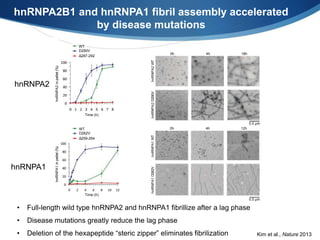
hnRNPA2B1 and hnRNPA1 fibril assembly accelerated
by disease mutations
USup35
ORD M domain C domain
PrLD ORD M domain C domain
1 40 114 254 685
S V
Time (h)
G
inpellet(%)
Time (h)
H
I
J
K
M
O
Q
inpellet(%)
Time (h)
WT
D290V
Δ287-292
WT
D262V
Δ259-264
WTD290VWTD262V
0h 4h 18h
0h 4h 12h
μm
μm
inpellet(%)
Time (h)
0
20
40
60
0 1 2 3
D290Vinpellet(%)
Time (h)
0
10
20
30
0 1 2 3 4
40
50
Δ287-292inpellet(%)
Time (h)
0
10
20
30
0 1 2 3
40
hnRNPA2inpellet(%)
Time (h)
0
10
20
30
0 1 2 3
Sup35
Sup35
USup35
ORD M domain C domain
PrLD ORD M domain C domain
1 40 114 254 685
S V
Time (h)
G
inpellet(%)
Time (h)
H
I
J
K
M
O
Q
inpellet(%)
Time (h)
WT
D290V
Δ287-292
WT
D262V
Δ259-264
WTD290VWTD262V
0h 4h 18h
0h 4h 12h
μm
μm
inpellet(%)
Time (h)
0
20
40
60
0 1 2 3 4
D290Vinpellet(%)
Time (h)
0
10
20
30
0 1 2 3 4
40
50
5 6
Δ287-292inpellet(%)
Time (h)
0
10
20
30
0 1 2 3 4
40
hnRNPA2inpellet(%)
Time (h)
0
10
20
30
0 1 2 3 4
Sup35
Sup35
hnRNPA2
hnRNPA1
• Full-length wild type hnRNPA2 and hnRNPA1 fibrillize after a lag phase
• Disease mutations greatly reduce the lag phase
• Deletion of the hexapeptide “steric zipper” eliminates fibrilization Kim et al., Nature 2013
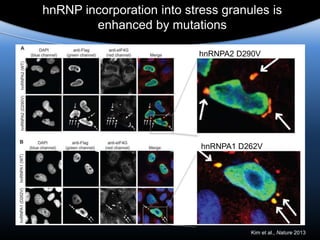
hnRNP incorporation into stress granules is
enhanced by mutations
hnRNPA2 D290V
hnRNPA1 D262V
Kim et al., Nature 2013
D
D
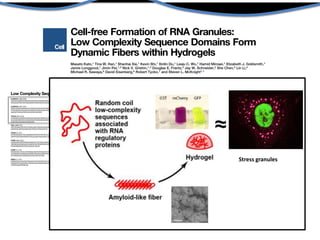
Stress granules
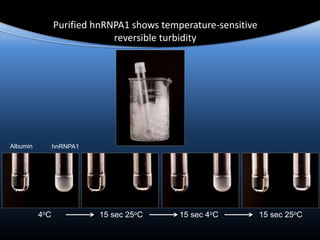
Purified hnRNPA1 shows temperature-sensitive
reversible turbidity
4oC 15 sec 25oC 15 sec 4oC 15 sec 25oC
Albumin hnRNPA1
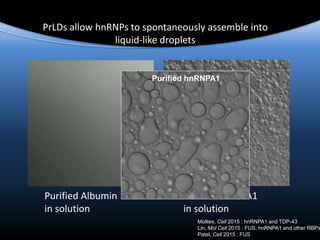
Purified Albumin
in solution
Purified hnRNPA1
in solution
PrLDs allow hnRNPs to spontaneously assemble into
liquid-like droplets
Purified hnRNPA1
Molliex, Cell 2015 : hnRNPA1 and TDP-43
Lin, Mol Cell 2015 : FUS, hnRNPA1 and other RBPs
Patel, Cell 2015 : FUS
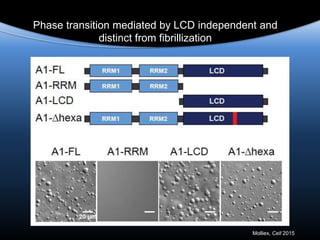
Phase transition mediated by LCD independent and
distinct from fibrillization
Molliex, Cell 2015
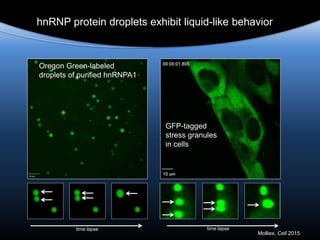
hnRNP protein droplets exhibit liquid-like behavior
time lapse time lapse
Molliex, Cell 2015
Oregon Green-labeled
droplets of purified hnRNPA1
GFP-tagged
stress granules
in cells
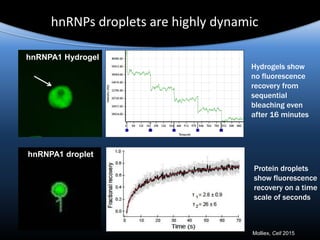
hnRNPs droplets are highly dynamic
Hydrogels show
no fluorescence
recovery from
sequential
bleaching even
after 16 minutes
Protein droplets
show fluorescence
recovery on a time
scale of seconds
hnRNPA1 Hydrogel
hnRNPA1 droplet
Molliex, Cell 2015
Time (ms)Relativeintensity
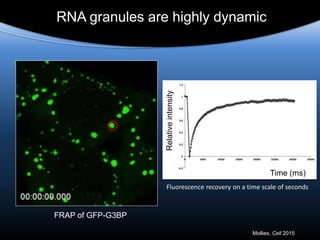
RNA granules are highly dynamic
FRAP of GFP-G3BP
Molliex, Cell 2015
Fluorescence recovery on a time scale of seconds
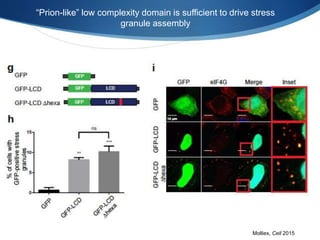
“Prion-like” low complexity domain is sufficient to drive stress
granule assembly
Molliex, Cell 2015
T [°C]
time
33
20
35
[A1-FL] (μM)
50 100 150 200 250 300
Temperature(⁰C)
10
15
20
25
30
35
150 100 75
[Ficoll] (mg/ml)
hnRNPA1 is poised at the phase boundary as we
approach physiological conditions of temperature,
concentration, salt and intracellular molecular
crowding
Mapping the phase diagram of liquid-liquid
phase separation
Individual mRNPs
m7Gppp
AAA
m7Gppp
AAA
m7Gppp
AAA
m7Gppp
AAA
m7Gppp
AAA
RNA granule
m7Gppp
AAA
m7Gppp
AAA
m7Gppp
AAA
LLPS
Hypothesis: phase separation by LCD-containing
RBPs underlies the formation of RNA granules and
related RNA-protein assemblies as well as their
liquid properties
Molliex, Cell 2015
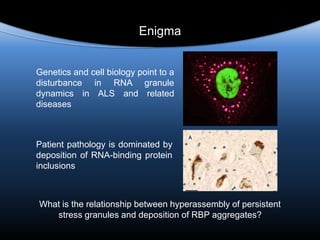
Genetics and cell biology point to a
disturbance in RNA granule
dynamics in ALS and related
diseases
Enigma
Patient pathology is dominated by
deposition of RNA-binding protein
inclusions
What is the relationship between hyperassembly of persistent
stress granules and deposition of RBP aggregates?
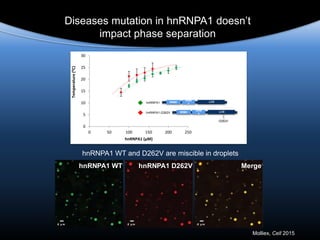
hnRNPA1 WT
5 µ m
hnRNPA1 D262V
5 µ m
Merge
5 µ m
0
5
10
15
20
25
30
0 50 100 150 200 250
Temperature(⁰C)
hnRNPA1 (μM)
Diseases mutation in hnRNPA1 doesn’t
impact phase separation
hnRNPA1 WT and D262V are miscible in droplets
D262V
RRM1
RRM
2
LCS
D262V
RRM1
RRM
2
LCS
hnRNPA1
hnRNPA1-D262V
D262V
Molliex, Cell 2015
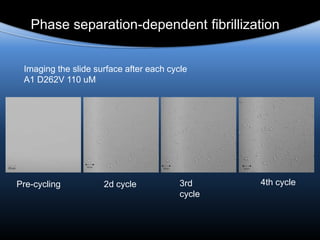
Phase separation-dependent fibrillization
Imaging the slide surface after each cycle
A1 D262V 110 uM
2d cycle 3rd
cycle
4th cyclePre-cycling
Molliex, Cell 2015
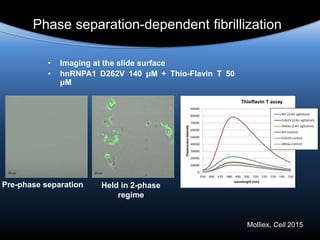
• Imaging at the slide surface
• hnRNPA1 D262V 140 μM + Thio-Flavin T 50
μM
Pre-phase separation Held in 2-phase
regime
Phase separation-dependent fibrillization
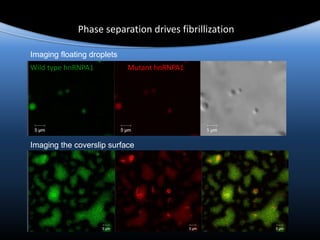
Phase separation drives fibrillization
Imaging floating droplets
Imaging the coverslip surface
Wild type hnRNPA1 Mutant hnRNPA1
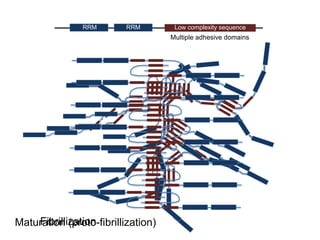
RRM RRM Low complexity sequence
Multiple adhesive domains
Maturation (proto-fibrillization)Fibrillization
Persistent Granule Assembly Promotes Amyloid
Formation
m7Gppp
AAA
m7Gppp
AAA
m7Gppp
AAA
m7Gppp
AAA
Individual mRNPs
(one phase)
AAA
m7Gppp
RNA Granule
(two phases)
Pathological
inclusions
Reversible
phase
separation
AAA
m7Gppp
m7Gppp
AAA
m7Gppp
AAA
m7Gppp
AAA
m7Gppp
AAA
Amyloid
formation
AAA AAA
AAA AAA
m7Gppp m7Gppp
m7Gpppm7Gppp
m7Gppp
AAA
m7Gppp
AAA
m7Gppp
AAA
m7Gppp
AAA
[hnRNP]low = low risk
of amyloid formation
[hnRNP]high = high risk
of amyloid formation
time
Insoluble residua
formed from the
most
amyloidogenic
constituents of
granules
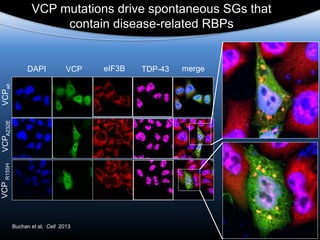
DAPI
VCPwt
eIF3B mergeTDP-43
VCPA232E
VCP
VCPR155H
VCP mutations drive spontaneous SGs that
contain disease-related RBPs
Buchan et al, Cell 2013
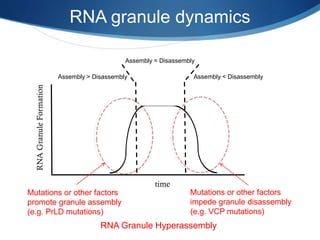
time
RNAGranuleFormation
Assembly > Disassembly
RNA granule dynamics
Mutations or other factors
promote granule assembly
(e.g. PrLD mutations)
Mutations or other factors
impede granule disassembly
(e.g. VCP mutations)
Assembly < Disassembly
Assembly = Disassembly
RNA Granule Hyperassembly
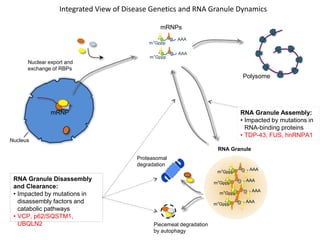
RNA Granule
mRNP
mRNPs
Nuclear export and
exchange of RBPs
Piecemeal degradation
by autophagy
RNA Granule Assembly:
• Impacted by mutations in
RNA-binding proteins
• TDP-43, FUS, hnRNPA1
Nucleus
Proteasomal
degradation
Polysome
m7Gppp
AAA
m7Gppp
AAA
m7Gppp
AAA
m7Gppp
AAA
m7Gppp
AAA
m7Gppp
AAA
RNA Granule Disassembly
and Clearance:
• Impacted by mutations in
disassembly factors and
catabolic pathways
• VCP, p62/SQSTM1,
UBQLN2
Integrated View of Disease Genetics and RNA Granule Dynamics
Collaborators:
Tanja Mittag
Jihun Lee
Taylor Lab:
Amandine Molliex
Hong Joo Kim
Maura Coughlin
Anderson Kanagaraj
St. Jude Imaging Resource:
Jamshid Temirov

Paul Taylor

  • 1.
    J. Paul Taylor,MD, PhD St. Jude Children’s Research Hospital Howard Hughes Medical Institute Dynamic RNA-protein assemblies in neurological disease
  • 2.
    Multisystem Proteinopathy –a pleiotropic syndrome Frontotemporal dementia ALS Inclusion body Myopathy Paget’s Disease of bone Index case Johnston et al. Neuron 2010 Watts et al. Nature Genetics 2004 R155H mutation in VCP Frontotemporal dementia ALS Inclusion body Myopathy Paget’s Disease of bone Index case R155H mutation in VCP • What is the basis of clinical pleiotropy in patients with identical VCP mutations? • What does this tell us about the etiologic relationship between these distinct age-related degenerative diseases? • What is the basis of clinical pleiotropy in patients with identical VCP mutations? • What does this tell us about the etiologic relationship between these distinct age-related degenerative diseases?
  • 3.
    Family 1 Family3Family 2 Family 4 Family 5 Family 6 Family 7 Family 8 Family 9 Multisystem Proteinopathy Families Benatar et al. Neurology 2013
  • 4.
    Mutations in hnRNPA2B1and hnRNPA1 cause MSP hnRNP A2B1 12 aa D290V D302V A2 ( 95%) B1 ( 5%) isoform LCS LCS MS9MS9 D262V hnRNP A1 52 aa a (95%) b ( 5%) isoform LCS LCS MS9MS9 D262V Kim et al., Nature 2013
  • 5.
    Pinkus et al.,Neuromuscular diseases 2014
  • 6.
    Gene Functional ClassMSP ALS FTD IBM Paget’s Protein present in pathology VCP Ubiquitin-dependent segregase ✔ ✔ ✔ ✔ ✔ yes p62/SQSTM1 Ubiquitin-dependent autophagy ✔ ✔ ✔ ✔ ✔ yes Optineurin Ubiquitin-dependent autophagy ✔ ✔ ✔ ✔ yes Ubiquilin2 Ubiquitin-dependent autophagy ✔ ✔ ✔ yes TDP-43 RNA-binding protein ✔ ✔ yes hnRNPA2B1 RNA-binding protein ✔ ✔ ✔ yes hnRNPA1 RNA-binding protein ✔ ✔ ✔ yes hnRNPDL RNA-binding protein ✔ yes TIA-1 RNA-binding protein ✔ ✔ ✔ yes The Molecular Genetics of Multisystem Proteinopathy Taylor, Neurology 2015
  • 7.
    Mutations in thesesame genes are found in sporadic diseas ALS hnRNPA1 TDP43 MATR3 FUS p62/SQSTM1 UBQLN2 OPTN VCP IBM hnRNPA2B1 MATR3 FUS p62/SQSTM1 UBQLN2 VCP Paget’s hnRNPA1 hnRNPA2B1 p62/SQSTM1 UBQLN2 OPTN VCP FTD TDP43 FUS p62/SQSTM1 UBQLN2 VCP
  • 8.
    Disease mutations impact“low complexity sequence” domains 80 % 53 Glycine 12 Asparagine 12 Tyrosine 9 Serine 7 Phenylalanine 5 Aspartic acid 4 Arginine 4 Proline 1 Glutamine 0 Threonine 0 Alanine 0 Methionine 0 Glutamic acid 0 Lysine 0 Cysteine 0 Histidine 0 Valine 0 Leucine 0 Isoleucine 0 Tryptophan Inspired by Steve McKnight TDP-43 hnRNP A1 D262V (fALS) D262N (MSP) N267S (sALS) MS9 hnRNP A2B1 D302V (MSP) MS9 Q335Y (hIBM) hnRNP DL D378N (hIBM)D378H (hIBM) Vieira et al. 2014 TIA-1 E384K (hIBM) Kim et al. 2013 Kim et al. 2013 Klar et al. 2013
  • 9.
    PrLDs contain a“steric zipper” motif that promotes fibrillization Core PrLD hnRNPA1 RRM1 RRM2 Glycine-Rich Domain M9 NLS 12 92 105 181 186 289268 320 GGYGGSGDGYNGFGNDGSNFGGGGSYNDFGNYNNQSSN 233 272 hnRNPA2 RRM1 RRM2 Glycine-Rich Domain M9 NLS 929 100 179181 296 319 341 Core PrLD NQGGGYGGGYDNYGGGNYGSGNYNDFGNYNQQPSNYGP 266 303 Zipper DB predictions
  • 10.
    hnRNPA2B1 and hnRNPA1fibril assembly accelerated by disease mutations USup35 ORD M domain C domain PrLD ORD M domain C domain 1 40 114 254 685 S V Time (h) G inpellet(%) Time (h) H I J K M O Q inpellet(%) Time (h) WT D290V Δ287-292 WT D262V Δ259-264 WTD290VWTD262V 0h 4h 18h 0h 4h 12h μm μm inpellet(%) Time (h) 0 20 40 60 0 1 2 3 D290Vinpellet(%) Time (h) 0 10 20 30 0 1 2 3 4 40 50 Δ287-292inpellet(%) Time (h) 0 10 20 30 0 1 2 3 40 hnRNPA2inpellet(%) Time (h) 0 10 20 30 0 1 2 3 Sup35 Sup35 USup35 ORD M domain C domain PrLD ORD M domain C domain 1 40 114 254 685 S V Time (h) G inpellet(%) Time (h) H I J K M O Q inpellet(%) Time (h) WT D290V Δ287-292 WT D262V Δ259-264 WTD290VWTD262V 0h 4h 18h 0h 4h 12h μm μm inpellet(%) Time (h) 0 20 40 60 0 1 2 3 4 D290Vinpellet(%) Time (h) 0 10 20 30 0 1 2 3 4 40 50 5 6 Δ287-292inpellet(%) Time (h) 0 10 20 30 0 1 2 3 4 40 hnRNPA2inpellet(%) Time (h) 0 10 20 30 0 1 2 3 4 Sup35 Sup35 hnRNPA2 hnRNPA1 • Full-length wild type hnRNPA2 and hnRNPA1 fibrillize after a lag phase • Disease mutations greatly reduce the lag phase • Deletion of the hexapeptide “steric zipper” eliminates fibrilization Kim et al., Nature 2013
  • 11.
    hnRNP incorporation intostress granules is enhanced by mutations hnRNPA2 D290V hnRNPA1 D262V Kim et al., Nature 2013
  • 12.
  • 13.
    Purified hnRNPA1 showstemperature-sensitive reversible turbidity 4oC 15 sec 25oC 15 sec 4oC 15 sec 25oC Albumin hnRNPA1
  • 14.
    Purified Albumin in solution PurifiedhnRNPA1 in solution PrLDs allow hnRNPs to spontaneously assemble into liquid-like droplets Purified hnRNPA1 Molliex, Cell 2015 : hnRNPA1 and TDP-43 Lin, Mol Cell 2015 : FUS, hnRNPA1 and other RBPs Patel, Cell 2015 : FUS
  • 15.
    Phase transition mediatedby LCD independent and distinct from fibrillization Molliex, Cell 2015
  • 16.
    hnRNP protein dropletsexhibit liquid-like behavior time lapse time lapse Molliex, Cell 2015 Oregon Green-labeled droplets of purified hnRNPA1 GFP-tagged stress granules in cells
  • 17.
    hnRNPs droplets arehighly dynamic Hydrogels show no fluorescence recovery from sequential bleaching even after 16 minutes Protein droplets show fluorescence recovery on a time scale of seconds hnRNPA1 Hydrogel hnRNPA1 droplet Molliex, Cell 2015
  • 18.
    Time (ms)Relativeintensity RNA granulesare highly dynamic FRAP of GFP-G3BP Molliex, Cell 2015 Fluorescence recovery on a time scale of seconds
  • 19.
    “Prion-like” low complexitydomain is sufficient to drive stress granule assembly Molliex, Cell 2015
  • 20.
    T [°C] time 33 20 35 [A1-FL] (μM) 50100 150 200 250 300 Temperature(⁰C) 10 15 20 25 30 35 150 100 75 [Ficoll] (mg/ml) hnRNPA1 is poised at the phase boundary as we approach physiological conditions of temperature, concentration, salt and intracellular molecular crowding Mapping the phase diagram of liquid-liquid phase separation Individual mRNPs m7Gppp AAA m7Gppp AAA m7Gppp AAA m7Gppp AAA m7Gppp AAA RNA granule m7Gppp AAA m7Gppp AAA m7Gppp AAA LLPS Hypothesis: phase separation by LCD-containing RBPs underlies the formation of RNA granules and related RNA-protein assemblies as well as their liquid properties Molliex, Cell 2015
  • 21.
    Genetics and cellbiology point to a disturbance in RNA granule dynamics in ALS and related diseases Enigma Patient pathology is dominated by deposition of RNA-binding protein inclusions What is the relationship between hyperassembly of persistent stress granules and deposition of RBP aggregates?
  • 22.
    hnRNPA1 WT 5 µm hnRNPA1 D262V 5 µ m Merge 5 µ m 0 5 10 15 20 25 30 0 50 100 150 200 250 Temperature(⁰C) hnRNPA1 (μM) Diseases mutation in hnRNPA1 doesn’t impact phase separation hnRNPA1 WT and D262V are miscible in droplets D262V RRM1 RRM 2 LCS D262V RRM1 RRM 2 LCS hnRNPA1 hnRNPA1-D262V D262V Molliex, Cell 2015
  • 23.
    Phase separation-dependent fibrillization Imagingthe slide surface after each cycle A1 D262V 110 uM 2d cycle 3rd cycle 4th cyclePre-cycling
  • 24.
    Molliex, Cell 2015 •Imaging at the slide surface • hnRNPA1 D262V 140 μM + Thio-Flavin T 50 μM Pre-phase separation Held in 2-phase regime Phase separation-dependent fibrillization
  • 25.
    Phase separation drivesfibrillization Imaging floating droplets Imaging the coverslip surface Wild type hnRNPA1 Mutant hnRNPA1
  • 26.
    RRM RRM Lowcomplexity sequence Multiple adhesive domains Maturation (proto-fibrillization)Fibrillization
  • 27.
    Persistent Granule AssemblyPromotes Amyloid Formation m7Gppp AAA m7Gppp AAA m7Gppp AAA m7Gppp AAA Individual mRNPs (one phase) AAA m7Gppp RNA Granule (two phases) Pathological inclusions Reversible phase separation AAA m7Gppp m7Gppp AAA m7Gppp AAA m7Gppp AAA m7Gppp AAA Amyloid formation AAA AAA AAA AAA m7Gppp m7Gppp m7Gpppm7Gppp m7Gppp AAA m7Gppp AAA m7Gppp AAA m7Gppp AAA [hnRNP]low = low risk of amyloid formation [hnRNP]high = high risk of amyloid formation time Insoluble residua formed from the most amyloidogenic constituents of granules
  • 28.
    DAPI VCPwt eIF3B mergeTDP-43 VCPA232E VCP VCPR155H VCP mutationsdrive spontaneous SGs that contain disease-related RBPs Buchan et al, Cell 2013
  • 29.
    time RNAGranuleFormation Assembly > Disassembly RNAgranule dynamics Mutations or other factors promote granule assembly (e.g. PrLD mutations) Mutations or other factors impede granule disassembly (e.g. VCP mutations) Assembly < Disassembly Assembly = Disassembly RNA Granule Hyperassembly
  • 30.
    RNA Granule mRNP mRNPs Nuclear exportand exchange of RBPs Piecemeal degradation by autophagy RNA Granule Assembly: • Impacted by mutations in RNA-binding proteins • TDP-43, FUS, hnRNPA1 Nucleus Proteasomal degradation Polysome m7Gppp AAA m7Gppp AAA m7Gppp AAA m7Gppp AAA m7Gppp AAA m7Gppp AAA RNA Granule Disassembly and Clearance: • Impacted by mutations in disassembly factors and catabolic pathways • VCP, p62/SQSTM1, UBQLN2 Integrated View of Disease Genetics and RNA Granule Dynamics
  • 31.
    Collaborators: Tanja Mittag Jihun Lee TaylorLab: Amandine Molliex Hong Joo Kim Maura Coughlin Anderson Kanagaraj St. Jude Imaging Resource: Jamshid Temirov