Non-Patentable Inventions in
India
By Atul S. Jaybhaye
Assistant Professor
Hidayatullah National Law University, Raipur
B.A.,LL.M.,NET
6/26/2020
Non-patentable inventions
• Sections 3 and 4 of the Patent Act, 1970, deals with
non-patentable inventions.
• Principle of patent law- mere discoveries or ideas are
not patentable.
• Novelty, utility and non-obviousness is not an
absolute rule.
• Public interest is of paramount importance, need to
protect at any cost.
Inventions non-patentable
Section 3(a)
• Frivolous inventions
• Inventions contrary to well established natural
laws
Section 3(b)
Inventions in which the primary or intended use or
commercial exploitation of which could be contrary
to public order or morality.
Inventions non-patentable
• Sec 3(c) Inventions that are a mere discovery of
something that already exists in nature.
 The mere discovery of a scientific principle
 or the formulation of an abstract theory or
 discovery of any living or
 non-living substances occurring in nature.
• Sec 3 (d)The mere discovery of a form already
existing in nature does not lead to enhancement of
efficacy.
Inventions non-patentable
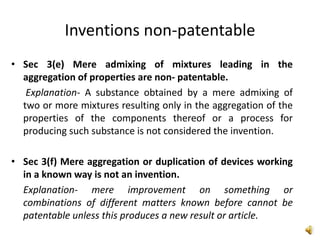
• Sec 3(e) Mere admixing of mixtures leading in the
aggregation of properties are non- patentable.
Explanation- A substance obtained by a mere admixing of
two or more mixtures resulting only in the aggregation of the
properties of the components thereof or a process for
producing such substance is not considered the invention.
• Sec 3(f) Mere aggregation or duplication of devices working
in a known way is not an invention.
Explanation- mere improvement on something or
combinations of different matters known before cannot be
patentable unless this produces a new result or article.
Inventions non-patentable
• Sec 3(h) Horticulture or agricultural method is non-patentable.
A method related to agriculture or horticulture.
Explanation- a method of producing plants like cultivation of algae and
mushrooms or improving the soil is not an invention and cannot be
patentable.
Note: However, agricultural equipments are patentable.
• Sec 3(i) Medicinal, curative, prophylactic, diagnostic, therapeutic for
treating diseases in human and animals are non-patentable.
Explanation– those medicinal methods administering medicines orally or
injecting it, surgical methods like stitch free surgeries, curative methods as
curing plaques etc does not fall under the ambit of the invention and are
non- patentable.
Inventions non-patentable
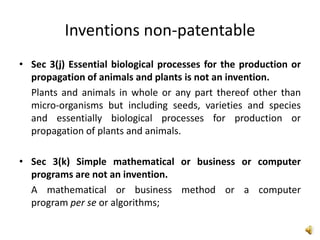
• Sec 3(j) Essential biological processes for the production or
propagation of animals and plants is not an invention.
Plants and animals in whole or any part thereof other than
micro-organisms but including seeds, varieties and species
and essentially biological processes for production or
propagation of plants and animals.
• Sec 3(k) Simple mathematical or business or computer
programs are not an invention.
A mathematical or business method or a computer
program per se or algorithms;
Inventions non-patentable
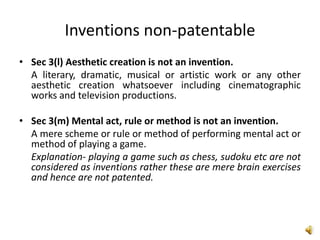
• Sec 3(l) Aesthetic creation is not an invention.
A literary, dramatic, musical or artistic work or any other
aesthetic creation whatsoever including cinematographic
works and television productions.
• Sec 3(m) Mental act, rule or method is not an invention.
A mere scheme or rule or method of performing mental act or
method of playing a game.
Explanation- playing a game such as chess, sudoku etc are not
considered as inventions rather these are mere brain exercises
and hence are not patented.
Inventions non-patentable
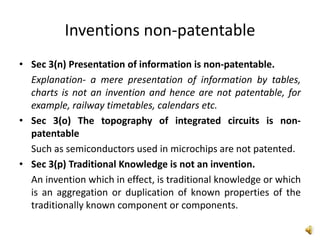
• Sec 3(n) Presentation of information is non-patentable.
Explanation- a mere presentation of information by tables,
charts is not an invention and hence are not patentable, for
example, railway timetables, calendars etc.
• Sec 3(o) The topography of integrated circuits is non-
patentable
Such as semiconductors used in microchips are not patented.
• Sec 3(p) Traditional Knowledge is not an invention.
An invention which in effect, is traditional knowledge or which
is an aggregation or duplication of known properties of the
traditionally known component or components.
Inventions non-patentable
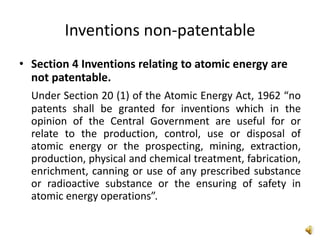
• Section 4 Inventions relating to atomic energy are
not patentable.
Under Section 20 (1) of the Atomic Energy Act, 1962 “no
patents shall be granted for inventions which in the
opinion of the Central Government are useful for or
relate to the production, control, use or disposal of
atomic energy or the prospecting, mining, extraction,
production, physical and chemical treatment, fabrication,
enrichment, canning or use of any prescribed substance
or radioactive substance or the ensuring of safety in
atomic energy operations”.
Landmark Cases of Non-patentable Inventions
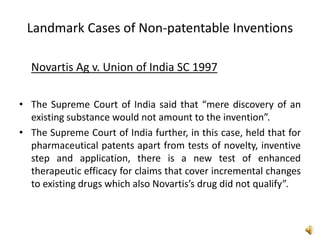
Novartis Ag v. Union of India SC 1997
• The Supreme Court of India said that “mere discovery of an
existing substance would not amount to the invention”.
• The Supreme Court of India further, in this case, held that for
pharmaceutical patents apart from tests of novelty, inventive
step and application, there is a new test of enhanced
therapeutic efficacy for claims that cover incremental changes
to existing drugs which also Novartis’s drug did not qualify”.
Landmark Cases of Non-patentable Inventions
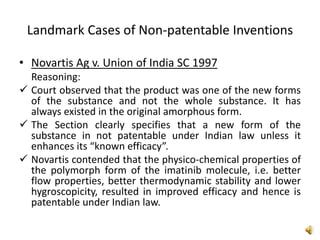
• Novartis Ag v. Union of India SC 1997
Reasoning:
 Court observed that the product was one of the new forms
of the substance and not the whole substance. It has
always existed in the original amorphous form.
 The Section clearly specifies that a new form of the
substance in not patentable under Indian law unless it
enhances its “known efficacy”.
 Novartis contended that the physico-chemical properties of
the polymorph form of the imatinib molecule, i.e. better
flow properties, better thermodynamic stability and lower
hygroscopicity, resulted in improved efficacy and hence is
patentable under Indian law.
Landmark Cases of Non-patentable Inventions
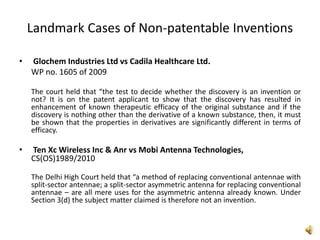
• Glochem Industries Ltd vs Cadila Healthcare Ltd.
WP no. 1605 of 2009
The court held that “the test to decide whether the discovery is an invention or
not? It is on the patent applicant to show that the discovery has resulted in
enhancement of known therapeutic efficacy of the original substance and if the
discovery is nothing other than the derivative of a known substance, then, it must
be shown that the properties in derivatives are significantly different in terms of
efficacy.
• Ten Xc Wireless Inc & Anr vs Mobi Antenna Technologies,
CS(OS)1989/2010
The Delhi High Court held that “a method of replacing conventional antennae with
split-sector antennae; a split-sector asymmetric antenna for replacing conventional
antennae – are all mere uses for the asymmetric antenna already known. Under
Section 3(d) the subject matter claimed is therefore not an invention.
Thank you…

Non patentable inventions in india

  • 1.
    Non-Patentable Inventions in India ByAtul S. Jaybhaye Assistant Professor Hidayatullah National Law University, Raipur B.A.,LL.M.,NET 6/26/2020
  • 2.
    Non-patentable inventions • Sections3 and 4 of the Patent Act, 1970, deals with non-patentable inventions. • Principle of patent law- mere discoveries or ideas are not patentable. • Novelty, utility and non-obviousness is not an absolute rule. • Public interest is of paramount importance, need to protect at any cost.
  • 3.
    Inventions non-patentable Section 3(a) •Frivolous inventions • Inventions contrary to well established natural laws Section 3(b) Inventions in which the primary or intended use or commercial exploitation of which could be contrary to public order or morality.
  • 4.
    Inventions non-patentable • Sec3(c) Inventions that are a mere discovery of something that already exists in nature.  The mere discovery of a scientific principle  or the formulation of an abstract theory or  discovery of any living or  non-living substances occurring in nature. • Sec 3 (d)The mere discovery of a form already existing in nature does not lead to enhancement of efficacy.
  • 5.
    Inventions non-patentable • Sec3(e) Mere admixing of mixtures leading in the aggregation of properties are non- patentable. Explanation- A substance obtained by a mere admixing of two or more mixtures resulting only in the aggregation of the properties of the components thereof or a process for producing such substance is not considered the invention. • Sec 3(f) Mere aggregation or duplication of devices working in a known way is not an invention. Explanation- mere improvement on something or combinations of different matters known before cannot be patentable unless this produces a new result or article.
  • 6.
    Inventions non-patentable • Sec3(h) Horticulture or agricultural method is non-patentable. A method related to agriculture or horticulture. Explanation- a method of producing plants like cultivation of algae and mushrooms or improving the soil is not an invention and cannot be patentable. Note: However, agricultural equipments are patentable. • Sec 3(i) Medicinal, curative, prophylactic, diagnostic, therapeutic for treating diseases in human and animals are non-patentable. Explanation– those medicinal methods administering medicines orally or injecting it, surgical methods like stitch free surgeries, curative methods as curing plaques etc does not fall under the ambit of the invention and are non- patentable.
  • 7.
    Inventions non-patentable • Sec3(j) Essential biological processes for the production or propagation of animals and plants is not an invention. Plants and animals in whole or any part thereof other than micro-organisms but including seeds, varieties and species and essentially biological processes for production or propagation of plants and animals. • Sec 3(k) Simple mathematical or business or computer programs are not an invention. A mathematical or business method or a computer program per se or algorithms;
  • 8.
    Inventions non-patentable • Sec3(l) Aesthetic creation is not an invention. A literary, dramatic, musical or artistic work or any other aesthetic creation whatsoever including cinematographic works and television productions. • Sec 3(m) Mental act, rule or method is not an invention. A mere scheme or rule or method of performing mental act or method of playing a game. Explanation- playing a game such as chess, sudoku etc are not considered as inventions rather these are mere brain exercises and hence are not patented.
  • 9.
    Inventions non-patentable • Sec3(n) Presentation of information is non-patentable. Explanation- a mere presentation of information by tables, charts is not an invention and hence are not patentable, for example, railway timetables, calendars etc. • Sec 3(o) The topography of integrated circuits is non- patentable Such as semiconductors used in microchips are not patented. • Sec 3(p) Traditional Knowledge is not an invention. An invention which in effect, is traditional knowledge or which is an aggregation or duplication of known properties of the traditionally known component or components.
  • 10.
    Inventions non-patentable • Section4 Inventions relating to atomic energy are not patentable. Under Section 20 (1) of the Atomic Energy Act, 1962 “no patents shall be granted for inventions which in the opinion of the Central Government are useful for or relate to the production, control, use or disposal of atomic energy or the prospecting, mining, extraction, production, physical and chemical treatment, fabrication, enrichment, canning or use of any prescribed substance or radioactive substance or the ensuring of safety in atomic energy operations”.
  • 11.
    Landmark Cases ofNon-patentable Inventions Novartis Ag v. Union of India SC 1997 • The Supreme Court of India said that “mere discovery of an existing substance would not amount to the invention”. • The Supreme Court of India further, in this case, held that for pharmaceutical patents apart from tests of novelty, inventive step and application, there is a new test of enhanced therapeutic efficacy for claims that cover incremental changes to existing drugs which also Novartis’s drug did not qualify”.
  • 12.
    Landmark Cases ofNon-patentable Inventions • Novartis Ag v. Union of India SC 1997 Reasoning:  Court observed that the product was one of the new forms of the substance and not the whole substance. It has always existed in the original amorphous form.  The Section clearly specifies that a new form of the substance in not patentable under Indian law unless it enhances its “known efficacy”.  Novartis contended that the physico-chemical properties of the polymorph form of the imatinib molecule, i.e. better flow properties, better thermodynamic stability and lower hygroscopicity, resulted in improved efficacy and hence is patentable under Indian law.
  • 13.
    Landmark Cases ofNon-patentable Inventions • Glochem Industries Ltd vs Cadila Healthcare Ltd. WP no. 1605 of 2009 The court held that “the test to decide whether the discovery is an invention or not? It is on the patent applicant to show that the discovery has resulted in enhancement of known therapeutic efficacy of the original substance and if the discovery is nothing other than the derivative of a known substance, then, it must be shown that the properties in derivatives are significantly different in terms of efficacy. • Ten Xc Wireless Inc & Anr vs Mobi Antenna Technologies, CS(OS)1989/2010 The Delhi High Court held that “a method of replacing conventional antennae with split-sector antennae; a split-sector asymmetric antenna for replacing conventional antennae – are all mere uses for the asymmetric antenna already known. Under Section 3(d) the subject matter claimed is therefore not an invention.
  • 14.