Patient-Provider
Communication:
Provider
Perspective
Day 16
Agenda
Review
Provider Perspective
Activity
Homework
Z I M C O R E H U B S | C O M P A N Y C U L T U R E H
A N D B O O K
anyone who offers health-related services to patients or clients
Physicians
Nurses
Therapists
Medical Technicians
Public Health Practitioners
Campaign Workers
Nutritionists
Health Educators
Any more?
Health Care
Provider....
05
larger-scale or broad factors from outside the
immediate context of the health care
provider/patient interaction
localized influences within the immediate
context of the health care provider/patient
interaction
M A C R O - L E V E L I N F L U E N C E S
M I C R O - L E V E L I N F L U E N C E S Organizational
influences
Interpersonal
influences
Cultural
influences
Power
dynamics
1.
2.
3.
4.
(Mattson & Hall, 2011, p. 157)
MOST work within an org. setting & MUST function within the
rules and confines of that org. & other org. they
interact with
ORG Influences
Managed Care
health care system with administrative control over primary
health care services within a medical group
practice that serves prepaid subscribers
HMOs and PPOs
aim to control medical costs & streamline processes for
efficiency
Organizational Culture
"actions, ways of thinking, practices, stories, and artifacts that
characterize a particular organization"
(Eisenberg, Goodall, & Trethewey, 2007, p. 127)
Organizational Rules & Guidelines
explicit or understood regulations that guide behavior within a
particular environment
(Mattson & Hall, 2011)
Organizational Influences
Women-longer, less technical, more PCC
Gender
Interpersonal
Influences
Different areas of medical care interact
with patients differently
Specialty
older, trained in more traditional methods-
paternalistic approach-more
knowledgeable and experienced
Age
some are more direct than others
Communication Style
(Mattson & Hall, 2011)
Benefits of (PCC) for Providers
Increased patient compliance
which means patients are more likely to follow what their health
care providers direct
them to do
increases providers' sense of accomplishments because patients
are more likely to have
improved health outcomes
Fewer malpractice claims
less likely to sue health care providers for mistreatment because
they feel a connection
with them and have their best interests in mind
incorporation of PCC are more likely to understand the
complexity of patients' conditions
& can treat their health issues more efficiently
Greater patient satisfaction
when patients feel that providers listen to them, seriously
consider their concerns, and
work with them to find solutions, they are generally more
satisfied with their providers
more likely to become repeat patients
1.
a.
b.
2.
a.
b.
3.
a.
b.
Active listening
Therapeutic interviewing
Advice giving
Empathy
Bad news delivery
1.
2.
3.
4.
5.
(Mattson & Hall, 2011)
Provider Skills for (PCC)
genuinely listening to what patients are saying and if necessary
encouraging
patients to talk more
listening without interrupting
maintaining eye contact
avoid distracting gestures
use encouraging nonverbals and verbals
nodding, murmuring phrases such as "yes" or "I see"
listen both to what patients say and to what they do not say
in tune with patients' tone and body language
repeat and clarify
Clarify: "In other words..."; "I mean..."; "I am trying to say..";
"I am not sure
what you mean."; "Could you please repeat/explain what you
mean?"
focusing attention on their patients by suspending their own
grames of reference and judgment
Active Listening1.
(Mattson & Hall, 2011)
https://positivepsychology.com/active-listening/
"an interpersonal exchange using verbal and nonverbal
messages that culminates in someone's
being helped" (van servellen, 2009, p. 169).
2. Therapeutic Interviewing
Therapeutic Interviewing (TI)
Goals:
Question Asking
Closed-ended questions (need specific details)
Open-ended questions (most information)
Clarifying questions (questions of fact that ensure they
understand what patients are saying)
Probing questions (determine additional information and
expand on what they said)
Ex: "Why do you think this is the case?"; "How did you
decide?";
"What is the connection between...and..?"
Common Language
Obtaining full descriptions of patients'
conditions and concerns
Reducing patients' emotional distress
Offering support
Listing primary and secondary health
problems
Establishing collaborative relationship
Two Key Interviewing Skills
Providers Need for TI
(Mattson & Hall, 2011)
"act of disclosing what one thinks or feels about another's
experience, namely, what you think they
should do, think, or feel" (van servellen, 2009, p. 169)
3. Advice Giving
when patients ask for advice from providers, they tend to be
more receptive to it
patients are not as receptive if they perceive providers to be
dominating or controlling
providers need to be sensitive when giving unsolicited advice to
patients
advice should be coupled with logical reasons & potential
outcomes
Examples
"You might want to consider..."
"An option you could take would be to..."
(Mattson & Hall, 2011)
4. Empathy
providers come to understand patients' situations and the
struggles patients face
challenging because providers are concerned about maintaining
professional boundaries while showing
genuine concern for patients
Emotional Contagion
having an affective response that consists of parallel emotions
to another or "feeling with another"
Empathetic Concern
having an affective response that consists of nonparallel
emotions to another of "feeling for another"
more communicatively effective stance for providers to take
with patients
PCC can be difficult to teach as it involves adjusting providers'
thought processes-not just their COM
behaviors
practice empathy
practice active listening
acknowledging patients' experiences and feelings, agreeing with
patients and conveying positive
feelings
identification with or vicariously experiencing the feelings or
thoughts of another
(Mattson & Hall, 2011)
https://www.youtube.com/watch?v=1Evwgu369Jw
Will be discussed on Friday!
5. Bad News Delivery
RA 9 DUE TONIGHT
WORK ON PODCAST
RA 10 DUE FRIDAY
READ NGO-METZGER
ET AL. (2008)
A PROVIDER'S
PERSPECTIVE
https://scopeblog.stanford.edu/2013/09/25/communicating-with-
terminally-ill-patients-a-physicians-
perspective/?utm_source=dlvr.it&utm_medium=feed
Day 15
PATIENT-
PROVIDER
COMMUNICATION:
PATIENT
PERSPECTIVE
AGENDA
Updates
Patient Perspective
Activity
Homework
anyone who receives health-
related services
audience members of nonmedica
services
clients of public health
services
target audience members of
health campaigns
individuals who surf the
internet for health informatio
PATIENTS
ARE...
(Mattson & Hall, 2011, pp. 120-121)
(Mattson & Hall, 2011, p. 122)
larger-scale or broader influences outside the
immediate context of the immediate context
of the interaction.
localized influences within the immediate
health care provider/patient context that
affect the interaction
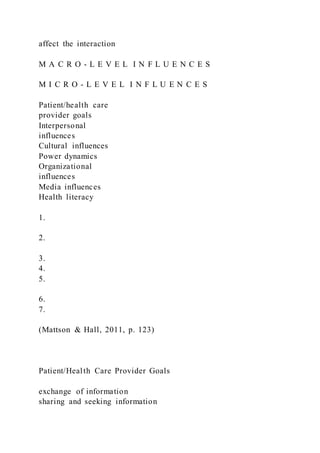
M A C R O - L E V E L I N F L U E N C E S
M I C R O - L E V E L I N F L U E N C E S
Patient/health care
provider goals
Interpersonal
influences
Cultural influences
Power dynamics
Organizational
influences
Media influences
Health literacy
1.
2.
3.
4.
5.
6.
7.
(Mattson & Hall, 2011, p. 123)
Patient/Health Care Provider Goals
exchange of information
sharing and seeking information
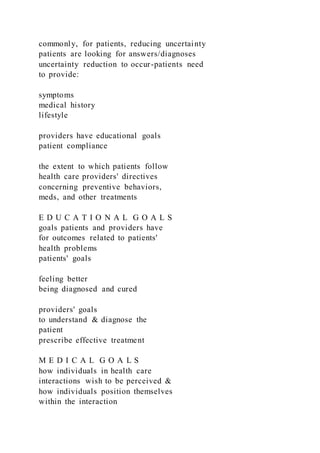
commonly, for patients, reducing uncertainty
patients are looking for answers/diagnoses
uncertainty reduction to occur-patients need
to provide:
symptoms
medical history
lifestyle
providers have educational goals
patient compliance
the extent to which patients follow
health care providers' directives
concerning preventive behaviors,
meds, and other treatments
E D U C A T I O N A L G O A L S
goals patients and providers have
for outcomes related to patients'
health problems
patients' goals
feeling better
being diagnosed and cured
providers' goals
to understand & diagnose the
patient
prescribe effective treatment
M E D I C A L G O A L S
how individuals in health care
interactions wish to be perceived &
how individuals position themselves
within the interaction
Facework
we adjust our behavior &
communication in order to present
our best self or our best face
providers wish to appear as an expert
and trustworthy
patients wish to appear knowledgeable
and responsible
goals-influence how they interact with
one another
R E L A T I O N A L G O A L S
(Mattson & Hall, 2011, pp. 124-125)
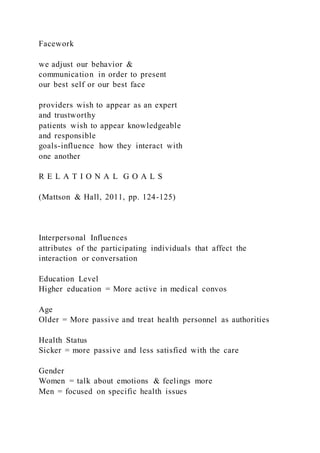
Interpersonal Influences
attributes of the participating individuals that affect the
interaction or conversation
Education Level
Higher education = More active in medical convos
Age
Older = More passive and treat health personnel as authorities
Health Status
Sicker = more passive and less satisfied with the care
Gender
Women = talk about emotions & feelings more
Men = focused on specific health issues
SES
lower SES = more passive
P A T I E N T A T T R I B U T E S
(Mattson & Hall, 2011, pp. 124-126)
MEDIA INFLUENCES
the increasingly important role that various forms of media have
in shaping patient/health care
provider interactions
(Mattson & Hall, 2011)
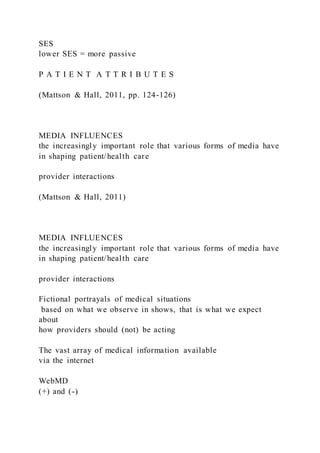
MEDIA INFLUENCES
the increasingly important role that various forms of media have
in shaping patient/health care
provider interactions
Fictional portrayals of medical situations
based on what we observe in shows, that is what we expect
about
how providers should (not) be acting
The vast array of medical information available
via the internet
WebMD
(+) and (-)
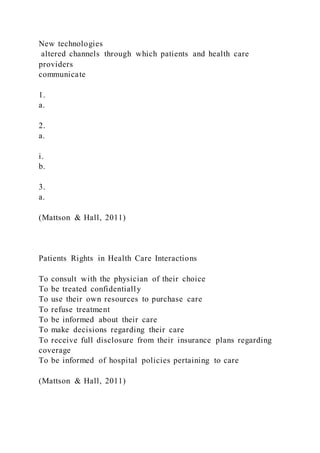
New technologies
altered channels through which patients and health care
providers
communicate
1.
a.
2.
a.
i.
b.
3.
a.
(Mattson & Hall, 2011)
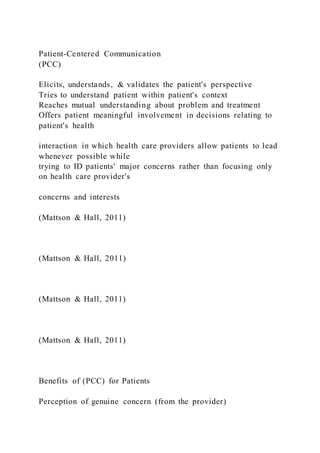
Patients Rights in Health Care Interactions
To consult with the physician of their choice
To be treated confidentially
To use their own resources to purchase care
To refuse treatment
To be informed about their care
To make decisions regarding their care
To receive full disclosure from their insurance plans regarding
coverage
To be informed of hospital policies pertaining to care
(Mattson & Hall, 2011)
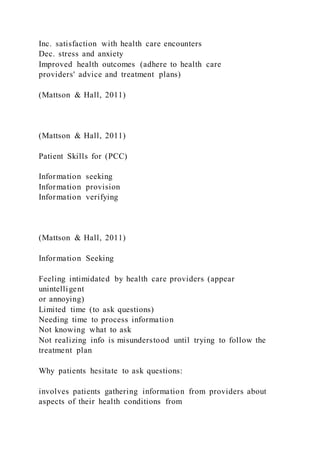
Patient-Centered Communication
(PCC)
Elicits, understands, & validates the patient's perspective
Tries to understand patient within patient's context
Reaches mutual understanding about problem and treatment
Offers patient meaningful involvement in decisions relating to
patient's health
interaction in which health care providers allow patients to lead
whenever possible while
trying to ID patients' major concerns rather than focusing only
on health care provider's
concerns and interests
(Mattson & Hall, 2011)
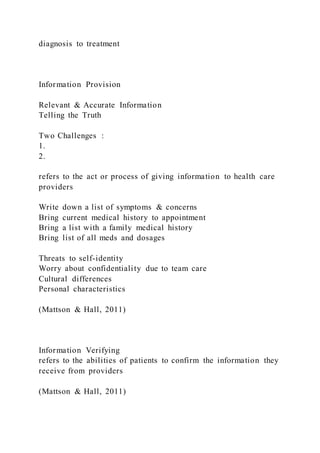
Benefits of (PCC) for Patients
Perception of genuine concern (from the provider)
Inc. satisfaction with health care encounters
Dec. stress and anxiety
Improved health outcomes (adhere to health care
providers' advice and treatment plans)
(Mattson & Hall, 2011)
Patient Skills for (PCC)
Information seeking
Information provision
Information verifying
(Mattson & Hall, 2011)
Information Seeking
Feeling intimidated by health care providers (appear
unintelligent
or annoying)
Limited time (to ask questions)
Needing time to process information
Not knowing what to ask
Not realizing info is misunderstood until trying to follow the
treatment plan
Why patients hesitate to ask questions:
involves patients gathering information from providers about
aspects of their health conditions from
diagnosis to treatment
Information Provision
Relevant & Accurate Information
Telling the Truth
Two Challenges :
1.
2.
refers to the act or process of giving information to health care
providers
Write down a list of symptoms & concerns
Bring current medical history to appointment
Bring a list with a family medical history
Bring list of all meds and dosages
Threats to self-identity
Worry about confidentiality due to team care
Cultural differences
Personal characteristics
(Mattson & Hall, 2011)
Information Verifying
refers to the abilities of patients to confirm the information they
receive from providers
(Mattson & Hall, 2011)
process of patients making sure they understand what is
being communicated to them
problem= patients are unable to follow instructions due to a
lack of understanding
RA 9 DUE (2/24)
CH. 5, PP. 155-
159; 162-171
CH. 6, PP. 190-192
TOOL KIT
https://www.npaf.org/patients-and-caregivers/skilled-
communications/

Patient provider communicationproviderperspectiveday

  • 1.
    Patient-Provider Communication: Provider Perspective Day 16 Agenda Review Provider Perspective Activity Homework ZI M C O R E H U B S | C O M P A N Y C U L T U R E H A N D B O O K anyone who offers health-related services to patients or clients Physicians Nurses
  • 2.
    Therapists Medical Technicians Public HealthPractitioners Campaign Workers Nutritionists Health Educators Any more? Health Care Provider.... 05 larger-scale or broad factors from outside the immediate context of the health care provider/patient interaction localized influences within the immediate context of the health care provider/patient interaction M A C R O - L E V E L I N F L U E N C E S M I C R O - L E V E L I N F L U E N C E S Organizational influences Interpersonal influences Cultural
  • 3.
    influences Power dynamics 1. 2. 3. 4. (Mattson & Hall,2011, p. 157) MOST work within an org. setting & MUST function within the rules and confines of that org. & other org. they interact with ORG Influences Managed Care health care system with administrative control over primary health care services within a medical group practice that serves prepaid subscribers HMOs and PPOs aim to control medical costs & streamline processes for efficiency Organizational Culture "actions, ways of thinking, practices, stories, and artifacts that
  • 4.
    characterize a particularorganization" (Eisenberg, Goodall, & Trethewey, 2007, p. 127) Organizational Rules & Guidelines explicit or understood regulations that guide behavior within a particular environment (Mattson & Hall, 2011) Organizational Influences Women-longer, less technical, more PCC Gender Interpersonal Influences Different areas of medical care interact with patients differently Specialty older, trained in more traditional methods- paternalistic approach-more knowledgeable and experienced Age some are more direct than others
  • 5.
    Communication Style (Mattson &Hall, 2011) (Mattson & Hall, 2011) Benefits of (PCC) for Providers Increased patient compliance which means patients are more likely to follow what their health care providers direct them to do increases providers' sense of accomplishments because patients are more likely to have improved health outcomes Fewer malpractice claims less likely to sue health care providers for mistreatment because they feel a connection with them and have their best interests in mind incorporation of PCC are more likely to understand the complexity of patients' conditions & can treat their health issues more efficiently Greater patient satisfaction when patients feel that providers listen to them, seriously consider their concerns, and work with them to find solutions, they are generally more satisfied with their providers more likely to become repeat patients 1. a.
  • 6.
    b. 2. a. b. 3. a. b. Active listening Therapeutic interviewing Advicegiving Empathy Bad news delivery 1. 2. 3. 4. 5. (Mattson & Hall, 2011) Provider Skills for (PCC) genuinely listening to what patients are saying and if necessary encouraging patients to talk more
  • 7.
    listening without interrupting maintainingeye contact avoid distracting gestures use encouraging nonverbals and verbals nodding, murmuring phrases such as "yes" or "I see" listen both to what patients say and to what they do not say in tune with patients' tone and body language repeat and clarify Clarify: "In other words..."; "I mean..."; "I am trying to say.."; "I am not sure what you mean."; "Could you please repeat/explain what you mean?" focusing attention on their patients by suspending their own grames of reference and judgment Active Listening1. (Mattson & Hall, 2011) https://positivepsychology.com/active-listening/ "an interpersonal exchange using verbal and nonverbal messages that culminates in someone's being helped" (van servellen, 2009, p. 169).
  • 8.
    2. Therapeutic Interviewing TherapeuticInterviewing (TI) Goals: Question Asking Closed-ended questions (need specific details) Open-ended questions (most information) Clarifying questions (questions of fact that ensure they understand what patients are saying) Probing questions (determine additional information and expand on what they said) Ex: "Why do you think this is the case?"; "How did you decide?"; "What is the connection between...and..?" Common Language Obtaining full descriptions of patients' conditions and concerns Reducing patients' emotional distress Offering support Listing primary and secondary health problems Establishing collaborative relationship
  • 9.
    Two Key InterviewingSkills Providers Need for TI (Mattson & Hall, 2011) "act of disclosing what one thinks or feels about another's experience, namely, what you think they should do, think, or feel" (van servellen, 2009, p. 169) 3. Advice Giving when patients ask for advice from providers, they tend to be more receptive to it patients are not as receptive if they perceive providers to be dominating or controlling providers need to be sensitive when giving unsolicited advice to patients advice should be coupled with logical reasons & potential outcomes Examples "You might want to consider..." "An option you could take would be to..." (Mattson & Hall, 2011) 4. Empathy providers come to understand patients' situations and the
  • 10.
    struggles patients face challengingbecause providers are concerned about maintaining professional boundaries while showing genuine concern for patients Emotional Contagion having an affective response that consists of parallel emotions to another or "feeling with another" Empathetic Concern having an affective response that consists of nonparallel emotions to another of "feeling for another" more communicatively effective stance for providers to take with patients PCC can be difficult to teach as it involves adjusting providers' thought processes-not just their COM behaviors practice empathy practice active listening acknowledging patients' experiences and feelings, agreeing with patients and conveying positive feelings identification with or vicariously experiencing the feelings or thoughts of another (Mattson & Hall, 2011)
  • 11.
    https://www.youtube.com/watch?v=1Evwgu369Jw Will be discussedon Friday! 5. Bad News Delivery RA 9 DUE TONIGHT WORK ON PODCAST RA 10 DUE FRIDAY READ NGO-METZGER ET AL. (2008) A PROVIDER'S PERSPECTIVE https://scopeblog.stanford.edu/2013/09/25/communicating-with- terminally-ill-patients-a-physicians- perspective/?utm_source=dlvr.it&utm_medium=feed Day 15 PATIENT- PROVIDER COMMUNICATION: PATIENT PERSPECTIVE AGENDA
  • 12.
    Updates Patient Perspective Activity Homework anyone whoreceives health- related services audience members of nonmedica services clients of public health services target audience members of health campaigns individuals who surf the internet for health informatio PATIENTS ARE... (Mattson & Hall, 2011, pp. 120-121) (Mattson & Hall, 2011, p. 122) larger-scale or broader influences outside the immediate context of the immediate context of the interaction. localized influences within the immediate health care provider/patient context that
  • 13.
    affect the interaction MA C R O - L E V E L I N F L U E N C E S M I C R O - L E V E L I N F L U E N C E S Patient/health care provider goals Interpersonal influences Cultural influences Power dynamics Organizational influences Media influences Health literacy 1. 2. 3. 4. 5. 6. 7. (Mattson & Hall, 2011, p. 123) Patient/Health Care Provider Goals exchange of information sharing and seeking information
  • 14.
    commonly, for patients,reducing uncertainty patients are looking for answers/diagnoses uncertainty reduction to occur-patients need to provide: symptoms medical history lifestyle providers have educational goals patient compliance the extent to which patients follow health care providers' directives concerning preventive behaviors, meds, and other treatments E D U C A T I O N A L G O A L S goals patients and providers have for outcomes related to patients' health problems patients' goals feeling better being diagnosed and cured providers' goals to understand & diagnose the patient prescribe effective treatment M E D I C A L G O A L S how individuals in health care interactions wish to be perceived & how individuals position themselves within the interaction
  • 15.
    Facework we adjust ourbehavior & communication in order to present our best self or our best face providers wish to appear as an expert and trustworthy patients wish to appear knowledgeable and responsible goals-influence how they interact with one another R E L A T I O N A L G O A L S (Mattson & Hall, 2011, pp. 124-125) Interpersonal Influences attributes of the participating individuals that affect the interaction or conversation Education Level Higher education = More active in medical convos Age Older = More passive and treat health personnel as authorities Health Status Sicker = more passive and less satisfied with the care Gender Women = talk about emotions & feelings more Men = focused on specific health issues
  • 16.
    SES lower SES =more passive P A T I E N T A T T R I B U T E S (Mattson & Hall, 2011, pp. 124-126) MEDIA INFLUENCES the increasingly important role that various forms of media have in shaping patient/health care provider interactions (Mattson & Hall, 2011) MEDIA INFLUENCES the increasingly important role that various forms of media have in shaping patient/health care provider interactions Fictional portrayals of medical situations based on what we observe in shows, that is what we expect about how providers should (not) be acting The vast array of medical information available via the internet WebMD (+) and (-)
  • 17.
    New technologies altered channelsthrough which patients and health care providers communicate 1. a. 2. a. i. b. 3. a. (Mattson & Hall, 2011) Patients Rights in Health Care Interactions To consult with the physician of their choice To be treated confidentially To use their own resources to purchase care To refuse treatment To be informed about their care To make decisions regarding their care To receive full disclosure from their insurance plans regarding coverage To be informed of hospital policies pertaining to care (Mattson & Hall, 2011)
  • 18.
    Patient-Centered Communication (PCC) Elicits, understands,& validates the patient's perspective Tries to understand patient within patient's context Reaches mutual understanding about problem and treatment Offers patient meaningful involvement in decisions relating to patient's health interaction in which health care providers allow patients to lead whenever possible while trying to ID patients' major concerns rather than focusing only on health care provider's concerns and interests (Mattson & Hall, 2011) (Mattson & Hall, 2011) (Mattson & Hall, 2011) (Mattson & Hall, 2011) Benefits of (PCC) for Patients Perception of genuine concern (from the provider)
  • 19.
    Inc. satisfaction withhealth care encounters Dec. stress and anxiety Improved health outcomes (adhere to health care providers' advice and treatment plans) (Mattson & Hall, 2011) (Mattson & Hall, 2011) Patient Skills for (PCC) Information seeking Information provision Information verifying (Mattson & Hall, 2011) Information Seeking Feeling intimidated by health care providers (appear unintelligent or annoying) Limited time (to ask questions) Needing time to process information Not knowing what to ask Not realizing info is misunderstood until trying to follow the treatment plan Why patients hesitate to ask questions: involves patients gathering information from providers about aspects of their health conditions from
  • 20.
    diagnosis to treatment InformationProvision Relevant & Accurate Information Telling the Truth Two Challenges : 1. 2. refers to the act or process of giving information to health care providers Write down a list of symptoms & concerns Bring current medical history to appointment Bring a list with a family medical history Bring list of all meds and dosages Threats to self-identity Worry about confidentiality due to team care Cultural differences Personal characteristics (Mattson & Hall, 2011) Information Verifying refers to the abilities of patients to confirm the information they receive from providers (Mattson & Hall, 2011)
  • 21.
    process of patientsmaking sure they understand what is being communicated to them problem= patients are unable to follow instructions due to a lack of understanding RA 9 DUE (2/24) CH. 5, PP. 155- 159; 162-171 CH. 6, PP. 190-192 TOOL KIT https://www.npaf.org/patients-and-caregivers/skilled- communications/