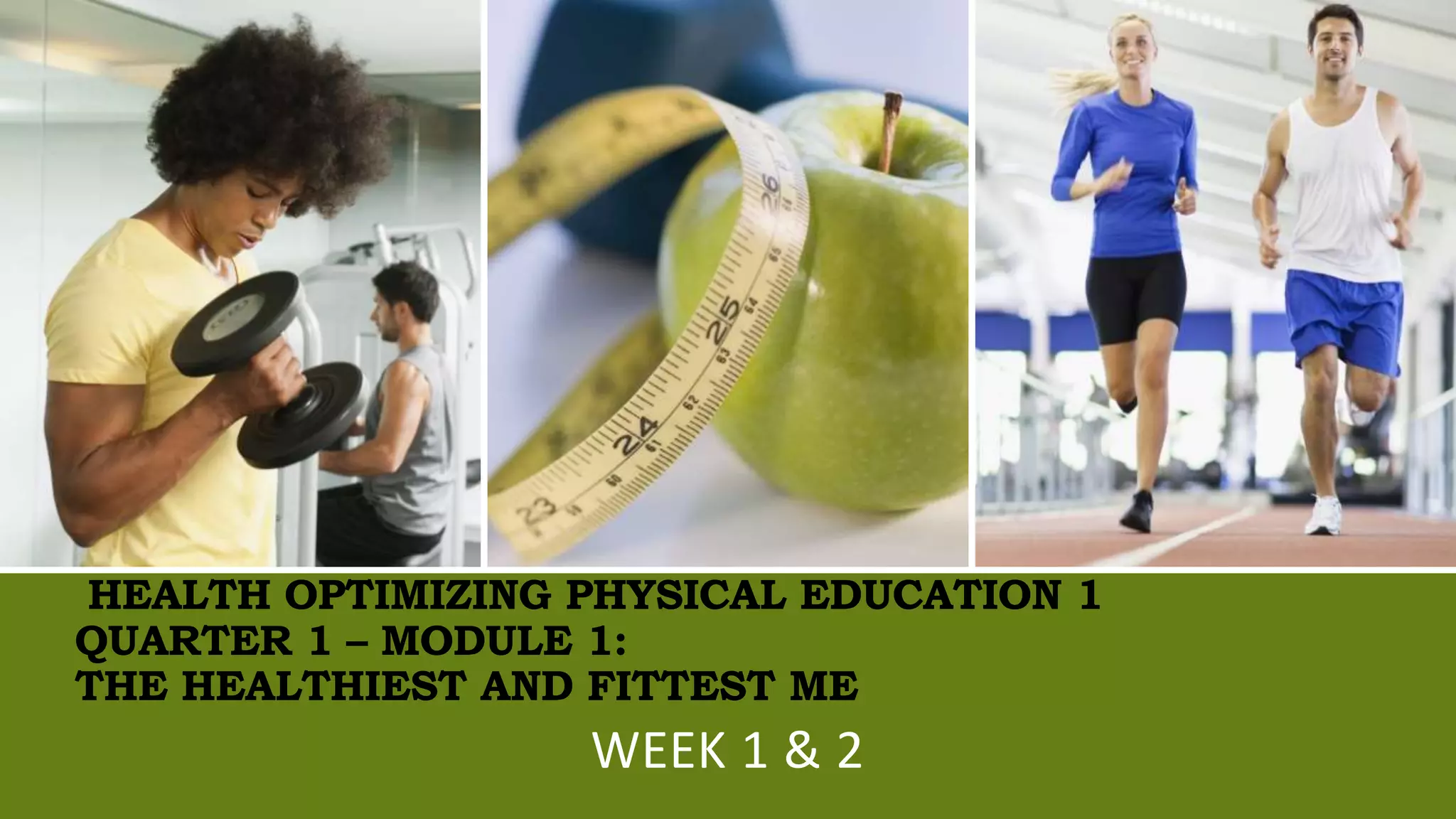
HEALTH OPTIMIZING PHYSICAL EDUCATION 1
QUARTER 1 – MODULE 1:
THE HEALTHIEST AND FITTEST ME
WEEK 1 & 2
THE FOLLOWING ARE SOME REMINDERS IN USING
THIS MODULE:
▪ 1. Use the module with care. Do not put unnecessary mark/s on any part of the
module. Use a separate sheet of paper in answering the exercises.
▪ 2. Don’t forget to answer What I Know before moving on to the other activities
included in the module.
▪ 3. Read the instruction carefully before doing each task.
▪ 4. Observe honesty and integrity in doing the tasks and checking your answers.
▪ 5. Finish the task at hand before proceeding to the next.
▪ 6. Return this module to your teacher/facilitator once you are through with it.
If you encounter any difficulty in answering the tasks in this module, do not
hesitate to consult your teacher or facilitator. Always bear in mind that you are
not alone.
WHAT I NEED TO KNOW
● Lesson 1 – Exercise, Eat and Excel
After going through this module, you are
expected to:
1. Self- assess health-related fitness (HRF)
status, barriers to physical activity
assessment participation and one’s diet.
PEH11FH-Ig-i-61
WHAT I KNOW
Direction: Read each statement
carefully, encircle the letter of
your answer.
15 QUESTIONS
EXERCISE, EAT AND EXCEL
LESSON 1
▪This lesson will help you learn and
understand the different health related
fitness and skill related fitness
components. This is designed to help you
clearly identify the different abilities of
the body in order for you to be physically
fit. You are considered physically fit
whenever you can do series of physical
activities without being or feeling tired.
Through this lesson, you will also deeply
learn the value of eating well and how it
affects the entire system of your body.
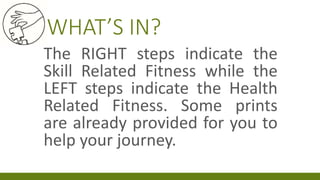
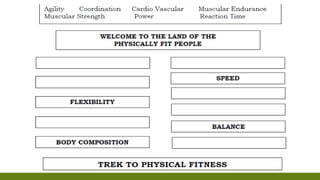
WHAT’S IN?
The RIGHT steps indicate the
Skill Related Fitness while the
LEFT steps indicate the Health
Related Fitness. Some prints
are already provided for you to
help your journey.
WHAT’S NEW?
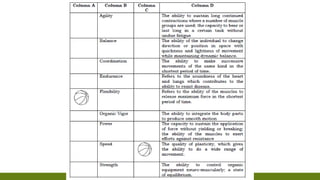
Task: PAIR IT UP!
Study the table below. Under Column B are
the specific components of physical fitness.
Pair each item with its description under
Column D. To signify pairing, draw any sports
equipment on Columns A and D opposite the
item and the description matched. An
example is provided below. Write your
answer in a separate sheet of paper.
WHAT IS IT
Physical Fitness as Defined
A person who is free from illnesses and can do physical or
sports activities and still has an extra energy to do more
activities is considered to be physically fit.
▪ Physical fitness is a combination of health fitness and body
fitness.
▪ Health fitness refers to your body’s ability to fight off
diseases.
▪ Body fitness, on the other hand, is refers to the ability to do
strenuous physical or sports activities without getting tired
easily.
HEALTH RELATED FITNESS
This is primarily associated with
disease prevention and functional
health. Participating in regular health-
related fitness helps you control your
weight, prevents diseases and illness,
improves mood, boosts energy and
promotes better sleep.
HEALTH RELATED FITNESS COMPONENTS
1. Body Composition
2. Cardiovascular Endurance
3. Flexibility
4. Muscular Endurance
5. Muscular Strength
SKILLS RELATED FITNESS COMPONENTS
1. Agility
2. Balance
3. Coordination
4. Power
5. Reaction Time
6. Speed
SPECIFIC COMPONENTS OF PHYSICAL FITNESS
1. Agility
2. Balance
3. Coordination
4. Endurance
5. Flexibility
6. Organic Vigor
7. Power
8. Speed
9. Strength
PHYSICAL ACTIVITY AND EXERCISE
Activities done by the
skeletal muscles that
utilize energy is called
Physical Activity.
4 DOMAINS OF PHYSICAL ACTIVITY AND
EXERCISE
1. Occupational
2. Domestic
3. Transportation
4. Leisure time.
EXERCISE
According to a study by
Buckworth and Dishman, exercise
is the “planned, structured,
repetitive bodily movements that
someone engages in for the
purpose of improving or
maintaining physical fitness or
health.
AEROBIC, MUSCLE-STRENGTHENING,
AND BONE-STRENGTHENING ACTIVITY
Aerobic activities, also called endurance activities,
are physical activities in which people move their
large muscles in a rhythmic manner for a sustained
period.
Muscle-Strengthening Activity This kind of
activity, which includes resistance training and
lifting weights, causes the body’s muscles to work
or hold against an applied force or weight.
Bone-Strengthening Activity This kind of activity
(sometimes called weight-bearing or weight-
loading activity) produces a force on the bones
that promotes bone growth and strength.
BARRIERS TO PHYSICAL ACTIVITIES
1. Lack of time
2. Social Support
3. Lack of Energy
4. Lack of Motivation
5. Fear of Injury
6. Lack of Skill
7. High Costs and Lack of Facilities
8. Weather Conditions
EATING HABITS
The term eating habits (or food habits)
refers to why and how people eat, which
foods they eat, and with whom they eat,
as well as the ways people obtain, store,
use, and discard food.
FACTORS THAT INFLUENCE EATING HABITS
▪Individual
▪Social
▪Cultural
▪Religious
▪Economic
▪Environmental
▪Political factors
IMPROVING YOUR EATING HABITS
▪Reflect
▪Replace
▪Reinforce
WHAT’S MORE
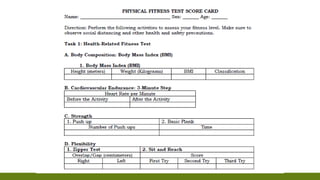
PHYSICAL FITNESS TEST
TASK 1: HEALTH - RELATED FITNESS TEST
1. Body Mass Index
2. Zipper Test
3. Sit and Reach
4. 3-Minute Step Test
5. Push Ups
6. Basic Plank
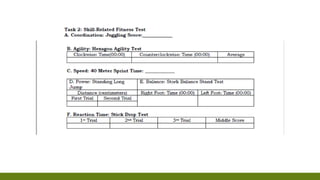
TASK 2: SKILLS-RELATED FITNESS
1. 40-m. Sprint
2. Standing Long Jump
3. Hexagon Agility Test
4. Stick Drop Test
5. Juggling
6. Stork Balance Stand Test
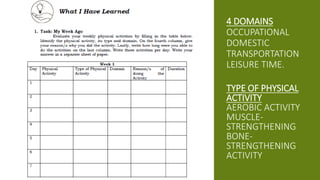
4 DOMAINS
OCCUPATIONAL
DOMESTIC
TRANSPORTATION
LEISURE TIME.
TYPE OF PHYSICAL
ACTIVITY
AEROBIC ACTIVITY
MUSCLE-
STRENGTHENING
BONE-
STRENGTHENING
ACTIVITY
ASSESSMENT
15 QUESTIONS

pe1_week1.pptx

  • 1.
    HEALTH OPTIMIZING PHYSICALEDUCATION 1 QUARTER 1 – MODULE 1: THE HEALTHIEST AND FITTEST ME WEEK 1 & 2
  • 2.
    THE FOLLOWING ARESOME REMINDERS IN USING THIS MODULE: ▪ 1. Use the module with care. Do not put unnecessary mark/s on any part of the module. Use a separate sheet of paper in answering the exercises. ▪ 2. Don’t forget to answer What I Know before moving on to the other activities included in the module. ▪ 3. Read the instruction carefully before doing each task. ▪ 4. Observe honesty and integrity in doing the tasks and checking your answers. ▪ 5. Finish the task at hand before proceeding to the next. ▪ 6. Return this module to your teacher/facilitator once you are through with it. If you encounter any difficulty in answering the tasks in this module, do not hesitate to consult your teacher or facilitator. Always bear in mind that you are not alone.
  • 3.
    WHAT I NEEDTO KNOW ● Lesson 1 – Exercise, Eat and Excel After going through this module, you are expected to: 1. Self- assess health-related fitness (HRF) status, barriers to physical activity assessment participation and one’s diet. PEH11FH-Ig-i-61
  • 4.
    WHAT I KNOW Direction:Read each statement carefully, encircle the letter of your answer. 15 QUESTIONS
  • 5.
    EXERCISE, EAT ANDEXCEL LESSON 1
  • 6.
    ▪This lesson willhelp you learn and understand the different health related fitness and skill related fitness components. This is designed to help you clearly identify the different abilities of the body in order for you to be physically fit. You are considered physically fit whenever you can do series of physical activities without being or feeling tired. Through this lesson, you will also deeply learn the value of eating well and how it affects the entire system of your body.
  • 7.
    WHAT’S IN? The RIGHTsteps indicate the Skill Related Fitness while the LEFT steps indicate the Health Related Fitness. Some prints are already provided for you to help your journey.
  • 9.
    WHAT’S NEW? Task: PAIRIT UP! Study the table below. Under Column B are the specific components of physical fitness. Pair each item with its description under Column D. To signify pairing, draw any sports equipment on Columns A and D opposite the item and the description matched. An example is provided below. Write your answer in a separate sheet of paper.
  • 11.
    WHAT IS IT PhysicalFitness as Defined A person who is free from illnesses and can do physical or sports activities and still has an extra energy to do more activities is considered to be physically fit. ▪ Physical fitness is a combination of health fitness and body fitness. ▪ Health fitness refers to your body’s ability to fight off diseases. ▪ Body fitness, on the other hand, is refers to the ability to do strenuous physical or sports activities without getting tired easily.
  • 12.
    HEALTH RELATED FITNESS Thisis primarily associated with disease prevention and functional health. Participating in regular health- related fitness helps you control your weight, prevents diseases and illness, improves mood, boosts energy and promotes better sleep.
  • 13.
    HEALTH RELATED FITNESSCOMPONENTS 1. Body Composition 2. Cardiovascular Endurance 3. Flexibility 4. Muscular Endurance 5. Muscular Strength
  • 14.
    SKILLS RELATED FITNESSCOMPONENTS 1. Agility 2. Balance 3. Coordination 4. Power 5. Reaction Time 6. Speed
  • 15.
    SPECIFIC COMPONENTS OFPHYSICAL FITNESS 1. Agility 2. Balance 3. Coordination 4. Endurance 5. Flexibility 6. Organic Vigor 7. Power 8. Speed 9. Strength
  • 16.
    PHYSICAL ACTIVITY ANDEXERCISE Activities done by the skeletal muscles that utilize energy is called Physical Activity.
  • 17.
    4 DOMAINS OFPHYSICAL ACTIVITY AND EXERCISE 1. Occupational 2. Domestic 3. Transportation 4. Leisure time.
  • 18.
    EXERCISE According to astudy by Buckworth and Dishman, exercise is the “planned, structured, repetitive bodily movements that someone engages in for the purpose of improving or maintaining physical fitness or health.
  • 19.
    AEROBIC, MUSCLE-STRENGTHENING, AND BONE-STRENGTHENINGACTIVITY Aerobic activities, also called endurance activities, are physical activities in which people move their large muscles in a rhythmic manner for a sustained period. Muscle-Strengthening Activity This kind of activity, which includes resistance training and lifting weights, causes the body’s muscles to work or hold against an applied force or weight. Bone-Strengthening Activity This kind of activity (sometimes called weight-bearing or weight- loading activity) produces a force on the bones that promotes bone growth and strength.
  • 20.
    BARRIERS TO PHYSICALACTIVITIES 1. Lack of time 2. Social Support 3. Lack of Energy 4. Lack of Motivation 5. Fear of Injury 6. Lack of Skill 7. High Costs and Lack of Facilities 8. Weather Conditions
  • 21.
    EATING HABITS The termeating habits (or food habits) refers to why and how people eat, which foods they eat, and with whom they eat, as well as the ways people obtain, store, use, and discard food.
  • 22.
    FACTORS THAT INFLUENCEEATING HABITS ▪Individual ▪Social ▪Cultural ▪Religious ▪Economic ▪Environmental ▪Political factors
  • 23.
    IMPROVING YOUR EATINGHABITS ▪Reflect ▪Replace ▪Reinforce
  • 24.
  • 25.
    TASK 1: HEALTH- RELATED FITNESS TEST 1. Body Mass Index 2. Zipper Test 3. Sit and Reach 4. 3-Minute Step Test 5. Push Ups 6. Basic Plank
  • 26.
    TASK 2: SKILLS-RELATEDFITNESS 1. 40-m. Sprint 2. Standing Long Jump 3. Hexagon Agility Test 4. Stick Drop Test 5. Juggling 6. Stork Balance Stand Test
  • 29.
    4 DOMAINS OCCUPATIONAL DOMESTIC TRANSPORTATION LEISURE TIME. TYPEOF PHYSICAL ACTIVITY AEROBIC ACTIVITY MUSCLE- STRENGTHENING BONE- STRENGTHENING ACTIVITY
  • 31.