PATENT DRAFTING
By
Dr. V. MANON MANI
ASSISTANT PROFESSOR
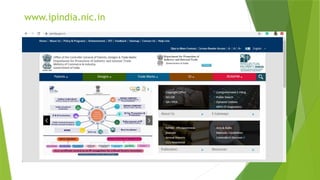
www.ipindia.nic.in
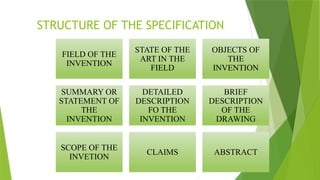
STRUCTURE OF THE SPECIFICATION
FIELD OF THE
INVENTION
STATE OF THE
ART IN THE
FIELD
OBJECTS OF
THE
INVENTION
SUMMARY OR
STATEMENT OF
THE
INVENTION
DETAILED
DESCRIPTION
FO THE
INVENTION
BRIEF
DESCRIPTION
OF THE
DRAWING
SCOPE OF THE
INVETION
CLAIMS ABSTRACT
FIELD OF THE INVENTION
 Invention and brief technology; scope of the invention
 The statement should begin with
 “The invention relates to…..”
 “Another invention relates to …..”
 “Most particularly”
 “ The advantage of the invention is”
 To avoid: details of the invention and limitations
STATE OF THE ART- BACKGROUND ART-
PRIOR ART
 Similar to review of literature.
 Significance of the findings with earlier research.
 National and international finding to be enclosed.
 Patent search from Patent search tools to be included.
 “One of the Prior art is …”
 To avoid: limitations in the scope.
 Should not label anything as invention.
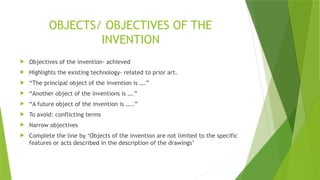
OBJECTS/ OBJECTIVES OF THE
INVENTION
 Objectives of the invention- achieved
 Highlights the existing technology- related to prior art.
 “The principal object of the invention is ….”
 “Another object of the inventions is ….”
 “A future object of the invention is …..”
 To avoid: conflicting terms
 Narrow objectives
 Complete the line by ‘Objects of the invention are not limited to the specific
features or acts described in the description of the drawings’
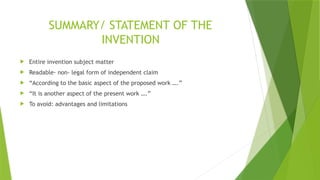
SUMMARY/ STATEMENT OF THE
INVENTION
 Entire invention subject matter
 Readable- non- legal form of independent claim
 “According to the basic aspect of the proposed work ….”
 “It is another aspect of the present work ….”
 To avoid: advantages and limitations
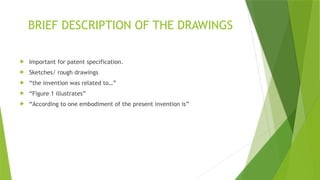
BRIEF DESCRIPTION OF THE DRAWINGS
 Important for patent specification.
 Sketches/ rough drawings
 “the invention was related to…”
 “Figure 1 illustrates”
 “According to one embodiment of the present invention is”
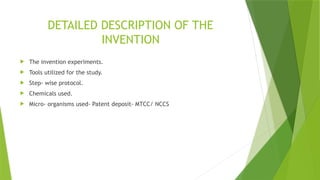
DETAILED DESCRIPTION OF THE
INVENTION
 The invention experiments.
 Tools utilized for the study.
 Step- wise protocol.
 Chemicals used.
 Micro- organisms used- Patent deposit- MTCC/ NCCS
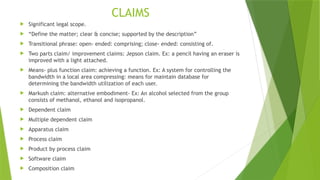
CLAIMS
 Significant legal scope.
 “Define the matter; clear & concise; supported by the description”
 Transitional phrase: open- ended: comprising; close- ended: consisting of.
 Two parts claim/ improvement claims: Jepson claim. Ex: a pencil having an eraser is
improved with a light attached.
 Means- plus function claim: achieving a function. Ex: A system for controlling the
bandwidth in a local area compressing: means for maintain database for
determining the bandwidth utilization of each user.
 Markush claim: alternative embodiment- Ex: An alcohol selected from the group
consists of methanol, ethanol and isopropanol.
 Dependent claim
 Multiple dependent claim
 Apparatus claim
 Process claim
 Product by process claim
 Software claim
 Composition claim
ABSTRACT
150- 200 WORDS
THANK YOU…

patent drafting & process- specification.pptx

  • 1.
    PATENT DRAFTING By Dr. V.MANON MANI ASSISTANT PROFESSOR
  • 2.
  • 3.
    STRUCTURE OF THESPECIFICATION FIELD OF THE INVENTION STATE OF THE ART IN THE FIELD OBJECTS OF THE INVENTION SUMMARY OR STATEMENT OF THE INVENTION DETAILED DESCRIPTION FO THE INVENTION BRIEF DESCRIPTION OF THE DRAWING SCOPE OF THE INVETION CLAIMS ABSTRACT
  • 4.
    FIELD OF THEINVENTION  Invention and brief technology; scope of the invention  The statement should begin with  “The invention relates to…..”  “Another invention relates to …..”  “Most particularly”  “ The advantage of the invention is”  To avoid: details of the invention and limitations
  • 5.
    STATE OF THEART- BACKGROUND ART- PRIOR ART  Similar to review of literature.  Significance of the findings with earlier research.  National and international finding to be enclosed.  Patent search from Patent search tools to be included.  “One of the Prior art is …”  To avoid: limitations in the scope.  Should not label anything as invention.
  • 6.
    OBJECTS/ OBJECTIVES OFTHE INVENTION  Objectives of the invention- achieved  Highlights the existing technology- related to prior art.  “The principal object of the invention is ….”  “Another object of the inventions is ….”  “A future object of the invention is …..”  To avoid: conflicting terms  Narrow objectives  Complete the line by ‘Objects of the invention are not limited to the specific features or acts described in the description of the drawings’
  • 7.
    SUMMARY/ STATEMENT OFTHE INVENTION  Entire invention subject matter  Readable- non- legal form of independent claim  “According to the basic aspect of the proposed work ….”  “It is another aspect of the present work ….”  To avoid: advantages and limitations
  • 8.
    BRIEF DESCRIPTION OFTHE DRAWINGS  Important for patent specification.  Sketches/ rough drawings  “the invention was related to…”  “Figure 1 illustrates”  “According to one embodiment of the present invention is”
  • 9.
    DETAILED DESCRIPTION OFTHE INVENTION  The invention experiments.  Tools utilized for the study.  Step- wise protocol.  Chemicals used.  Micro- organisms used- Patent deposit- MTCC/ NCCS
  • 10.
    CLAIMS  Significant legalscope.  “Define the matter; clear & concise; supported by the description”  Transitional phrase: open- ended: comprising; close- ended: consisting of.  Two parts claim/ improvement claims: Jepson claim. Ex: a pencil having an eraser is improved with a light attached.  Means- plus function claim: achieving a function. Ex: A system for controlling the bandwidth in a local area compressing: means for maintain database for determining the bandwidth utilization of each user.  Markush claim: alternative embodiment- Ex: An alcohol selected from the group consists of methanol, ethanol and isopropanol.  Dependent claim  Multiple dependent claim  Apparatus claim  Process claim  Product by process claim  Software claim  Composition claim
  • 11.
  • 12.